

Civilizational Roots and Global Survival: Why Sanātana Dharma Needs Bharat for Its Survival
 Aditi Joshi · 03/09/2026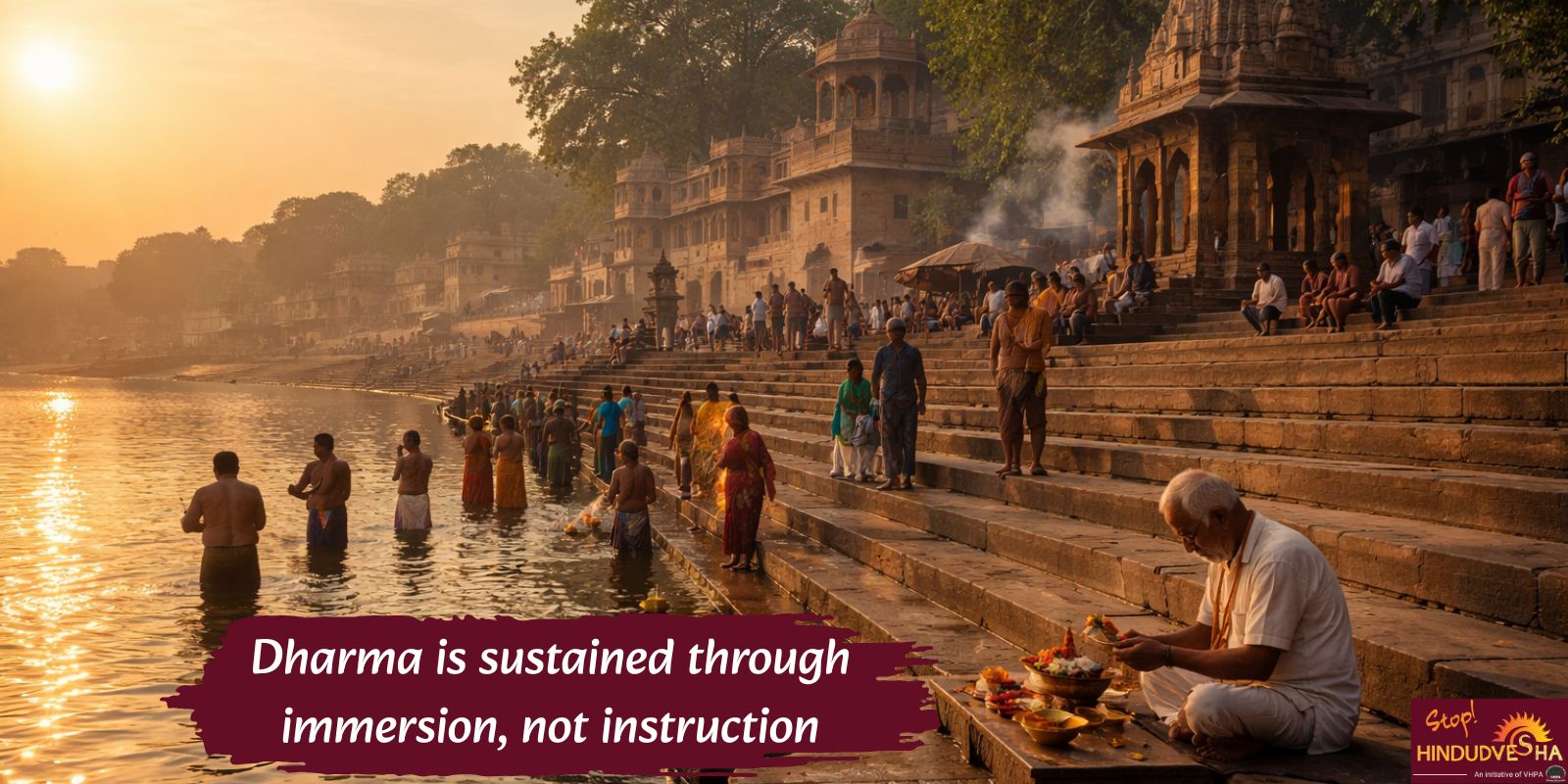
- Only in Bharat do the full conditions of dharmic continuity exist at scale: ambient religious immersion, guru–śiṣya transmission, institutional density, and a living sacred landscape.
- Operating under host-state regulation, cultural translation, and minority conditions, diaspora Hindu Dharma tends over generations toward symbolic or heritage forms.
- State interference in temples, epistemic displacement in education, and postcolonial interpretive frameworks have weakened institutional autonomy and civilizational self-legitimacy. When dharma is treated as an object to be managed, explained, or reformed rather than inhabited, its capacity for self-reproduction diminishes.
- Preserving Sanātana Dharma in Bharat is a civilizational responsibility, not nationalism. A tradition that weakens at its source cannot remain fully alive globally; the future of Hindu tradition depends on the vitality of its oldest soil.
The survival of Sanātana Dharma as a living, self-renewing civilizational tradition is inseparable from its survival in Bharat, its only continuous geographical, cultural, and metaphysical home. This is not a sentimental claim, but a structural one. Civilizational survival does not simply mean that people continue to identify as Hindu or hold private beliefs. It means that tradition can sustain and pass on its institutions, practices, norms, and ways of transmission across generations without depending on outside support.
While Hindu communities today exist across the world through migration, intellectual exchange, and spiritual influence, this global presence operates under conditions very different from those that sustain full civilizational reproduction. These dynamics become clearer when diaspora expression is evaluated in terms of structure rather than identity or emotion.
Sanātana Dharma is often misunderstood through a model borrowed from Abrahamic religions, where continuity is thought to depend mainly on belief and scripture. This way of understanding it does not fit how dharma actually survives. Sanātana Dharma functions as a plural and layered civilizational system. Authority is spread across different sampradāyas, practices are carried through lived rituals, knowledge is passed on in everyday languages, and philosophy endures through diversity and debate across generations. Belief matters, but belief alone is not enough. Continuity depends on living social, ritual, and educational structures that embed dharma in daily life.
This structure can be understood as a civilizational ecology: an interlinked system of sacred geography, temples, ritual and teaching lineages, philosophical traditions, and everyday cultural forms. Sacred geography ties religious meaning to specific places. Temples serve not only as sites of worship, but also as ritual, economic, and calendrical centers. Lineages pass on forms of embodied knowledge that cannot be preserved through texts alone, and philosophical traditions remain alive through ongoing debate rather than static records. When several parts of this system weaken, its ability to fully reproduce itself as a civilization is diminished.
Even with strong commitment, diaspora traditions face structural constraints. Religious practice depends on the tolerance of host societies and continual cultural translation. Transmission to the next generation increasingly relies on organized teaching rather than everyday immersion. Over time, this often produces a form of heritage religion that is meaningful but thinner in institutions and ritual life. Bharat alone sustains the full density required for full civilizational reproduction. Preserving Sanātana Dharma in its homeland is, therefore, not nationalism, but a civilizational responsibility essential to its global vitality.
Dharma as a Civilizational System, Not a Portable Creed
Unlike proselytizing traditions that rely on uniform texts, centralized authority, and formal confession of belief, Sanātana Dharma operates through what can be described as distributed sacredness. Sacredness in the dharmic framework is not limited to a single canon, clergy, or institutional center. It is spread across geography, ritual practice, and everyday social life. Rivers are sacred not as symbols, but as ritually active presences woven into daily and seasonal practices. Mountains are not treated as metaphors, but as sites of tapasya, where spiritual and ascetic effort is tied to specific landscapes. Temples are not congregational halls meant mainly to affirm shared belief. They are living institutions sustained by hereditary lineages, land endowments, calendrical duties, and locally grounded cosmologies. In the same way, philosophy within Sanātana Dharma is not a fixed system of doctrine, but an ongoing intellectual practice carried forward through sampradāyas, commentarial traditions, teaching lineages, and lived debate.
This kind of civilizational density cannot be reproduced through voluntary association alone. Modern substitutes such as cultural societies, spiritual centers, or identity-based organizations may preserve certain practices or memories, but they lack the structural depth needed for long-term civilizational continuity. When Sanātana Dharma is reduced to yoga studios, meditation retreats, festival performances, or symbolic identity markers, it becomes separated from the broader system that historically sustained it. What is lost is not devotion itself, but the interconnected infrastructure—ritual, spatial, institutional, linguistic, and pedagogical—that generates meaning beyond individual choice or occasional participation.
Belief, as an internal and portable orientation, can travel easily across borders. Civilization, by contrast, depends on place-based institutions, inherited practices, and everyday cultural reinforcement. Sanātana Dharma belongs to this second category. Its continuity requires not only followers, but a functioning civilizational environment capable of sustaining sacredness as a shared, lived reality rather than a matter of personal preference.
Having established this civilizational structure, the question is no longer whether Sanātana Dharma can travel, but what is structurally lost when it does.
Structural Limits of Diaspora Transmission
Diaspora Hindu communities have played an important role in preserving memory, selected rituals, and philosophical interest outside the subcontinent. However, these efforts operate within structural limits that affect their ability to sustain long-term civilizational continuity. The first limit is political and legal. Diaspora religious institutions operate at the discretion of host states, constrained by zoning laws, regulatory regimes, and shifting political conditions. Practices once seen as culturally neutral can, under shifting ideological frameworks, be labeled “problematic,” “exclusionary,” or inconsistent with prevailing social norms. Without control over sacred space, religious continuity becomes conditional rather than inherent.
A second limit lies in interpretation. Hindu diaspora traditions are especially vulnerable to reinterpretation, as concepts rooted in Sanskritic metaphysics are translated into more publicly acceptable categories such as universal ethics, wellness practices, or psychological tools. Rituals are reframed as symbolism, deities as archetypes, and dharma as a set of abstract “values.” While these translations make the tradition easier to explain and accept, they also gradually reduce its metaphysical and ritual depth, replacing civilizational specificity with culturally comfortable abstraction.
A third limit appears across generations. Language loss, simplified ritual practice, intermarriage, and educational pressures slowly shift dharma from a lived civilizational orientation into a form of heritage identity. What often remains is affiliation without fluency, memory without transmission, and symbolism without sustained practice. This shift does not reflect moral failure or lack of commitment among diaspora Hindus, but a predictable outcome of minority status and ongoing cultural mediation.
Taken together, these dynamics describe a structural reality. Without a living civilizational center that continuously generates texts, teachers, rituals, debates, and sacred rhythms, global expressions of Sanātana Dharma tend to function as symbolic extensions—emotionally meaningful and culturally expressive but increasingly limited in depth and capacity for reproduction.
Bharat as the Irreplaceable Civilizational Anchor
Bharat alone sustains the full civilizational grammar of Sanātana Dharma because it maintains the conditions in which religious meaning is continuously generated rather than episodically remembered. In this setting, dharma is not encountered mainly as an abstract set of ideas, but as a lived order shaped by time, place, and social life. Understanding develops through regular participation in inherited practices that organize daily routines, seasonal rhythms, and stages of life. Metaphysical ideas are absorbed through practice long before they are consciously analyzed.
The dharmic landscape in Bharat functions as a learning environment rather than a symbolic backdrop. Knowledge is transmitted through constant exposure to ritual patterns, language, and social expectations that do not require formal initiation to take effect. Ethical instincts, cosmological assumptions, and metaphysical intuitions are shaped through social immersion rather than formal teaching. In this context, learning comes before belief. One lives within dharma before reflecting on it. This form of transmission cannot be replicated where religious life is limited to specific places or restricted time windows.
Bharat sustains continuity not only by preserving the past, but by allowing for structured change. Interpretive authority is spread across lineages and institutions that enable internal critique, adaptation, and renewal without breaking coherence. Change occurs within inherited frameworks rather than through rupture, ensuring that transformation remains intelligible from within the tradition. This capacity for self-adjustment distinguishes civilizational continuity from static traditionalism.
Equally important is the social grounding of religious authority. In Bharat, dharmic legitimacy does not rest only on personal conviction or charisma, but on recognized transmission, apprenticeship, and communal validation. This places religious knowledge within shared memory rather than individual choice, limiting fragmentation into purely personalized forms of spirituality.
It is this close integration of practice, authority, learning, and social life that allows Sanātana Dharma to sustain plurality without incoherence and continuity without rigidity. Global Hindu Dharma, regardless of its vitality, remains dependent on this civilizational depth for renewal and orientation.
Internal Erosion, Not External Hostility
Paradoxically, the most serious present-day threat to Sanātana Dharma does not come from open external opposition, but from gradual internal weakening within Bharat itself. In the past, dharmic continuity was sustained by a largely autonomous civilizational system in which temples functioned as self-governing institutions rooted in local economies, ritual calendars, and community life. Interference in this system has disrupted more than administrative arrangements. It has altered the internal logic that once aligned ritual authority, patronage, and accountability. When temples are treated as public utilities or bureaucratic assets rather than civilizational institutions, continuity shifts from organic renewal to procedural control.
Alongside this institutional disruption is a parallel shift in education and public discourse. Dharmic traditions are increasingly interpreted through frameworks that lie outside their own ways of understanding. Sociological, ethical, or historicist readings are often privileged, while metaphysical claims and lived forms of knowledge are set aside. This does not simply add new perspectives. Over time, it displaces indigenous categories of meaning, casting them as intellectually outdated or normatively suspect. Dharma is then encountered less as a way of knowing and more as an object to be explained, weakening confidence in the tradition at its epistemic core.
The cumulative result is a change in how a civilization relates to its own inheritance. Traditions begin to be treated as legacies that must be managed, reformed, or justified, rather than as living systems capable of internal critique and renewal. When this mindset becomes normal within the homeland, its effects extend beyond national borders. Global Hindu communities draw not only rituals and symbols from Bharat, but also confidence in the legitimacy of the tradition itself. When the civilizational center loses authority over its own institutions and categories, diaspora transmission increasingly becomes defensive, symbolic, or compensatory rather than generative.
State–religion theory helps explain this process. Modern states tend to see themselves as the final authority over religious legitimacy. Religious institutions are treated as administrative entities to be regulated, standardized, or reformed according to secular governance norms. This differs sharply from premodern dharmic polities, where religious institutions operated with significant autonomy. Under modern managerial logic, bureaucratic oversight replaces civilizational self-regulation, changing how authority and continuity are reproduced.
Postcolonial epistemology explains why this dynamic is particularly destabilizing in the Indian context. Colonial knowledge systems reclassified indigenous traditions using foreign categories: religion as belief, ritual as custom, philosophy as speculation, and sacred geography as myth. Although colonial rule has formally ended, these frameworks remain embedded in education, policy, and public discourse. The result is an epistemic imbalance. Sanātana Dharma is expected to justify itself using external standards, while its own categories are treated as outdated, unscientific, or suspect. Over time, this internalization of alien frameworks weakens civilizational self-confidence.
Comparative civilizational history highlights what is at stake. Hellenism survived Roman conquest intellectually, but lost its institutional and ritual foundations, leaving behind mainly texts and aesthetics. Confucianism endured political upheaval only where the state re-integrated its epistemology into education and administration. Where that link weakened, it survived largely as an ethical philosophy. Zoroastrianism, once removed from institutional centrality in Persia, persisted through diaspora memory, but on a much smaller civilizational scale.
These cases point to a recurring pattern. When a tradition loses institutional autonomy and epistemic authority in its homeland, diaspora survival alone cannot sustain full civilizational reproduction. The center may retain symbolic presence, but its ability to generate continuity declines. The periphery then relies increasingly on performance, heritage, or textual preservation rather than lived reproduction. Applied to Sanātana Dharma, this pattern highlights the significance of internal institutional and epistemic weakening within Bharat as a long-term concern, distinct from direct external opposition.
Civilizational Responsibility Beyond Nationalism
To say that Sanātana Dharma must be preserved in Bharat is not to deny its global relevance, but to recognize the conditions that make it authentic. Preservation here does not mean freezing the tradition or closing it off. It means protecting institutional autonomy, ritual continuity, philosophical depth, and cultural self-respect that allow the tradition to renew itself from within. Such preservation makes it possible to adapt without losing substance, and to sustain continuity without stagnation.
This responsibility goes beyond contemporary political labels. It is not a project of cultural dominance, but of civilizational continuity. A tradition that cannot maintain its own epistemic and institutional foundations cannot meaningfully participate in global plurality, because it lacks the internal coherence needed for sustained and equal dialogue.
If Sanātana Dharma is to remain more than an aesthetic preference, a commercialized wellness language, or a nostalgic identity marker, it must stay anchored where it functions as a living civilizational system rather than a symbolic inheritance. The vitality of the global Hindu ecosystem, paradoxically, depends on the health of its oldest soil, where the tradition continues to reproduce itself with full metaphysical, ritual, and cultural depth.

Donate to HINDUDVESHA
Our Mission is to explore and expose Hindudvesha through research analysis, education and response.
SUPPORT US