

Between Denial and Despair: The Effete Mindset Holding Hindus Back
 Dr. Jai G. Bansal · 10/20/2025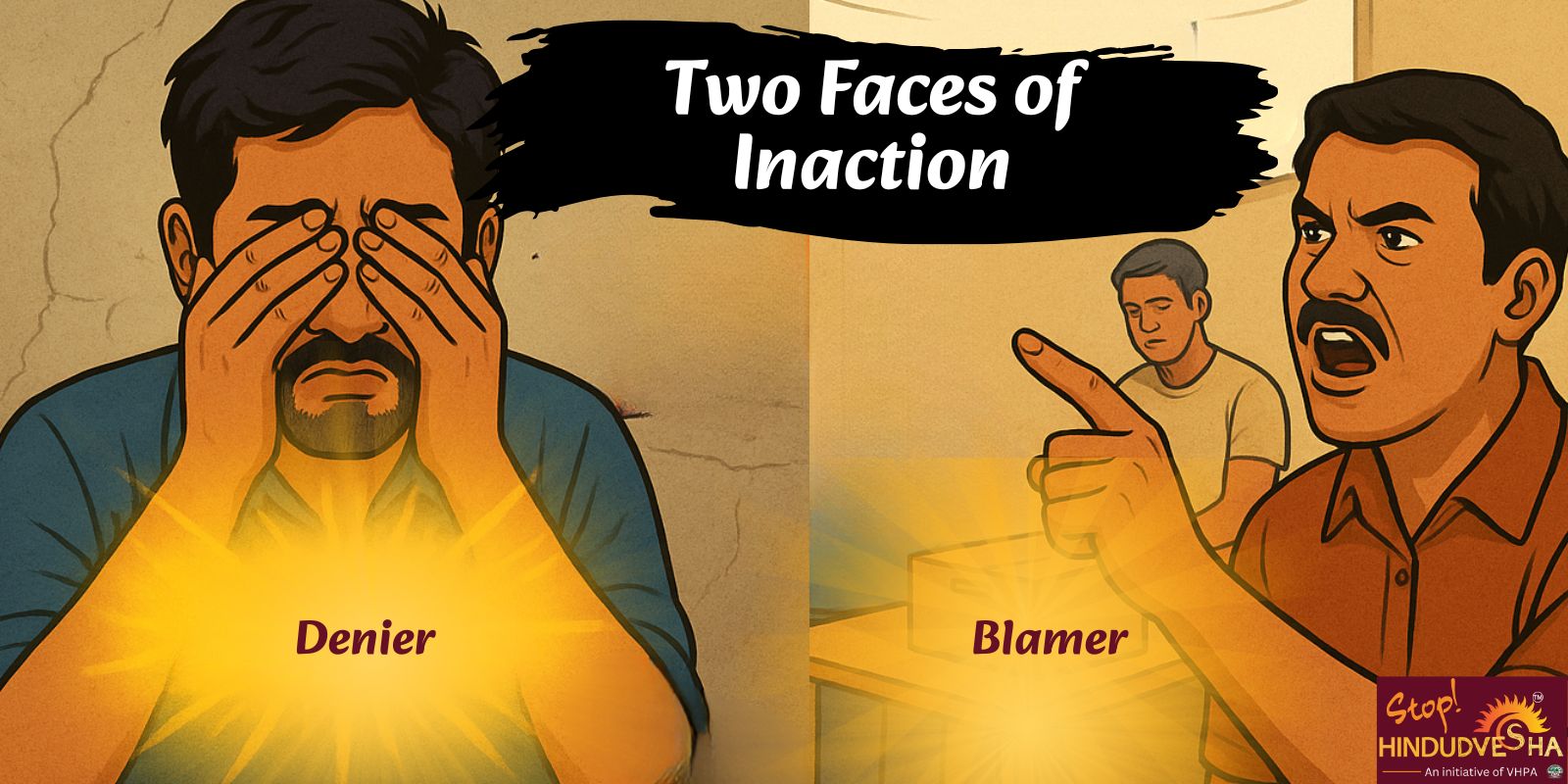
Author’s Note:
The views expressed in this editorial reflect the collective editorial stance of StopHindudvesha.org. Our mission is to expose bias, educate with facts, and empower Hindus to reclaim their narrative with clarity and confidence.
- Two opposing reader emails reveal a deeper crisis in Hindu society — one rooted in denial, the other in frustration.
- Many Hindus remain effete: unwilling to educate themselves, contribute, or take responsibility, preferring excuses and comfort over action.
- The first reader’s objection to “division” reflects fear of truth and a habit of mistaking silence for virtue.
- The second reader’s anger over temple control and weak leadership is valid but misplaced; VHPA’s role in America is awareness, not activism in Bharat.
- Stop Hindudvesha asserts that awareness is action — silence has cost Hindus too much, and truth must now speak without apology.
This week, we received two emails from Stop Hindudvesha readers — and they couldn’t have been more different.
The first reader essentially told us to remove him from our mailing list. He accused us of “creating divisions in society” and even called our work “Adhamic.” His message was polite but dripping with the old anxiety many Hindus still carry: that speaking up for ourselves is somehow wrong.
The second reader, however, had a very different tone — and his words deserve to be read in full:
“Please let us know what you are doing for Hinduism either in India or the world. Our temples are allowed to be looted in India under the Hindu Religious and Charitable Endowment Act passed by Nehru. Modi has not removed that anti-Hindu law even after ten years of his rule. No organization is asking Modi to remove this anti-Hindu law and any of the anti-Hindu laws in effect. Meanwhile, Modi government is giving thousands of crores to WAQF Board to fund Muslim families to have more children. Modi is also funding hate-preaching madrasas while Hindu schools are closing due to lack of funds. Please tell me what VHPA is doing about it.”
One reader thinks we are the problem. The other thinks we’re not doing enough to address whatever is ailing the Hindu ecosystem. Both, in their own way, reflect the confusion and contradictions that define the modern Hindu mindset — half afraid, half angry; torn between denial and despair. Most Hindus today refuse to educate themselves about what’s happening around them. They bury their angst about the state of Hindu society under the comfortable excuse of “I’m busy.” They criticize organizations for not doing enough, yet won’t give an hour of their time or a fraction of their income to support them. They demand leadership but refuse to follow; they crave change but shun responsibility. It’s easier to complain than to contribute. And when asked to stand up, most quietly step back, telling themselves it’s not their job, someone else should do it. This selective indifference — this moral laziness wrapped in politeness — is how civilizations wither while their people still pretend to be civilized.
To the First Reader: The Comfort of Denial
Let’s be honest. When someone says, “You’re creating division,” what they often mean is, “Please don’t disturb my comfort.”
So, dear reader, let’s ask: do you find our data incorrect? Our logic flawed? Or are you simply uncomfortable hearing truths that cut too close to the bone? If facts aren’t the issue, maybe fear is.
For centuries, Hindu society has been conditioned to avoid confrontation — to choose silence over self-respect, even when wronged. It’s like that pigeon who shuts its eyes when it sees a cat coming, hoping that what it refuses to see will somehow disappear. That instinct for denial has cost us everything — our temples, our lands, our dignity, and even our history.
Calling truth-telling “divisive” is a moral evasion. Real harmony can’t exist on a foundation of ignorance. To expose injustice is not to create conflict; it’s to clear the fog that allows injustice to thrive.
If acknowledging Hinduphobia and historical wrongs makes you uncomfortable, then perhaps the problem isn’t with what we’re saying — but with the mirror we’re holding up. And remember: closing your eyes doesn’t make the cat go away.
To the Second Reader: The Anger of the Impatient
Now to our second reader — the one whose frustration practically leaps off the screen. Every line of his email carries the pain and anger of a Hindu who feels abandoned by those he purportedly trusted to lead. His message deserves to be heard in full:
“I am writing to you because you represent Vishwa Hindu Parishad. You are supposed to represent the worldwide Hindus. You are the leader. You are saying, ‘if the Hindu community got together and began to mobilize like some other communities’ — well — who is supposed to organize this mobilization? Isn’t it your job to organize the movement? When VHP came into existence, we had great hopes. We thought that finally we got some leadership and VHP will take up Hindu issues with whoever is concerned. However, all our hopes dashed. We soon found out that VHP is another dead organization with do-nothing leadership sitting at the top as leaders and saying, ‘why do the hard work if you can get momentary satisfaction by blaming others’? Sir, YOU are supposed to do the hard work. It is YOUR job to organize and take up the issues involved with Hindu security. If you can’t handle it, let someone else do it. Hindu temples are still being looted by the States under MODI rule while MODI gives thousands of crores to WAQF Board? You as VHP leader don’t think it is your job to represent Hindus?”
Your anger is real, and much of it is justified. The continued state control of Hindu temples through the HRCE Act is indeed a travesty. Unequal laws, government funding of religious boards, and the slow response to these injustices have rightfully angered many Hindus. We share that anger.
But there’s also a fundamental confusion in your letter that needs to be cleared. The Vishwa Hindu Parishad of America (VHPA) is not the same as VHP Bharat. We share the same ideals, but our karmabhumi is different. VHPA’s work is based in the United States, not India. Our mission is to serve, educate, and strengthen the Hindu voice in America — to raise awareness about what ails us, what has been done to us, and by whom and why. We do not make laws in India, nor can we repeal them. That responsibility lies with citizens and lawmakers in Bharat. What we can do — and are doing — is helping Hindus everywhere understand the scope of the problem, so that they can demand justice from those who govern.
You ask why we are not leading a large-scale campaign or movement. The answer is simple: because our dharma here is education, not street politics. We are building awareness, shaping narratives, and preparing minds — so that when society wishes to act, it acts with clarity, conviction, and knowledge. Movements without understanding collapse into noise. Laws don’t change until minds change, and minds don’t change until they are informed.
Still, the harder question remains: What are you doing about it? Are you writing, volunteering, donating, or helping build institutions that can fight these injustices? Or have you, like so many, taken refuge in frustration while expecting others to fix what you will not touch?
Perhaps your anger is less about what VHPA hasn’t done, and more about what Hindu society as a whole still refuses to do — to get educated, to get involved, and to demand accountability. That frustration is fair. But turning it on those who are at least trying to awaken the community doesn’t help.
So, here’s our challenge to you: don’t just write to criticize — write to contribute. Don’t ask who will lead — step up and lead with us. VHPA is not an ivory tower; it’s a platform. And Stop Hindudvesha is part of that mission — a space for truth-telling, not excuse-making. The awakening we all want will not come from one organization or one leader. It will come when Hindus everywhere decide that silence and cynicism are no longer options.
Between Denial and Despair
Both these readers, though opposite in attitude, spring from the same effete civilizational mindset — drained of confidence, direction, and moral energy. One hides from reality; the other screams at it. One denies the disease; the other demands a miracle cure. Both forget that a civilization broken over a thousand years doesn’t heal in a decade.
It took centuries of invasions, forced conversions, colonial distortion, and academic manipulation to weaken Hindu self-belief. Undoing that will take patient, disciplined, and intelligent work. That’s what Stop Hindudvesha is doing — not waving flags, but rewriting narratives.
We’re fighting in the space where all great battles are first won or lost — the mind. Before you can rebuild a temple, you must rebuild the confidence to say it was yours. Before you can fight legal injustice, you must first expose it to a public that’s forgotten it even exists.
Those who call our work “divisive” fear truth. Those who call it “insufficient” underestimate its power. But both are reacting to the same thing — the awakening of Hindu consciousness. It’s happening, slowly but surely, and yes, it makes people uncomfortable. That’s a good sign. Growth always does.
The Mission: Education as Resistance
Our mission is straightforward: to expose anti-Hindu bias in academia, the media, and public life. We don’t invent enemies; we reveal them. We don’t spread hate; we dismantle it.
Every article, every report, every analysis we publish chips away at the giant wall of distortion built around Hindu civilization. For decades, others have defined us — as oppressors, as casteists, as “majoritarians.” We’re taking back that right. Narrative sovereignty — the ability to tell our own story — is the foundation of every strong civilization.
Some ask, “But what’s the use of education?” To them we say: education is revolution. Every awakening in Hindu history — from Adi Shankaracharya to Swami Vivekananda — began with the pen, not the sword. Awareness creates clarity; clarity leads to courage; and courage changes everything.
So, yes, we’ll continue to do exactly what we’re doing — researching, writing, exposing, and teaching. Because truth doesn’t just defend itself. Someone has to stand guard.
The Cost of Silence
In the end, both these letters remind us of one thing: silence has been Hindu society’s deadliest addiction. For generations, we confused politeness with peace, and restraint with strength. But silence didn’t save us. It only emboldened those who sought to erase us.
We are done being silent.
If our words offend, so be it. Truth has a way of doing that. If our work feels insufficient, then join in and make it stronger. But don’t stand by and call for peace when the price of that “peace” has been centuries of cultural amnesia and surrender.
Stop Hindudvesha will continue to do what it was created to do — speak truth to distortion, educate with courage, and hold a mirror to our times. We are not against anyone. We are simply for clarity, for dignity, and for Dharma.
Because truth isn’t what divides us — it’s what frees us. And silence? We’ve already paid too high a price for that.

Donate to HINDUDVESHA
Our Mission is to explore and expose Hindudvesha through research analysis, education and response.
SUPPORT US