

Behind the Academic Façade: Inside Al-Falah University’s Radical Grooming Machinery
 Aditi Joshi · 12/04/2025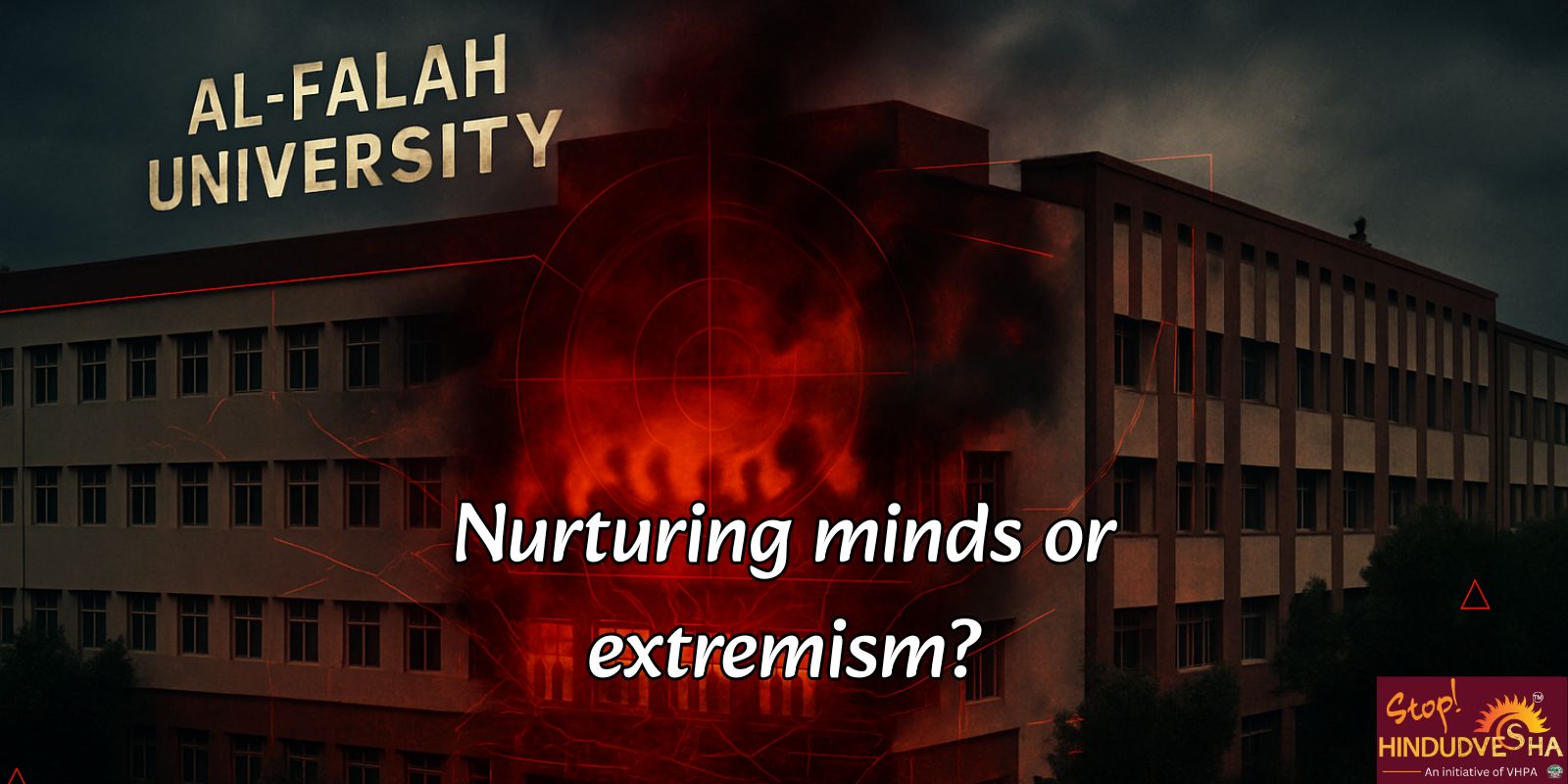
- Al-Falah University projects a respectable academic image but operates with significant opacity and centralized control.
- Demographic clustering and vulnerable student groups create fertile ground for ideological influence.
- Weak oversight allows identity-based networks to shape campus dynamics.
- Governance lapses and regulatory concerns raise red flags about internal culture.
- Analysts warn the institution’s structure may enable extremist narratives to grow unchecked.
Shatrubodh, understood as a civilizational discipline of awareness, reminds us that threats rarely appear first in the form of open violence. They take root through the gradual capture of institutions that shape thinking, identity, and collective behavior. It is a framework that stresses vigilance toward the forces that influence society from within, especially when those forces mask themselves as neutral or developmental.
Al-Falah University (AFU), established as an engineering college in 1997 and elevated to university status in 2014, exemplifies this principle with unsettling precision. While projecting itself as a rising private university in the NCR belt, AFU functioned, based on publicly reported investigations, as a semi-insulated ecosystem where identity politics, administrative opacity, and socio-economic vulnerabilities intersected to create an environment conducive to ideological influence. Its demographic composition, dominated by students from radicalization-sensitive regions, combined with trust-based governance and weak oversight, enabled the emergence of tightly knit identity-based networks that could override the institution’s academic mission.
Radicalization studies affirm that environments marked by grievance consolidation, social homogeneity, and unchecked ideological narratives often serve as early incubators of extremist worldviews.[1] Thus, AFU becomes analytically important not simply due to allegations involving individuals linked to extremist modules responsible for the Red Fort suicide blast[2] but because it demonstrates how an educational institution can gradually transform into an ideological bubble. Through structural weaknesses and controlled demographic clustering, AFU reveals how academic spaces may become inadvertent, or in certain contexts deliberate, conduits for extremist ideologies, validating the Shatrubodh insight that institutional capture is the true genesis of radicalization.[3]
The Trust Structure and Its Early Footprint (1997–2014)
From its inception, the Al-Falah Charitable Trust, operating from Okhla, New Delhi, functioned as the central nervous system of AFU. Every critical dimension of the institution flowed through the Trust: finances, hiring, appointments, promotions, and long-term strategic direction. In effect, AFU did not evolve as an academic institution with distributed responsibilities; it grew as an extension of a private trust with concentrated authority.
This organizational design produced a set of predictable vulnerabilities. A trust-run management structure, operating with minimal external scrutiny, meant that AFU was not required to follow the transparency norms expected of universities governed through boards, senates, or independent oversight bodies. As a result, the institution developed in an insulated environment where conflicts of interest, politicization, and ideological capture were harder to detect. Leadership, drawn almost entirely from within the same trust-centric circle, added another layer of risk.
Such homogeneity encourages conformity, suppresses dissent, and restricts the diversity of thought essential for a healthy academic culture. In the lens of Shatrubodh, this ideological uniformity inside a closed administrative system acts as an early warning sign, often preceding groupthink and internal opacity.
The university’s physical geography further compounded these issues. Located on a large, isolated campus at the outskirts, AFU became a self-contained world where informal hierarchies and patronage networks could grow without challenge. Limited external engagement and strong internal bonding made the institution structurally resistant to transparency, reform, or effective oversight.
University Status Without Structural Reform (2014 onwards)
The transition from Al-Falah Institute to Al-Falah University in 2014, following recognition under the Haryana Private Universities (Amendment) Act, marked a pivotal juncture at which structural reforms were not only desirable but essential.[4] University status confers a substantially higher degree of institutional autonomy, encompassing authority over curriculum design, the research agenda, financial management, faculty appointments, and internal regulatory compliance. With this expanded autonomy comes a corresponding expectation of strengthened governance structures, diversified leadership, and transparent operational systems. However, in the case of AFU, this transition did not produce any meaningful internal transformation.
Instead, the administrative culture of the Al-Falah Charitable Trust continued with minimal alteration, effectively scaling the same centralized, opaque governance model under the new designation as a university. The absence of reforms was evident across several dimensions: governance bodies remained insular, leadership roles did not diversify, independent oversight mechanisms were not introduced, and systems for recruitment, financial auditing, and academic quality assurance remained opaque. Such continuity signifies not organizational stability but institutional stagnation, in which the formal upgrade in status was not matched by a corresponding increase in accountability or academic rigor.
The Demographic Pipeline: Who Enters the Ecosystem?
The demographic composition of Al-Falah University’s student intake reveals patterns that are significant from a radicalization-risk analysis standpoint.[5] A substantial proportion of students originated from Mewat (Nuh), a district consistently identified in internal security assessments as one of India’s most vulnerable zones for religious radicalization, owing to a combination of socio-economic deprivation, limited state presence, and long-standing ideological penetration by external actors. Students arriving from such environments often carry pre-existing grievances, tightly knit community identities, and limited exposure to pluralistic academic cultures, making them receptive to grievance-based narratives if placed within insular institutional settings.
A second major student cluster came from Western Uttar Pradesh and Bihar, regions characterized by significant economic stress and heightened identity insecurity. Research in radicalization studies points out that youth from economically fragile backgrounds often demonstrate increased susceptibility to narratives that promise dignity, belonging, or collective empowerment, particularly when they encounter closed peer networks and low faculty oversight. In educational institutions where governance systems lack transparency and mentoring structures remain weak, these students frequently turn to informal social groups for support, inadvertently creating pathways for ideological mobilization.
Additionally, the presence of students from Kashmir introduces another layer of vulnerability. Kashmir’s socio-political environment, shaped by prolonged conflict, separatist discourse, and decades of targeted ideological messaging, often conditions young people to interpret events through frames of grievance and identity. When such students enter a university ecosystem that is insufficiently diverse and lacks robust exposure to alternative perspectives, the risk of ideological echo chambers forming increases. These students may both reinforce each other’s perceptions and become receptive to individuals or networks that reaffirm their pre-existing narratives.
Importantly, these demographic characteristics are not problematic in themselves. Young people from any background can thrive in open, well-regulated academic ecosystems. However, when such populations converge within an institution that is administratively opaque, socially insular, and governed through homogeneous leadership networks, the structural environment can unintentionally facilitate ideological grooming. Radicalization research across global contexts demonstrates that vulnerable populations exposed to closed ecosystems show heightened susceptibility to three key influences: grievance reinforcement, where existing frustrations are validated and amplified; identity mobilization, where communal identity becomes the dominant organizing principle; and emotional manipulation, where appeals to solidarity, protection, or religious duty shape group behavior.
In AFU’s case, the combination of a high-risk demographic profile and a structurally closed institutional ecosystem created conditions that align closely with these risk factors. The interaction between student vulnerabilities and institutional opacity becomes central to understanding how certain narratives may find fertile ground, not through overt indoctrination, but through the absence of countervailing structures, diverse discourse, or transparent governance mechanisms.
How Radicalization Was Cultivated
Post-incident investigations into the 2025 Red Fort blast, as reported in multiple national security briefings, referenced the arrests of certain AFU faculty members allegedly linked to extremist networks. While the veracity of individual cases remains subject to judicial scrutiny, the pattern itself is important from an institutional analysis perspective. Faculty in universities often operate as intellectual and social authority figures, especially within institutions where oversight mechanisms are weak or centralized under a single Trust. In such environments, faculty members with external ideological affiliations can serve as ideological anchors, shaping students’ perceptions through selective teaching, informal counselling, or curated academic discourse. They may also function as gatekeepers, controlling access to student groups, religious circles, or community-specific mentorship networks. Research on campus-based radicalization in Europe and Southeast Asia shows that such faculty figures often serve as nodes, linking internal student clusters to external actors without attracting immediate administrative attention. The absence of robust monitoring, peer review, or independent academic governance structures significantly increases the likelihood that such influence will go undetected for prolonged periods.
A related concern emerges from accounts describing identity-based mentorship within the AFU ecosystem. Several accounts suggest that mentorship programs, religious instruction groups, and informal study circles sometimes took on roles beyond academic support. Radicalization studies repeatedly note that identity-centric mentorship, where guidance is framed primarily around shared community, religious, or socio-political identity, can serve as a potent channel for ideological conditioning. In such settings, students may be exposed to grievance amplification, where real or perceived injustices are reinforced through selective historical or political narratives.[6] Similarly, curated messaging may position the community as “under siege”, a framing that research identifies as central to the construction of defensive or retaliatory narratives in vulnerable youth populations. Over time, these narratives can contribute to the normalization of extremist thought, not through explicit instruction, but through gradual shifts in worldview, reinforced by peer validation and mentor authority. This mirrors findings from studies on Islamist, far-right, and separatist radicalization across universities in the UK, France, and Indonesia, where identity-centric mentorship emerged as a consistent early-stage driver of ideological alignment.
Residential spaces further complicate this landscape. The network of university hostels, trust-managed rental units, and informal shared accommodations forms a crucial element of AFU’s overall risk profile. Security analyses of radicalization hotspots note that semi-private living spaces associated with educational institutions often become meeting points where students can gather outside formal oversight. Such spaces may also function as logistical safe zones, providing privacy for discussions, planning, or external coordination that may not occur within monitored campus areas. Because these residences fall into a grey zone, neither fully supervised by university administration nor entirely independent, they can serve as discreet operational environments. This pattern is neither unique nor unprecedented. Similar dynamics have been documented in case studies from German technical universities, Malaysian religious colleges, and certain North African student movements, where radical grooming or recruitment has been observed to thrive in campus-adjacent residential areas. The combination of social bonding, lack of monitoring, and a sense of shared identity creates an environment conducive to the formation of tightly knit ideological clusters.
Regulatory Red Flags as Indicators of Deeper Problems
The issuance of a NAAC show-cause notice to Al-Falah University in 2025, following allegations that the institution had publicly claimed accreditation it did not actually possess, represents a significant breach of regulatory integrity.[7] In higher education governance, such misrepresentation is more than an administrative lapse; it reflects an institutional willingness to fabricate legitimacy when formal evaluation processes do not yield favorable outcomes. This tendency suggests a weak compliance culture, where adherence to statutory norms is secondary to preserving public perception. In the broader institutional governance framework, fabricated accreditation claims often signal deeper systemic issues, ranging from poor internal auditing practices to an administrative hierarchy resistant to external scrutiny.
A second major indicator of governance fragility emerged with the suspension of AFU’s membership in the Association of Indian Universities (AIU).[8] AIU membership is not merely symbolic; it is a benchmark for degree equivalence, inter-university cooperation, and institutional reputation. Suspension for being “not in good standing” signals serious deficiencies in operational standards, documentation, reporting, or compliance with AIU’s quality expectations. Such actions by centralized bodies typically occur only after multiple warnings or sustained non-alignment with regulatory norms, implying that the institution’s issues were not isolated incidents but part of a broader pattern.
Collectively, these regulatory lapses highlight vulnerabilities inherent in AFU’s governance structure. They point toward possible misreporting practices, inadequate internal checks, and administrative systems that can be manipulated or bypassed. Research on institutional radicalization and organizational capture consistently shows that environments marked by regulatory non-compliance often struggle to prevent the infiltration of ideological networks. Weak documentation, opaque decision-making, and the absence of external audits create spaces where unmonitored influence can take root. In this sense, AFU’s regulatory shortcomings are not simply technical violations; they form a structural precursor that increases the risk of ideological capture by reducing transparency and weakening accountability mechanisms.
From Narratives to Networks
Publicly available investigative reports suggest that the alleged radicalization pathway at AFU followed a multi-stage progression that aligns closely with patterns documented in international studies on campus-based extremist recruitment.[9] The process appears to begin with the identification of vulnerable students, typically those experiencing identity insecurity, socio-economic stress, or psychological dislocation. Such individuals are commonly targeted because they are more responsive to narratives that provide meaning, belonging, or ideological certainty. Following this initial selection, students were reportedly exposed to curated ideological content, often presented in ways that emphasized selective interpretations of history, politics, or religious identity. Research across South Asian universities has noted that early exposure to such content is designed to prime students for deeper engagement.
Subsequently, these students were allegedly isolated within identity-based social circles, a tactic well recognized in radicalization literature. Isolation serves two purposes: it reduces exposure to counter-narratives and strengthens emotional reliance on the group. Within these controlled social clusters, indoctrination through grievance-based narratives takes place. Grievances, whether historical, political, or personal, are selectively amplified to foster feelings of collective victimhood, a psychological condition identified by scholars as a key precursor to extremist susceptibility.
Investigations also suggest that radicalized faculty members may have played a role in filtering potential recruits, assessing which students demonstrated loyalty, ideological receptiveness, or operational utility. This stage mirrors processes documented in Pakistan’s Punjab universities and in certain Bangladeshi madrasa-university hybrids, where faculty-linked gatekeepers act as intermediaries between students and wider extremist networks. Those who passed these internal filters were allegedly introduced to external handlers, facilitating the transition from ideological alignment to organizational integration.
The infrastructure facilitating this latter phase appears to have included campus-linked residential spaces functioning as logistical nodes. Such semi-private locations reportedly served as meeting points, accommodation hubs, or safehouses, patterns consistent with radicalization pathways observed in Middle Eastern institutions where private student housing provides operational cover. The final stage of the process involved the operationalization of recruits into extremist networks, marking the shift from passive ideological adherence to active involvement, a progression widely recognized in global radicalization models.
Taken together, the alleged sequence, from identification to operationalization, closely mirrors radicalization modules documented in Pakistan, Bangladesh, and select Middle Eastern universities. This alignment underscores that the structural vulnerabilities present at AFU are not isolated anomalies but part of a broader pattern observed in academic environments where governance is weak, oversight is minimal, and identity-based networks exercise disproportionate influence.
Understanding Shatrubodh Via AFU
Al-Falah University cannot be understood as an isolated anomaly; its trajectory reflects a structural pattern observable across several institutions where identity-driven networks exercise disproportionate influence. AFU demonstrates how higher education spaces, when governed without transparency or independent oversight, can gradually transform into ecosystems conducive to ideological consolidation. Institutions that are captured by tightly knit identity groups often operate through informal power structures that remain opaque to regulatory bodies. When such institutions also draw students from demographically vulnerable regions, the combination generates conditions in which ideological grooming can occur quietly, without overt organizational intent or public visibility. This dynamic underscores the need for vigilant monitoring frameworks, not for punitive purposes, but to safeguard the integrity of educational environments.
From a Shatrubodh perspective, the AFU case illuminates a critical dimension of ideological conflict: the battleground often begins in spaces not traditionally associated with confrontation. Classrooms, student hostels, faculty mentoring systems, administrative communication channels, and campus social networks constitute the earliest theatres where narratives compete for influence. If governance lacks accountability, these micro-spaces may gradually become conduits for ideological warfare that precedes overt radicalization. Shatrubodh therefore argues for structural vigilance, recognizing early indicators, strengthening oversight mechanisms, and fostering academic cultures in which transparency, diversity of thought, and responsible leadership serve as protective factors against ideological capture.
The AFU pattern points to a deeper challenge facing the Indic civilization: the weaponization of education. Throughout history, civilizations have been most vulnerable not when external threats surged, but when internal institutions responsible for shaping the next generation were compromised. When academic spaces become recruitment zones, overtly or covertly, they do more than endanger security; they erode the cultural continuity that educational systems are meant to reinforce. The manipulation of youth through selective narratives, identity mobilization, or grievance amplification effectively transforms students into ideological actors operating under the camouflage of intellectual pursuit.
What emerges is not merely a threat to law and order but a civilizational risk, where the foundational values of inquiry, synthesis, and pluralism, central to the Indic knowledge tradition, are displaced by insular, adversarial, or exclusionary ideologies.
Citations
[1] Red Fort blast case: ED conducts raids on 25 premises linked to Al-Falah University, including in Delhi; https://www.deccanherald.com/india/delhi/red-fort-blast-case-ed-conducts-raids-on-25-premises-linked-to-al-falah-university-including-in-delhi-3801607
[2] The Red Fort Suicide Attack: India’s Stark Civilizational Wake-Up Call – Hindu Dvesha; https://stophindudvesha.org/the-red-fort-suicide-attack-indias-stark-civilizational-wake-up-call/
[3] Hindus Preach Secularism, Others Jihad; https://stophindudvesha.org/while-they-preach-jihad-hindus-preach-secularism-the-ostrich-syndrome-of-a-civilization-in-peril/
[4] Run by trust, Faridabad’s Al-Falah University started as an engineering college in 1997 | Gurgaon News – The Times of India; https://timesofindia.indiatimes.com/city/gurgaon/run-by-trust-faridabads-al-falah-university-started-as-engineering-college-in-1997/articleshow/125258474.cms
[5] ‘White collar terror ecosystem, radical professionals in J&K’: 8 arrested in terror module bust – key points | India News – The Times of India; https://timesofindia.indiatimes.com/india/white-collar-terror-ecosystem-radical-professionals-in-jk-8-arrested-in-terror-module-bust-key-points/articleshow/125221445.cms
[6] Delhi blast: All about Faridabad’s Al-Falah University whose doctors were arrested for making bombs; https://m.economictimes.com/news/india/delhi-blast-all-about-faridabads-al-falah-university-whose-doctors-were-arrested-for-making-bombs/articleshow/125265306.cms
[7] Al-Falah University website taken down after NAAC notice; https://www.thehindu.com/news/national/al-falah-university-under-scanner-for-delhi-red-fort-blast-gets-show-cause-from-naac-over-false-accreditation-claim/article70275034.ece
[8] ‘Does not appear to be in good standing’: AIU suspends Al-Falah University’s membership after Red Fort blast; https://www.businesstoday.in/india/story/does-not-appear-to-be-in-good-standing-aiu-suspends-al-falah-universitys-membership-after-red-fort-blast-502145-2025-11-14
[9] Anatomy of a white-collar terror module; https://www.newindianexpress.com/explainers/2025/Nov/15/anatomy-of-a-white-collar-terror-module

Donate to HINDUDVESHA
Our Mission is to explore and expose Hindudvesha through research analysis, education and response.
SUPPORT US