

Balen Shah’s Rise: Signaling a Hindu Civilizational Resurgence in Nepal
 Rati Agnihotri · 05/03/2026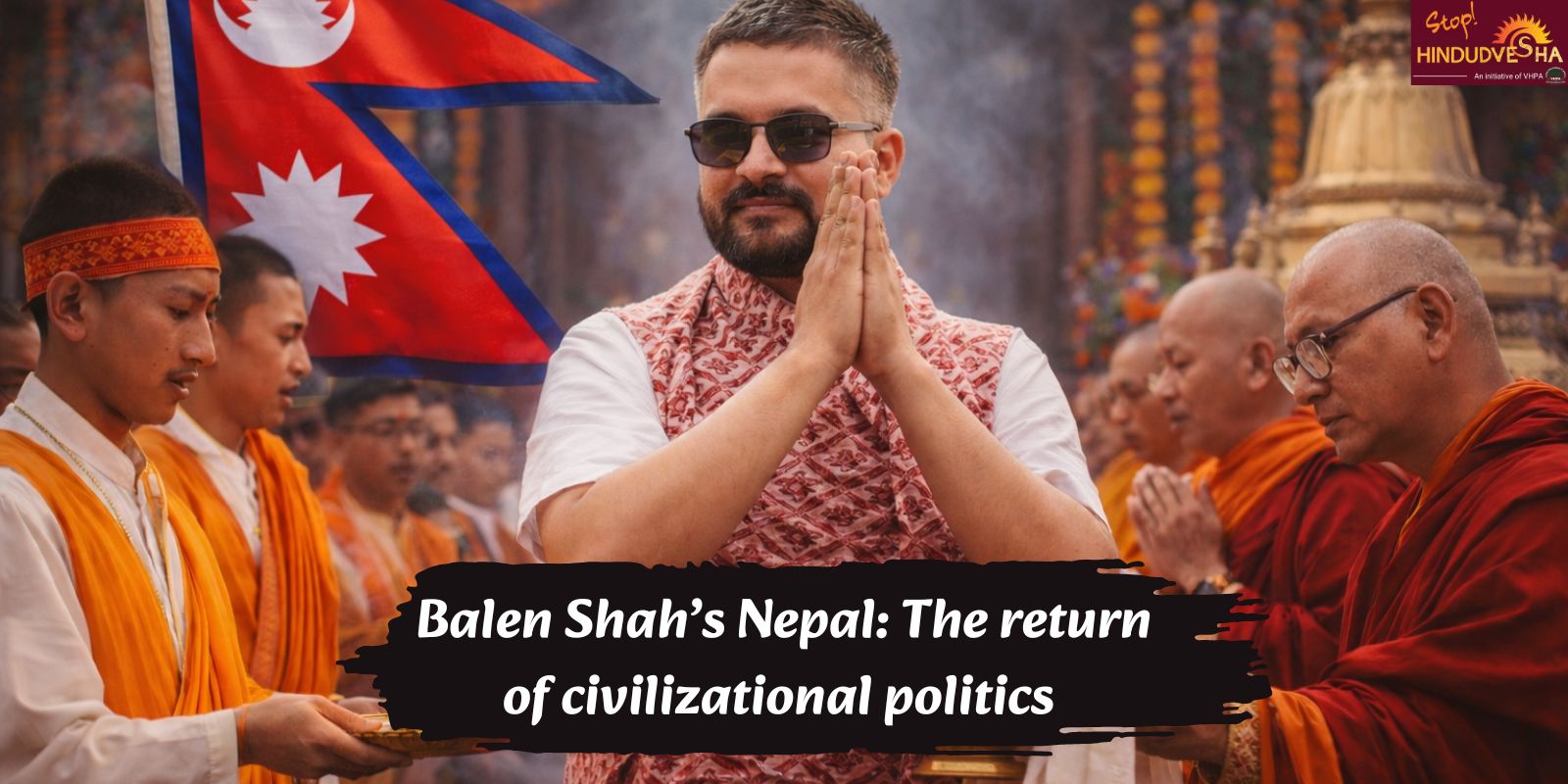
Summary
Nepal’s recent elections mark a major turning point, with Balen Shah’s rise disrupting entrenched political structures and signaling a broader shift in national discourse. His leadership blends governance reform with a renewed emphasis on cultural and civilizational identity, reflected in symbolic gestures, policy choices, and political messaging. From leveraging popular culture to advancing reforms in education and public institutions, Shah’s approach challenges the long-standing influence of left-leaning ideological frameworks. Set against Nepal’s deep Dharmic heritage and its history as a Hindu kingdom, this shift has revived debates around identity and the idea of a Hindu Rashtra. While the outcome remains uncertain, the current moment reflects a deeper contest over Nepal’s civilizational direction and political future.
Nepal’s recent elections represent a major turning point in the country’s political trajectory, upending its established order in a way few events have in recent decades. The rise of Prime Minister Balen Shah and the decisive success of his Rastriya Swatantra Party (RSP) have disrupted a deeply entrenched elite, signaling a clear public mandate for change.
Early indications from Shah’s administration point to a governance approach that combines institutional reform with a renewed emphasis on national identity. Known for his cultural expression and political messaging, Shah projects a leadership style that openly engages with Nepal’s civilizational roots. His public persona suggests an attempt to align governance with deeper societal values.
There are also signs of a departure from the ideological patterns that have shaped Nepal’s recent past, particularly the influence of left-leaning frameworks within political and social institutions. In their place, the administration appears to be exploring a model grounded in ethical and civilizational principles.
Nepal remains a historic center of Hindu civilization, despite its transition to a secular republic in 2006. After years of political instability and frequent leadership changes, this election could mark the beginning of a more stable phase, with implications that extend beyond Nepal’s borders.
This shift is not merely administrative; it represents a direct challenge to decades of ideological dominance by communist frameworks that have shaped Nepal’s political and institutional discourse.
When Popular Culture Meets Civilizational Narratives
Balen Shah’s rise in Nepal’s politics stands out for its unconventional character and cultural resonance. Trained as a structural engineer and known widely as a rapper, he first entered public office by winning the Kathmandu mayoral election as an independent candidate. Long before formal politics, he had built a following through Nepal’s hip-hop scene, where his music addressed corruption, inequality, and systemic dysfunction [1]. What distinguishes his trajectory is not just the shift from music to politics, but the way he has carried the language and energy of popular culture into the political arena.
Shah’s approach reflects a broader shift in how political engagement is being shaped, particularly among younger generations. By using music and digital media as tools of communication, he has reimagined political messaging for a Gen Z audience. His work does not simply critique governance failures; it embeds those critiques within a larger framework of identity, belonging, and cultural continuity. In doing so, he bridges the gap between contemporary expression and civilizational memory.
This synthesis became especially visible in March 2026 with the release of his song “Jai Mahakaali.” [2] The track invokes Devi Mahakali, presenting her as a source of ‘shakti’ (strength, energy, capacity) and ‘sanrakshan’ (protection, preservation) for the nation. The song’s imagery and lyrics connect national aspirations with civilizational symbolism, framing Nepal’s challenges and hopes within a Dharmic worldview. It is not merely a devotional piece, but a cultural statement that ties national renewal to inherited traditions. The response was immediate; the video, interwoven with scenes from Shah’s campaign and everyday life in Nepal, gained widespread attention within hours of release [3].
The same blending of cultural and political expression was evident during his oath-taking ceremony. The event featured an interwoven sequence of Hindu and Buddhist rituals: young Brahmin priests chanting Vedic mantras, Buddhist monks reciting sacred verses, and traditional elements such as the blowing of conches. Notably, these rituals were conducted simultaneously, offering a visual articulation of Nepal’s civilizational fabric, where Hindu and Buddhist traditions coexist as part of a shared continuum [4].
This display drew criticism from sections of Nepal’s intellectual circles, who labeled the ceremony overly religious [5]. Such reactions appear less about principle and more about unease within an entrenched elite whose influence over public discourse is being challenged. For years, these circles shaped governance debates through a narrow secular lens. The visible return of Dharmic symbolism unsettles that dominance, pointing to a gradual erosion of their hold over cultural narratives and ideological framing in the public sphere. For many observers, however, the ceremony reflected integration, reaffirming Nepal’s civilizational identity within a plural framework rather than undermining it [6].
Shah’s choice to take the oath on the auspicious occasion of Ram Navami further reinforced this alignment with civilizational markers. His consistent invocation of the Ramayana during his campaign underscores a deliberate effort to root political messaging in shared cultural narratives [7].
In this sense, Balen Shah’s political style represents more than a personal brand. It reflects an evolving mode of leadership in which popular culture, civilizational identity, and governance intersect, reshaping how politics is communicated and challenging the ideological vocabulary that has long dominated public discourse.
Challenging the Old Order
Balen Shah’s early tenure has been marked by an ambitious reform agenda that seeks to reshape key sectors of governance, administration, and education. His proposed 100-point plan signals an intent to move beyond incremental change and instead pursue structural transformation. Among its most discussed elements is the directive encouraging educational institutions with foreign or anglicized names to adopt indigenous identities [8]. This move has been interpreted by many as an effort to counter lingering forms of cultural dependency and to instill a stronger sense of national identity among younger generations.
These reforms are not occurring in isolation. They reflect a broader effort to push back against the long-standing influence of communist-aligned networks that have shaped Nepal’s education system and public institutions. For decades, ideological frameworks rooted in leftist politics have extended beyond governance into academic and civic spaces, often blurring the line between institutional function and political mobilization.
Critics and supporters alike acknowledge that the trend of naming schools after Western institutions has long been associated with perceptions of prestige and quality. Commentators such as LB Thapa, writing in The Rising Nepal, have argued that this reflects a deeper pattern of mental colonization, where foreign associations are equated with superiority [9].
Perhaps the most consequential and controversial reform is the decision to restrict political activity within educational institutions and public offices. Under the new framework, student political organizations are to be replaced with student councils, while teachers and civil servants are barred from overt party affiliations. For decades, these spaces have functioned as pipelines for ideological mobilization, with party-affiliated student wings—particularly those aligned with leftist movements—exercising disproportionate influence and often blurring the boundary between education and political indoctrination.
The policy is widely viewed as an attempt to depoliticize institutions that have, for decades, been influenced by party-linked student wings and ideological mobilization, often associated with disruption and factionalism [10] [11].
These reforms must be understood against the backdrop of Nepal’s political history, where left-leaning parties, including the Communist Party of Nepal (UML) and the Maoist Center, have played a dominant role. The electoral success of the Rastriya Swatantra Party represents a challenge to this entrenched ideological landscape. Shah’s emphasis on governance reform, rather than doctrinal alignment, positions his vision as distinct from that of traditional actors, who are shaped by rigid ideological commitments.
The scale of the RSP’s victory, securing a commanding majority in parliament, further underscores the public’s appetite for change. Many established political figures were unseated, reflecting a shift away from identity-driven politics toward performance-based expectations [12].
At the same time, Shah’s foreign policy posture, emphasizing neutrality and national interest, points to an effort to recalibrate Nepal’s external alignments. While some interpret this as a shift away from established patterns of influence, including China’s long-standing role, entrenched geopolitical ties mean that any meaningful rebalancing is likely to remain complex and gradual.
Nepal’s Dharmic History
Nepal’s civilizational identity is rooted in a deep and enduring Dharmic heritage, where Hindu and Buddhist traditions have evolved not in isolation, but in close dialogue with one another. This synthesis is not merely philosophical; it is lived through ritual, memory, and sacred geography. The land itself carries associations with some of the most revered figures in the Dharmic world, shaping Nepal’s place within a wider civilizational continuum.
One of the most significant anchors of this heritage is Lumbini, located in the Terai plains of southern Nepal, widely recognized as the birthplace of Gautama Buddha in the 6th century BCE [13]. As the origin point of one of the world’s major spiritual traditions, Lumbini has long drawn pilgrims and seekers, reinforcing Nepal’s role as a cradle of spiritual thought and practice.
Equally central to Nepal’s identity is the city of Janakpur, traditionally associated with the birth of Maa Sita, a defining figure in the Ramayana. Janakpur, named after Raja Janak of the ancient Mithila kingdom, continues to embody this legacy through ritual and celebration. Each year, the town becomes the focal point of the Sita-Ram Vivah Panchami festival, a multi-day observance that reenacts the sacred marriage of Sita and Bhagwan Ram. Devotees gather at the Janaki Temple to participate in processions, devotional singing, and ceremonial rites. A particularly striking feature of the festival is the symbolic Baraat (wedding procession) that travels from Ayodhya to Janakpur, underscoring enduring cultural linkages across regions and reinforcing a shared Dharmic narrative [14] [15] [16].
Historically, Nepal has also been understood as part of a broader civilizational geography often described in traditional sources as Himavat Khanda. This expansive conception situates Nepal within the sacred landscape of the Himalayas, long regarded in Dharmic traditions as a space of tapasya (spiritual discipline), jnana (knowledge, self-realization), and divine presence. References in classical literature, including Puranic texts and astronomical works such as the Brihat Samhita, point to the cultural significance of this region. In the 18th century, King Prithvi Narayan Shah famously described Nepal as the “real Hindustan,” reflecting his view of the kingdom as a bastion of unbroken Hindu cultural practice during a period of political change in the subcontinent [17] [18].
At the heart of Nepal’s sacred geography lies the Pashupatinath Temple, one of the most revered shrines dedicated to Bhagwan Shiva. Situated along the Bagmati River, the temple has, for centuries, been a major center of pilgrimage, its presence deeply embedded in scriptural and devotional traditions. The Himalayas themselves, often invoked in sacred literature, are described as the abode of Shiva and as the birthplace of numerous sages, reinforcing Nepal’s spiritual stature [19].
Nepal’s presence in a wide range of classical texts, including the Mahabharata, Ramayana, and various Puranas, further attests to its long-standing place in the Dharmic imagination. Even when not explicitly named, the Himalayas, so central to these traditions, evoke the region’s spiritual geography [20].
Perhaps the most distinctive feature of Nepal’s Dharmic history is the seamless coexistence of Hindu and Buddhist traditions. Deities such as Bhairava, Ganesha, Saraswati, and Vajrayogini are venerated across communities, while festivals and rituals often transcend doctrinal boundaries [21].
Hindu Rashtra – Nepal Historical Identity
Nepal’s historical identity as a Hindu Rashtra was shaped over centuries through royal patronage, cultural continuity, and relative political autonomy. Early and medieval dynasties, including the Lichhavis and the Mallas, played a crucial role in institutionalizing Hindu traditions while also accommodating local practices and Buddhist influences. A decisive moment came in 1769 when Prithvi Narayan Shah unified the Kathmandu Valley and established the Shah dynasty. Under his leadership, Nepal consolidated itself as a Hindu kingdom, distinct in its political and cultural orientation. Unlike much of the Indian subcontinent, which experienced successive phases of Mughal and later British dominance, Nepal retained a degree of sovereignty. This relative insulation allowed Nepal to preserve and further develop a syncretic Dharmic tradition that blended ideas from diverse cultural streams [22] [23].
Following India’s independence in 1947, Nepal’s Rana regime faced growing internal dissent. The Nepali Congress, aligning with King Tribhuvan of Nepal, led a movement that ultimately weakened Rana authority. This transition culminated in Nepal’s first general elections in 1959, ushering in a brief period of parliamentary governance. However, tensions soon emerged between the elected government and the monarchy under Nepal’s Mahendra, who dissolved the government and introduced a centralized political system.
The 1962 Constitution formally defined Nepal as a Hindu kingdom, emphasizing unity under the Crown. Yet over time, the concentration of power within the monarchy came under increasing criticism. By the late 20th century, political pressures led to constitutional reforms, including the 1990 Constitution, which maintained Nepal’s Hindu identity while expanding democratic participation and limiting royal authority.
Despite these reforms, the monarchy’s association with political control and its perceived use of religious identity for legitimacy contributed to growing public discontent. This culminated in the Jana Andolan, a mass movement that reshaped Nepal’s political structure. The outcome was the abolition of the monarchy and the adoption of an interim constitution that redefined Nepal as a secular republic in 2006 [24] [25].
Nepal’s transition from a Hindu kingdom to a secular state marked a profound shift, but it did not erase the deep civilizational roots that had defined the nation for centuries. The idea of Nepal as a Hindu Rashtra continues to resonate in cultural memory and public discourse, reflecting the enduring interplay between political structures and civilizational identity.
In that sense, the debate over a Hindu Rashtra is not merely constitutional; it reflects a deeper contest over civilizational identity, historical continuity, and the future direction of Nepal’s political and cultural order.
Can Nepal Become a Hindu Rashtra Again?
The question of whether Nepal can once again be formally recognized as a Hindu Rashtra has remained an enduring theme in its political and social discourse. In recent years, this debate has gained renewed visibility, with calls for constitutional recognition emerging from across society. Contrary to common assumptions, the demand is not confined to pro-monarchy groups. It reflects a broader sentiment that views Nepal as a civilizational homeland of Hindu traditions, a perception shaped by history, culture, and demography, with a significant majority of the population identifying with Hindu practices.
Observers note that the weakening of Nepal’s Hindu monarchy in the 1990s created space for the expansion of Christian missionary activity, the spread of Islamic fundamentalism, and the growing influence of China in politics. The resulting instability fueled renewed calls for restoring the monarchy. By March 2025, these demands escalated into violence, as a protest organized by the Rashtriya Prajatantra Party (RPP) in Kathmandu led to a police crackdown and the death of one protester [26].
The movement is neither uniform nor centrally organized. It cuts across party lines and ideological positions, as reflected in campaigns led by individuals from diverse political backgrounds. Reports in recent years have highlighted initiatives, including signature drives and public demonstrations, advocating for a return to a Hindu Rashtra framework [27].
Younger generations have also engaged with this debate in unexpected ways. While recent protest movements have not always been ideologically cohesive, the idea of cultural and civilizational identity has surfaced within their demands, indicating that the conversation extends beyond traditional political actors [28].
Whether Nepal ultimately redefines itself constitutionally remains uncertain. However, the emergence of leadership that openly acknowledges cultural roots and emphasizes governance reform has already altered the tone of public discourse. This shift resonates beyond Nepal, intersecting with broader global conversations about identity, tradition, and modern statehood. In that sense, the debate over a Hindu Rashtra is not only about constitutional status, but about how a society understands and negotiates its civilizational inheritance in a changing world.
Citation
[1] Balen Shah: From rapper and engineer to Nepal’s rising political star | World News – India TV; https://www.indiatvnews.com/news/world/balen-shah-from-rapper-and-engineer-to-nepal-rising-political-star-election-results-2026-2026-03-06-1032809
[2] (46) BALEN – JAY MAHAKAALI (Swapnil, Chronic Beatz, Foeseal) – YouTube; https://www.youtube.com/watch?v=Yse0H0mXEuQ
[3] Nepal PM Balendra Shah Balen releases new video song Jai Mahakali ahead of swearing-in Viral; https://ndtv.in/world-news/nepal-pm-balendra-shah-balen-releases-new-video-song-jai-mahakali-ahead-of-swearing-in-viral-views-record-11272567
[4] 7 brahmans, 108 batuks, 107 monks: Balen Shah’s Hindu-Buddhist ritual-filled oath slammed over secular concerns – The Statesman; https://www.thestatesman.com/world/7-brahmans-108-batuks-107-monks-balen-shah-hindu-buddhist-ritual-filled-oath-slammed-over-secular-concerns-1503574778.html
[5] Ibid.
[6] New Mayor Balen Shah Introduces Vedic Rituals During Oath Ceremony | Ratopati | No. 1 Nepali News Portal; https://english.ratopati.com/story/55806/balen-uses-new-method-in-cold-storage
[7] Balendra Shah oath as Nepal Prime Minister on Ram Navami; https://organiser.org/2026/03/26/345788/world/balendra-shah-to-take-oath-as-nepal-prime-minister-on-ram-navami-hindu-rituals-to-resonate-during-the-ceremony/
[8] Balen Shah Nepal prime minister bans student politics reforms education system arrests rivals – India Today; https://www.indiatoday.in/world/story/balen-shah-nepal-prime-minister-bans-student-politics-reforms-education-arrests-rivals-2888977-2026-03-30
[9] Education System Demands Radical Reforms; https://risingnepaldaily.com/news/78464
[10] Balen Shah Nepal prime minister bans student politics reforms education system arrests rivals – India Today; https://www.indiatoday.in/world/story/balen-shah-nepal-prime-minister-bans-student-politics-reforms-education-arrests-rivals-2888977-2026-03-30
[11] Nepal’s ‘Gen-Z’ PM Balen Shah announces bold 100-point plan; no student politics, may even impact US due to…;https://news24online.com/world/nepals-gen-z-pm-balen-shah-announces-bold-100-point-plan-no-student-politics-may-even-impact-us-due-to/787290/
[12] A New Generation Takes Power in Nepal | Carnegie Endowment for International Peace; https://carnegieendowment.org/russia-eurasia/research/2026/03/balen-shah-nepal-election-RSP-gen-z
[13] Lumbini, the Birthplace of the Lord Buddha – UNESCO World Heritage Centre; https://whc.unesco.org/en/list/666/
[14] Nepal’s ancient city of Janakpur immerse in ‘Bibah Panchami’ celebrations of Bhagwan Ram and Sita mata; https://organiser.org/2024/12/07/268393/world/nepals-ancient-city-of-janakpur-immerse-in-bibah-panchami-celebrationsof-bhagwan-ram-and-sita-mata/
[15] (46) Ayodhya से Janakpur के लिए निकली श्री Ram Barat की बारात, बारातियों में भारी उत्साह | Aaj Tak-YouTube; https://www.youtube.com/watch?v=5o43Fslg-rU
[16] (46) अयोध्या से बारात पहुँची जनकपुर पहुँचे 20 लाख बराती | Vivah panchami Ram barat |Sita vivah vlog-5 – YouTube; https://www.youtube.com/watch?v=vRcaHkZaTMM&t=123s
[17]Vedic Hindu Civilization : Hindu Kingdom Nepal and its Cultural Traditions – Review Nepal News; https://reviewnepal.com/articles/vedic-hindu-civilization-hindu-kingdom-nepal-and-its-cultural-traditions.html
[18] Nepal and India the original land of Civilization – By Dirgha Raj Prasai – Hindu Janajagruti Samiti; https://www.hindujagruti.org/news/27721.html
[19] “Sacred Nexus of Nepal in Hindu Mythology: Representation and Significance in Sanskrit Scriptures” by Ramesh Prasad Adhikary; https://www.nepjol.info/index.php/academia/article/view/73355/56134
[20] Ibid.
[21] “Nepali Culture and Society: A Historical Perspective” by Prayag Raj Sharma; https://sources.mandala.library.virginia.edu/sites/mandala-sources.lib.virginia.edu/files/pdf-files/4308_0.pdf
[22] Nepal – Himalayas, Monarchy, Unification | Britannica; https://www.britannica.com/place/Nepal/History
[23] Nepal: The Other Hindus; https://swarajyamag.com/politics/nepal-the-other-hindus
[24]Nepal – Himalayas, Monarchy, Unification | Britannica; https://www.britannica.com/place/Nepal/History
[25]Nepal: The Other Hindus; https://swarajyamag.com/politics/nepal-the-other-hindus
[26] Why Nepal wants return of “Hindu Rashtra’: ‘King’ only hope of people fed up with corruption and instability over last 17 years; https://www.opindia.com/2025/04/nepal-hindu-rashtra-monarchy-pakistan-china-missionaries/
[27] Parties And Politicians Seek ‘Return To Hindu Rashtra’ – StratNews Global; https://stratnewsglobal.com/nepal/nepal-parties-and-politicians-seek-return-to-hindu-rashtra/
[28]Nepal Protest: सेना के हाथ में नेपाल, Gen-Z का प्रस्ताव – हिंदू राष्ट्र और सुशीला कार्की को पीएम से कम कुछ नहीं – Nepal Unrest Army Takes Control After Gen Z Protests Over Corruption; https://www.jagran.com/world/other-nepal-unrest-army-takes-control-after-gen-z-protests-over-corruption-24042791.html

Donate to HINDUDVESHA
Our Mission is to explore and expose Hindudvesha through research analysis, education and response.
SUPPORT US