

As Muslims Become the Largest Group, Will Kerala Become the Next Kashmir?
 Rakesh Krishnan Simha · 03/25/2026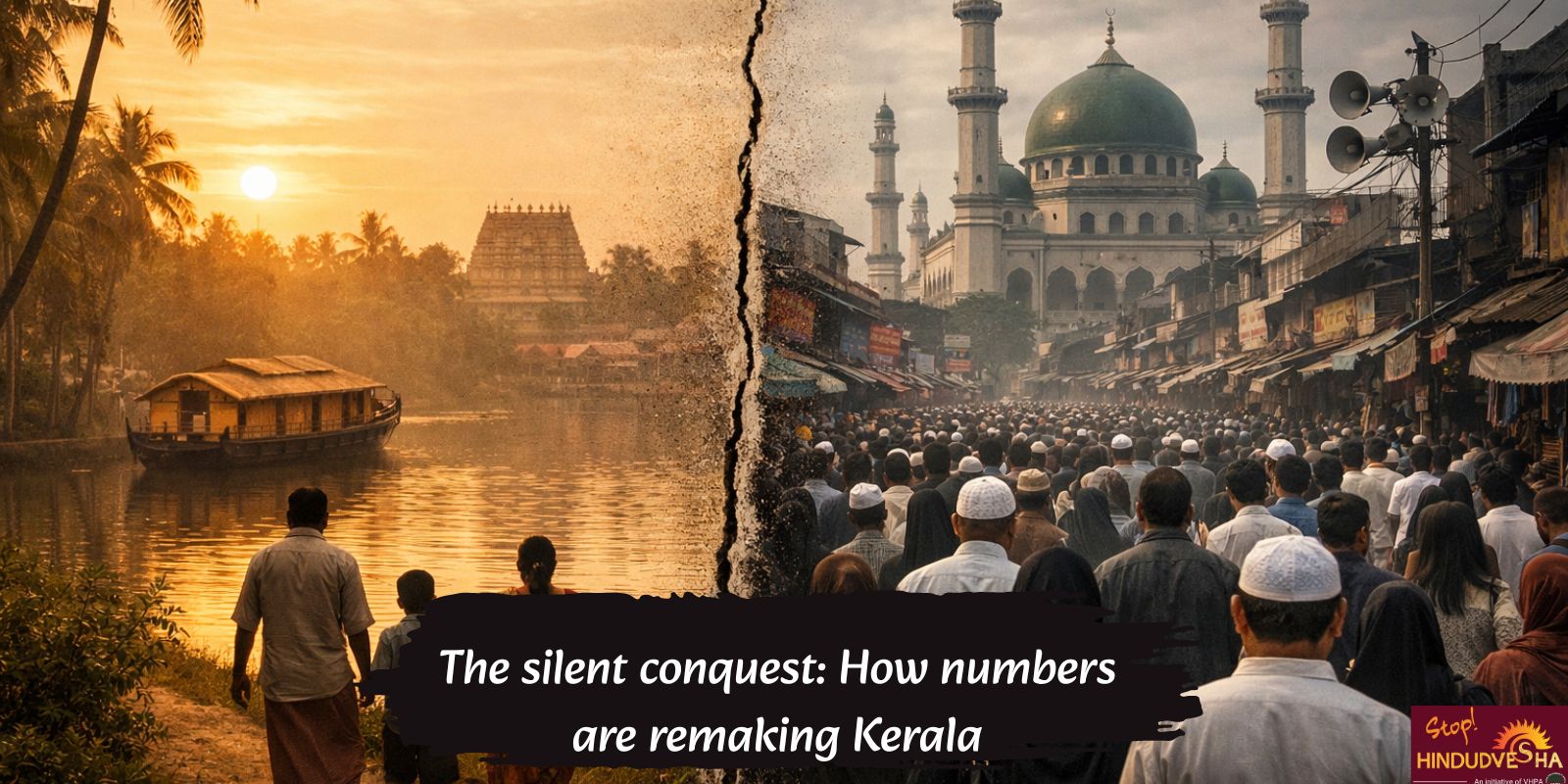
Summary
Kerala’s long-standing reputation for religious harmony is facing growing strain as demographic patterns shift and Muslim political influence expands. Census data and birth trends show a steady rise in the Muslim population alongside slower growth among Hindus and Christians, leading to fears of declining social and political influence. Demands for district reorganization, expanded reservations, and greater access to resources have intensified these concerns. Everyday incidents, land disputes, and cultural pressures are seen as signs of weakening coexistence. Instances of radicalization and political polarization have further deepened mistrust. Comparisons with Kashmir reflect anxieties about marginalization. At the same time, economic stability and social peace remain vital for all communities. The future of Kerala depends on whether its diverse groups can restore mutual trust and preserve its tradition of pluralism and shared prosperity.
“Demography is destiny.” – Auguste Comte, French philosopher and writer (1798-1857)
In serene tropical Kochi, where tranquil backwaters flow seamlessly towards the stunning palm-fringed coastline, one might still glimpse the old Kerala — the one immortalized in travel brochures as “God’s Own Country.” Here, in the shadow of the Chinese fishing nets that have dangled over the shores for centuries, a Hindu temple’s bells chime in distant conversation with the muezzin’s call from a mosque; a 16th-century synagogue holds Friday prayers for the last remaining Jews; and an old Latin church rises against the sky like a forgotten relic. This is the syncretism mentioned in social studies textbooks and cacophonic TV debates; this is the state touted as a melting pot where people of different faiths happily celebrate each other’s festivals.
Yet, beneath this postcard serenity, fissures are appearing. In the bustling markets of Mattancherry last summer, a local fisherman, a sprightly man named Rajan Panickar, with callused hands from years of hauling in fishing nets, leaned in. “The numbers are changing,” he said, glancing at a group of young men in skullcaps haggling over dates. “Soon, we’ll be the minorities in our own land.”
Rajan, a Hindu from the Ezhava community, wasn’t alone in his unease. Across Kerala, a state long hailed for its communal equilibrium, anxieties over demographic changes are growing. With the Muslim population edging upward — projected to approach 30 percent in recent estimates — demands for administrative redrawing and enhanced reservations are stoking fears among Hindus and Christians that their rights, cultural freedom, and access to resources could erode. It’s a narrative that echoes far beyond Kerala’s verdant hills, resonating with broader Indian debates on identity, equity, and the perils of majority-minority reversals.
The Numbers Don’t Lie
Perhaps you are wondering — why focus on a small state in the southern nook of India? After all, isn’t the Muslim population growing rapidly across India? What’s so special about Kerala? Well, here’s the crux of the matter: whenever the issue of Islamic and Christian fundamentalism in India comes up, the liberal commentariat showcases Kerala as a shining example of syncretism. In their view, it’s a state with a significant Muslim and Christian population, and yet everyone lives in harmony. In fact, they assert it is desirable to have a sizable minority that cancels “Hindu majoritarianism.” They claim, wrongly of course, that Kerala’s high Human Development Index[1] is due to the large Christian and Muslim population, and that it would be even better if they outnumber Hindus.
Well, that is precisely what is about to happen in Kerala. With a dramatic decline in the Hindu population and a proportionate increase in the Muslim population, the much-hyped syncretism of the liberals is disappearing like mist on a sunny morning in Kochi.
The 2011 Census painted a picture of balance: Hindus at 54.73 percent, Muslims at 26.56 percent, and Christians at 18.38 percent[2]. But fertility trends and migration patterns are reshaping the canvas. In 2021, while 104,000 new people were added to the Muslim population, the Hindu population increased by just 1,099, and the Christian population decreased by 6,218[3].
By 2023, estimates from the Kerala Migration Survey suggest Hindus have dipped to around 53.2 percent, Muslims risen to 29.3 percent, and Christians fallen to 16.9 percent[4].
Live birth data tells a starker story: In 2019, Muslims accounted for 44.4 percent of births, far outpacing their population share, while Hindus and Christians lagged at 41 percent and 14.3 percent, respectively[5]. Projections indicate a Muslim plurality by mid-century, though Kerala’s overall fertility rate hovers below replacement levels for all groups, signaling an aging society rather than explosive growth. These shifts aren’t mere statistics; they’re kindling unease in a state where religious identity intertwines with politics, economics, and daily life.
The equation is simple – as the Muslim population increases, Hindus are staring at marginalization in all spheres of life in Kerala.
The Divide and Rule Game of Subcontinental Muslims
Take the recent clamor for bifurcating Ernakulam district, Kerala’s bustling commercial heart. In early January 2026, the Kerala Muslim Jamaath, a prominent community organization, publicly demanded the split, proposing a new district centered on Muvattupuzha[6]. They cited “demographic changes and evolving social conditions” as rationale, framing it as a bid for balanced development. But their demand has a veiled intent: Muvattupuzha and surrounding areas have seen a surge in Muslim settlement, and a new district could consolidate influence in a region where Muslims now form a significant bloc. “It’s about creating Islamic enclaves,” one Christian leader in Kochi told me, echoing sentiments in the local media.
For Hindus, who form a slim majority in Ernakulam at around 46 percent, and Christians at 38 percent, this feels like a prelude to dilution — fears amplified by national narratives of demographic invasion.
These fears aren’t baseless. The proposal to bifurcate Ernakulam echoes the 1969 formation of Malappuram – the first district created in an Indian state with a specifically designed Muslim-majority, a precedent for administrative gerrymandering along religious lines. Coming just over two decades after the Muslims of the Indian Subcontinent, including those from Kerala, had voted, agitated, rioted, and killed Hindus for the creation of Pakistan, this was seen as yet another separatist demand from the Islamists[7].
According to a senior Left leader, Paloli Mohammed, “Before independence, the strongest demand for a separate nation as Pakistan came from (Kerala’s) Malappuram district.” He explained why Kerala Muslims were at the forefront of breaking India: “The [separatist] Muslim League advocated for the formation of Pakistan. This demand was most strongly raised in the Malappuram district in the country. At that time, prominent members of the Muslim community supported British rule. Therefore, they received favorable support from the British for their demand for Pakistan[8].”
An Islamic Grab for Community Resources
Compounding these anxieties are the calls for heightened job reservations. Kerala already allocates 10-12 percent of government posts and educational seats to Muslims under the Other Backward Classes (OBC) framework, a legacy of pre-independence policies recognizing Kerala Muslims’ socio-economic lags. Yet, the community leaders argue this falls short; a 2025 survey by the Backward Classes Development Department highlighted Muslim underrepresentation in state jobs at 13.5 percent, well below their population share[9].
Demands for a caste census — echoed by the Indian Union Muslim League (IUML), a key coalition partner in the state’s opposition United Democratic Front — aim to recalibrate quotas, potentially boosting Muslim access to 15-20 percent. The Muslim view is that this is equity, not favoritism. But for Hindus and Christians, this smacks of minorityism — leveraging growing numbers for disproportionate gains, especially as Gulf remittances have elevated many Muslim households economically above national averages.
These demands aren’t abstract; they’re rooted in Kerala’s unique history, now strained by modern pressures. The state’s syncretic ethos traces to its status as a major entrepot: Arab merchants brought Islam in the 7th century; Syrian Christian refugees fleeing the Persian Empire introduced Christianity in the 4th century CE; and Jewish settlers arrived even earlier, around the time of King Solomon (970-931 BCE) attracted by the spice trade and in much larger numbers as refugees after the destruction of the First Temple (587 BCE)[10]. Intermarriages and shared customs forged a tapestry of coexistence, bolstered by high literacy (over 95 percent) and land reforms under communist governance since 1957.
Yet as Muslim economic mobility surges — fueled by Gulf jobs, remittances, and vast amounts of unaccounted funds from Qatar[11] — perceptions of disparity persist. Hindus, comprising ancient feudal communities like Ezhavas and Nairs, fear erosion of their traditional sway in politics and land; Christians, concentrated in central Kerala, worry about cultural marginalization and loss of their significant accumulated wealth from small businesses and large plantations amid declining birth rates.
The specter of Kashmir looms large in these conversations. In that 97 percent Muslim-majority region, the Hindu minority Kashmiri Pandits faced exodus amid violence in the 1990s, their properties seized, and communities fractured[12]. “If Kerala tips Muslim-majority, will Hindus become the new Pandits?” a Kochi academic pondered, drawing parallels. In Kashmir, Hindus report curtailed political participation and land laws favoring Muslims — echoes that Kerala Hindus and Christians invoke when discussing bifurcation or reservations. “Once majority shifts, protections vanish,” Rajan, the businessman, said, his voice laced with resignation.
Challenge to Co-Existence
Tensions aren’t hypothetical but tangible. Krishnendhu R Nath is a non-resident Indian based in Malaysia. During the Islamic fasting month of Ramzan, she was travelling through the Muslim-dominated Malappuram district when she felt sick and needed some lime soda. Her husband’s friend checked in most of the shops along the highway but was told, “Since it is a fasting month, such things cannot be sold.” Startled by the reply, Nath herself went out to a shop and confronted a shopkeeper, “What is the problem with selling Nimbu Pani during the fasting season? What will travelers like us, who have no fasting, do?” As per her Facebook post, the answer she got was: “It is not that we don’t like to. But our shops will be destroyed if we do that.” She went into another shop where she got a similar reply, upon which she exclaimed in anger, “Is this Saudi Arabia?![13]”
Author Tufail Ahmed comments, “Co-existence has long been the founding principle of Indian civilization. Understandably, Muslims close their restaurants in Malappuram and other Muslim-dominated regions of India in daytime during Ramzan, but it is worrying that now it is impossible for Hindus and Christians to open their restaurants in Malappuram during the fasting month or sell eatables in shops not owned by Muslims. Unable to protest, local Hindus have willingly accepted their position as Dhimmis, second-class citizens.”
“The Hindu community in Malappuram is now far subdued, far outnumbered by Muslims,” says Vivek Vibha, an architect based in Kochi. He reminds us that a few years ago, there were arson attacks on some temples in Malappuram, allegedly by an insane person, “but the same insane person couldn’t burn a mosque.”
Ahmed says these incidents are not isolated, but part of a continuing movement of ideas that challenges the co-existence of Kerala’s society. For instance, Ansiba Hassan, a Muslim actress from Kerala, faced abuse from Islamist trolls after she posed for a photograph with Buddhist monks. She was forced to remove the photograph from her Facebook page. Actress Nazriya Nazim was targeted for hurting religious sentiments because she did not wear the hijab in real life.
Penchant for Jihad
This jihadist version of Islam has manifested in flashpoints like the Munambam land dispute. In Ernakulam district, a 404-acre tract claimed as Islamic property by the Kerala State Waqf Board pitted mostly Christian residents against the claim, asserting it was gifted and sold decades ago. The Kerala High Court ruled against the board in 2024, criticizing procedural lapses, but the episode inflamed communal rhetoric. Social media buzzed with accusations of “land jihad,” a term that is derided by liberals but proved uncannily prescient in Munambam. Meanwhile, the Bharatiya Janata Party (BJP), historically marginal in Kerala, gained its first Lok Sabha seat in 2024 by representing Hindu anxieties, allying with Christian factions wary of Muslim assertiveness[14].
And adding to the growing list of Islamic jihadist activity is the disproportionately large number of Muslim youth from Kerala who have joined or tried to join the Islamic State. This hardcore Islamic terror group is on a mission to establish the ‘Holy Caliphate’ across the world. Between 2017 and 2019, as many as 149 people from Kerala joined the terrorist group[15].
This fatal attraction among Kerala Muslims for the Islamic State vindicates communist Chief Minister VS Achuthanandan, who in 2010 warned that Muslims were trying to turn Kerala into an Islamic state via Love Jihad – the conversion of non-Muslim women by trapping them in affairs. The veteran politician said extremist groups in the state were trying to multiply Muslim numbers in the state “by influencing youth of other religions and converting them by giving money, marrying them to Muslim women, and thus producing kids of the community.” In a way, the veteran leader was endorsing the concerns expressed by the Kerala High Court, which in August 2009, asked the state police to probe if there was an organised racket working to lure youth for conversion using love and money[16].
With competing religious groups vying for an ever-larger share of a very small pie, Kerala has long been a polarized society. But with the so-called Muslim minority now presenting unreasonable demands, this polarization risks unraveling Kerala’s social fabric. As demands escalate, resentment brews. Christians, once allied with Muslims against Hindu dominance, now eye IUML’s outsized influence in the ruling coalition with suspicion. Hindus, traditionally fragmented by caste, unite under fears of appeasement. Sporadic incidents — vandalism of temples, disputes over festival routes — hint at brewing strife, though nothing yet rivals the riots seen in places like Bengal, Delhi, and Karnataka.
The irony is poignant: Kerala’s Muslims, the most prosperous segment of their community nationally, stand to lose most from a Hindu-Christian backlash. Their remittances fund mosques, schools, and businesses, thriving in stability. Polarization could deter investment, disrupt migration, and invite national interventions, as seen in Kashmir. “We’re all in the same boat,” a Muslim entrepreneur in Malappuram reflected, his warehouse stacked with Gulf-imported goods. “If it sinks, no one wins.”
The Path Forward
As the sun sets over the backwaters, one hopes the murmurs of anxiety give way to renewed harmony. For in Kerala, as in any mosaic, the beauty lies not in uniformity, but in how the pieces fit together. If they fracture, the loss will be irreparable — not just for individuals in Kerala but for the soul of God’s Own Country.
If jihad wins and Kerala fails, it will be a huge slap in the face of the liberal commentariat, which has for decades peddled the line that a Hindu majority is not a desirable ingredient for a thriving democracy in India. In fact, it is becoming clear to ordinary Indians across India that only if Hindus are a majority can democracy and free speech remain sustainable. For, in areas where Hindus have become a minority — such as Kashmir, parts of Bengal, Malappuram in Kerala, Kanyakumari in Tamil Nadu, and the Northeast — either Sharia or Church-based Christian fundamentalism rules. The Hindu has become marginalized.
Citations
[1] Government of Kerala. “Quality of Life.” Invest Kerala 2025. https://investkerala2025.kerala.gov.in/quality-of-life/
[2] Census2011. “Kerala Religion Data.” https://www.census2011.co.in/data/religion/state/32-kerala.html
[3] Sanatan Prabhat. “Article on Kerala Demography.” https://sanatanprabhat.org/english/126893.html
[4] Samayam Malayalam. “Religious and Community Population Data of Kerala.” https://malayalam.samayam.com/latest-news/kerala-news/religious-and-samudayika-population-data-of-kerala-hindus-christians-muslims-nairs-and-ezhavas/articleshow/126435548.cms
[5] Centre for Policy Studies India. “Religious Demography of India I: Kerala.” CPS Blog, January 2025. https://blog.cpsindia.org/2025/01/religious-demography-of-india-i-kerala.html
[6] Mathrubhumi English. “Kerala Muslim Jamaath Seeks New District with Muvattupuzha as Headquarters.” https://english.mathrubhumi.com/news/kerala/bifurcate-ernakulam-kerala-muslim-jamaath-seeks-new-district-with-muvattupuzha-as-headquarters-e18walzy
[7] Swarajya. “Soft Corner for Communists: What Else Explains Media’s Silence on the Tanur Riots in Kerala?” https://swarajyamag.com/politics/soft-corner-for-communists-what-else-explains-medias-silnece-on-the-tanur-riots-in-kerala
[8] Times of India. “Demand for Pakistan Was Popular in Malappuram.” https://timesofindia.indiatimes.com/city/kochi/demand-for-pak-was-popular-in-mlpm/articleshow/116950228.cms
[9] Press Information Bureau, Government of India. “Review Meeting on Backward Classes Development.” https://www.pib.gov.in/PressReleasePage.aspx?PRID=2184988®=3&lang=2
[10] International Journal of Creative Research Thoughts. “Socio-Religious Study of Kerala.” https://ijcrt.org/papers/IJCRT2203176.pdf
[11] Enforcement Directorate, Government of India. “Press Release: Arrest of Ismail Chakkarath.” November 27, 2024. https://enforcementdirectorate.gov.in/sites/default/files/latestnews/Press%20Release%20%20Arrest-Ismail%20Chakkarath-27-11-2024%203.pdf
[12] SAGE Journals. “Article on Radicalisation in Kerala.” https://journals.sagepub.com/doi/10.1177/17506980241243236
[13] Ahmed, Tufail. “The Roots of Islamic Radicalisation in Kerala.” New Age Islam.
https://www.newageislam.com/radical-islamism-jihad/tufail-ahmad-new-age-islam/the-roots-islamic-radicalisation-kerala/d/108722
[14] Verdictum. “Kerala High Court on Munambam Waqf Property Dispute.”
https://www.verdictum.in/court-updates/high-courts/kerala-high-court/the-state-v-tki-ahamed-sherief-2025ker74409-munambam-property-waqf-property-dispute-1594079
[15] Onmanorama. “Kerala Youth Recruited by ISIS Terror Outfits.” July 28, 2020. https://www.onmanorama.com/news/kerala/2020/07/28/kerala-isis-recuits-terror-outfits.html
[16] The Times of India. “Kerala CM Reignites ‘Love Jihad’ Theory.”
https://timesofindia.indiatimes.com/india/kerala-cm-reignites-love-jihad-theory/articleshow/6216779.cms

Donate to HINDUDVESHA
Our Mission is to explore and expose Hindudvesha through research analysis, education and response.
SUPPORT US