

Profiting From Hindus While Policing Hindu Identity: Corporate India’s War on Hindu Culture
 Rati Agnihotri · 05/29/2026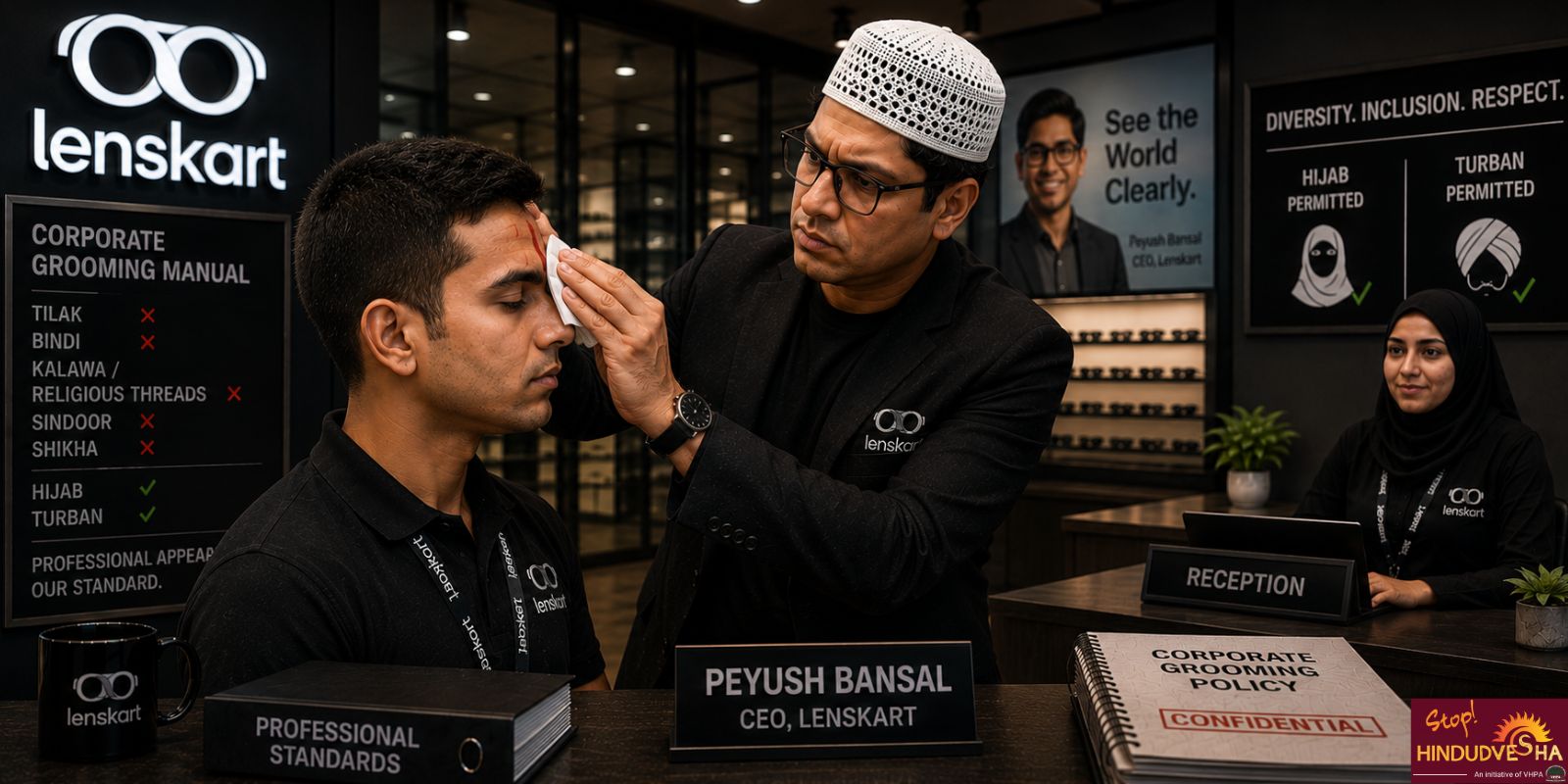
Summary
In a country where Hindus form nearly 80 percent of the population and represent the primary consumer base, a growing number of corporate controversies are raising questions about anti-Hindu bias in the workplace. Allegations linked to companies such as Lenskart and Tata Consultancy Services suggest that visible Hindu symbols, including tilak, bindi, kalawa, and shikha, are increasingly being targeted under grooming standards framed as professionalism. Such policies go beyond dress codes, reflecting a wider cultural hierarchy in which Hindu identity is regulated while other religious expressions receive accommodation. The article examines how workplace policies, corporate culture, media framing, and financial practices may collectively contribute to the marginalization of Hindu identity within India’s corporate ecosystem.
A series of recent revelations from India’s corporate sector is exposing the systematic erosion of Hindu cultural rights in the workplace.
Hindu employees in prominent companies are being pressured through formal grooming policies to remove, conceal or minimize visible symbols such as the tilak, kalawa, shikha, sindoor, and bindi — all in the name of “professional appearance.” In a country where Hindus form nearly 80 percent of the population and the primary customer base, what was once everyday cultural expression is now treated as a professional liability.
The Lenskart grooming guidelines scandal brought the issue into sharp focus: Hindu symbols were to be minimized or erased, while the hijab and other Islamic markers remained explicitly permitted. Similar complaints have emerged from Tata Consultancy Services and other major firms, where Hindu employees allege they are being coerced into suppressing their identity to avoid career penalties.
Corporations that generate enormous profits from India’s Hindu-majority market are increasingly policing the very identity of the people who sustain them. The result is a clear cultural hierarchy: the majority Hindu identity is being sanitized and subordinated inside workplaces built on Hindu talent, consumers, and purchasing power.
Lenskart’s Deep Rot Exposed
The controversy erupted when an internal Lenskart grooming document was leaked online. Netizens reacted with shock and outrage at its blatantly Hinduphobic content: “bindi is not allowed”, “sindoor should be minimal and not fall on the forehead”, and “religious threads/wristbands must be taken out” — a clear reference to the kalawa. [1]
While the guidelines explicitly banned or restricted multiple Hindu symbols, they specifically permitted hijabs and turbans. Author and activist Shefali Vaidya was among the first to challenge the document. She verified its authenticity through trusted sources and AI detection tools. [2] [3]
Owing to public backlash, Lenskart CEO Peyush Bansal issued a statement claiming that the manual was “outdated” and didn’t reflect the company’s present guidelines [4]. Shefali Vaidya swiftly rejected the claim as a blatant falsehood:
“I have irrefutable proof that Lenskart_com CEO Peyushbansal is LYING when he says that the grooming code that says NO Bindi is ‘outdated’. I have proof of a video audit with the date of 08/04/2026 where an employee was given a low rating for wearing a bindi. Will share in due course. Happy to share everything with a good lawyer. Lenskart is a publicly listed company that has to follow SEBI guidelines, not Bansal’s private enterprise, and they are violating Article 15 of the Indian Constitution.” – Shefali Vaidya on X [5]
Regardless of when it was drafted or whether it is now obsolete, the very existence of such a policy reveals a deep-rooted cultural bias within the organization.
Lenskart’s Full-Scale War on Hindu Identity
What unfolded at Lenskart was never just a grooming manual. It laid bare a deeply entrenched culture of institutionalized anti-Hindu discrimination and the brazen normalization of Hinduphobia.
As public fury mounted, images from Lenskart stores across India told the real story. Muslim women served customers wearing hijabs without hesitation, while Hindu employees were stripped of all visible religious symbols. When Hindu activists and concerned citizens began visiting stores to verify the ground reality, they captured shocking evidence: photographs of Hindu Gods dumped at foot level, deliberately hidden under employees’ desks so customers wouldn’t see them.[6]
Ex-employees then flooded social media with harrowing testimonies. Multiple staff claimed they were fired for refusing to erase their tilak, kalawa, or other Hindu markers. [7] One explosive thread alleged that Lenskart had sacked at least 1,000 employees for the same “crime.” Though mainstream media has largely ignored the scale, the sheer number of detailed, named accounts makes it impossible to dismiss.
CEO Peyush Bansal’s response was pure damage control. After calling the original manual “outdated,” the company issued a new “inclusive” style guide. [8] The arrogant, self-righteous statement — “We have heard you… and we have listened” — was widely mocked as hollow theater. Critics rightly slammed a publicly listed company for running a blatantly unconstitutional, discriminatory policy and then expecting applause for a cosmetic U-turn. [9]
The testimonies expose a toxic culture that runs far deeper than any single policy. Zeel Soghasia from Gujarat was bluntly told during his hiring interview that he must cut off his shikha and remove his tilak — or forget about the job. When he reached the Navi Mumbai training center, he was thrown out for the same reason.[10]
The discrimination infected every corner of the workplace. Hindu festivals were sidelined while generous leave was granted for Ramzan. During video audits, Hindu women were reportedly forced to remove their bindis or had them humiliatingly wiped off by auditors. Verbal abuse for wearing Hindu symbols was routine.[11]
The Lenskart scandal reveals something grotesque: Hindus are being treated as second-class citizens in their own homeland. Forcible removal of bindis, rejection of candidates over shikhas, and hiding Hindu deities are nothing short of calculated acts of cultural erasure and religious apartheid inside a major Indian company.
From FabIndia to HDFC — Corporate India’s Rampant Anti-Hindu Culture
As the controversy intensified, the names of several other prominent Indian companies began circulating on social media for allegedly using grooming guides that discriminate against Hindu religious symbols. Air India’s cabin crew guidelines, widely shared online, mirrored Lenskart’s by prohibiting bindi, kalawa, tilak, and sindoor. The airline claimed the documents were outdated and no longer in effect. [12] Individual testimonies on social media also accused the well-known Ayurvedic brand Forest Essentials of banning Hindu symbols. [13]
The Indian corporate sector has been under scrutiny for institutionalized Hinduphobia for years. In October 2021, FabIndia faced massive backlash for rebranding Deepawali as “Jashn-e-Riwaaz”. In 2020, Tanishq’s advertisement openly glorifying love jihad was withdrawn after public outrage. In October 2023, HDFC Bank drew criticism for a Hinduphobic Navratri campaign that replaced a woman’s bindi with a “no entry” sign. In March 2019, Hindustan Unilever’s Surf Excel ad showed a young girl helping a Muslim boy avoid Holi colors so he could reach the mosque in clean clothes. [14]
Unlike Lenskart’s written grooming restrictions, the TCS Nashik controversy revealed another form of pressure: coercive workplace power. Allegations suggested Hindu employees were not merely asked to suppress symbols but drawn into environments where refusal to participate in Islamic social expectations carried professional consequences. Critics argued that this crossed the line from accommodation into institutional coercion.
Given the scale of these recurring controversies, the Lenskart scandal may represent only the visible edge of a much larger institutional pattern. Many such practices may remain undocumented because employees fear professional retaliation, while weak whistleblower protections and selective media attention ensure that such allegations rarely receive sustained scrutiny.
A striking pattern across these controversies is how rarely they enter mainstream scrutiny in their original form. Allegations of anti-Hindu workplace bias often first emerge on social media, from whistleblowers, or from independent activists rather than from established media institutions. The TCS Nashik controversy followed the same trajectory: early coverage softened or reframed the allegations as generic “sexual harassment” complaints, stripping away the communal and coercive dimensions central to the accusations. [15] Similarly, portions of the coverage surrounding Lenskart treated the revelations as little more than a social media outrage cycle, subtly recasting complainants as aggressors rather than examining the underlying discrimination claims.
The asymmetry extends beyond grooming policies into finance and corporate ethics. What appears in dress codes and workplace conduct is increasingly reflected in broader institutional choices, where accommodation for one set of religious norms coexists with the marginalization of Hindu identity.
Brazen Islamic Appeasement in Corporate India
A rising culture of brazen Islamic appeasement runs parallel to the institutionalized anti-Hindu discrimination prevalent across many Indian corporates.
Amid the explosive TCS Nashik jihad controversy, Tech Mahindra came under heavy fire for anti-Hindu bias at its Goregaon office in Mumbai. Advocate Ashutosh Dubey exposed on X how the company had declared its office pantry a “Footwear-Free Zone” during Ramzan to facilitate Islamic prayers and iftar, instructing all employees to comply in the name of “unity.” Multiple other allegations flooded social media, accusing the company of biased hiring, preferential treatment for Muslim employees during religious occasions, and blatantly uneven enforcement of rules. Tech Mahindra predictably denied the charges, claiming an internal review found them “inaccurate and unfounded.” [16]
Following the TCS Nashik controversy, the Tata group also faced criticism over its “Shariah-compliant” Tata Ethical Mutual Fund. Launched in 1996, the fund invests in accordance with Islamic financial principles, avoiding sectors such as banking, insurance, liquor, tobacco, gambling, and entertainment. Tata Mutual Fund describes it as an equity scheme guided by Shariah norms, with holdings across major Indian companies including Infosys, Tata Consultancy Services, Tech Mahindra, and Hindustan Unilever.[17] [18]
Though legally permitted, Shariah-compliant investing by Indian corporates is deeply problematic — even dangerous. At a time when radical Islamist extremism is spreading rapidly through white-collar workplaces — from the Al-Falah University scandal and the doctors’ jihad module to surging workplace conversions and targeted grooming of Hindu women — these funds and Halal certifications function as covert instruments of Islamist influence and financial jihad.
The imbalance is glaring in a Hindu-majority nation. Hindus, who form the overwhelming majority, have no equivalent mainstream frameworks like Sattvik investing. While Shariah-compliant finance is enthusiastically embraced and normalized by Indian corporations, Hindu civilizational principles are systematically sidelined. This is a blatant cultural and religious asymmetry that legitimizes one faith’s financial ecosystem while marginalizing the civilizational identity of the country’s majority.
Hindu CEOs Leading the War on Hindu Identity
What makes these scandals particularly disturbing is that many of the companies accused of anti-Hindu bias are not foreign multinationals imposing outside values. They are Indian corporations led by Hindu CEOs, founders, and promoters — individuals who publicly benefit from Hindu-majority markets while privately enforcing policies that marginalize Hindu expression inside their organizations.
The contradiction is difficult to ignore. In public, many corporate leaders embrace the language of heritage, tradition, and Indian identity. Inside the workplace, however, visible Hindu symbols are often treated as obstacles to a polished global image.
This reflects a deeper civilizational insecurity within sections of India’s corporate elite. In the pursuit of international legitimacy, Western investor approval, and cosmopolitan branding, visible Hindu identity is increasingly viewed as provincial, excessive, or reputationally inconvenient. Rather than projecting confidence in the civilizational culture from which they profit, some business leaders appear more comfortable sanitizing it.
The issue is beyond hypocrisy. It is the emergence of a corporate mindset that treats Hindu identity as something acceptable in festivals and advertising campaigns, but undesirable in professional spaces. Symbols that would trigger outrage if restricted elsewhere are casually regulated when they belong to Hindus.
When Hindu-owned companies regulate Hindu identity more aggressively than anyone else, the issue ceases to be about grooming policy. It becomes a form of cultural self-erasure, where sections of the Hindu elite participate in the policing of their own civilizational identity.
Endnote – Hindu Consumers Must Weaponize Their Economic Power
As Lenskart faced widespread Hindu boycott, its shares tumbled nearly 5%.[19] The #BoycottLenskart trend continues to rage on social media, fueled by the company’s refusal to genuinely acknowledge its anti-Hindu grooming policy. Despite the new “all religions allowed” guideline, customers remain skeptical. Most see it as a temporary damage-control exercise that will likely be ignored once public attention fades.
The broader public response, especially outside social media, has been disappointingly lukewarm. Decades of one-sided secular conditioning have left large sections of urban Hindu consumers numb — even to blatant discrimination against their own identity.
This must change. Hindu consumers need to start exercising economic power rooted in Dharma. When buying decisions are guided by cultural self-respect rather than mere convenience, companies pushing Halal certification, Shariah funds, or anti-Hindu policies will think twice. Hindu CEOs are getting away with anti-Hindu practices only because of widespread consumer apathy.
Symbolic outrage alone will not reverse institutional bias. Structural remedies are necessary:
- A government-mandated code of conduct to protect the religious and civilizational identity of the Hindu majority.
- A secure, government-backed anonymous whistleblowing platform for employees.
- Promotion of Sattvik Certification and Sattvik investment frameworks.
- Regular external audits to detect discriminatory practices.
- Mandatory public disclosure of grooming policies, holiday calendars, and internal guidelines on company websites.
The time for passive consumption is over. Hindu society must hit back where it hurts corporates the most — in their balance sheets.
Citations
[1] Lenskart controversy: Bindi-hijab storm refuses to die down despite CEP Peyush Bansal’s clarification. Here’s why – India Today; https://www.indiatoday.in/india/story/lenskart-dress-code-controversy-boycott-calls-backlash-ceo-peyush-bansal-2898118-2026-04-18
[2] Shefali Vaidya on X; https://x.com/ShefVaidya/status/2044302806446944638
[3] Shefali Vaidya on X; https://x.com/ShefVaidya/status/2044385244296646976
[4] India Today News Desk. “Lenskart Controversy: Bindi-Hijab Storm Refuses to Die Down Despite CEO Peyush Bansal’s Clarification. Here’s Why.” India Today, April 18, 2026. https://www.indiatoday.in/india/story/lenskart-dress-code-controversy-boycott-calls-backlash-ceo-peyush-bansal-2898118-2026-04-18
[5] Shefali Vaidya on X; https://x.com/ShefVaidya/status/2045358331141771326
[6] Lenskart Row: Shefali Vaidya’s call – ‘Stand up, don’t stay silent’; https://organiser.org/2026/04/21/349813/bharat/lenskart-row-shefali-vaidya-to-hindus-stand-up-for-yourselves-dont-wait-for-someone-else-to-fight-for-your-dharma/
[7] I was asked to remove tilak: Ex-Lenskart staff alleges discriminatory firing: watch video; https://www.msn.com/en-in/money/topstories/i-was-asked-to-remove-tilak-ex-lenskart-staff-alleges-discriminatory-firing-watch-video/ar-AA21f1x4?ocid=finance-verthp-feeds&apiversion=v2&domshim=1&noservercache=1&noservertelemetry=1&batchservertelemetry=1&renderwebcomponents=1&wcseo=1&bundles=feat-es2020-c
[8] Lenskart Issues New Dress Code After Backlash Over Bindi, Tilak, Peyush Bansal’s clarification; https://www.ndtv.com/india-news/lenskart-issues-new-dress-code-after-backlash-over-bindi-tilak-peyush-bansals-clarification-11378195
[9] Ibid.
[10] Video and Audio Evidence Reveal Peyush Bansal’s Lenskart Penalized Hindus For Wearing Bindi, Kumkum, Kalawa – The Commune; https://thecommunemag.com/video-and-audio-evidence-reveal-peyush-bansals-lenskart-penalized-hindus-for-wearing-bindi-kumkum-kalawa/
[11] Ibid.
[12] After Lenskart, Air India’s grooming policy document goes viral; https://organiser.org/2026/04/20/349473/bharat/after-lenskart-air-indias-grooming-policy-document-goes-viral-bindi-sindoor-and-tilak-come-under-fire/
[13] Shefali Vaidya on X; https://x.com/ShefVaidya/status/2046214480770838917
[14] Exposing the Corporate Jihad across Bharat; https://organiser.org/2026/04/20/349580/bharat/corporate-jihad-across-bharat-the-systematic-erasure-of-hindu-identity-at-workplace/
[15] (7) Lenskart Row: Tilak vs Hijab Dress Code Sparks Backlash | Peyush Bansal Controversy | N18V – Youtube; https://www.youtube.com/watch?v=Xb048zZF6cU
[16] Tech Mahindra denies religious bias claims amid wide scrutiny on IT workplace practices – BusinessToday; https://www.businesstoday.in/technology/story/tech-mahindra-denies-religious-bias-claims-amid-wider-scrutiny-on-it-workplace-practices-525795-2026-04-15
[17] After TCS Nashik scandal, Tata faces fresh backlash over Rs 3624.91 cr ‘shariah-compliant’ ethical mutual fund; https://www.dnaindia.com/india/report-after-tcs-nashik-scandal-tata-faces-fresh-social-media-backlash-over-rs-3624-cr-shariah-compliant-ethical-mutual-fund-3206871
[18] Tata Ethical Fund Direct Growth – Tata Mutual Fund; https://www.tatamutualfund.com/mutual-funds/tata-ethical-fund-direct-growth
[19] Lenskart shares tumble 5% amid online backlash over dress code row – The Economic Times; https://economictimes.indiatimes.com/markets/stocks/news/lenskart-shares-tumble-5-amid-boycott-calls-online-backlash-over-religious-dress-code-controversy/articleshow/130385860.cms?from=mdr

Donate to HINDUDVESHA
Our Mission is to explore and expose Hindudvesha through research analysis, education and response.
SUPPORT US