

The Red Fort Suicide Attack: India’s Stark Civilizational Wake-Up Call
 Aditi Joshi · 11/14/2025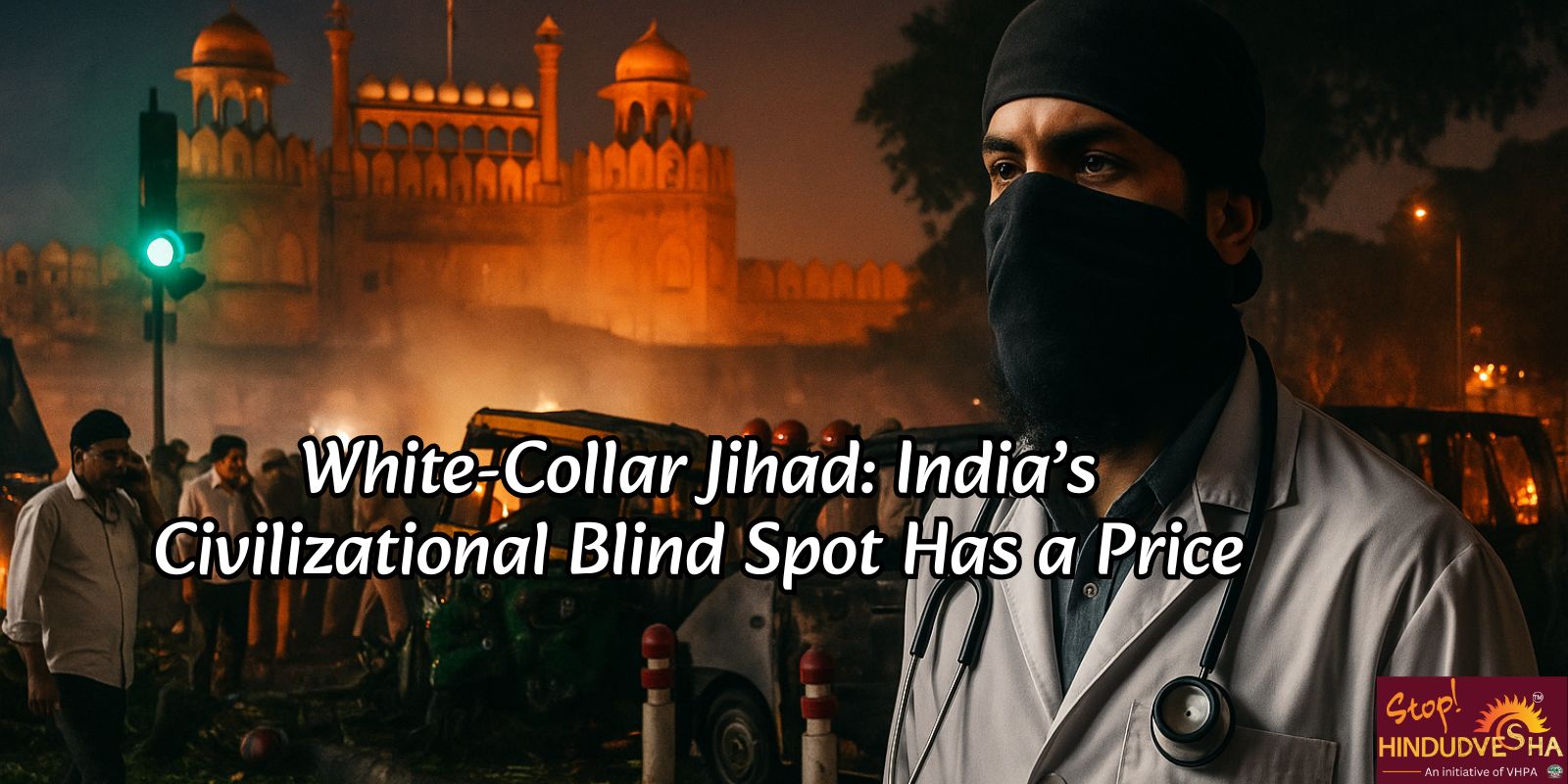
- A Faridabad doctor turned suicide bomber carried out the Red Fort attack, showing how radicalization now reaches educated, urban professionals.
- Raids uncovered a major terror network, including nearly 3,000 kg of explosives, dozens of VBIEDs in preparation, and Pakistan-backed links to JeM and AGH.
- Several accused were affiliated with Al-Falah University, exposing how radical networks can operate within modern campuses and professional institutions.
- Radicalization in this case fused theology, grievance narratives, and modern operational tools, creating a highly skilled, covert ecosystem.
- The Red Fort was chosen for its civilizational symbolism, underscoring that the threat is ideological, not circumstantial, and demands far greater clarity in India’s security approach.
When a bomb-laden Hyundai i20 exploded outside Delhi’s Red Fort metro station on November 10, 2025, the first shock was the blaze and the wreckage. The deeper shock came later when forensic teams identified the driver as Dr. Umar-un-Nabi, a Faridabad-based physician who had embraced violent extremism and carried out a suicide mission.
His final act was not an impulsive breakdown but the endpoint of a quiet, sustained ideological descent. A man trained to heal had been reshaped into an agent of mass violence. The Red Fort blast stands as more than a terror incident; it shows how contemporary jihadist networks seep into India’s urban, educated environments by exploiting civilizational vulnerabilities we still hesitate to acknowledge.
A doctor at the wheel of a car bomb near one of India’s most iconic monuments should be enough to force a reconsideration of how we understand radicalization.
From Faridabad to Red Fort: Uncovering the Plot
The established facts are stark and deeply disquieting. On November 10, the vehicle moved through several points across the National Capital Region, was spotted near the Sunehri Masjid parking area, remained idle there for hours, and finally exploded at about 6:52 p.m. in front of the Lal Qila metro station. The blast set nearby vehicles ablaze and caused severe casualties along one of Old Delhi’s most crowded corridors.
Subsequent raids in Faridabad, tied to the same operational network, led to the seizure of nearly 3,000 kilograms of explosives along with weapons, triggering circuits, and other bomb-making components. The scale of the materials recovered made it clear that the Red Fort blast was not an isolated undertaking.[1]
As investigators probed deeper, they found indications that the module—reportedly involving medical professionals and other highly educated individuals—was preparing a large, coordinated attack. The plan appeared to center on multiple vehicle-borne improvised explosive devices deployed across several major cities. Intelligence assessments suggest that as many as 32 cars were at various stages of conversion for this purpose.
This expanding picture has also revealed troubling organizational linkages. Emerging evidence points to operational or ideological connections with Jaish-e-Mohammed (JeM) and Ansar Ghazwat-ul-Hind, both Pakistan-backed jihadist groups with a long record of high-casualty strikes in India.
The arrests linked to the Faridabad module have drawn uncomfortable attention to Al-Falah University because the institution is inherently complicit, and several of the accused, including doctors, faculty members, and students, were affiliated with it, thereby exposing a serious institutional vulnerability. What the case suggests is that the university “produces jihadists” in the doctrinal sense, and that its ecosystem, like many private institutions operating with minimal ideological scrutiny, became a permissive environment in which radical networks could recruit, indoctrinate, and operationalize educated individuals.[2]
The Al-Falah episode is more of an indictment of one institution and a warning about how modern, respectable campuses can be fronts for transnational jihadist narratives when civilizational vigilance is absent.
The Rise of the White-Collar Jihadist
The most disquieting and analytically revealing dimension of this conspiracy lies in the sociological and professional profile of its principal operatives. The popular imaginary, still shaped by post-9/11 clichés, often defaults to the figure of the marginalized madrasa dropout as the archetypal terrorist foot-soldier. The present case, however, demands a radical reorientation of that lens.
The individuals implicated in this network are medical doctors and teaching faculty embedded within the institutional framework of a private university and hospital in Faridabad. Their professional standing offered them legitimacy, routine access to sensitive environments, and the ability to operate without attracting suspicion.
They were also positioned within networks that provided financial support, laboratory resources, technical expertise, and the mobility needed to move personnel and materials across regions. Together, these factors created an operational ecosystem far more capable and concealed than a conventional terror cell.
This constellation makes one point unmistakably clear: the motivational substrate here is not rooted in material deprivation but in ideological intensity. These are beneficiaries of modernity who deliberately weaponize its privileges.
The trajectory of Umar-un-Nabi and his cohort exemplifies a global pattern that crystallized most visibly during the ISIS expansion of the mid-2010s: the rise of the “white-collar jihadi.” These actors, engineers, doctors, software professionals, embodied a paradoxical duality: outwardly integrated into globalized professional life, yet inwardly committed to an eschatological project that seeks the violent undoing of the modern social order. Their radicalization is less a product of structural exclusion and more a function of ideological seduction within transnational jihadist circuits.
The radicalization process in this case appears to operate along three mutually reinforcing axes. The first is theological absolutism, anchored in a closed interpretive worldview that relies on rigid textual literalism. This framework elevates particular readings of jihad into mandatory religious duty, casting violence against “kafirs” or “apostate regimes” as not only permissible but sanctified. Through this lens, the Indian state is stripped of political legitimacy and recast as a theologically invalid target, creating the moral logic that guides such actors.
Layered on top of this doctrinal rigidity is a pan-Islamist grievance narrative that draws on transnational themes of Muslim victimhood.[3] India is framed as a “Hindu oppressor state,” while Kashmir is portrayed as “occupied territory” awaiting liberation through force. These narratives, constantly reinforced by online propaganda, diasporic echo chambers, and cross-border handlers, supply emotional charge and ideological justification. The individual’s discontent is absorbed into a global struggle, transforming private frustration into a civilizational mission. [4]
The final axis is operational modernity, marked by a seamless adoption of the tools and techniques of contemporary insurgency. Encrypted platforms allow covert communication; professional identities provide legitimacy and access; financial pathways are engineered to avoid detection. Reports of a Türkiye-based handler known as “Ukasa” point to a multi-node transnational command structure. [5] Together, these elements show how modern technologies and professional systems are repurposed to execute a form of violence fundamentally opposed to the very modernity it exploits.
When this volatile combination of absolutist theology, global grievance narratives, and technologically enabled planning enters a space like a medical college, the consequences can be devastating. Institutions designed to heal and preserve life can become inadvertent incubators for individuals who repurpose their scientific training and professional ethics toward the pursuit of mass violence. The Red Fort attack displayed this convergence with unsettling clarity: a medical professional, educated to save lives, was reshaped into a vehicle of destruction.
This is not a stray aberration but an emerging pattern that warrants immediate scholarly, policy, and societal engagement.
The Message Behind the Blast
The choice of the Red Fort, its imposing ramparts, and the historical precincts surrounding it is anything but incidental. It is a deliberate act of civilizational signaling, an attempt to communicate power, grievance, and intent through symbolic geography. This attack cannot be understood simply as another episode of urban terrorism. It must be read as a message rooted in civilizational semiotics.
The semiotics of the Red Fort reveal why the site holds such resonance for jihadist ideologues. In modern India, it functions as the ritualized center of sovereign authority. Each Independence Day, the Prime Minister raises the national tricolor from its ramparts, reaffirming democratic power and, crucially, the fact that political legitimacy in this land no longer flows from the Mughal court or any other imperial order. In the public mind, the Red Fort symbolizes a confident, assertive, and non-Islamic national identity.
At the same time, the fort is inseparable from its Mughal legacy. For centuries, it served as the ceremonial and administrative seat of a dynasty that exercised political and cultural dominance across large parts of the subcontinent. For Islamist ideologues, this history carries an emotional charge: it represents a lost realm, a memory of supremacy that, in their worldview, demands restoration through violence.
To detonate a car packed with explosives beside this geography, at peak evening traffic, is therefore to convey a pointed message. It is an assertion of capability and intent: a declaration that the heart of India’s sovereignty —the emblem of its civilizational self-confidence —can be targeted.
Ideology, Not Grievance
India’s strategic establishment has long displayed a curious hesitation when confronted with the ideological nature of jihadist violence. The analytical instinct is to reduce each incident to a familiar administrative frame, law and order, intelligence lapses, or local grievance. The Red Fort blast shatters that comfortable template. It demands that we finally acknowledge what many have avoided saying aloud: the battle being waged is not merely tactical but civilizational.
The choice of geography tells its own story. Red Fort is not simply a monument; it is the site where the Prime Minister unfurls the national tricolor each Independence Day, the ritualized center of India’s democratic sovereignty. It is equally, within jihadist imagination, a vestige of the Mughal imperium, a reminder of a past age of Islamic dominion over this land. To strike at this site is to strike at layered symbols of power: India’s present sovereignty and a fantasized memory of lost supremacy. The geography was not accidental. It was the message.
This message becomes clearer when set against the broader context. In the days leading up to the attack, security agencies had already dismantled a major explosives hub in Faridabad, recovering nearly 2,900 kilograms of explosive material and arresting several suspects, including medical professionals. Subsequent raids across Kashmir, Haryana, and Uttar Pradesh revealed an extensive network under strain and surveillance. Far from being blindsided, the state was in fact intercepting multiple elements of a rapidly escalating plot. The Red Fort blast appears to have been the lone operational success that slipped through the tightening net.
The drive of Dr Umar-un-Nabi, sixteen frantic hours across the NCR after the Faridabad crackdown, was not the calm execution of a master plan. It was the desperate endgame of a collapsing operation. This is not to deny the need for systemic improvement. But it is to reject the lazy cliché of a “sleeping state.” In an era of high-volume, encrypted, Pakistan-enabled jihad, even an active intelligence grid will confront statistical breaches. The real lesson is not denunciation but expansion: more capability, more technology, more doctrinal clarity.
Which brings us to the real blind spot in India’s discourse: radicalization. It is intellectually tempting to cling to secular comfort narratives, poverty, unemployment, and alienation. But the Red Fort blast exposes the inadequacy of that lens. Here was a doctor, a man with professional training, social respectability, employment, and institutional affiliation. He did not turn himself into a human bomb because his stipend was delayed or because the state failed to provide him opportunity. He acted because he believed a certain reading of religion demanded it, because he viewed India’s sovereignty, especially its Hindu civilizational resurgence, as illegitimate, and because he operated within a network that transformed belief into action.
Radicalization is not dangerous merely because it produces violence. It is dangerous because it transforms educated, socially integrated individuals into ideologically weaponized enemies of the society that raised them. Every Umar-un-Nabi represents a double loss: a doctor in whom the nation invested, and a suicide bomber the nation must now defend against.
Wrapping Up
What India lacks is not policing capacity but civilizational clarity. The concept of Shatrubodh, awareness of hostile doctrines, captures the missing layer.[6] It is not a call for indiscriminate suspicion; it is a call for precision. It asks us to recognize that the ideology at work here is not an amorphous “extremism” but a specific radical Islamist interpretation. It asks us to acknowledge that target selection, Red Fort today, Ram temple gatherings and Hindu festivals tomorrow, is doctrinal, not incidental. And it asks us to accept that deradicalization is not a workshop, a hashtag, or a syllabus addition; it is a long, serious, intellectually grounded effort involving theology, community leadership, and state policy.
Radicalization is bad in the most literal, concrete sense: it turns healers into killers, classrooms into covert cells, and symbols of national pride into potential blast sites. If that does not jolt us into Shatrubodh,[7] into a calm, clear-eyed understanding of the ideology that seeks to break India from within, we will have learned nothing from the mangled bodies on that November evening in Old Delhi.
The Red Fort blast stands as more than a security incident. It is a moral and civilizational alarm bell. Radicalization, in its most literal sense, turns healers into killers, classrooms into covert cells, and national symbols into blast sites. If this does not jolt India into a clearer understanding of the ideological project seeking to fracture it from within, then we will have learned nothing from the mutilated bodies on that November evening in Old Delhi.
In the end, the choice before India is stark. Either we continue treating these episodes as episodic aberrations. Or we learn, calmly, unsentimentally, and with civilizational confidence, that this is a contest over the meaning of India itself.
Citations
[1] Delhi Terror Probe: J&K Police Bust Module Involving Doctors, Seize 2,900kg Explosives; https://www.indiatoday.in/amp/india/video/delhi-terror-probe-jk-police-bust-module-involving-doctors-seize-2900kg-explosives-ytvd-2817139-2025-11-11
[2] Rs 20 Lakh Cash, 2,900 Kg Of Explosives, 20 Quintals Of NPK Fertilizer: What Conspired Inside Al-Falah University’s Room 13, 4 Ahead Of Delhi Car Blast; https://timesofindia.indiatimes.com/city/faridabad/rs-20-lakh-cash-2900-kg-of-explosives-20-quintals-of-npk-fertilizer-what-conspired-inside-al-falah-universitys-room-13-4-ahead-of-delhi-car-blast/amp_articleshow/125289410.cms
[3] Three Banes of India’s Muslims: Victimhood Syndrome, Power Theology, Obsession with Identity Politics: https://sabrangindia.in/three-banes-of-indias-muslims-victimhood-syndrome-power-theology-obsession-with-identity-politics/amp/
[4] How the narrative of Muslim victimhood is pushed to promote political Islam in India; https://www.firstpost.com/opinion/how-the-narrative-of-muslim-victimhood-is-pushed-to-promote-political-islam-in-india-10976281.html/amp
[5] Codename ‘Ukasa’: Turkiye Handler Directed Delhi Terror Module; How Bomber Umar’s 2022 Trip Planned Strikes; https://timesofindia.indiatimes.com/city/delhi/codename-ukasa-turkiye-handler-directed-delhi-terror-module-how-bomber-umars-2022-trip-planned-strikes/amp_articleshow/125288313.cms
[6] While They Preach Jihad, Hindus Preach Secularism: The Ostrich Syndrome of a Civilization in Peril; https://stophindudvesha.org/while-they-preach-jihad-hindus-preach-secularism-the-ostrich-syndrome-of-a-civilization-in-peril/
[7] Between Denial and Despair: The Effete Mindset Holding Hindus Back; https://stophindudvesha.org/between-denial-and-despair-the-effete-mindset-holding-hindus-back/

Donate to HINDUDVESHA
Our Mission is to explore and expose Hindudvesha through research analysis, education and response.
SUPPORT US