
No Land for Hindu Vegetarians – How Food Became a Political Weapon of Hinduphobia
 Rati Agnihotri · 08/22/2025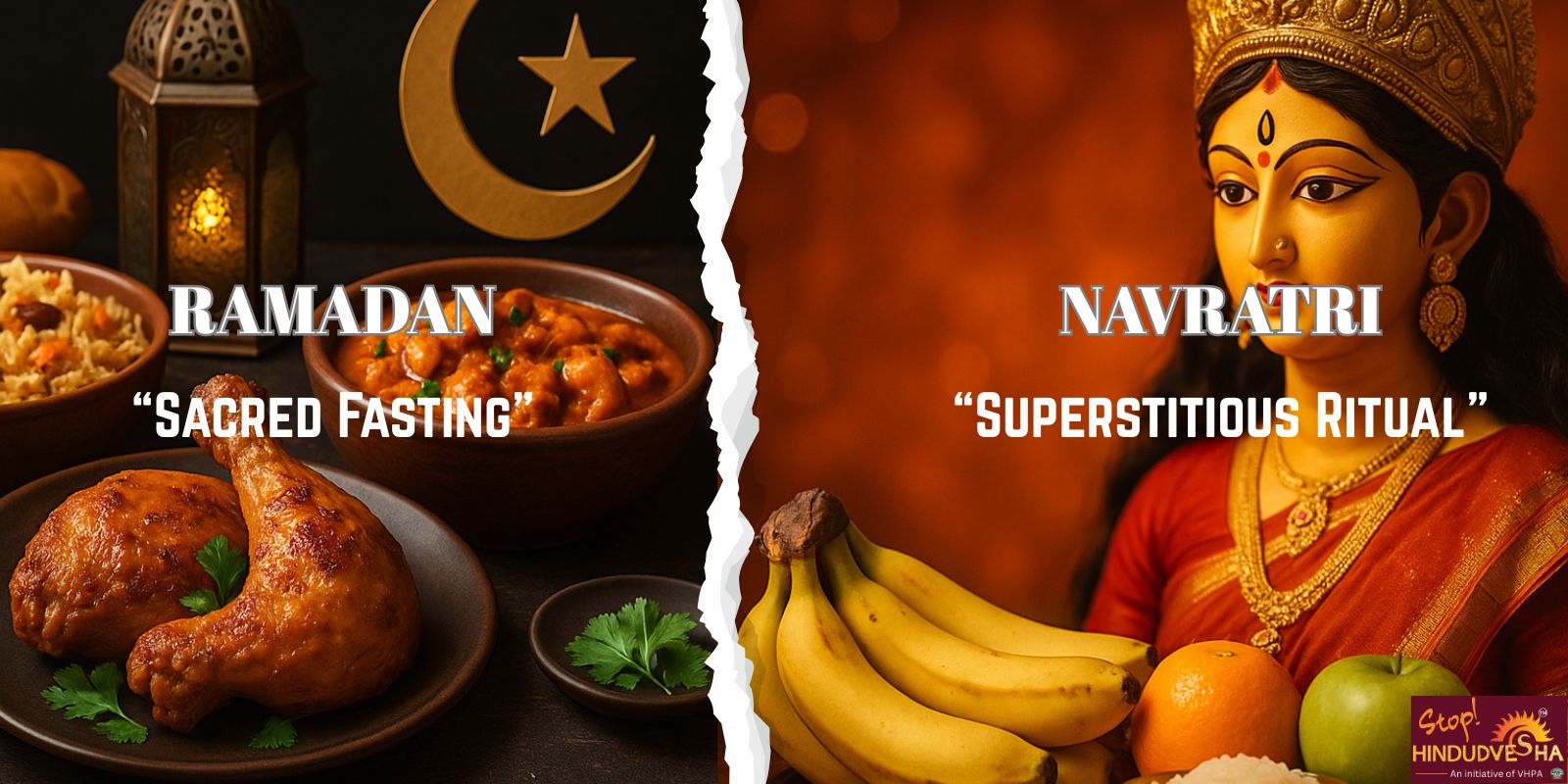
- Targeting vegetarianism—especially during Hindu festivals—has become a convenient strategy to malign the Hindu community.
- Woke-influenced popular culture relentlessly mocks and disrespects Hindu dietary practices, particularly during sacred occasions.
- Kanwar pilgrims (Kanwariyas) are routinely vilified by the left-liberal cabal for their vegetarian food choices, turning a devotional act into an object of hate-driven propaganda.
- The left-liberal ecosystem exhibits glaring double standards—upholding the dietary sensitivities of minority religions while ridiculing those of Hindus.
- The growing attack on Hindu vegetarianism must be understood as part of a broader woke narrative that amplifies global Hinduphobia.
When Sudha Murty, Chairperson of the Infosys Foundation, casually mentioned in a July 2023 media interview that she prefers to carry her own food and cooking supplies when traveling abroad, she likely didn’t anticipate the storm that would follow. Overnight, her simple preference—rooted in her vegetarian lifestyle—sparked outrage among self-proclaimed progressive circles. Woke activists accused her of being a “passive-aggressive casteist,” of promoting “Brahmanical hegemony,” and of showing disrespect toward others’ food cultures. [1] [2]
Apart from the fact that she identifies as a “pure vegetarian,” what truly irked Sudha Murty’s critics was her unapologetic Hindu identity. For the left-liberal cabal, being a “pure vegetarian” is problematic enough, but when a Hindu pure vegetarian openly expresses her dietary choices, it becomes, in their eyes, an unforgivable offense. The outrage directed at Murty was therefore not just about her food preferences; it was equally a targeted attack on her Hindu identity.
Attacks on vegetarianism often serve as a smokescreen for targeting Hindus and advancing Hinduphobic narratives. When vegetarianism is rebranded as “veganism” under the influence of woke ideology, it is suddenly celebrated as a virtuous choice, praised for promoting health, sustainability, and ethical living. But when vegetarianism is rooted in the religious beliefs, spiritual values, cultural traditions, and way of life of the Hindu community, it is mocked, vilified, and subjected to relentless criticism.
As India has undergone a profound civilizational and cultural resurgence over the past decade, Hindus are getting more assertive about their cultural beliefs and practices. This has led to an even greater degree of backlash from the left-liberal cabal, which has doubled up its vicious attack on Hindu Dharma and culture.
This article explores how a dual process is unfolding in the context of “Hindu vegetarians” – food has been turned into an ideological tool for perpetuating Hinduphobia and attacking “Hindutva”. At the same time, “resisting Hindutva” becomes a pretext for viciously dehumanizing and demonizing Hindu cultural practices and traditions.
Demonizing Devotion: The War on Hindu Vegetarian Traditions
For the left-liberal ecosystem, Hindu Dharma has become a convenient smokescreen for advancing ideological agendas. Their typical modus operandi—marked by the liberal use of terms like “Hindutva fascism” and “Brahmanical patriarchy”—serves to discredit genuine Hindu concerns and cultural expressions. As previously explored on this forum[3], there is a recurring pattern of overtly demonizing Hindu practices and traditions under the guise of progressive critique. In this process, ordinary Hindus have been reduced to easy scapegoats, bearing the brunt of a broader ideological war.
Furthermore, attacking vegetarianism becomes an easy way to target the Hindu community, especially during festivals. Thus, any government directive aimed at respecting the religious sentiments of Hindus during their festivals is portrayed as a conspiracy against the minority community.
In April 2022, the South Delhi Municipal Corporation (SDMC) announced the temporary closure of all meat shops located near temples during the Navratri celebrations. Such short-term restrictions are common across various parts of North India during this festival, aimed at respecting the religious sentiments of the Hindu community, as many devotees observe a strict vegetarian diet during the nine days. However, the left-liberal ecosystem in India often portrays these administrative decisions as conspiratorial moves against the rights of minority communities, leaving no stone unturned in fueling controversy.[4]
In response to the ban, Siddharth Varadarajan, founder of The Wire, directed sharp criticism at the food choices of devotees in a piece he wrote for a national daily: “Why should meat shops be shut during Navaratri in Ghaziabad or any other place? Those fasting or those who are vegetarian are free to do their own thing, but why are their food habits being foisted on all Indians and hurting the business of meat vendors“? [5]
Shekhar Gupta, the founder of The Print, wrote on X that it is impossible to find a city or a region in India where 99% of people are vegetarian. “Even if they were, it’s a free country & no majority can force its choices on people. And if indeed they could, vegetarians beware. A very wide majority of us Indians are meat-eaters,” he had tweeted.
Pseudo-journalist Aditya Menon took to X to mock the dietary practices of the Hindu community, posting, “I can’t buy meat because you don’t eat onion and garlic? Strange religion”.[6]
There are numerous similar instances where local administrative decisions—such as the temporary closure of meat shops during Hindu festivals like Navratri and Kanwar Yatra—are portrayed by sections of the media and the so-called “intellectual community” as oppressive, anti-minority, and indicative of “Hindutva supremacy.” Even the Western media is quick to join the chorus. An April 2022 BBC headline reads, “Meat ban: India isn’t vegetarian but who’ll tell the right-wing?”[7]insinuating that the Delhi government’s temporary closure of meat shops during Navratri was part of a right-wing conspiracy. In another article from 2017, titled “India meat crackdown leaves butchers concerned,” the BBC appears to mock the religious sentiments of Hindus, questioning the beef ban implemented by the Uttar Pradesh government. The BBC gives little regard to Hindu religious sensitivities, while displaying an outsized concern for the grievances of butchers.[8]
Then, there is the wokeism-influenced popular culture machinery, which leaves no stone unturned in mocking and disrespecting the food preferences of the Hindu community during their festivals. It is not unusual to come across lifestyle websites doling out casual suggestions of “non-veg” options during Diwali.[9] Moreover, trolling and mockery of Hindu vegetarians during festivals like Navratri has become so commonplace that it isn’t even questioned any longer. [10]
Overall, attacks on vegetarian food practices during Hindu festivals have become a political tool to target what is often labelled as “Hindutva supremacy” or “Hindu majoritarianism.” It creates a vicious cycle—the demonization of vegetarianism becomes a pretext to attack “Hindutva.” In turn, “Hindutva” becomes a convenient excuse to vilify the cultural practices, traditions, and lifestyle of the broader Hindu community.
Media’s War on Kanwariya Traditions
The Kanwar Yatra is held annually in the month of Shravan (mid-July to mid-August) according to the Hindu calendar. During this time, devotees of Bhagwan Shiva carry the “Kanwar” on their shoulders, walking barefoot to collect Gangajal (water from the Ganga River) from Haridwar, Gaumukh, or Gangotri. The Gangajal collected is then poured on the Shiv Lingam.[11]
Since Kanwar pilgrims, known as Kanwariyas, often walk for several days, they regularly stop for food and rest along the way. As they observe a strictly vegetarian diet during the Yatra, many prefer to ensure that the restaurants they visit do not prepare non-vegetarian food alongside, out of respect for their religious discipline and dietary practices.
Over the past few years, various state governments have implemented certain administrative measures, including a temporary ban on meat sales along Kanwar routes and the mandatory disclosure of ownership details of food shops and restaurants in these areas. These steps are intended to respect the religious sentiments and dietary preferences of the Kanwar pilgrims. However, the left-liberal ecosystem has reacted with predictable outrage, twisting these practical decisions into narratives of discrimination. In the process, even the simple food choices of the pilgrims are being vilified as though they were criminals merely for adhering to their beliefs.
In July 2024, the Supreme Court put a stay on a directive issued by certain state governments, which required eateries along the Kanwar Yatra route to publicly display the names, addresses, and mobile numbers of shop owners and their staff. This stay was prompted by petitions driven by woke activism. However, the apex court also observed that food establishments may still be required to display information about the type of food they serve, recognizing the right of pilgrims to make informed dietary choices during the Yatra.[12]
In 2025, the state governments of Uttar Pradesh and Uttarakhand issued a directive requiring restaurants and hotels along the Kanwar Yatra route to display and scan QR codes, allowing pilgrims to access the license and registration details of these establishments. The order was soon challenged in the Supreme Court through a petition. However, the apex court declined to stay the directive, stating that customers have a right to know whether an eatery serves only vegetarian food or both vegetarian and non-vegetarian options. The court further emphasized that consumer choice is paramount, and patrons are entitled to know if non-vegetarian food has previously been prepared in the establishment.[13] [14]
What stands out here is the implicit agenda of a particular section of the media, which goes into overdrive during the Kanwar Yatra to vilify ordinary Hindu pilgrims. These devotees are often accused of promoting “Hindutva supremacy,” advancing “Hindu majoritarianism,” and infringing upon the rights of minority communities—simply for wanting to exercise their choice of eating vegetarian food in accordance with their religious beliefs and sensitivities.
It has become a common practice among certain media outlets to portray Kanwariyas as hooligans by using isolated incidents to demonize Hindu Dharma and its followers. In July 2025, Uttar Pradesh’s Chief Minister issued a warning to Kanwariyas, stating that those engaging in unruly behavior during the Yatra are “miscreants” who infiltrate pilgrim groups and tarnish their reputation.[15]
The spread of fake news aimed at maligning Kanwar pilgrims and fostering prejudice against Hindu cultural practices is not uncommon. A July 2017 report by OpIndia exposed a series of misleading news stories related to that year’s Kanwar Yatra. According to the report, several media outlets claimed that non-vegetarian food had been entirely banned in a North Indian town for the duration of the Yatra. The story sparked outrage among netizens, many of whom viewed such a ban as excessive and unreasonable. However, the Uttar Pradesh Police soon issued a clarification via their official X account, explaining that no blanket ban had been imposed. Instead, it was a long-standing tradition during the Kanwar Yatra to request that roadside stalls serving non-vegetarian food—especially those near temples or along the main pilgrimage route—temporarily relocate a short distance away out of respect for the pilgrims’ religious sentiments.[16]
Faith Filter: Ramadan Is Sacred, Navratri Is Superstition
Western media often bends over backwards to showcase its apparent sensitivity toward the religious dietary practices of the Muslim community, such as the prohibition on consuming pork in Islam.[17] Yet, when similar deference is shown to Hindu sentiments through directives like the cow slaughter ban in India, the very same media outlets are quick to cry “right-wing politicization.”[18]
When it comes to fasting during Ramadan, the Western media offers a culturally sensitive and nuanced portrayal. In contrast, fasting during the nine auspicious days of Navratri is frequently depicted in a casual or dismissive tone, sometimes even as a form of irrational self-denial or outdated tradition.[19]
The hypocrisy is equally evident in the contrasting attitudes toward Halal certification versus Satvic certification. The woke ecosystem openly praises and legitimizes the Halal certification framework, even as it increasingly functions as a tool of economic control and a subtle mechanism for advancing Islamic supremacy. Yet, when the idea of “Satvic certification” is brought up—grounded in Hindu dietary principles and spiritual values—it is instantly met with derision. Predictably, the same cabal responds with stock accusations such as “Hindutva supremacy” and “Brahmanical patriarchy,” revealing a clear ideological double standard. [20] [21]
Caste-washing Vegetarianism: The Woke Playbook to Vilify Hindus
The toxic concoction of wokeism and Hinduphobia continues to fuel a global narrative to demonize vegetarianism, especially when it’s connected with Hindu religious beliefs, traditions, lifestyle choices, and cultural practices.
A simple Google search for the term “Vegetarianism and caste” yields a flood of articles suggesting that vegetarianism is less about food, health, or the environment, and more about “caste.” This brand of vegetarianism-bashing has evolved into a full-fledged industry, with the left-liberal media and segments of the humanities and social sciences academia playing a prominent role in spreading these distorted narratives, irrationally and relentlessly tying vegetarianism to “caste oppression.”
The increased targeting of “Hindu vegetarians” is a direct offshoot of wokeism, where academic concepts like Critical Race Theory are being forcefully mapped onto the concept of “caste” in the Indian context, to illogically conclude that the so-called Hindu caste system is at the core of all structural inequalities afflicting the world. This “woke framing of vegetarianism through a caste lens”[22] ultimately targets the Hindu community. A significant tactic of the woke lobby involves the distortion of the term “pure vegetarian” to forcefully link it to the discourse of casteism.
Terms like “Militant Vegetarianism” are now being coined to dehumanize Hindu vegetarians further. A quick Google search of the phrase reveals numerous articles accusing vegetarians in India of promoting exclusionary practices. “Enough of militant vegetarianism,” declares the headline of a November 2022 article in the Free Press Journal. The piece accuses Hindu vegetarians of so-called “food fanaticism,” selectively highlighting isolated incidents to portray vegetarianism—and by extension, Hindu Dharma—in a negative light. It goes so far as to lament that vegetarians are spreading “false beliefs” about non-vegetarian food being tamsik, and presents it as a problem that some Hindus also avoid onion, garlic, and root vegetables as part of their spiritual discipline.[23]
An article titled “Diet and diktat” published by The Frontline[24] In November 2015, it laments what it calls the “extremist and ill-informed political positions of the Sangh Parivar about cow slaughter and extreme vegetarianism”. The virulently Hinduphobic piece finds it problematic that the Indian Prime Minister should be portrayed as someone eating “sattvik (vegetarian) lunch during Navaratri”. “He is shown as a proud Hindu leader who painstakingly observes a fast on religious occasions when he survives on fruits and a modest vegetarian meal”, declares the article in a tone implying the exposure of a great travesty.
Thus, the increased targeting of the practice of vegetarianism during Hindu festivals must be looked at within the larger context of wokeism amplifying Hinduphobic narratives globally.
Wrapping Up
The ongoing cultural and civilizational resurgence of the Hindu community has unsettled the left-liberal ecosystem. Thus, the attacks on Hindu cultural practices, traditions, and lifestyle choices, including vegetarianism, have intensified.
To effectively counter the wave of disinformation and propaganda surrounding vegetarianism, the Hindu community must proactively create its own narratives around vegetarianism based on the amalgamation of the spiritual and the scientific. These narratives must be effectively disseminated through various platforms. Furthermore, a massive socio-cultural movement utilizing the digital medium is the need of the hour, wherein netizens from within the community effectively counter anti-vegetarianism narratives through social media.
Citations
[1] Sudha Murty’s extreme vegetarianism has ruffled some feathers on the internet: Read – Times of India; https://timesofindia.indiatimes.com/life-style/food-news/sudha-murtys-extreme-vegetarianism-has-ruffled-some-feathers-on-the-internet-read/articleshow/102164553.cms
[2] Sudha Murty gets trolled for carrying food during foreign visits; Here’s why | Today News; https://www.livemint.com/news/india/sudha-murty-gets-trolled-for-carrying-food-during-foreign-visits-heres-why-11690344795765.html
[3] Vilification of Hindu Dharma Through Misguided Gender Narratives – Hindu Dvesha; https://stophindudvesha.org/vilification-of-hindu-dharma-through-misguided-gender-narratives/
[4] Navratri meat ban: How it has been used as a political tool to hurt religious sentiments of Hindus during festivals; https://www.opindia.com/2022/04/meat-consumption-ban-navratri-politication/
[5] Ibid.
[6] Ibid.
[7] Meat ban: India isn’t vegetarian, but who’ll tell the right-wing?”; https://www.bbc.com/news/world-asia-india-61020025
[8] India meat crackdown leaves butchers concerned – BBC News; https://www.bbc.com/news/world-asia-india-39364448
[9] Diwali 2024: Easy Chicken Recipes For Your Diwali Party; https://www.slurrp.com/article/diwali-2022-easy-chicken-recipes-for-your-diwali-party-1666174791015
[10] Demonizing Vegetarianism – A Direct Attack on Hindu Identity – Hindu Dvesha; https://stophindudvesha.org/demonizing-vegetarianism-a-direct-attack-on-hindu-identity/
[11] Events & Festivals in India | A Ministry of Tourism Initiative; https://utsav.gov.in/view-event/kanwar-yatra
[12] ‘No need to display owners’ names, show menu’, SC stays UP, Uttarakhand order to eateries on Kanwar Yatra route; https://www.newindianexpress.com/nation/2024/Jul/22/no-need-to-display-owners-names-show-menu-sc-stays-up-uttarakhand-order-to-eateries-on-kanwar-yatra-route
[13] Supreme Court upholds UP, Uttarakhand QR code mandate in restaurants, stating consumers must know if non-veg was served before; https://www.opindia.com/2025/07/customer-is-king-supreme-court-refuses-to-stay-up-and-uttarakhand-govts-orders-to-display-qr-codes-in-restaurants-during-kanwar-yatra/
[14] Kanwar Yatra: SC directs eateries to display only license & registration info; refuses to interfere in QR code row | India News – Times of India; https://timesofindia.indiatimes.com/india/kanwar-yatra-sc-directs-eateries-to-display-only-license-registration-info-refuses-to-interfere-in-qr-code-row/articleshow/122830238.cms
[15] Kanwar Yatra Row: Adityanath Blames Miscreants for Defaming Devotees; https://www.deccanherald.com/india/uttar-pradesh/days-after-kanwariyas-assault-crpf-jawan-adityanath-says-people-trying-to-defame-kanwar-yatris-3639071
[16] Media spreads Fake News about eggs and non-veg being banned in Greater Noida for Kanwar Yatra; https://www.opindia.com/2017/07/media-spreads-fake-news-about-eggs-and-non-veg-being-banned-in-greater-noida-for-kanwar-yatra/
[17] Anger over pork sausages at Germany Islam event; https://www.bbc.com/news/world-europe-46406120
[18] Meat ban: India isn’t vegetarian, but who’ll tell the right-wing?; https://www.bbc.com/news/world-asia-india-61020025
[19] Festivals and political opportunism of media: ‘The Guardian’ and its anti-Hindu agenda; https://www.opindia.com/2019/06/festivals-and-political-opportunism-of-media-the-guardian-and-its-anti-hindu-agenda/#google_vignette
[20] Is Malhar certification the answer to Halal?; https://theprint.in/opinion/is-malhar-the-answer-to-halal-food-standards-shouldnt-be-a-hindu-muslim-issue/2547709/
[21] Satvik vs Halal: Exclusion Served with a Side of Communal Politics – The Wire; https://thewire.in/religion/satvik-vs-halal-exclusion-served-with-a-side-of-communal-politics
[22] Demonizing Vegetarianism – A Direct Attack on Hindu Identity – Hindu Dvesha; https://stophindudvesha.org/demonizing-vegetarianism-a-direct-attack-on-hindu-identity/
[23] Enough of militant vegetarianism!; https://www.freepressjournal.in/analysis/enough-of-militant-vegetarianism
[24] Diet and diktat – Frontline; https://frontline.thehindu.com/the-nation/diet-and-diktat/article7866053.ece

Donate to HINDUDVESHA
Our Mission is to explore and expose Hindudvesha through research analysis, education and response.
SUPPORT US