
Demonizing Vegetarianism – A Direct Attack on Hindu Identity
 Rati Agnihotri · 10/22/2024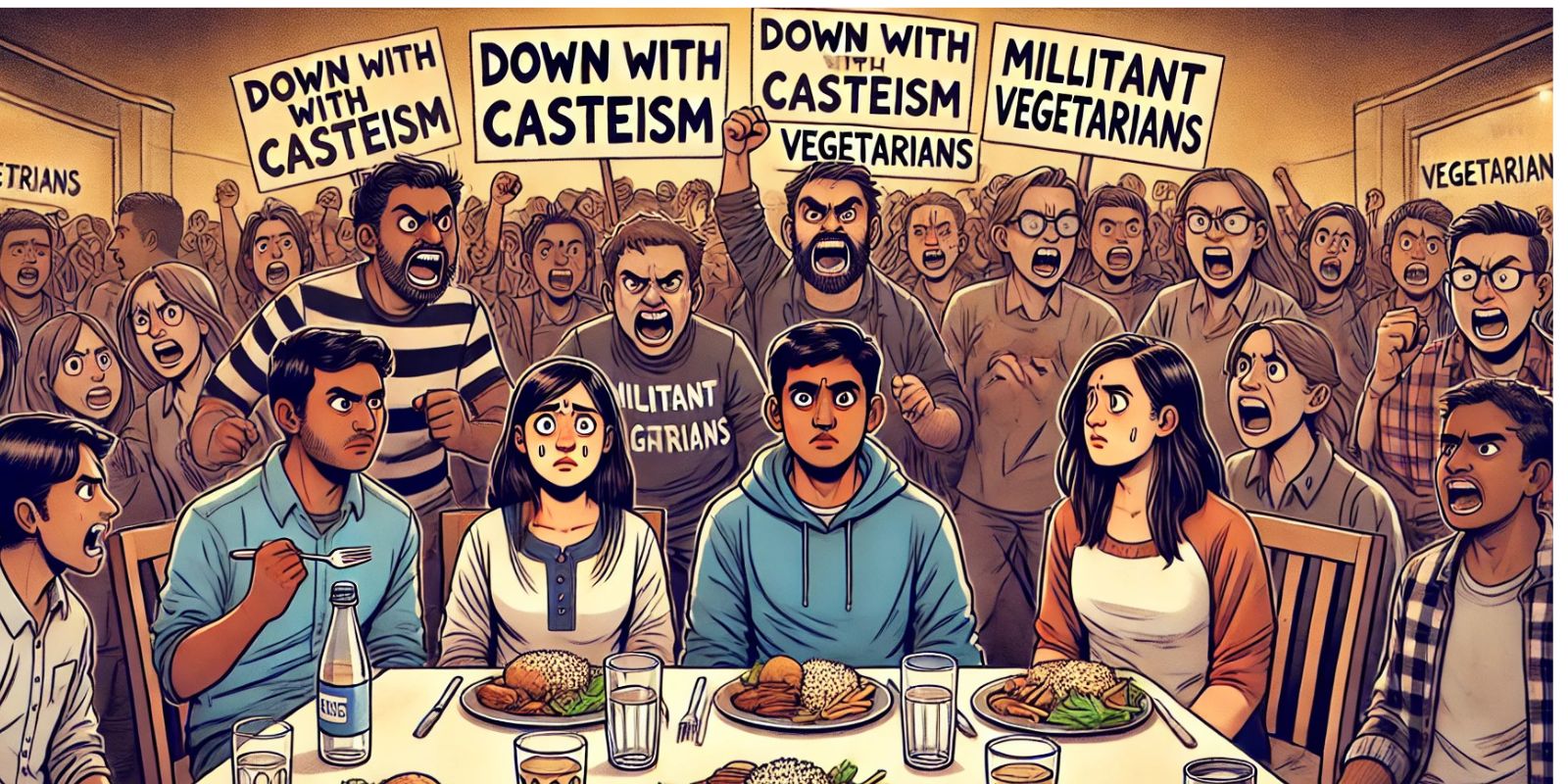
- Vegetarianism is being framed through a caste lens to shame and demonize vegetarians.
- Western Critical Race Theory is being adapted into a Critical Caste Theory and imposed on the practice of vegetarianism
- Trolling and harassment of vegetarians are rising, especially during Hindu festivals like Navratri.
- Vegetarians are being denied freedom of food choice and are silenced from speaking positively about vegetarianism.
- Anti-vegetarian discourse ultimately targets Hindu practices and beliefs.
- Vegetarian communities are being marginalized, with growing opposition to services catering exclusively to them.
The recent controversy regarding the alleged use of animal fat in the ghee used for preparing Prasadam at the Tirumala temple in Tirupati hardly received any coverage in Western media[1], with only the BBC making a brief mention of it. This lack of attention is partly due to the broader Hinduphobic framing that informs the Western media coverage of issues concerning India and Hindus. However, there’s also a deeper reason behind this neglect. For Hindus, the presence of “animal fat” in food offerings made to the deity, which devotees later consume, is a grave violation, comparable to “blasphemy” (for lack of a better word). Yet, this sentiment carries little weight within the Abrahamic worldview that influences much of Western—and now even non-Western—media. The idea of “pure vegetarianism” or even vegetarianism as a principle is not fully grasped or valued, making the concerns of Hindus around this issue seem trivial or irrelevant in Western eyes.
This is why the adulteration of Tirupati Prasadam Laddus with animal fat hasn’t sparked the outrage it should have. To the Westernized gaze, which many Hindus have unfortunately internalized, it’s seen as “the natives getting worked up over nothing.” Indian author Chetan Bhagat even took to social media to lecture Hindus, arguing that they should focus on issues like potholes, air pollution, and educational scams rather than Prasadam purity. [2] People like Bhagat, who embody the “brown sepoy” mindset, have absorbed the Western perspective to such an extent that they go out of their way to belittle Hindu concerns, often exceeding even the most blatant racists in their eagerness to stay in the spotlight.
The broader takeaway from this controversy is that vegetarianism, deeply connected to Hindu values, has become a target of the global woke ecosystem. During Navratri—a nine-day Hindu festival dedicated to celebrating nine forms of Goddess Durga, during which many Hindus observe fasting—a mockery of vegetarians has become so normalized that it hardly raises an eyebrow. Imagine if such jokes were directed at those fasting for other religious rituals; they would never be deemed acceptable. But when it’s about Hindu traditions, anything goes. As a result, vegetarians, seen as representatives of Hinduism, are increasingly shamed and demonized simply for choosing to be vegetarian.
If you search the term “militant vegetarianism,” you’ll be surprised by the sheer number of articles that appear, many of which harshly criticize vegetarianism and label vegetarians as extremists. In fact, as soon as you enter “militant vegetarianism” into Google, the AI promptly provides an overview, reinforcing this negative narrative: “Militant vegetarianism is a social ideology that seeks to maintain traditional hierarchies and segregation in food consumption and can lead to violence.”
The Google AI overview doesn’t stop there. It also lists various examples of “militant vegetarianism,” including the creation of vegetarian localities, beef ban, appropriation of animal compassion (whatever that means), citing environmental concerns as a reason for being vegetarian, denying office space to someone based on their vegetarian status, etc. [3]
The Google AI overview defining “militant vegetarianism” comes across as almost militant in itself, stripping vegetarian communities of their basic rights and publicly shaming and intimidating them. Would Google dare to create a similar AI overview for terms like “militant halal practices” or “militant non-vegetarianism”? Highly unlikely.
So, what is it about vegetarians and vegetarianism that provokes such a reaction from the woke, leftist ecosystem? Why are vegetarians increasingly demonized, and why is the existence of communities advocating non-violence and the non-killing of animals portrayed as a threat?
The question is, what drives this hostility, and what justifies such blatant animosity toward vegetarians? Let’s delve into this issue to uncover the underlying reasons.
Framing of vegetarianism from a caste lens
In their impactful book Snakes in the Ganga: Breaking India 2.0, Rajiv Malhotra and Vijaya Viswanathan highlight how Western academia uses Critical Race Theory as a template to construct a similar Critical Caste Theory for India. They expose a disturbing trend where the Indian caste system is being framed as the root cause of all global inequality and discrimination, including racism. The result is the portrayal of so-called upper-caste Hindus as the “ultimate oppressors,” completely ignoring the reality that Hindus—across all castes—have historically been subjugated by Islamic and European colonizers. [4]
This strategy weaponizes caste to vilify Hindus and Hindu Dharma on a global scale. In the process, vegetarianism has also been dragged into the crossfire. The radical communist ecosystem in India has picked up this toxic narrative, pushing it further by turning Hindu food choices into a subject of intense scrutiny and criticism. Vegetarians are being publicly shamed for their dietary preferences, and institutions that implement vegetarian-friendly policies are being threatened and pressured by far-left organizations. As a result, the targeting of vegetarians has become yet another tool to undermine Hindu practices and identity.
In July 2023, IIT Bombay became the focal point of a controversy following media reports that the institution had earmarked separate eating space for vegetarians and that non-vegetarians were not allowed to dine there. The Ambedkar Periyar Phule Study Circle (APPC), a student body on the IIT campus, reportedly raised the issue on social media. The APPC alleged that even though IIT Bombay didn’t officially have any policy for designating separate areas for vegetarians, some individuals were making these changes on their whims, and thus, non-vegetarian students felt intimidated, humiliated, and discriminated against. [5]
This escalated into a huge controversy with many media reports slamming IIT Bombay for exhibiting “casteist tendencies”. In September 2023, the organization officially designated separate tables for vegetarians in its hostel canteen.[6] However, the controversy continued as motivated groups kept accusing IIT Bombay of being an upper-caste bastion.
A similar controversy erupted at IIT Hyderabad in October 2023 when the institute created a separate section for vegetarians in one of its dining areas following a student survey that asked if they preferred a “vegetarian-only” space. What was merely an administrative decision to accommodate students’ dietary preferences was sensationalized by the media, with reports accusing the institute of promoting caste privilege.[7]
In July 2023, Sudha Murthy—an educator, author, philanthropist, and Rajya Sabha member—was embroiled in controversy after casually mentioning in an interview that she preferred to carry her own food and cooking items when traveling abroad. Her reason? She was concerned about the possibility of the same utensils being used for both vegetarian and non-vegetarian dishes. This simple, personal preference was sensationalized by woke media outlets and social media users, who labeled her a “passive-aggressive casteist.” [8] Sudha Murthy’s so-called “crime” seemed to be that she identified as a “pure vegetarian” and openly expressed her concern about the possibility of vegetarian food in foreign restaurants being contaminated by utensils or cookware used for non-vegetarian dishes.
The outrage against Sudha Murthy’s harmless preference reveals a troubling trend. It’s not just about exaggerating or misinterpreting her words; it reflects a climate of hyper-vigilance against vegetarians, where even the basic right to choose one’s food is being questioned and attacked. This hostility is not just ridiculous; it’s dangerous, as it stigmatizes vegetarians and their personal choices, framing them as symbols of oppression rather than respecting their dietary boundaries.
The kind of demonization and public shaming vegetarians are being subjected to reminds one of the famous “Spiral of Silence” theory of public opinion. The theory, in a nutshell, means that an individual’s perception of the general wave of public opinion drastically impacts their willingness to express their views. If the individual notices that their opinion is unpopular overall, they will become conscious and would much rather stay silent. The woke ecosystem is hell-bent on making the mere idea of public expression of one’s identity as a vegetarian such an unpopular and unwanted one that vegetarians, too, will eventually shrink into their personal space, scared of offending anyone by exercising their freedom of choice.
It’s not just a matter of silencing a vegetarian’s right to freedom of expression. The very choice of being a vegetarian is being vehemently attacked from all quarters, making that scenario not very far-fetched when vegetarians will be forced to give up their food practices and eat meat.
In October 2023, Suryakant Waghmore, Sociology Professor at IIT Bombay, drew a comparison between vegetarians and militants (terrorists) in the context of the debate surrounding the allocation of separate dining spaces for vegetarians at the institute. Waghmore reportedly wrote an op-ed for The Indian Express in which he attributed “militant vegetarianism” to the Hindu community, particularly the “upper caste’, who he claimed used vegetarianism as a form of caste privilege to uphold traditional values of hierarchy and segregation in food practices. [9]
Thus, the woke framing of vegetarianism through a caste lens targets the Hindu community, many of whom are “pure vegetarians.” The term “pure vegetarian,” in this context, simply means the practice of eating only vegetarian food that hasn’t been brought into contact with non-vegetarian food items. But the woke lobby distorts the term by forcefully mapping caste discourse onto vegetarianism.
Freedom of Choice for all except Vegetarians!
We live in a time when freedom of choice is regarded as sacrosanct (as it should be). But as with most things, this freedom of choice comes with a caveat. There is acute hypocrisy in the exercise for these matters as such categories are selectively interpreted to over-include certain interest groups and exclude others.
It’s bizarre that the same lobby that takes the concept of freedom of choice to extreme levels while defending one’s freedom to eat whatever they want (halal meat), or dress however they want (Hijab), doesn’t treat vegetarianism as a matter of choice. When it comes to vegetarianism, the whole logic is turned upside down, and being a vegetarian becomes an infringement on the other’s right to eat non-vegetarian food.
Let’s be clear: most vegetarians who face trolling and attacks on social media aren’t making any negative statements about non-vegetarian food or those who consume it. They may simply be celebrating vegetarianism (which is not a crime by any standard), sharing its health benefits, or explaining their reasons for choosing it. Yet, if we go by the Google AI overview of “militant vegetarianism” mentioned earlier, even a vegetarian speaking positively about their dietary choices is portrayed as discriminatory and oppressive.
This is why aggressive attacks on exclusive services for vegetarians are becoming increasingly common. A prime example is the backlash against the food delivery app Zomato’s all-vegetarian service launched in March 2024. The service catered specifically to pure vegetarian customers, offering a selection of restaurants that exclusively serve vegetarian food, ensuring zero risk of non-vegetarian contamination through shared pots, pans, or utensils. Zomato even introduced green uniforms for its vegetarian fleet to distinguish this service, replacing the usual red uniforms worn by its delivery personnel. Yet, what was simply an attempt to respect dietary preferences became a target of intense criticism, accused of promoting division and discrimination.[10]
What began as a straightforward business decision by Zomato, based on customer feedback, quickly spiraled into a major controversy on social media. Woke netizens accused the company of promoting casteist, derogatory, and divisive attitudes simply because it established a separate delivery fleet for vegetarians. Left-leaning media outlets also jumped on the bandwagon, using the controversy to fuel their usual Hinduphobic, anti-vegetarian narratives.
Ultimately, Zomato withdrew the “green uniform” feature for its vegetarian fleet. The international media eagerly seized the opportunity, spinning the rollback as a supposed victory against what they framed as the “oppressive and militant” nature of vegetarianism. The BBC ran a story titled “Zomato: India food delivery app rolls back green uniform plan,” reinforcing stereotypes of militant vegetarianism. The article stated, “In India, eating meat is closely tied to the country’s rigid caste practices. People who describe themselves as ‘pure vegetarian’ often have separate vessels to cook and consume the food to ensure it does not interact with any form of meat,” furthering misconceptions and pushing the narrative that vegetarianism is inherently linked to caste-based discrimination. [11]
While vegetarians are denied the basic freedom to discuss their food choices openly, woke non-vegetarians freely troll and demonize the practice on social media. A clear example occurred in June 2024, when Bollywood actress Swara Bhaskar took it upon herself to play the woke police, targeting a food blogger for her “proud to be vegetarian” post on X. Despite not being tagged in the post, Bhaskar felt compelled to shame the blogger simply for celebrating her vegetarian lifestyle, turning a harmless expression of pride into an opportunity for public ridicule.
“I am proud to be a vegetarian. My plate is free from tears, cruelty, and guilt”, the blogger had written. In response, Bhaskar wrote, “Honestly…I don’t understand this smug self-righteousness of vegetarians. Your entire diet is made up of denying the calf its mother’s milk… forcibly impregnating cows, then separating them from their babies & stealing their milk. You eat root vegetables? That kills the whole plant! Please relax with the virtue signaling just because it’s Bakr Eid”.
Social media is flooded with vile hatred and stereotypes targeting vegetarians. Misconceptions like vegetarian diets being protein-deficient are widespread, and vegetarian food is frequently mocked. Staples like dal, rice, chapatti, vegetables, and curd are unfairly linked to poverty, as if not eating meat is a sign of financial inability. Anti-vegetarian stereotypes are rampant online. While this isn’t the place to delve into every example, the key point is that vegetarians are often denied the right to counter the misinformation and propaganda attacking their food choices. If they speak up, they are instantly branded as “militant vegetarians,” stifling any attempt to defend themselves. [12]
Hindu Dharma – the ultimate target of the vegetarianism-bashing lobby
It shouldn’t come as a surprise that Hindu Dharma is the ultimate target of the vegetarianism-bashing lobby. The deliberate framing of vegetarianism from the position of caste-privilege reeks of anti-Hindu propaganda. This evades the complex reality that being a vegetarian in the 21st century has little to do with Hindu Dharma. It’s increasingly becoming a lifestyle choice. Many Hindus are non-vegetarians, while many non-Hindus practice vegetarianism. But the woke lobby seeks to target Hindus in the garb of keeping a check on so-called “militant vegetarianism”. The woke ecosystem is systematically attacking the Hindu way of life – festivals, culture, traditions, etc. and the attack on food habits is a part of that pattern.
Hindu Dharma emphasizes the principles of Ahimsa or non-violence. As Dr. David Frawley, renowned Vedic scholar and author, emphasizes in a write-up that non-violence and a vegetarian diet have been an integral part of India’s spiritual traditions for a long time, be it Vedic, Buddhist, or Jain. He further emphasizes that even though Hindu Dharma encourages vegetarianism “as an important aid for yogic and spiritual practices” and Hindu ashrams and temples routinely serve only vegetarian food, Hinduism embraces people of all levels and doesn’t impose vegetarianism on anyone. Frawley further points out how leftist scholars have deliberately over-emphasized the meat-eating side of Hindu practices without a nuanced understanding of the context of those practices, probably intending to hurt Hindu sentiments for political gain.
David Frawley further highlights that in Rig Veda, the oldest Vedic text, the main offerings consist of various plant and dairy products like ghee, honey, milk, yogurt, grain, etc. He emphasizes that in contrast to the emphasis on plant and dairy products, references to actual animal sacrifices in the Rig Veda are just a handful, and even those are highly symbolic. [13] More importantly, David Frawley highlights the academic distortion of Hinduism wherein leftist scholars randomly pick up on a few possible instances of meat eating in Vedic texts and then amplify these instances to spread anti-Hindu misinformation and anti-vegetarianism propaganda on a massive scale:
To deal with such distortions, Hindus should know their religion better. They should be aware of the diversity of Hindu groups and practices historically and geographically. What Hindu Dharma overall promotes is a recognition of the sacred. This includes honoring the diversity of life in terms of individuals, cultures, plants, animals, and the entire world of nature. Hindu vegetarianism arose out of that recognition and should be viewed in that context.[14] ( David Frawley )
Well-known author Stephen Knapp, primarily known for his writings on Vedic culture, also writes that vegetarianism has been indeed recommended in Vedic scriptures. He says that an in-depth research of Vedic texts reveals numerous references “ which explain in no uncertain terms the karmic dangers of meat-eating and unnecessary animal slaughter.” Knapp emphasizes that the Vedas suggest that meat eating should be given up for “one’s spiritual and even material progress.” Stephen Knapp’s detailed write-up on this topic offers a valuable resource for those seeking to learn more about the subject. He extensively quotes Vedic scriptures to demonstrate how the Vedas propagated a vegetarian way of life.[15]
These examples clearly show that Hindu scriptures promote a vegetarian way of life, which is precisely why the anti-vegetarian lobby finds it problematic. Vegetarianism is demonized because of its close association with Hindu Dharma and its principles, making it a target for the woke worldview shaped by an Abrahamic ecosystem. The irony is that veganism—an even stricter form of vegetarianism that excludes dairy—is not subject to the same level of criticism. Being a “vegan” is often celebrated as “woke” and “progressive,” while being a vegetarian is branded as “casteist” and “regressive.” This glaring double standard highlights that the systematic demonization of vegetarianism is ultimately aimed at discrediting Hindu Dharma and its associated practices.
Closing thoughts
Many vegetarians might dismiss these concerns, believing they still have the freedom to eat what they want and that media narratives don’t really impact their lives. However, the reality is more complex. The demonization of vegetarianism is no longer confined to negative perceptions and rhetoric—it has moved into active disruption.
As seen in the backlash against Zomato’s all-vegetarian fleet and the uproar over separate eating spaces for vegetarians at IITs, far-left radicals are aggressively targeting the infrastructure supporting vegetarian communities. Exclusive services for vegetarians are under attack, and if this trend continues, it could eventually affect the availability of vegetarian options in restaurants and public spaces. This campaign has moved beyond mere wordplay and is now focused on dismantling the support systems of vegetarian communities, directly impacting their choices and way of life.
In July 2024, a controversy erupted during the Hindu festival of Kanwar Yatra over a directive from the Uttar Pradesh government requiring all shops and eateries to display the names of their owners and employees. The decision was made in response to concerns from Hindu pilgrims about Muslim-owned restaurants using Hindu names while serving non-vegetarian dishes. Given that Kanwar Yatra pilgrims strictly adhere to a pure vegetarian diet, the directive aimed to ensure transparency for the devotees. However, the left-liberal media quickly spun the issue into a major controversy, framing a simple administrative measure meant to respect the dietary sentiments of Hindu pilgrims as an act of “minority oppression,” “upper-caste privilege,” and other sensational labels.[16]
If such an administrative decision had been made for any other religious community, it would likely have been seen as a measure to respect their religious sentiments, and the matter would have ended there—without any controversy. But in the case of the Kanwar Yatra, the directive requiring name displays led to a backlash, culminating in the Supreme Court stepping in to put a stay on the Uttar Pradesh government’s order.[17]
This situation highlights the precarious position of Hindu vegetarians. It’s time for Hindus to recognize that the attack on vegetarianism isn’t just about food choices—it’s a broader attack on Hindu Dharma, its culture, and its traditions. Hindus must wake up to the fact that defending vegetarianism is not just about dietary preferences but about preserving their cultural and spiritual heritage.
Citations
[1] Tirupati: The famed holy sweet in an unsavoury row in India; https://www.bbc.com/news/articles/cglkenxgd5xo
[2] Chetan Bhagat’s points out sugar & animal bones amid Tirupati prasad controversy; https://www.indiatimes.com/trending/social-relevance/chetan-bhagats-points-out-sugar-animal-bones-amid-tirupati-prasad-controversy-642377.html
[3] Google AI overview; https://www.google.com/search?q=militant+vegetarianism&client=safari&sca_esv=5e54f03f1edc9c8a&sxsrf=ADLYWIKkfb7TS8K74GmJuZS8FyprcMG2Gg%3A1728282643463&source=hp&ei=E4ADZ82jGsPb1sQPwtWIsAI&iflsig=AL9hbdgAAAAAZwOOIwbliP5-8Dy667f4d61jq7tl8mt5&oq=militant%C2%A0&gs_lp=Egdnd3Mtd2l6IgptaWxpdGFudMKgKgIIADIEECMYJzIFEAAYgAQyCBAAGIAEGLEDMgoQABiABBgUGIcCMgUQABiABDIFEAAYgAQyBRAAGIAEMgUQABiABDIFEAAYgAQyBRAAGIAESJwWUABY6QtwAHgAkAEBmAGmAqABxwyqAQUwLjcuMrgBAcgBAPgBAZgCCKAC-grCAgoQIxiABBgnGIoFwgIKEC4YgAQYJxiKBcICCxAuGIAEGJECGIoFwgIKEAAYgAQYQxiKBcICERAuGIAEGLEDGNEDGIMBGMcBwgILEAAYgAQYsQMYgwHCAgsQABiABBiRAhiKBcICGRAuGIAEGEMYxwEYmAUYmQUYigUYngUYrwHCAg0QLhiABBixAxhDGIoFwgIOEC4YgAQYkQIY1AIYigXCAg4QLhiABBiRAhixAxiKBcICDRAAGIAEGLEDGEMYigXCAgsQLhiABBjHARivAZgDAJIHBzAuNi4xLjGgB6Rj&sclient=gws-wiz
[4] Snakes in the Ganga: Breaking India 2.0 by Rajiv Malhotra and Vijaya Viswanathan
[5] IIT Bombay Food Discrimination Complaint: ‘Vegetarians in IIT-Bombay blocking space in mess for themselves’ | India News – Times of India; https://timesofindia.indiatimes.com/india/vegetarians-in-iit-bombay-blocking-space-in-mess-for-themselves/articleshow/102258907.cms
[6] Months after row, IIT-B designates six tables for vegetarians in its hostel canteen | Mumbai News – The Indian Express; https://indianexpress.com/article/cities/mumbai/months-after-row-iit-b-designates-six-tables-for-vegetarians-in-its-hostel-canteen-8959244/
[7] After Bombay, ‘ Pure Veg’ section and mess in IIT-Hyderabad; https://www.thenewsminute.com/telangana/after-bombay-pure-veg-section-and-mess-in-iit-hyderabad
[8] Sudha Murty gets trolled for carrying food during foreign visits; Here’s why | Today News; https://www.livemint.com/news/india/sudha-murty-gets-trolled-for-carrying-food-during-foreign-visits-heres-why-11690344795765.html
[9] IIT Bombay: Professor draws parallel between vegetarianism and militancy, attributes food choices to caste influences; https://organiser.org/2023/10/13/201357/bharat/iit-bombay-professor-draws-parallel-between-vegetarianism-and-militancy-attributes-food-choices-to-caste-influences/
[10] Attacking vegetarianism the latest frontier of wokeism?; https://hindupost.in/featured/attacking-vegetarianism-the-latest-frontier-of-wokeism/#
[11] Zomato: India food delivery app rolls back green uniform plan; https://www.bbc.com/news/world-asia-india-68573282
[12] ‘It appears your wisdom…’ Swara Bhasker slammed over her ‘vegetarian’ tweet – India TV; https://www.indiatvnews.com/entertainment/news/it-appears-your-wisdom-swara-bhasker-slammed-over-her-vegetarian-tweet-2024-06-17-937331
[13] Eating of Meat and Beef in the Hindu Tradition-Hindu Perspective; https://hinduperspective.com/2013/06/16/eating-of-meat-and-beef-in-the-hindu-tradition-by-david-frawley/
[14] Ibid.
[15] Vegetarianism Recommended in Vedic Scripture; https://www.stephen-knapp.com/vegetarianism_recommended_in_Vedic_scripture.htm#:~:text=By%20Stephen%20Knapp,shastras%20do%20not%20condemn%20it.
[16] Uttar Pradesh: Kanwar Yatra: Why is there a controversy over UP police’s name display rule? – The Economic Times; https://economictimes.indiatimes.com/news/india/kanwar-yatra-who-has-problems-with-up-polices-name-display-rule-and-why/articleshow/111880655.cms?from=mdr
[17] Kanwar yatra: Supreme Court stays order to name owners | India News – Times of India; https://timesofindia.indiatimes.com/india/kanwar-yatra-supreme-court-stays-order-to-name-owners/articleshow/111937386.cms

Donate to HINDUDVESHA
Our Mission is to explore and expose Hindudvesha through research analysis, education and response.
SUPPORT US