

Brahmin-Bashing: A Western Neurosis Disguised as Social Justice
 Aditi Joshi · 07/18/2025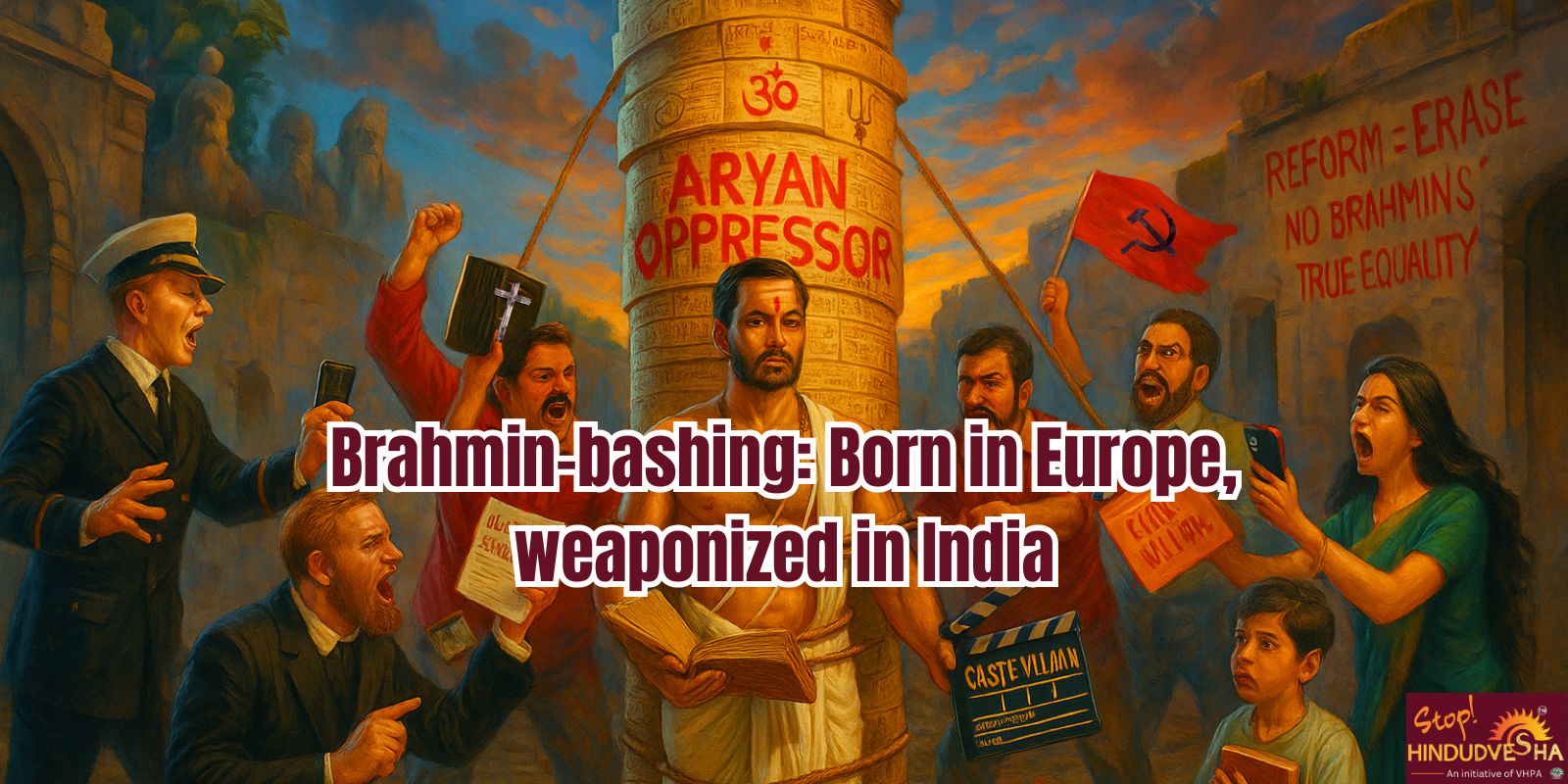
- In today’s public discourse, Brahmin-bashing has evolved from critique into a cultural performance, a fashionable display of virtue signaling that pervades campuses, cinema, political rallies, and digital activism.
- The term “Brahminical” is used to shame and dehumanize, turning complex traditions into flat caricatures of oppression.
- This hostility is not an outgrowth of Indian social evolution. It is a projected pathology, born from European religious trauma.
- European Indologists, steeped in centuries of anti-clericalism, projected their fears of the Catholic Church onto Brahmins, as Eastern versions of corrupt, power-hoarding Catholic priests.
- What we witness today as Brahmin-bashing is the product of ideological engineering, a narrative arc that begins in Reformation Europe, passes through colonial anthropology and missionary polemic, and finds expression in Marxist historiography and modern identity politics.
In today’s hyper-politicized discourse, Brahmin-bashing has transcended critique and entered the realm of cultural fashion, a virtue-signaling performance flaunted in university seminars, viral social media threads, woke film scripts, and even mainstream political rhetoric. The term “Brahminical” is no longer used with any semblance of intellectual rigor or historical context; instead, it is hurled as an ideological bludgeon, intended to shame, silence, and dehumanize. It evokes a carefully manufactured sense of guilt and moral outrage, not against individual actions, but against an entire group whose identity is now painted as inherently oppressive. What was once a reference to philosophical or ritual frameworks is now wielded as a pejorative term, aimed squarely at the spiritual core of the Hindu tradition.
But this hostility toward Brahmins, so normalized today that it often escapes scrutiny, is not the organic result of India’s social evolution, nor is it a natural outcome of caste reform. Rather, it is the accumulated sediment of five centuries of European religious trauma, colonial misrepresentation, racial pseudo-science, Marxist ideological projection, and postmodern identity politics. It is not a social movement rooted in dharmic introspection, but an imported pathology, borrowed from the intellectual crisis of the West and retrofitted onto Indian society.
To understand this orchestrated demonization, one must turn not to any Vedic text or Shastric tradition, but to an unlikely starting point: 16th-century Europe, where the seeds of anti-priestly sentiment were sown in blood and fury. It was here that Martin Luther’s Reformation ignited centuries of anti-clerical hatred, targeting the Catholic priesthood as corrupt gatekeepers of knowledge and power. This profound civilizational trauma, which engulfed Europe in two hundred years of religious wars, birthed an archetype of the evil priest, a figure whose power stemmed from ritual, whose authority was feared, and whose existence came to symbolize institutional oppression.
When European missionaries and Indologists later encountered the Brahmins of India, custodians of sacred texts, preservers of philosophical traditions, and teachers of dharma, they projected this same European neurosis onto the Brahmin. In the colonial imagination, the Brahmin was not a sage, a seeker, or a scholar, but a stand-in for the Catholic priest: arrogant, exploitative, and in need of dismantling. And thus began the long arc of ideological projection, where the Brahmin became a canvas onto which generations of Western, and later Indian, ideologues would paint their own frustrations, guilt complexes, and revolutionary fervor.
This article traces that arc, from the Protestant anti-priest impulse, through British colonial anthropology and missionary propaganda, into the hands of Marxist historians, and finally into the vocabulary of today’s social justice warriors. It shows how Brahmin-phobia is not an accidental byproduct of reform, but a carefully constructed narrative, one that seeks not to uplift, but to divide; not to correct, but to condemn.
Protestant Trauma and the Birth of Anti-Clerical Archetypes
When Martin Luther nailed his 95 Theses to the door of the Wittenberg Castle Church in 1517, he did more than spark a theological debate; he triggered a profound civilizational rupture. [1] His challenge to the Catholic Church’s indulgence trade became the opening salvo in a deeper war, a war against the very idea of religious authority vested in a priestly elite. The Protestant Reformation that followed was not simply about dogma; it was about power, class, and access to truth. Luther and his successors accused the Catholic clergy of hoarding divine knowledge, corrupting Christ’s teachings with ritualism, and exploiting the masses under the guise of salvation.
What emerged was a profound cultural and psychological revolt against the priest. In the Protestant imagination, the priest was no longer a guide to transcendence but a manipulator, an obstacle between the individual and God. Over the next two centuries, this anti-clerical rage calcified into Europe’s intellectual DNA. Bloody religious wars, from the Thirty Years’ War to the English Civil War[2], cemented the image of the priest not as a spiritual authority but as a political actor cloaked in superstition[3]. The Catholic Church was demonized as a decadent institution, its rituals portrayed as empty theatre, and its priesthood as morally bankrupt gatekeepers of control[4].
This deep-seated distrust, born in Europe’s religious crucible, did not remain confined to the continent. When European missionaries, colonial administrators, and later Indologists began engaging with India, particularly after the Portuguese arrival in 1498, they brought with them a baggage of anti-priestly bias. But India presented a cultural puzzle that confounded them. Here was a civilization thriving not on centralized dogma, but on decentralized sacred knowledge; a tradition with no Church, no Pope, no Inquisition, but a priestly class that preserved sacred texts, interpreted complex metaphysics, and anchored civil society through rituals and education.
Instead of recognizing this as a different paradigm of religiosity, these Europeans misread it through the only lens they knew, their own civilizational trauma. The Brahmin became the mirror onto which they projected their unresolved anxieties about the Catholic clergy. In their imagination, the Brahmin wasn’t a seeker of truth but a gatekeeper of arcane rites; not a philosopher who debated cosmology, but a conniving schemer who monopolized power through ritual mystification. The European mind, wounded by centuries of Church dominance, had found in the Brahmin a familiar villain, exotic, brown-skinned, but functionally equivalent to the enemy they had long fought at home.
Thus, the Reformation’s psychological hangover metastasized across continents, reappearing in colonial India not as a reformist impulse but as a subtle form of civilizational aggression. The Brahmin was not studied; he was indicted. And this indictment, masked as objective scholarship, would go on to influence everything from missionary tracts to colonial education policies and later, Marxist historiography.
In this way, the Brahmin did not become a villain because of his actions, but because of his resemblance, in the minds of wounded Europeans, to a figure they were trained to hate. This was not comparative religion; it was projective demonology, dressed up as Enlightenment rationality.
Colonialism and the Construction of the “Brahmin Oppressor”
The British Empire did not merely conquer territory; it sought to reorder the very consciousness of the societies it ruled. Nowhere was this more insidious than in the way it dealt with India’s civilizational structures. Once the initial colonial gaze encountered the Brahmin, not merely as a religious functionary, but as a custodian of Sanskrit, philosophy, jurisprudence, astronomy, and cultural memory, it became clear that the Brahmin posed a unique challenge to the empire’s project. He was not just a priest; he was a scholar, a teacher, a legal advisor, and often, a community leader. This made him an obstacle to both imperial control and missionary conversion.
Thus began a systematic effort by the British to dismantle the intellectual and cultural authority of the Brahmin, not by open confrontation, but by reframing his very identity, through the twin tools of pseudo-science and evangelical rhetoric.
Colonial administrators like Herbert Hope Risley and John Nesfield played pivotal roles in this effort. Armed with the ideological weapons of 19th-century Europe, racial determinism and phrenological anthropology, they launched an ethnographic campaign that would come to define Indian social categories for generations. Risley, in particular, infamously attempted to classify castes based on “nasal index” measurements, insisting that Brahmins were of purer “Aryan stock,” while lower castes were “aboriginal Dravidians.”[5]
This fabricated Aryan-Dravidian divide, now widely debunked by genetic and linguistic scholarship, was not just a misguided academic theory. It was a strategic wedge, a way to fracture Hindu society from within by racializing caste and delegitimizing the Brahmin as an alien oppressor rather than an organic part of the Indic civilizational ecosystem.
Parallel to this, British Christian missionaries launched their own campaign, targeting the Brahmins not with calipers and measurements, but with theological contempt. Unable to match the depth, subtlety, and antiquity of Hindu thought, especially as expressed by Brahmin scholars, missionaries like Alexander Duff and Bishop Robert Caldwell sought instead to delegitimize the Brahmin’s role through moral denunciation. They portrayed Brahmins as ritualistic tyrants, hoarders of sacred knowledge, and enemies of the “true” faith, invoking tropes strikingly similar to the Protestant vilification of Catholic priests back home.
Duff accused Brahmins of spiritual despotism, while Caldwell weaponized his linguistic theories to construct the Dravidian identity as a victim of “Aryan” Brahminical aggression, an argument eagerly absorbed into later Dravidian politics. This wasn’t disinterested scholarship; it was civilizational warfare dressed up as philology and theology.
Meanwhile, Thomas Babington Macaulay’s infamous 1835 “Minute on Education” completed the assault on Brahminical intellectual authority. By replacing Sanskrit and Persian with English as the medium of education, Macaulay didn’t just alter pedagogy; he displaced an entire knowledge tradition. The gurukul system, largely maintained by Brahmin teachers, was systematically dismantled. In its place emerged a class of English-educated Indians who were, in Macaulay’s words, “Indian in blood and colour, but English in taste, in opinions, in morals and in intellect.”
The result was a civilizational rupture. Brahmins, once the bridge between the sacred and the social, were now branded as relics of a dark age, while the new “enlightened” Indian was expected to ape the manners and morals of his colonizer. Sanskrit, Vedanta, Nyaya, and Mimamsa were relegated to obscurity in favor of Western liberal arts, utilitarianism, and Protestant ethics.
In effect, the British institutionalized the projection that began with the Reformation, weaponizing racial anthropology, missionary polemic, and colonial education policy to dismantle the cultural authority of the Brahmin. What began as a psychological projection evolved into an administrative blueprint, laying the groundwork for centuries of anti-Brahmin rhetoric that would later be picked up and radicalized by Marxist historians and post-independence political movements.
Dravidianism and the Racialization of Hindu Society
In Tamil Nadu, the modern phenomenon of anti-Brahminism took a particularly virulent and racialized form, deeply rooted in colonial constructs and missionary engineering. Far from being a homegrown critique of caste hierarchies, the Dravidian movement was incubated in the laboratories of European racial theory and Protestant evangelism, and later appropriated by native political actors for mass mobilization and populist gain.
At the heart of this ideological alchemy stood Bishop Robert Caldwell, a 19th-century missionary whose linguistic theories would become the bedrock of Dravidian separatist thought. In his 1856 treatise A Comparative Grammar of the Dravidian or South-Indian Family of Languages, Caldwell didn’t merely catalogue language structures, he infused them with a racial narrative, asserting that Tamil-speaking “Dravidians” were a distinct racial group, fundamentally different from the so-called “Aryan” invaders, embodied by the Brahmins[6].
While his linguistic arguments were riddled with flaws and speculative leaps, they served a clear missionary agenda: to alienate the Tamil population from their Sanskritic-Hindu heritage and thus make them more susceptible to Christian influence. By constructing a racial divide where none had historically existed, Caldwell laid the groundwork for a new narrative of victimhood, where Brahmins were cast not as fellow Tamils but as foreign colonizers, a spiritual and cultural elite that had subjugated an indigenous people.
It was this racial myth, conjured by a colonial missionary, that would later radicalize Periyar E.V. Ramasamy, the father of the Dravidian movement. A man disillusioned by upper-caste dominance within Congress politics and deeply influenced by atheistic rationalism, British racial theory, and Protestant critiques of priesthood, Periyar launched a campaign not of social reform, but of open hostility and dehumanization. His movement did not merely seek to uplift so-called “non-Brahmins”, it called for the eradication of Brahmin presence and influence from Tamil society[7].
Periyar’s language was explicit, violent, and unapologetic. He publicly called for the “annihilation of Brahmins”, encouraged the burning of Hindu idols and scriptures, and normalized the desecration of temples and sacred symbols. Far from being marginal, this rhetoric became the ideological lifeblood of Dravidian politics, which would go on to dominate Tamil Nadu for decades through parties like the Dravida Munnetra Kazhagam (DMK) and later the All India Anna Dravida Munnetra Kazhagam (AIADMK)[8].
What made this movement so potent was its repackaging of colonial anthropology into a vocabulary of social justice. The same racial divide invented by Caldwell was now used to frame political campaigns, educational narratives, and state policy. Anti-Brahminism became institutionalized, not as a critique of privilege, but as a politics of vengeance. Reservation policies, textbook content, and public rhetoric all began to reflect this deep-seated animus, turning one community into the perpetual scapegoat for all of Tamil Nadu’s social ills.
This ideological weaponization of race, cloaked in the language of rationalism and social equity, continues to shape public discourse in Tamil Nadu to this day. The Brahmin is not viewed as an individual with a complex history, varied economic standing, or multifaceted cultural role, but rather as a mythical villain, a totem of inherited guilt and symbolic oppression. And tragically, many within the state have internalized this colonial fabrication as native truth.
Thus, Dravidian politics did not emerge as a response to authentic, indigenous injustice, but as a racialized Frankenstein, stitched together from the bones of British anthropology, missionary propaganda, and Enlightenment-era anti-clericalism. Its legacy is not one of upliftment, but of division, deracination, and perpetual grievance, a legacy that continues to fracture the very dharmic foundations it claims to reform.
Marxist Mutation: Brahmin as the Bourgeois Villain
When India emerged from the shadow of colonial rule in 1947, it had a rare opportunity: to reclaim its indigenous civilizational ethos and heal from centuries of imperial distortion. Instead, it walked headlong into the arms of another ideological colonizer: Marxism[9].
India’s post-independence intelligentsia, deeply influenced by European socialism, Soviet historiography, and Nehruvian secularism, did not discard the colonial lens through which Indian society had been interpreted. Instead, they reframed colonial binaries using Marxist vocabulary. The British may have divided India into Aryan and Dravidian; the Marxists replaced that with “oppressor” and “oppressed”, “Brahmin” and “Shudra”, “ideology” and “labor.”
But unlike the West, India had no industrial capitalist class, no bourgeoisie in the Marxist sense to demonize. So Indian Marxists created their own villain, retrofitting the Brahmin into the mold of the European landlord or factory owner. The Brahmin, traditionally a knowledge-worker, often economically modest and socially rooted in duties rather than privileges, was now cast as the ideological enforcer of caste-based oppression. The Brahmin was no longer the student of the Veda, but the CEO of systemic exploitation.
D.D. Kosambi, a Marxist historian and mathematician, spearheaded this ideological inversion[10]. He viewed all of Indian history through the lens of historical materialism, where the spiritual traditions of Hinduism were dismissed as superstructure and the Brahmin as its primary custodian and propagandist. Romila Thapar and Irfan Habib continued this project, systematically detaching Indian philosophy, art, and ritual from their metaphysical foundations and reducing them to instruments of social control.
This distorted view was not confined to the ivory towers of academia. It was institutionalized through NCERT textbooks, university syllabi, and media discourse, ensuring that generations of Indian students encountered the Brahmin not as a philosopher or scientist but as a casteist villain. The sophisticated traditions of Vedanta, Mimamsa, Nyaya, and Ayurveda were stripped of intellectual dignity and moral legitimacy, replaced with flat narratives of oppression and privilege.
What this Marxist historiography deliberately ignored was the actual socio-economic complexity of Brahmin life across India. In many regions, Brahmins were among the most impoverished, surviving as temple priests, village teachers, and mendicants. But nuance was never the goal. Ideological utility was. And for Marxist discourse to succeed in India, the Brahmin had to be cast as the perpetual enemy, the face of oppression, even when the facts said otherwise.
Brahmin-Bashing in Today’s Woke Culture
The fruits of this intellectual poisoning are now fully visible in contemporary “woke” culture, where anti-Brahmin sentiment has been repackaged in the language of progressivism, feminism, and social justice[11].
In modern Indian films, especially in regional and Left-leaning cinema, the Brahmin is portrayed with clinical consistency as a manipulative priest, a lecherous landlord, or a smirking oppressor, a figure of disdain with no inner world, no ethical struggle, no complexity. Rarely, if ever, does the screen portray the Brahmin as a saintly teacher, a sacrificing scholar, or a freedom fighter, roles they have historically occupied in abundance.
In academia, “dismantling Brahminical patriarchy” has become a fashionable slogan, echoed in conferences and published in peer-reviewed journals. But the term “Brahminical” is never clearly defined, intentionally so. It is vague enough to condemn everything from Vedic chanting to Sanskrit grammar, temple rituals, yoga, Ayurveda, and even family values. In essence, it becomes a blanket term for anything remotely dharmic, a stand-in for Hinduism itself.
Social media has further amplified this trend. Hashtags like #SmashBrahminicalPatriarchy are less about actual reform and more about creating a digitally sanctioned outlet for civilizational self-hate. Ironically, many of the most vocal participants in this anti-Brahmin discourse are urban, English-speaking elites, often hailing from privileged caste backgrounds themselves. They employ the language of resistance while occupying precisely the kind of institutional power they claim to oppose —a classic case of ideological virtue signaling that costs them nothing but earns them academic and social currency.
From Justice to Hatred: The Dangerous Tipping Point
What began as a critique has now crossed the line into unambiguous hate speech, and yet it continues to masquerade as activism. Political leaders, social media influencers, and public intellectuals have called for boycotts of Brahmin-run businesses, advocated for excluding Brahmins from government posts, and in some extreme cases, even suggested extermination, echoing genocidal rhetoric once used against Jews in Europe.
Yet, no legal action is taken, no condemnations issued, no op-eds written. In fact, such statements are often celebrated as “brave,” “revolutionary,” or “anti-caste.” Had such language been directed at any other minority, the reaction would be instant and global. But against Brahmins, it is treated as fair game, the last publicly acceptable form of bigotry in a society obsessed with performative wokeness.
The Fallout: Fracturing Hindu Society
This campaign of vilification is not just morally bankrupt; it is strategically catastrophic. By isolating and demonizing a single varna, Hindu society has imported Abrahamic frameworks of “original sin,” “hereditary guilt,” and “eternal victimhood”, concepts completely alien to the karma-based, action-centered ethics of dharma.
The result is a Hindu society divided against itself, unable to forge civilizational solidarity in the face of existential threats: aggressive missionary expansionism, Islamist separatism, and global Hinduphobia in Western academia. Brahmins, instead of being allies in cultural preservation, are cast as liabilities, creating internal schisms that play directly into the hands of anti-Hindu forces.
By turning Brahmin into a hate symbol, Hindu society unwittingly attacks its own memory-keepers, its textual transmitters, its spiritual scaffolding. What remains is a decapitated civilization, one ashamed of its roots, suspicious of its teachers, and vulnerable to ideological colonization.
Reclaiming the Narrative
The way forward is not to deny the existence of caste-based injustices, nor to romanticize any one community. But we must firmly reject the wholesale demonization of Brahmins, an ancient, plural, and integral part of the Indic civilization, based on imported ideologies and weaponized half-truths.
Let us remember that Brahmins have:
- Safeguarded India’s spiritual inheritance, preserving the Vedas and Upanishads through meticulous oral transmission across generations, without the aid of modern tools or institutions.
- Shaped India’s intellectual foundations, building schools of philosophy, Nyaya, Vedanta, Mimamsa, Sankhya, that interrogated the nature of reality, consciousness, and ethics.
- Lived lives of austerity and duty, with many renouncing material comforts in pursuit of knowledge, teaching, and service to dharma rather than power or wealth.
- Pioneered advances in ancient sciences, contributing to astronomy (Aryabhata), grammar and linguistics (Panini), logic (Gautama), and medicine (Charaka, Sushruta).
- Led spiritual and social reform, from Bhakti revolutionaries like Ramanuja and Chaitanya Mahaprabhu to modern visionaries like Swami Vivekananda and Dayananda Saraswati.
- Stood at the frontlines of India’s freedom movement, with figures like Subramania Bharati, Aurobindo Ghosh, and Savarkar, who combined nationalism with cultural revival.
They were never a monolith of power or privilege, but a diverse collective of scholars, teachers, reformers, and seekers whose contributions nourished the soul of this civilization. To reduce them to a stereotype is not just inaccurate, it is a grave injustice to India’s historical truth.
Unity Over Guilt
Vilifying Brahmins is not justice; it is an act of inherited vengeance, wrapped in the cloak of activism. It is the ideological residue of European religious trauma, colonial racial fantasies, missionary resentment, and Marxist class warfare, none of which arise organically from the Indic worldview.
A society cannot be built on borrowed guilt and fractured memory. It must be rooted in truthful introspection, mutual respect, and civilizational coherence.
Because the revival of Sanatana Dharma will not come through the erasure of any community, but through the harmonization of all, each fulfilling their dharma, each honored for their karma, and none condemned by birth.
Let the future be shaped not by resentment, but by renaissance.
Citations
[1] Martin Luther posts 95 theses | October 31, 1517 | HISTORY; https://www.history.com/this-day-in-history/october-31/martin-luther-posts-95-theses
[2] British Civil Wars | National Army Museum; https://www.nam.ac.uk/explore/british-civil-wars
[3] Thirty Years’ War; https://www.history.com/articles/thirty-years-war
[4] Thirty Years’ War: The first modern war?; https://blogs.icrc.org/law-and-policy/2017/05/23/thirty-years-war-first-modern-war/
[5] CJ Fuller, Ethnographic inquiry in colonial India: Herbert Risley, William Crooke, and the study of tribes and castes; https://eprints.lse.ac.uk/84172/1/Fuller_Ethnographic%20inquiry_2017.pdf
[6] Comparative Grammar of the DravidianIGNCA | Indira Gandhi National Centre for the Arts; https://ignca.gov.in › Asi_data
[7] Church-Dravidianism Nexus: An Ideological Time Bomb Against Sanatana and Sovereignty; https://stophindudvesha.org/church-dravidianism-nexus-an-ideological-time-bomb-against-sanatana-and-sovereignty/
[8] Is Brahmin Genocide Round The Corner? Book Looks At The Crystal Ball And Here’s What It Found; https://swarajyamag.com/books/is-brahmin-genocide-round-the-corner-book-looks-at-the-crystal-ball-and-heres-what-it-found
[9] Reclaiming the Roots: Challenging Marxist Control of Indian History; https://stophindudvesha.org/reclaiming-the-roots-challenging-marxist-control-of-indian-history/
[10] Kosambi’s Quest for Caste | Economic and Political Weekly; https://www.epw.in/engage/gallery/kosambis-quest-caste
[11] The Woke Pipeline to Jihad: Social Media’s Role in Radicalization – Hindu Dvesha; https://stophindudvesha.org/the-woke-pipeline-to-jihad-social-medias-role-in-radicalization/

Donate to HINDUDVESHA
Our Mission is to explore and expose Hindudvesha through research analysis, education and response.
SUPPORT US