

India’s Linguistic Fault Lines: Unpacking South India’s Anti-Hindi Narrative
 Aditi Joshi · 03/27/2025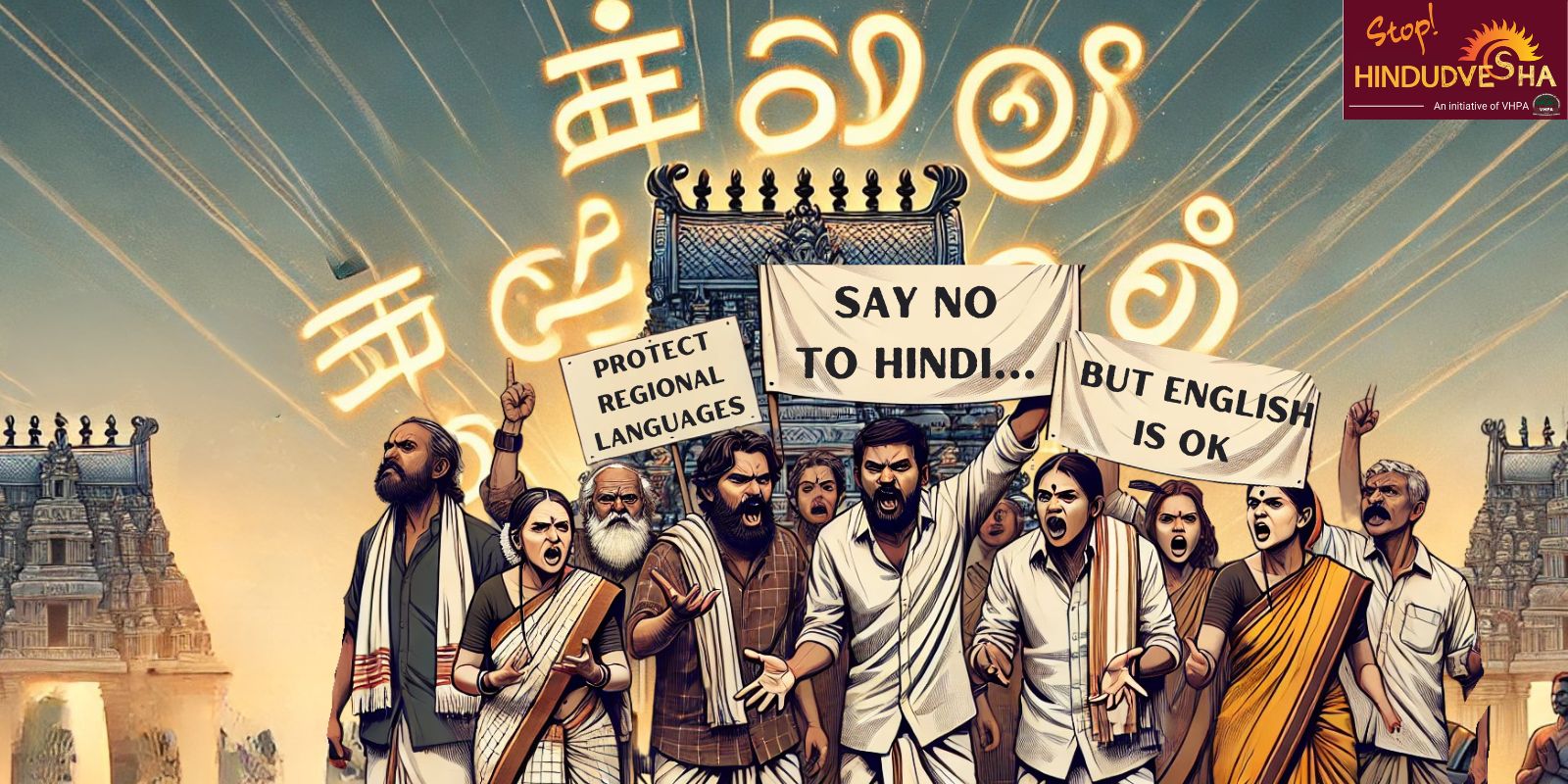
- The British propagated the Aryan-Dravidian divide, fueling linguistic and regional divisions that persist today.
- Parties like DMK in Tamil Nadu and regional groups in Karnataka and Kerala use Hindi opposition to consolidate voter bases.
- Hashtags like #StopHindiImposition, memes, and digital petitions highlight resistance against Hindi in education, signboards, and governance.
- Digital spaces act as echo chambers, reinforcing narratives of linguistic pride and North-South linguistic conflicts.
- While promoting regional languages, such campaigns also increase polarization, prompting counter-responses from pro-Hindi groups.
As a linguistically diverse nation, India has often witnessed debates over the role of Hindi as a national language. While the Indian Constitution recognizes Hindi and English as official languages, states in the southern region have historically resisted the imposition of Hindi. This resistance, at times, manifests as outright opposition to the language, particularly in Tamil Nadu, Karnataka, and Kerala. This sentiment has taken new forms with the rise of digital communication and social media, leading to widespread online campaigns and narratives against Hindi.
Linguistic tensions in India have been a subject of debate for decades, with particular focus on the resistance to Hindi in South Indian states. The issue is deeply intertwined with regional identity, historical grievances, and political maneuvering.[1]
Despite their aggressive stance against Hindi, claiming it threatens their regional languages, many South Indian politicians and intellectuals unabashedly embrace English—the very colonial language that played a key role in dismantling indigenous linguistic traditions. They passionately decry Hindi as a threat to their cultural identity yet carry out governance, education, and even activism in English—without so much as a raised eyebrow. This selective outrage lays bare the hypocrisy at play. Hindi, an Indian language, is painted as the oppressor, while English—the quintessential symbol of colonial domination—is not only accepted but enthusiastically embraced. One might wonder if the issue is truly about preserving linguistic heritage or simply about clinging to a colonial crutch under the guise of cultural resistance.
This article examines Hindi bashing in South India through online discourse, social media trends, and digital activism while tracing its roots to colonial narratives like the Aryan Invasion Theory and their impact on today’s linguistic tensions.
Aryan Invasion Theory Fuels Linguistic Divide
One of the most significant and long-lasting narratives imposed on India by British colonial rulers was the Aryan Invasion Theory (AIT). Introduced by 19th-century British Indologist Max Mueller, this theory claimed that the Indian subcontinent was shaped by an invasion of Indo-Aryans, a group of people supposedly migrating from Central Asia who imposed their language and culture upon the indigenous Dravidian populations. [2] By portraying Indian society as racially and linguistically divided, colonial administrators used the theory as a tool to justify their rule, arguing that if India had always been fragmented, then British governance was necessary to maintain order. [3]
The impact of this colonial construct was particularly pronounced in South India, where it was co-opted by emerging linguistic and political movements. The Dravidian identity was gradually positioned in direct opposition to what was framed as an “Aryan” North Indian identity. [4] This idea found fertile ground in Tamil Nadu, where political movements, particularly the Dravidian movement, actively promoted the notion that Tamil and other South Indian languages and cultures were distinct and oppressed by the so-called Aryan hegemony. The British-supported theory fueled anti-Hindi sentiment, strengthening the argument that North India’s linguistic and cultural influence was an imposition rather than an organic evolution of shared heritage. [5][6] Consequently, opposition to Hindi and broader North Indian influence became a crucial ideological pillar for Dravidian politics, a legacy that persists to this day. [7]
Over time, however, the emerging scholarship has challenged the foundations of the Aryan Invasion Theory. Extensive genetic, linguistic, and archaeological research increasingly points toward an Indigenous Aryan Theory or Out of India Theory. These perspectives suggest that Indian civilization developed internally over millennia through complex interactions rather than a singular foreign invasion. Advances in genetic research have shown that Indian populations have had deep-rooted continuity for tens of thousands of years, contradicting the notion of an external Aryan influx that reshaped the subcontinent. Archaeological evidence, particularly from sites like Rakhigarhi, has further reinforced this idea, suggesting that India’s cultural and linguistic evolution was largely indigenous rather than the result of an invasion. [8]
However, despite being debunked, the Aryan Invasion Theory continues to be used as a political tool, especially by regional parties that seek to sustain a distinct Dravidian identity. The theory serves as a justification for ongoing opposition to Hindi and North Indian cultural influence, with social media platforms further amplifying these narratives in the digital age. Political groups continue to invoke the theory to assert regional distinctiveness and mobilize support, ensuring that the colonial construct of Aryan-Dravidian divisions remains embedded in contemporary discourse.
Historical Context
The resistance to Hindi in South India has deep historical roots, shaped by a series of events that intensified opposition to the language’s perceived imposition. Tamil Nadu, in particular, has been the epicenter of this movement, where the anti-Hindi agitations of the 1930s and 1960s became defining moments in the state’s political and cultural identity. The rise of the Dravidian movement further fueled this resistance, framing Hindi as an instrument of North Indian dominance and a threat to Tamil linguistic and cultural heritage. [9][10]
The first significant wave of anti-Hindi protests emerged in the 1930s when the colonial government introduced Hindi as a compulsory subject in schools. This move was met with fierce opposition, particularly from Tamil nationalists and leaders of the Justice Party. E.V. Ramasamy, also known as Periyar. He became one of the most vocal critics of Hindi imposition, arguing that it was a deliberate attempt to erode Tamil identity and establish linguistic hegemony. The protests, marked by widespread demonstrations, student-led strikes, and arrests, set the stage for future resistance movements. [11]
The agitation reached its peak in the 1960s when the Indian government proposed making Hindi the sole national language. This decision was seen as a direct threat to Tamil Nadu’s linguistic and cultural autonomy, sparking violent protests across the state. The 1965 anti-Hindi agitation witnessed large-scale student demonstrations, clashes with law enforcement, and extreme acts of resistance, including self-immolation by protesters who viewed the imposition of Hindi as an existential threat to their identity. The movement left a lasting impact on Tamil Nadu’s political landscape, strengthening the hold of Dravidian parties, particularly the DMK (Dravida Munnetra Kazhagam), which positioned itself as the guardian of Tamil culture against linguistic oppression. [12][13]
While Tamil Nadu remains the stronghold of Hindi resistance, similar sentiments have been observed in other southern states. In Karnataka, resistance to Hindi has surfaced in various forms, particularly in opposition to Hindi signboards and demands for greater employment opportunities for native Kannadigas in government and private sectors. In Kerala, although the linguistic landscape differs due to the prominence of Malayalam, a strong assertion of Malayali identity has led to resistance against forced linguistic homogeneity. The broader South Indian sentiment remains wary of any perceived attempts to impose Hindi at the expense of regional languages, reflecting a long-standing assertion of linguistic federalism over centralized uniformity.
The resistance to Hindi in South India is not merely a linguistic issue but a deeply political and cultural one. Despite repeated reassurances from the central government that Hindi will not replace regional languages, the legacy of past agitations continues to influence contemporary debates on linguistic autonomy in India.
Role of Political Parties
In several South Indian states, regional political parties have strategically weaponized linguistic pride, turning it into a powerful tool for identity politics. Dravidian parties in Tamil Nadu, as well as regional parties in Karnataka, Kerala, Telangana, and Andhra Pradesh, have consistently framed Hindi as a threat to their native languages and cultural identities. This narrative has played a crucial role in consolidating voter bases and reinforcing regional autonomy in linguistic matters.
In Tamil Nadu, the Dravidian parties—primarily the DMK and AIADMK—have long positioned themselves as defenders of Tamil linguistic supremacy. Opposition to Hindi has been a central theme in their electoral campaigns, with leaders frequently invoking historical resistance movements of the 1930s and 1960s. The DMK, in particular, has taken a hardline stance, advocating for Tamil to be prioritized in education, governance, and official documentation while resisting any attempts to introduce Hindi as a compulsory language. This linguistic assertion is deeply tied to Tamil Nadu’s Dravidian identity and remains one of the state’s most enduring political strategies. [14][15]
In Karnataka, the push for Kannada linguistic pride has gained momentum through institutional efforts and activism. The Kannada Development Authority (KDA) and pro-Kannada organizations like Karnataka Rakshana Vedike (KRV) have actively campaigned against the increasing presence of Hindi in public spaces, particularly in signage and official communication. Their efforts have led to protests against using Hindi in metro stations, bank signboards, and railway announcements, with demands that Kannada be given prominence. Several regional political parties in Karnataka have supported these movements, aligning themselves with pro-Kannada sentiments to appeal to voters who prioritize regional identity. [16]
In Kerala, opposition to Hindi has been more subdued than in Tamil Nadu and Karnataka, yet there remains a strong emphasis on maintaining Malayalam’s prominence in education and administrative affairs. Unlike Tamil Nadu, where Hindi is framed as a cultural and political threat, the discourse in Kerala is centered more on preserving Malayalam’s official status and ensuring that state policies prioritize native-language instruction over external linguistic influences. [17]
In Telangana and Andhra Pradesh, the linguistic debate is relatively muted compared to the other southern states, but regional parties have taken measured stances in favor of their native languages. The prominent political parties in Telangana have advocated for Telugu as the primary medium of instruction in schools and administrative affairs, pushing back against any suggestions that Hindi should be given precedence. Similarly, Telugu remains the dominant language in governance and education in Andhra Pradesh, with political parties emphasizing regional linguistic identity without engaging in overtly aggressive anti-Hindi rhetoric. [18]
Digital Manifestations of Hindi Bashing
The rise of online anti-Hindi sentiment reflects a deeply troubling shift in India’s linguistic discourse—one that prioritizes divisive rhetoric over national unity. What began as a political tool for regional parties has now metastasized into a digital movement that actively fuels linguistic animosity, undermining the very fabric of India’s diverse yet unified identity. The internet and social media platforms like Twitter, Facebook, Reddit, and YouTube have provided a breeding ground for a toxic form of linguistic nationalism that promotes exclusion rather than coexistence.
These digital campaigns go far beyond advocating for linguistic diversity; they foster an environment where an Indian language—spoken by a significant portion of the population—is demonized and portrayed as an oppressive force. This narrative completely disregards the historical and cultural significance of Hindi, reducing it to a political scapegoat. It is one thing to preserve and promote regional languages; it is another to actively incite hostility against a language that forms a key part of India’s linguistic heritage. [19]
Memes and satirical content have further trivialized the issue, turning what should be a thoughtful discussion on linguistic diversity into an exercise in mockery and ridicule. Many South Indian meme pages and online influencers consistently portray Hindi and its speakers as unwanted outsiders in their states, creating a toxic “us vs. them” mindset. Such content not only alienates millions of Hindi speakers but also sets a dangerous precedent where linguistic pride morphs into intolerance and discrimination.
This movement has also found traction in organized digital activism, with petitions calling for Hindi’s removal from public signboards, exams like NEET and UPSC, and central government communications. The insistence on erasing Hindi from public spaces sends a clear message that certain linguistic groups are unwelcome in specific regions of their own country.
Perhaps the most unsettling element of this online movement is the role of influencers and social media personalities who glorify linguistic separatism. YouTubers and Instagram influencers routinely frame anti-Hindi sentiment as a form of resistance, presenting Hindi speakers as cultural aggressors. These influencers not only misrepresent Hindi’s role in India’s linguistic landscape but also encourage a generation of impressionable youth to view their fellow citizens through a lens of linguistic antagonism.
The digital echo chambers that sustain this movement reinforce selective and distorted historical narratives, ensuring that anti-Hindi rhetoric remains unchecked. Blogs, forums, and social media groups amplify biased interpretations, portraying Hindi as an enemy rather than an integral part of India’s linguistic diversity. These platforms entrench linguistic divisions by continuously feeding users a one-sided perspective, making meaningful dialogue nearly impossible.
Societal Impact and Counter-Narratives
The digital opposition to Hindi has led to significant and far-reaching consequences, many of which are deeply troubling for India’s social fabric. While proponents claim that these movements strengthen regional linguistic pride, the reality is that they fuel division, encourage hostility, and escalate tensions between communities. Instead of fostering a constructive dialogue about linguistic diversity, these online campaigns have become a breeding ground for polarization, pushing India further into unnecessary linguistic strife.
One of the direct effects of this digital movement is the rise of an aggressive form of regional linguistic assertion. Rather than celebrating regional languages in a way that complements India’s multilingual heritage, digital activists frame the issue as a zero-sum battle—where the advancement of regional languages must come at the cost of Hindi’s suppression. This attitude is evident in demands to remove Hindi from public spaces, government communications, and national examinations, effectively trying to erase its presence rather than achieving a balance between languages.
More dangerously, this online opposition has exacerbated polarization between Hindi-speaking and non-Hindi-speaking communities. The tone of many anti-Hindi campaigns is not merely about regional pride but often takes on an explicitly hostile character. Memes, hashtags, and digital movements frame Hindi speakers as cultural aggressors, fostering an environment of resentment rather than cooperation. This polarization manifests in everyday interactions, from job discrimination based on language preferences to tensions over signboards and public services. In the long run, this hostility threatens the very principle of national integration by creating artificial linguistic barriers where none should exist.
This unchecked digital movement against Hindi has done more harm than good. It has moved beyond legitimate concerns about linguistic diversity and devolved into a campaign of exclusion and division. If left unchallenged, it risks normalizing intolerance in the name of identity, fracturing the very unity that India’s linguistic diversity is meant to celebrate.
Conclusion
The phenomenon of Hindi bashing in South Indian states is deeply rooted in historical, political, and cultural contexts. While the resistance to Hindi has existed for decades, the internet has provided a new platform for amplification, allowing regional identities to assert themselves more aggressively. However, this digital discourse often veers into extreme narratives, reinforcing linguistic divides rather than fostering a more inclusive linguistic framework. Moving forward, it is crucial to strike a balance between linguistic pride and national integration, ensuring that digital activism does not translate into real-world hostility.
Citations
[1] Mainstreaming the Hatred of Hindu-Brahmins; https://stophindudvesha.org/origins-hate-mongering-european-indology/
[2] Evolution of Languages in South Asia; https://scientiamag.org/evolution-of-languages-in-south-asia/
[3] Karl Schmidt; An Atlas and Survey of South Asian History; p14
[4] The Dravidian movement and Aryan illusions; https://www.thehindu.com/opinion/lead/the-dravidian-movement-and-aryan-illusions/article65672119.ece
[5] Dravidian, Aryan identities created during British rule: Tamil Nadu governor R N Ravi; https://timesofindia.indiatimes.com/city/chennai/dravidian-aryan-identities-created-during-british-rule/articleshow/102242590.cms
[6] “British Design To…”: Tamil Nadu Governor On Dravidian, Aryan Divide; https://www.ndtv.com/india-news/british-design-to-tamil-nadu-governor-rn-ravi-on-dravidian-aryan-divide-4508374
[7] The Legacy of Dravidian Parties in Tamil Nadu Politics; https://kalyanchandra.com/the-legacy-of-dravidian-parties-in-tamil-nadu-politics/
[8] An Ancient Harappan Genome Lacks Ancestry from Steppe Pastoralists or Iranian Farmers; https://pmc.ncbi.nlm.nih.gov/articles/PMC6800651/
[9] The Legacy of Dravidian Parties in Tamil Nadu Politics; https://kalyanchandra.com/the-legacy-of-dravidian-parties-in-tamil-nadu-politics/
[10] 1967: Rise of Dravidian movement and the dramatic fall of Congress; https://www.newindianexpress.com/states/tamil-nadu/2019/Mar/01/1967-rise-of-dravidian-movement-and-the-dramatic-fall-of-congress-1945098.html
[11] Tamil Nadu’s battle against Hindi imposition: A legacy of resistance; https://thesouthfirst.com/tamilnadu/tamil-nadus-battle-against-hindi-imposition-a-legacy-of-resistance/
[12] Tamilians who can speak Hindi up 50% in 10 yrs across Tamil Nadu; https://timesofindia.indiatimes.com/city/chennai/despite-linguistic-politics-tamils-speaking-hindi-up-50-in-10-years/articleshow/66021459.cms
[13] TN: 85-year-old DMK cadre self-immolates in Salem protesting against ‘Hindi imposition’, CM Stalin reacts; https://www.aninews.in/news/national/general-news/tn-85-year-old-dmk-cadre-self-immolates-in-salem-protesting-against-hindi-imposition-cm-stalin-reacts20221127013059/
[14] Why Tamil Nadu, Centre are at loggerheads over NEP, language politics; https://indianexpress.com/article/political-pulse/tamil-nadu-mk-stalin-nep-dharmendra-pradhan-education-9841938/
[15] Tamil Nadu’s Long-Standing Lie Is Getting Called Out: Dalits Feel Let Down By Dravidian Parties; https://swarajyamag.com/politics/tamil-nadus-long-standing-lie-is-getting-called-out-dalits-feel-let-down-by-dravidian-parties
[16] Voices get louder in Karnataka against ‘Hindi imposition’; https://timesofindia.indiatimes.com/india/voices-get-louder-in-karnataka-against-hindi-imposition/articleshow/118770211.cms
[17] Kerala always for 3-language policy, but is against Hindi imposition: Minister; https://www.indiatoday.in/amp/india/kerala/story/language-formula-row-kerala-higher-education-minister-r-bindu-centre-hindi-imposition-2692841-2025-03-12
[18] ‘Language not to be hated… if you learn Hindi, you can interact better in places like Delhi’: Chandrababu Naidu; https://indianexpress.com/article/cities/hyderabad/chandrababu-naidu-hindi-push-telugu-language-row-9890965/
[19] From a T-shirt to a phenomenon: How ‘Hindi Theriyathu Poda’ clothing went viral; https://www.thehindu.com/news/cities/chennai/why-hindi-theriyathu-poda-t-shirts-became-popular/article32642309.ece

Donate to HINDUDVESHA
Our Mission is to explore and expose Hindudvesha through research analysis, education and response.
SUPPORT US