

Zohran Mamdani’s Dystopian Vision: Flogging the Dead Horse of Communism
 Rakesh Krishnan Simha · 02/02/2026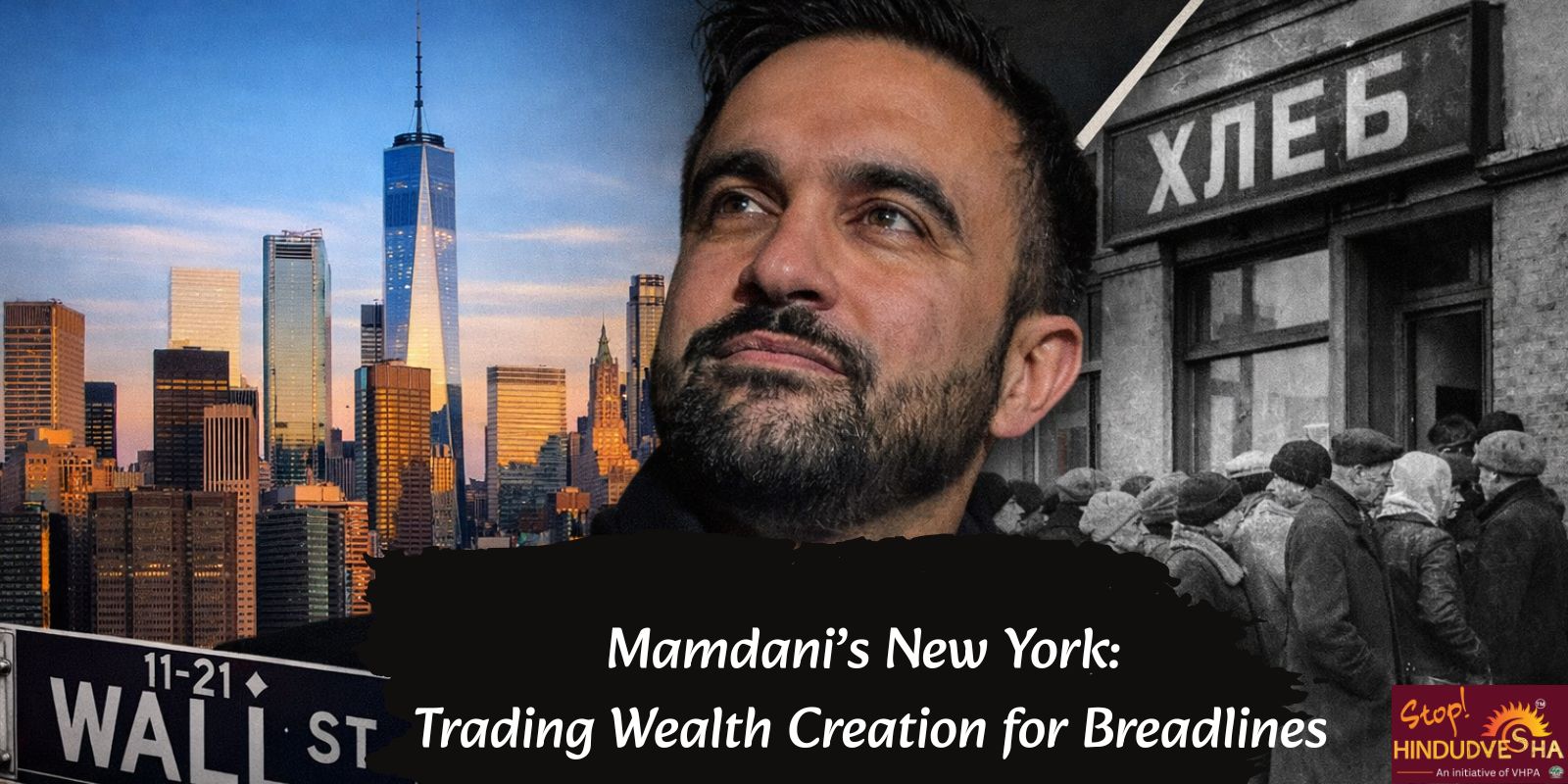
- The United States and much of the world rejected communism after decades of economic failure, repression, and mass death, consigning collectivism to history by the early 1990s.
- New York’s new mayor, Zohran Mamdani, openly embraces collectivist rhetoric and policies, framing state intervention as compassion and “warmth.”
- Historical evidence from the Soviet Union, China, Cuba, Venezuela, and communist-led regions in India shows collectivism produces scarcity, capital flight, inefficiency, and human suffering.
- Mamdani’s proposals on rent control, taxation, transit, policing, wages, and state-run services mirror these failed models and risk undermining New York’s market-driven dynamism.
- Beyond economics, collectivism threatens New York’s pluralism and opportunity culture, risking polarization, brain drain, fiscal decline, and long-term urban decay.
For more than four decades, the United States led a global war against communism, an ideology responsible for the deaths of millions of innocent civilians who resisted collectivism and state ownership of property, including land, homes, and the means of production[1]. Between 1989 and 1991, nation after nation, from Poland and Hungary to Latvia and Russia, concluded that communism had devastated their societies, economies, and ways of life. In the end, collectivism was consigned to the dustbin of history[2].
Yet the new mayor of New York City appears determined to revive this long-dead horse and haul it into the twenty-first century, straight into the throbbing heart of global capitalism. On January 1, 2026, Zohran Mamdani was sworn in as the 111th mayor of New York City. His inaugural address, delivered to a crowd huddled against the East River’s winter wind, echoed with a line that could have been scripted by a ghost from Leningrad: “We will replace the frigidity of rugged individualism with the warmth of collectivism[3].”
Be Careful What You Wish For
The slogan quickly became a flashpoint in national debates over urban policy, economics, and the future of America’s largest city. The mayor’s words lingered in the cold air, ironic and improbable, drawing cheers from progressives gathered beneath fluttering banners of the Democratic Socialists of America. To his supporters, Mamdani represented redemption in a city split by extremes: glassy penthouses piercing the sky while subway riders moved through pockets of despair below. Rising from Queens assemblyman to mayor, New York’s first Muslim one, he ran on a platform promising sweeping change: freezing rents, making buses free, establishing universal childcare funded by higher taxes on the wealthy, creating a new Department of Community Safety to redirect resources from traditional policing, and even exploring municipal grocery stores to address food insecurity. Framed as pathways to affordability and abundance, these proposals carry the unmistakable imprint of collectivist thinking, privileging state intervention over market dynamics.
To skeptics, however, from the pinstriped suites of Wall Street to editorial boards upstate, this was not a set of pragmatic reforms. It was the revival of an ideology long thought buried, its ghosts resurfacing to haunt the present. New York is no neutral polity; it is a myth-making engine, churning out stories of immigrant strivers turning pushcarts into conglomerates, of garage tinkerers building global enterprises in the shadows of skyscrapers.
Mamdani’s collectivism, for all its humane rhetoric, collides directly with this ethos of entrepreneurial audacity. History offers a sobering warning: when innovation is stifled, cities do not renew themselves; they decay. The lights dim slowly, echoing the ruins of regimes that once promised utopia but delivered breadlines and blackouts instead. In a metropolis where finance alone generates more than $350 billion annually[4], and where venture capital flows with tidal force, this ideological drag risks capsizing the very vessel that has carried millions from penury to prominence.
Collectivism, often a euphemism for state-controlled economic systems rooted in Marxist thought, carries a record scarred by inefficiency, scarcity, and authoritarianism. From the Soviet gulags to Venezuela’s hyperinflation, communist experiments are estimated to have claimed between 85 and 100 million lives in the twentieth century alone, according to The Black Book of Communism, a landmark account of these regimes’ crimes[5]. Mamdani’s vision, though constrained by American democratic institutions, risks importing these structural failures into the world’s financial capital, potentially transforming New York from a beacon of innovation into a cautionary tale of decline. Measured against the weight of history, the lesson remains unchanged: communism does not work, and New Yorkers may soon be reminded why.
The Graveyard of Collectivist Dreams
To grasp the dangers inherent in Mamdani’s approach, one must first confront the empirical record of collectivism. Its defenders often insist that “true” communism has never been tried. Yet across countries and decades, the pattern is consistent and unmistakable: centralized planning suppresses human initiative, invites corruption, and produces widespread suffering.
The Soviet Union under Joseph Stalin offers an early and grim illustration. In the 1930s, Stalin’s forced collectivization of agriculture sought to modernize the economy by folding private farms into state-run collectives[6]. Instead, it unleashed catastrophic famines that killed millions through starvation and related causes, events widely documented by historians and recognized by several governments as genocide. In some regions, execution and arrest quotas were imposed, and local officials exceeded them to demonstrate ideological zeal[7]. Peasants responded by slaughtering livestock and concealing grain, hollowing out food supplies, and fueling black markets. By the 1980s, Soviet citizens stood in long lines for basic necessities, and by 1991, the economy collapsed under the cumulative weight of inefficiency. Central planning failed because it ignored price signals and personal incentives, transforming potential abundance into chronic scarcity.
China’s experience under Mao Zedong proved even more disastrous. The Great Leap Forward (1958–1962), an attempt to force rapid industrialization through collectivized communes, triggered the deadliest famine in human history. Death toll estimates range from 15 to 55 million, with recent scholarship converging around 45 million deaths caused by starvation, executions, and exhaustion[8]. Backyard steel furnaces churned out unusable metal, while falsified production figures concealed collapsing harvests. The Cultural Revolution that followed claimed an additional two million lives[9]. China’s reversal came only after market-oriented reforms were introduced in the late 1970s, unleashing economic growth and lifting hundreds of millions out of poverty[10]. Even the ruling party now tacitly acknowledges this reality: modern Chinese prosperity emerged not from collectivism, but from its abandonment.
Closer to home, Cuba under Fidel Castro remains a living case study in stagnation. Collectivized agriculture and state monopolies have produced persistent food shortages, driven as much by structural inefficiency as by external sanctions. In recent years, the regime has appealed to the United Nations for food assistance, as milk and bread grow scarce amid rolling blackouts. Thousands continue to risk their lives on makeshift rafts to escape a system where ration cards govern daily existence. Economic output remains anemic, with GDP per capita trailing far behind that of neighboring capitalist economies[11].
Venezuela offers the most recent and vivid cautionary tale. Once South America’s wealthiest nation, buoyed by vast oil reserves, it unraveled under the socialist policies of Hugo Chávez and Nicolás Maduro. Widespread nationalization, rigid price controls, and aggressive wealth redistribution triggered an economic collapse, culminating in hyperinflation that exceeded 1,000,000% in 2018. Empty store shelves, fuel shortages, and a mass exodus of more than seven million Venezuelans lay bare how collectivist governance squanders even extraordinary natural wealth. Critics often point to U.S. sanctions, yet Venezuela’s downward spiral began years earlier, driven by systemic mismanagement and corruption intrinsic to state-dominated control[12].
The pattern repeats elsewhere. North Korea’s hermit regime, Cambodia under the Khmer Rouge, where roughly two million people were murdered out of a population of four million, and Eastern Europe prior to 1989 all tell the same story: crippled economies, crushed freedoms, and human costs measured in the millions. In India, communist rule in states such as West Bengal and Kerala offers another illustration[13]. West Bengal’s Left Front government, in power from 1977 to 2011, repelled investment through militant unions and coercive land reforms, producing decades of deindustrialization and chronic unemployment. Kerala, despite notable gains in health and education, continues to lag behind liberalized states in economic growth, marked by persistent poverty and large-scale outward migration.
Against this record stands the success of economies built on individualism. The United States, Japan, South Korea, Singapore, and much of Western Europe prospered through free markets, entrepreneurship, and strong property rights. India’s recent experience is also instructive. For decades after independence, socialist planning held growth to roughly 3 to 3.5 percent a year. The liberalization reforms of 1991, which dismantled licensing regimes, reduced tariffs, and welcomed foreign investment, unleashed sustained expansion, with growth averaging 6 to 7 percent and India emerging as the world’s third-largest economy by purchasing power parity[14]. Human beings are not ants; they respond to incentives, innovation, and choice, not directives imposed from above.
These outcomes are not historical accidents. They are structural. Collectivism rests on the belief that central planners can allocate resources more effectively than markets. As Friedrich Hayek warned, no authority can aggregate or process the dispersed knowledge held by millions of individuals. The predictable result is scarcity, black markets, and, ultimately, coercion to enforce compliance.
Mamdani’s Blueprint: Echoes of Failure in the Big Apple
Now apply this lens to Mamdani’s agenda. As outlined on his campaign website and reiterated in transition documents, his platform envisions a New York in which government expands substantially to guarantee “safety, affordability, and abundance[15].” Yet many of these proposals closely resemble past collectivist experiments, risking familiar outcomes in a city already struggling with high costs, crime, and an uneven post-pandemic recovery.
Housing sits at the center of this vision. Mamdani promises to freeze rents in rent-stabilized units, intensify enforcement against so-called bad landlords, and expand publicly funded affordable housing. The intent may be compassionate, but the record of rent control is sobering. In New York itself, existing caps have produced predictable distortions: under-maintained buildings, black-market sublets, and reduced housing supply, all of which deepen shortages. Extending rent freezes risks deterring private investment, encouraging capital flight, and accelerating physical decay, an outcome uncomfortably reminiscent of state-managed housing systems elsewhere.
In Basic Economics, Thomas Sowell warns that price controls disrupt the signals that coordinate supply and demand. When rents are set below market levels by municipal decree, landlords face weaker incentives to maintain properties or build new ones. Sowell also highlights a subtler cost: misallocation. Rent control often locks scarce housing into the hands of tenants who no longer need it, such as empty nesters in oversized apartments, while newcomers with greater need are shut out. What is presented as fairness, he argues, ends up producing both inefficiency and inequity[16].
Sowell extends this critique beyond housing, citing the U.S. gasoline shortages of the 1970s. Price caps did not make fuel cheaper in practice; they produced long lines, rationing, and black markets. The lesson is straightforward: overriding market dynamics does not eliminate scarcity; it magnifies it.
Transportation policy follows a similar logic. Mamdani proposes fare-free buses and faster public transit, financed by higher taxes on the wealthy. The idea is appealing, but fare-free systems strain budgets without guaranteeing corresponding gains in efficiency or reliability. The plan largely sidesteps the MTA’s roughly $15 billion deficit. Subsidizing rides could inflate operating costs, forcing cuts elsewhere or prompting further tax increases. In collectivist systems, state-run transportation often becomes synonymous with unreliability. New York’s transit network already struggles with delays and aging infrastructure; expanding centralized control risks compounding those problems.
Universal childcare, funded through progressive taxation, is intended to ease family burdens. Yet concentrating new taxes on a narrow group of high earners, particularly those making more than $1 million annually, carries risks[17]. New York depends heavily on the top 1 percent, which supplies roughly 40 percent of the city’s income tax revenue. Policies perceived as punitive may accelerate the outflow already seen during the pandemic, when an estimated 300,000 residents left the city. The dynamic echoes earlier experiments, such as West Bengal’s communist rule, where hostility to capital drove away investors and hollowed out a once-vibrant economy.
Mamdani also proposes a structured path to raise the minimum wage to $30 an hour by 2030, citing stagnant wages amid rising living costs. The plan calls for annual increases tied to inflation or productivity growth, whichever is higher, followed by automatic post-2030 adjustments linked to CPI or sector-specific productivity metrics. While framed as predictable and fair, such mandates risk pricing lower-skilled workers out of the labor market and accelerating automation or business relocation.
Underpinning these initiatives is an aggressive expansion of progressive taxation. Large corporations and high-income residents would shoulder a greater share of the burden, with the stated aim of shifting costs away from low- and middle-income New Yorkers. In theory, this redistribution would generate sustainable funding for social services, infrastructure, and community programs. In practice, it assumes a tax base that remains stationary and compliant, an assumption repeatedly challenged by both economic history and New York’s own recent experience.
Mamdani’s proposed Department of Community Safety would shift emphasis away from traditional policing toward mental health and social services, likely reducing resources available to the NYPD. While framed as reform, this amounts to a softened version of “defund the police,” a move that risks emboldening criminal activity, particularly in a city that has already experienced recent crime spikes. Within a collectivist framework, such policies often privilege notions of equity over operational effectiveness. History suggests that similar experiments, such as Cuba’s neighborhood committees, frequently drift from community support into informal surveillance and social control[18].
Even more troubling is Mamdani’s proposal to establish municipal grocery stores to combat food insecurity. Government-run food distribution carries unmistakable historical baggage, recalling Soviet bread lines or Venezuelan rationing systems, where state monopolies fostered inefficiency, corruption, and chronic shortages. In a city defined by dense, competitive private markets, municipal grocery stores risk crowding out private retailers, weakening competition, and ultimately raising prices for consumers across the board.
Mamdani’s language of “warm collectivism” draws unmistakably from Marxist tradition, offering the promise of solidarity while downplaying the role of incentives. His early executive actions targeting so-called “junk fees” signal an interventionist posture, but experience shows that excessive regulation often backfires[19]. Businesses can easily adapt by spreading costs elsewhere through incremental price increases, leaving consumers no better off. New York’s economy, anchored by finance, technology, and tourism, has long depended on individual initiative and market dynamism. Introducing collectivist policies at scale risks accelerating brain drain, deterring investment, and straining public finances, transforming the city from a global engine of opportunity into a cautionary tale of a failed utopia.
The Human Cost: Why New York Can’t Afford This Experiment
Beyond economics, collectivism exacts a human cost. In Stalin’s Soviet Union, dissenters vanished into gulags. In Mao’s China, intellectuals were publicly humiliated, imprisoned, or worse. Mamdani governs within a democratic system, not a totalitarian one, but his emphasis on collective solidarity over individual agency risks fostering similar social polarization, a dynamic visible in Venezuela’s deep internal divisions.
New York’s defining strength lies in its diversity, what Mamdani himself has described as “8.5 million stories.” That pluralism has always been powered by opportunity rather than uniformity. Collectivism threatens to flatten those differences, replacing aspiration with dependency. Major employers, from Wall Street institutions to Silicon Alley startups, could choose lower-tax, lower-regulation states, hollowing out job creation[20]. Tourism, still recovering from the pandemic, could also suffer if the city acquires a reputation for fiscal instability or ideological experimentation.
Business leaders warn of a familiar doom loop: higher taxes drive departures, shrinking the tax base and prompting still higher taxes in response. A 2025 report by the New York City Bar Association called for caution and balance in pursuing reform[21]. Against this backdrop, Mamdani’s sweeping promises face unavoidable scrutiny. Can they be sustained without massive state or federal support? Many skeptics doubt it, particularly given Albany’s own fiscal constraints.
A Wake-Up Call for New Yorkers
Mamdani’s agenda is not innovative. It is a revival of ideas pulled from the ash heap of history. The promised “warmth” of communism has always been an illusion, concealing a record of economic failure and social decay. New York, the engine of American prosperity, cannot afford to indulge this experiment. Voters must demand accountability, businesses must speak clearly for open markets, and the city must reaffirm the individual initiative that made it great.
If not, the Big Apple risks rotting from within. The ghosts of Marx and Lenin loom; let’s not invite them in.
Citations
[1] Swarajya Magazine. “The Communist Red Terror at 100 and Lenin at 150.” https://swarajyamag.com/politics/the-communist-red-terror-at-100-and-lenin-at-150
[2] Office of the Historian, U.S. Department of State. “The Fall of Communism in Eastern Europe, 1989–1991.” https://history.state.gov/milestones/1989-1992/fall-of-communism
[3] Los Angeles Times Editorial Board. “Mamdani, Collectivism, and the Future of New York.” January 6, 2026. https://www.latimes.com/opinion/story/2026-01-06/mamdani-collectivism
[4] USAFacts. “What Is the Gross Domestic Product (GDP) of New York?”
https://usafacts.org/answers/what-is-the-gross-domestic-product-gdp/state/new-york/
[5] Courtois, Stéphane, et al. “Introduction.” Journal of Democracy 10, no. 2 (1999). https://muse.jhu.edu/article/16325/summary
[6] Naimark, Norman M. “Stalin and the Question of Genocide.” Stanford News, September 23, 2010. https://news.stanford.edu/stories/2010/09/naimark-stalin-genocide-092310
[7] Sciences Po. “Mass Crimes under Stalin (1930–1953).” Mass Violence & Resistance Research Network. https://www.sciencespo.fr/mass-violence-war-massacre-resistance/en/document/mass-crimes-under-stalin-1930-1953.html
[8] Dikötter, Frank. “I’m Trying to Solve a Decades-Old Mystery: How Many People Were Killed in China’s Great Famine?” Cato Institute, January 7, 2013.
https://www.cato.org/commentary/im-trying-solve-decades-old-mystery-how-many-people-were-killed-chinas-great-famine
[9] The National Archives (UK). “The Cultural Revolution.” https://www.nationalarchives.gov.uk/education/resources/the-cultural-revolution/
[10] World Economic Forum. “How China Got Rich: A 40-Year History of Economic Transformation.” World Economic Forum, June 2025. https://www.weforum.org/stories/2025/06/how-china-got-rich-40-year-history-of-economic-transformation/
[11] Sheller, Mimi. “Cuba and the Myth of Socialist Prosperity.” Ashbrook Center.
https://ashbrook.org/viewpoint/onprin-v7n5-sheller/
[12] Norberg, Johan. “Venezuela Shows Why Socialism’s Failure Still Matters.” Cato Institute. https://www.cato.org/commentary/venezuela-shows-why-socialisms-failure-still-matters
[13] NewsDrum Opinion.. “How the Communists Lovingly Ruined West Bengal.” https://www.newsdrum.in/opinion/how-the-communists-lovingly-ruined-west-bengal
[14] Panagariya, Arvind. “India: Growth Slowdown, Fiscal Challenges, and Reforms.” National Bureau of Economic Research, Working Paper no. 19024. https://www.nber.org/papers/w19024
[15] Mamdani, Zohran. “Platform.” Zohran for NYC. https://www.zohranfornyc.com/platform
[16] RENX Editorial Team. “The Rent Control Myth: Stability Today, Scarcity Tomorrow.” RENX. https://renx.ca/the-rent-control-myth-stability-today-scarcity-tomorrow
[17] Thompson, Derek. “Why Rich New Yorkers Are Leaving.” The Atlantic, December 2025. https://www.theatlantic.com/politics/2025/12/rich-new-yorkers-leave-mamdani-wealth-tax-consequences/685155/
[18] Institute for War & Peace Reporting. “Cuba’s Neighbourhood Committees Lose Impetus.” https://iwpr.net/global-voices/cubas-neighbourhood-committees-lose-impetus
[19] CBS News New York. “NYC Mayor Zohran Mamdani Launches Junk Fee Task Force Targeting Hidden Fees.” https://www.cbsnews.com/newyork/news/nyc-mayor-zohran-mamdani-junk-fee-task-force-hidden-fees/
[20] Built In NYC. “Where Exactly Is, or Was, Silicon Alley?” https://www.builtinnyc.com/articles/where-exactly-or-was-silicon-alley
[21] New York City Bar Association. 2025 Legislative Agenda. January 2025.
https://www.nycbar.org/wp-content/uploads/2025/01/20221384-2025LegislativeAgenda.pdf

Donate to HINDUDVESHA
Our Mission is to explore and expose Hindudvesha through research analysis, education and response.
SUPPORT US