

Western Media’s Demonization of the Ambani Wedding: Part of the Larger Indophobia Template?
 Rati Agnihotri · 07/31/2024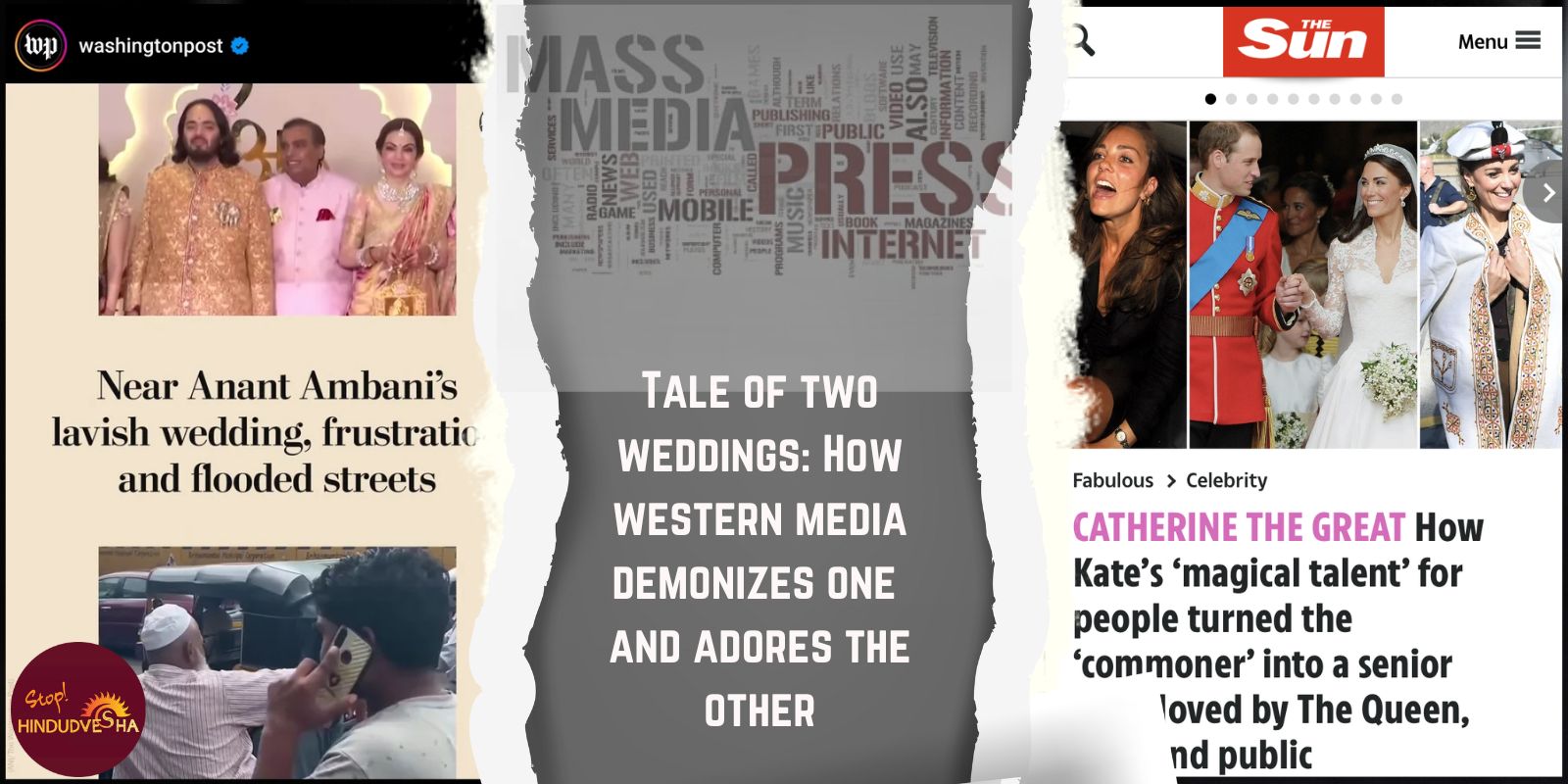
- Western media has a penchant for glamorizing and exoticizing India’s poverty, slumdog millionaire style.
- Western media & think tank ecosystem obsessed with human interest stories exaggerating India’s developmental issues and concerns.
- Biased media coverage of the recently concluded Anant Ambani-Radhika Merchant wedding reflects West’s discomfiture with India’s attempts to forge its cultural narrative on a global scale.
- Critical coverage of the Ambani wedding in stark contrast to the straightforward and positive coverage of elite Western mega events like royal weddings, Ascot races, etc.
- Ambani wedding showcasing Hindu traditions and culture, a far cry from the woke weddings of Bollywood.
Having worked extensively in international media, I understand the patterns and motivations of the global news cycle. If you are a correspondent for an international news channel covering India, you are immediately expected to focus on stories that highlight India’s “problems.”
No manual tells you to do that. But it’s an unsaid norm embedded in the internal workings of the global media ecosystem. When covering countries of the global South, such as India, you are expected to look for human interest stories showcasing their problems – poverty, unemployment, hunger, gender disparity, caste system, etc. The fancy and motivated indexes dished out by Western think tanks every year – Global Hunger Index, World Poverty Index, Democracy Index, etc., provide readymade fodder for stories, the sole aim of which seems to be to put India in a sorry light.
You are also encouraged to work on stories exaggerating the country’s developmental issues and concerns. For example, if you interview the residents of a locality that suffers from acute water shortage, it’s obvious they will be critical of the government policies, and what they tell you is based on their personal experience and woes. Now consider the scenario: a couple of interviews from a locality somewhere in India that suffers acute water shortage are amplified using visuals and human-interest elements to construct a sorry picture of India on a global scale. There is nothing scientific or even rational about this kind of journalism. Dramatic storytelling is used to create a certain perception of India on the world stage. That works because people are so used to seeing and reading such stories that when the stereotypes keep repeating, they become a reality.
The West has a penchant for glamorizing and exoticizing India’s poverty-slum dog millionaire style. When it comes to news regarding India’s achievements – space exploration milestones, economic growth, urban development, scientific advances, Indian business tycoons becoming big globally, etc., the Western ecosystem seems rather miffed. They don’t quite know what to do with this kind of news because it doesn’t fit their agenda! So, they twist such news to somehow make everything about economic inequality, caste system, poverty, etc.
Western countries have long marketed themselves as a formidable object of “cultural aspiration.” Countries like the UK, France, Germany, etc., have marketed themselves globally based primarily on soft power. When Indians go to these countries to study or work, they are also expected to be in awe of their “culture” and “sophistication,” which the Western media and popular culture ecosystem depict on a grandiose scale. But when it comes to India’s attempts at projecting a grand narrative about its culture, the Western ecosystem dismisses these at the outset.
Any opulent and luxurious celebration of Indian culture and tradition or the ambitious merger of Indian culture with the aesthetics of contemporary modernity and the luxury marketplace are dismissed as “vulgar” and “unnecessary.” The arguments are always the same: such a display of wealth and luxury is unnecessary in a poor nation.
West seems interminably fixated on India’s image portrayed in Rudyard Kipling’s famous poem “The White Man’s Burden.” Kipling, a well-known British author and journalist born in British India, has been deservedly criticized for his controversial poem, in which he invokes racist stereotypes of “natives” and unequivocally advocates imperialism. Kipling’s novel “Kim” has also faced criticism for its exoticization of India and its racist stereotyping of Indians as superstitious, mystical, and subservient to the British colonial rulers depicted in the novel.[1]
It appears the West finds it hard to come to terms with India’s development, which is why it routinely exhibits Indophobia and Hinduphobia in its portrayal of issues concerning the country.
In this write-up, we will explore the Western media’s biased coverage of the recent wedding of Anant Ambani and Radhika Merchant in India. Anant is the son of Mukesh Ambani, the Chairman and Managing Director of Reliance Industries – said to be the richest person in India and 11the richest in the world, with an estimated net worth of 123.7 billion USD. [2]
Ambani Wedding Critique: Western Media’s Envy on Full Display
The recent Anant Ambani-Radhika Merchant wedding generated overwhelming interest in the media, most of which was predictably negative. The Western media used the Ambani wedding to build a narrative of “growing economic inequality” and “the rise of crony capitalism” in India. The fact that This sort of criticism is nothing short of a joke, considering that the Western economy itself operates very much within the capitalistic framework that has generated way more billionaires than India, was lost on them.
“A Wedding Puts India’s Gilded Age on Lavish Display,” reads The New York Times headline. “Many Indians cheer the rise of moguls like Mukesh Ambani, whose son’s wedding has become a global spectacle. To them, India’s poverty is predictable, but such opulence is not”, reads the blurb. [3]
One doesn’t even have to read the story all the way through. The blatant Indophobia is evident in the blurb itself, where the writer declares that poverty in India is predictable while opulence is shocking and unexpected. It sounds much like the rich neighbor’s envy of a previously poor neighbor suddenly getting rich and competing in status with them. This is the kind of pedestrian jealousy the West exhibits in this childish media coverage.
The Washington Post did a rather sensational piece covering the wedding. It decided to contrast the “spectacle” of the Ambani wedding with the “flooding in Mumbai” due to annual rains. “Across the river from a lavish Indian wedding, frustration and flooded streets,” read the headline. “The extravagant nuptials of Anant Ambani were a national Rorschach test: an awe-inspiring showcase of Indian affluence or indictment of lopsided development?” says the blurb. [4]
The article dramatically contrasts the arrangements being made in Mumbai for Anant Ambani’s wedding with the flood-like conditions created in the city due to heavy rains. It’s written in a typical conspiracy theory fashion and is devoid of logic. What is the writer trying to imply? That since there is waterlogging in nearby areas due to heavy rains, the billionaire businessman should not hold his son’s wedding on moral grounds. How often have you seen the UK’s royal weddings being halted or the Oscar ceremonies in the US being canceled because there are homeless people on the streets? More importantly, how often do you recall the Western media taking such a moral high ground regarding high-profile events in the West?
The two events—Anant Ambani’s wedding and the annual flooding of Mumbai roads during heavy rains—are completely unrelated. One is a wedding celebration, and the other is a civic issue, which the media has every right to cover as a separate issue in its own right. However, The Washington Post, at its sensationalist best, conflates the two issues to misguide readers with its extreme left-wing rhetoric, suggesting that citizens of a developing country should live in a state of perpetual mourning because there are still poor people. This conflation misleads readers and unfairly criticizes a celebratory event by connecting it to an unrelated civic problem.
The Western media critique of the Ambani wedding follows the same template. It becomes a self-anointed morality and ethical police and self-righteously reprimands the Ambanis for holding their son’s wedding “lavishly” in a country still not “rich enough.”
“Lavish Ambani wedding divides opinions in India” is the BBC headline for a short video piece on the wedding. This sensational piece creates controversy out of nothing by juxtaposing shots from the Ambani wedding with a brief sound bite of a poor person saying that they are having such a lavish wedding while people are starving for food. This is journalism at its sensational and unethical best, or worst. Using poor people as props in their agenda-setting is what such so-called stories essentially do. The whole idea behind this less than 1-minute video clip is to prove somehow that Ambanis are “crony capitalists” responsible for the plight of their lesser-privileged Indian counterparts.
The Indian media follows the same template for criticizing the Ambani wedding. A left-liberal publication called The Leaflet declares that the Ambani wedding is “vulgar.” The headline reads, “Ambani event exposes the vulgarity of India’s plutocracy.” [5]
The Western media critique of the Ambani wedding follows the same template. It becomes a self-anointed morality and ethical police and self-righteously reprimands the Ambanis for holding their son’s wedding “lavishly” in a country still not “rich enough.”
The write-up goes all out in its demonization of the Ambanis, holding them responsible for the plight of the middle-class and poor Indians who take bank loans and go out of their way to fund the weddings of their children. The article then talks about the presumed proximity of Mukesh Ambani and Indian Prime Minister Narendra Modi, carrying forward the Western narrative that the Indian government is “going out of its way” to favor business tycoons like Ambani.
The write-up then goes completely illogical, declaring that the Ambani wedding event “symbolized the de-facto plutocracy of India,” suggesting a form of governance where the wealthy exercise control over the government either directly or indirectly:
“A Wedding at Ambani’s: Feast for the Richest,” reads the headline of an article published by The Hindustan Gazette. “The Story of Two Indias & The Performative Art of Wealth & Power,” says the headline of an opinion piece carried by Madras Courier. The story is hard to follow as it jumps from one point to the next, jumbles together many random things, and is ultimately confusing. From its demonization of the Ambanis and their “ostentatious display,” it suddenly targets Indian Prime Minister Modi, accusing him of crafting the “Chai Wala” (tea seller) narrative to market a certain image of himself to the public. The piece states, “Much like the aforementioned billionaires, Narendra Modi narrates a story—that he, who comes from a humble background of a Chai Wala, became Prime Minister… Indeed, he worked tirelessly to create his persona; he has a retinue of camera people capturing his every move. He is an expert at performative politics, indeed.” [6]
One could also argue the reverse: it is indeed the writers of such pieces who are experts in performative politics! Notice how the criticism of the Ambani wedding invariably leads to criticism of the Indian government and democracy in many of these articles. This reveals that Indiaphobia or anti-India sentiment is at the root of such criticism. Since billionaire Mukesh Ambani symbolizes India’s rising global economic prowess, he becomes an easy and frequent target.
The Good Stuff that They Neglected to Highlight
In the run-up to the Anant-Radhika wedding, the Ambani family organized a “Samuh Vivah” (mass wedding) for over 50 underprivileged couples from the Palghar area between Gujarat and Mumbai. The ceremony, held at the Reliance Corporate Park in Navi Mumbai, was attended by around 800 people, including local social workers, couples’ family members, and community representatives.
The Ambani family presented each bride with a check amounting to 1.01 lakh rupees (approximately 1,200 USD), symbolizing streedhan (personal assets of a woman). The brides also received gold and silver ornaments. Additionally, the newlyweds were provided adequate post-marriage support, including essential household and grocery supplies for a year. [7]
The Western media gives over-the-top coverage to even the slightest charity done by Western NGOs in “third world” countries like India. But how many stories have you seen discussing the philanthropic activities of the Ambanis or other business families in India? Perhaps highlighting the charity work done by local Indians (especially Hindus) for their less privileged counterparts doesn’t fit their agenda of perpetuating the legacy of the “white man’s burden.”
The Ambani family also organized a 40-day Bhandara (public feast) in the run-up to the wedding. This Bhandara, held at their home in Mumbai, reportedly feeds almost 9,000 people daily. Charity is an inherent aspect of the Hindu marriage ecosystem. During marriage ceremonies, it is considered auspicious to feed the less fortunate. Bhandaras are common in Hindu social functions and festivities, serving as social levelers where there is no concept of class or status. In such community feasts held at Hindu temples, people from all backgrounds and statuses dine together.
The philanthropic activities of the Mukesh Ambani family are coordinated through the Reliance Foundation under the leadership of Nita Ambani. According to the EdelGive Hurun India Philanthropy List 2023, Mukesh Ambani and his family ranked at number 3, donated Rs 376 crore in FY23. Their philanthropic endeavors channeled through the Reliance Foundation, focused on enhancing the healthcare and education sectors.[8]
Royal Pomp Praised, Ambani Opulence Criticized
The Western media has different standards for covering the weddings of the rich and famous in countries like India compared to royal weddings in Western countries. It’s ironic that the media, which projects itself as “progressive,” is ultra-critical of the wealth spent by self-made business leaders like Mukesh Ambani on their son’s wedding. In contrast, it bends backward to revel in the pomp and splendor of royal weddings, such as those of Prince Charles (now King Charles III) and Lady Diana and Prince William and Kate Middleton.
Mukesh Ambani might have inherited a portion of his business empire from his father, but the Ambanis are not exactly “royals”—far from it. His father, Dhirubhai Ambani, came from a poor family in the Gujarati village of Chorwad. Due to his family’s difficult circumstances, he was forced to leave school early and do odd jobs to support his family, as per media reports. His first salary was reportedly a mere Rs 300 (less than 4 USD) while working at a gas station. [9]
The point is that columnists go berserk trying to justify the pomp and ostentatiousness of royal weddings in the name of “tradition” and “tourism.” However, they suddenly adopt a “communist” stance, focusing on income inequality and poverty, when it comes to the weddings of the self-made rich and famous in “third world” countries like India.
Contrast this with the British royals, who are born with a silver spoon and inherit wealth purely on a hereditary basis. A comparative analysis of the wealth of the Ambanis with that of the British royal family is beyond the scope of this article, but Mukesh Ambani’s wealth pales in comparison to the influential royal family. Yet, the hypocrisy of the Western media is glaring: they go ga-ga over royal weddings while having the audacity to label the wedding celebrations of the son of a self-made Indian business leader as vulgar and ostentatious.
Prince William and Kate Middleton’s wedding was such a hyped-up affair that the media still go berserk over it, some 13 years after the event! “Prince William, Princess Kate celebrate 13th wedding anniversary: See the throwback photo.”[10], reads a recent headline by USA Today. “Why Prince William and Kate Middleton Didn’t Release a Current Photo for their Wedding Anniversary,” says the Cosmopolitan headline.[11] “Everything you should know about Kate Middleton’s wedding dress,” reads a headline from British Heritage Travel. [12] “I’m thrilled to be at the royal wedding: even this republican loves a royal knees-up”, says The Guardian headline from 2018. [13]
The point is that columnists go berserk trying to justify the pomp and ostentatiousness of royal weddings in the name of “tradition” and “tourism.” However, they suddenly adopt a “communist” stance, focusing on income inequality and poverty, when it comes to the weddings of the self-made rich and famous in “third world” countries like India.
Ambani Wedding Celebrates Hindu Customs Unlike Bollywood’s Woke Ceremonies
Most importantly, the recently concluded Ambani wedding was rooted in Hindu traditions and customs, unlike the usual woke Bollywood weddings.
Everything about the Ambani wedding—from designing wedding invites and venue decoration to the lineup of rituals—was curated to showcase Hindu Sanskriti (culture) and Sabhyata (civilization) to a global audience.
A recent write-up in The New Indian Express aptly sums up how the Ambani wedding has become an enduring symbol of India’s soft power on a global scale. It highlights how countries like South Korea have successfully branded and exported their culture through films, beauty products, and K-pop.
The article further discusses how the global popularity of these cultural products has significantly contributed to the South Korean economy by boosting tourism and increasing exports. It then argues that high-profile events like the Ambani wedding can do the same for India, bringing economic benefits, boosting cultural tourism, generating employment, and increasing the demand for certain Indian products in the global market by creating much-needed hype around Indian culture.[14]
Nita Ambani talked about the symbolic significance of the ritual of “Kanyadaan” in a Hindu Vivah Sanskar (marriage tradition). While addressing the guests, she spoke of the importance of daughters in Hindu culture. She highlighted the self-reforming nature of Hindu Dharma and philosophy, which has enabled women to be respected for ages. She emphasized that Hindu scriptures teach us that wherever there are daughters, there is auspiciousness and that daughters possess a higher God-given power. She also highlighted that an Indian wedding rests on the foundation of perfect equality between the var (groom) and the kanya (bride) and their families.[15]
Mukesh Ambani also discussed Hindu wedding rituals’ significance while welcoming guests. He emphasized that such ceremonies are among the most important rites of passage in an individual’s life, linking them to spiritual practices, societal duties, and the wider community. While welcoming the guests, he elaborated on the essence of a Hindu wedding and invoked the Pancha Tattva (essential five elements of the universe according to Hindu philosophy) or the five foundational elements of Mother Nature to offer sustenance and strength to the couple. [16]
The Ambani family’s highlighting of Hindu marriage traditions and rituals on a global platform is indeed significant. There are many misconceptions and stereotypes surrounding Hindu wedding rituals like saat phere (seven rounds of the sacred fire solemnizing marriage) and Kanyadaan (the symbolic giving away of the daughter to another family as she embarks on a new journey in life to light up a new home with her sublime presence). These beautiful rituals are often distorted and demonized by the Western ecosystem; Hindu marriage rituals are interpreted literally and simplistically through an Abrahamic lens. Thus, Kanyadaan is depicted as an exploitative ritual, “literally throwing away one’s daughter,” and similar misunderstandings arise.
It’s vital that this anti-Hindu propaganda is countered on a global scale, and the best way to do so is by projecting Hindu customs and traditions as a “grand spectacle” and highlighting their significance on an international platform. The lifestyle and spectacles of the rich and famous set trends for people worldwide. Whether this is good or bad, it’s the reality. Thus, when the Ambanis showcase Hindu customs and traditions at their family weddings unapologetically, it sends a larger message to middle-class Indians who are increasingly getting alienated from their Hindu roots under the influence of woke culture.
Most importantly, the Ambani wedding stands in stark contrast to the woke weddings of the elite Bollywood celebrities, where Hindu rituals are increasingly getting diluted and Christian traditions are infringing in the name of secularism.
Bollywood actress Parineeti Chopra and politician Raghav Chaddha got married in 2023. Looking at the wedding pictures, one can’t help but notice that they are trying to merge the rituals of a Christian wedding ceremony with Hindu Vivah Sanskar. The bride and groom are dressed in shades of white and even walk down the aisle surrounded by rows of white flowers and a cheering crowd. The bride has her white chunni trailing on the ground, recreating the walk of a Christian bride.[17]
Most importantly, the Ambani wedding stands in stark contrast to the woke weddings of the elite Bollywood celebrities, where Hindu rituals are increasingly getting diluted and Christian traditions are infringing in the name of secularism.
Many high-profile weddings in India might as well be cocktail parties. The “Hindu” essence of the wedding is toned down or diluted to create a ‘cool and modern’ vibe. Popular culture also conveys the impression that these “secular” weddings devoid of their Hindu roots are the norm for elite Indians these days. A web series called Made in Heaven, streaming on Amazon Prime, showcases many such weddings of the ultra-rich in India, which seem devoid of Hindu rituals and traditions. The implicit message of such popular culture products is that one has to hide or annihilate their Hindu identity to look modern.
In the Anant Ambani-Radhika Merchant wedding, the exact opposite happened. The family was unabashedly showcasing its Hindu identity. Considering the unprecedented media coverage the wedding got, the formidable merger of Hindu tradition and modern luxury was splashed across social media. A Hindu wedding was marketed as a cultural product on an unprecedented scale. This upsets the dynamics of the Western media, academia, and think tank ecosystem that’s spent massive resources and time to perpetuate Hinduphobia at various levels.
Conclusion
Finally, one must bear in mind that for the anti-Hindu Western ecosystem, Hinduphobia and Indophobia go hand in hand.
The West’s demonization of Indian business leaders like Mukesh Ambani has a lot to do with their Hindu identity and the proud showcasing of their cultural roots. This is ironic because elite Western educational institutions and think tanks seek hefty funding from these business leaders. They are happy with the money coming in, but they’d much prefer these Indian business leaders downplay or, better still, annihilate their Hindu identity, at least in public.
Citations
[1] AD’s English Literature: Some Critical Issues from Rudyard Kipling’s “Kim”; https://ardhendude.blogspot.com/2023/06/some-critical-issues-from-rudyard.html#:~:text=One%20of%20the%20primary%20criticisms,backdrop%20for%20the%20protagonist’s%20adventures.
[2] List of Top 10 Richest People in India 2024; https://www.jagranjosh.com/general-knowledge/top-richest-person-in-india-1717848970-1#
[3] Ambani Wedding Shows Off India’s New Gilded Age – The New York Times; https://www.nytimes.com/2024/07/12/world/asia/india-ambani-wedding-billionaire.html
[4] Indian wedding of Anant Ambani spurs working-class frustration – The Washington Post; https://www.washingtonpost.com/world/2024/07/16/india-wedding-anant-ambani-mumbai/
[5] Ambani event exposes the vulgarity of India’s plutocracy – The Leaflet; https://theleaflet.in/ambani-event-exposes-the-vulgarity-of-indias-plutocracy/
[6] The Story of Two Indias & The Performative Art of Wealth & Power | Madras Courier; |https://madrascourier.com/opinion/the-story-of-two-indias-the-performative-art-of-wealth-power/
[7] Ambani family hosts mass wedding for 50 underprivileged couples – The Hindu; https://www.thehindu.com/news/cities/mumbai/ambani-family-hosts-mass-wedding-for-50-underprivileged-couples/article68362452.ece
[8] Shiv Nadar donated Rs 5.6 cr day, up from Rs 3 cr per day in FY22: EdelGive Hurun India List 2023 – BusinessToday; https://www.businesstoday.in/latest/corporate/story/shiv-nadar-donated-rs-56-cr-a-day-up-from-rs-3-cr-per-day-in-fy22-edelgive-hurun-india-list-2023-404332-2023-11-02
[9] Dhirubai Ambani: Mukesh Ambani’s father’s first salary was Rs 300; lesser-known facts about Reliance Founder; https://www.dnaindia.com/business/report-dhirubhai-ambani-mukesh-ambani-s-father-s-first-salary-was-rs-300-lesser-known-facts-about-reliance-founder-3036139#
[10] Kate Middleton Prince William Wedding: Royals toast 13th anniversary; https://www.usatoday.com/story/entertainment/celebrities/2024/04/29/prince-william-princess-kate-wedding-anniversary-photo/73497606007/
[11] Why Prince William and Kate Middleton Didn’t Release a New Anniversary Pic; https://www.cosmopolitan.com/entertainment/celebs/a60646613/why-prince-william-kate-middleton-didnt-release-new-photo-wedding-anniversary/
[12] Kate Middleton’s wedding dress; https://britishheritage.com/royals/kate-middletons-wedding-dress
[13] I’m thrilled to be at the royal wedding: even this republican loves a royal knees-up | Hadley Freeman | The Guardian; https://www.theguardian.com/commentisfree/2018/may/19/at-royal-wedding-republican-knees-up-hadley-freeman
[14] Ambani Wedding: Where India’s soft power and economy said ‘I do’ – The New Indian; https://www.newindian.in/ambani-wedding-where-indias-soft-power-and-economy-said-i-do/#google_vignette
[15] Anant-Radhika Wedding: Nita Ambani Explains ‘Kanyadaan’ Ceremony in Hindu Weddings In A Heartfelt Video; https://news.abplive.com/lifestyle/anant-radhika-wedding-nita-ambani-explains-kanyadaan-ceremony-in-hindu-weddings-in-a-heartfelt-video-watch-1703384
[16] Mukesh Ambani talks about the Hindu traditional wedding, credits this person for curating grand ceremony; https://www.dnaindia.com/viral/report-mukesh-ambani-talks-about-hindu-traditional-wedding-credits-nita-ambani-3097491
[17] Unraveling the subtle secularization and wokeization of the Hindu Vivaah Sanskar; https://hindupost.in/dharma-religion/unraveling-the-subtle-secularization-and-wokeization-of-the-hindu-vivaah-sanskar/

Donate to HINDUDVESHA
Our Mission is to explore and expose Hindudvesha through research analysis, education and response.
SUPPORT US