

Tirupati Prasadam Controversy: Hindu Apathy Amid Blatant Attacks on Their Traditions
 Rati Agnihotri · 10/10/2024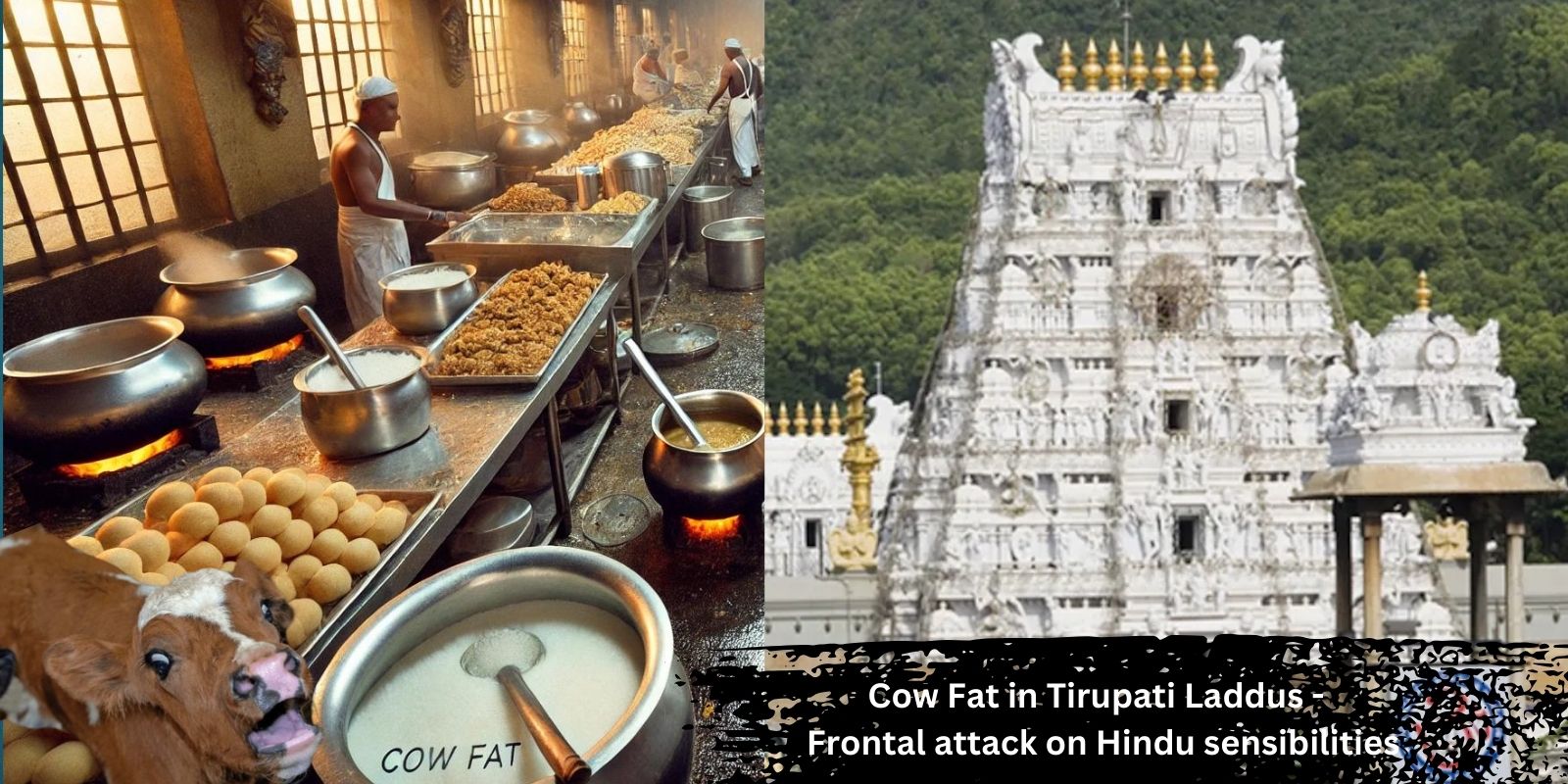
- The Tirupati Laddu controversy is part of a broader pattern of anti-Hindu sentiment, with Hindus frequently targeted by a coalition of global forces and internal apathy.
- Despite its profound religious implications, the issue is being reduced to a “food safety” and corruption problem, masking its potential as an anti-Hindu conspiracy.
- The controversy underscores the dangers of state-run temple management will continue to undermine Hindu traditions and beliefs.
- Even though Hindus form 80% of India’s population, there is widespread indifference and lack of proactive response when their religious sentiments are attacked.
- The Himachal Pradesh protests show that when Hindus unite, their voice can compel action.
George Orwell’s line, “All animals are equal, but some animals are more equal than others,” symbolizes the plight of Hindus in modern India. Though Animal Farm satirized the Bolshevik Revolution, its message resonates today, where global deep state machinery—an unholy alliance of communist, Christian missionaries, and radical Islamist forces—targets Hindus. Just as the “lesser animals” suffered under the tyranny of the “higher animals,” the Hindu ecosystem faces systematic discrimination and oppression from these powerful forces.
The recent controversy over the Tirupati Laddu Prasadam allegedly containing pig fat, beef fat, and fish oil shows the bias of “secularism” in India. In India, the religious beliefs of all communities are protected—except for Hindus. Despite being 80% of India’s population, Hindus have been conditioned to stay silent even when their religious sentiments are openly attacked. This mindset has created a cycle where so-called minorities freely undermine Hindu beliefs and traditions without any fear of consequences.
The issue arose when Andhra Pradesh Chief Minister Chandrababu Naidu accused the previous government of using animal fat instead of pure ghee in the laddus. The Gujarat-based National Dairy Development Board then tested a ghee sample and confirmed the presence of “beef tallow, pig fat, and fish oil” in their report.[1]
Despite the seriousness of the findings, the Hindu community’s response has been lackluster at best. While there have been the usual social media outrage and TV debates, along with condemnation from prominent Hindu seers and Gurus demanding an impartial probe, there has been no significant public protest from the wider community. The entire matter is now being framed merely as a “food safety” problem, ignoring the possibility that it could be a deliberate attempt to insult Hindu sentiments and mock Hinduism.
This isn’t just about punishing the culprits—it highlights a larger issue: the mismanagement of Hindu temples by the state. When governments run Hindu temples with non-Hindus on temple boards, incidents like this are inevitable.
In this article, we will examine the Tirupati Laddu Prasadam controversy from the point of view of these three issues:
- Hindu apathy vis-à-vis assaults on their dharmic beliefs and sentiments.
- Secular framing of issues involving Hindu religious sentiments.
- State control of Hindu temples.
Abject Hindu Apathy
If one goes by the chatter on social media and TV coverage, it may seem like the Tirupati Laddu, one might think that Hindus have finally come out of their stupor to safeguard their rights. Many prominent leaders like Jagadguru Swami Vasudevanand Saraswati, Shrimant Yamuna Puri, Mahant Swami Harichaitanya, Sri Sri Ravi Shankar, and Sadhguru have voiced their outrage and demanded an impartial investigation into the adulteration of the Tirupati Laddu Prasadam.[2] Shankaracharya Swami Avimukteshwaranand Saraswati has also stressed the need for Hindu control over temple management. [3]
However, there has been little response from influential Hindus in fields like entertainment, business, and technology. Not a single Bollywood celebrity has condemned the Tirupati Prasadam adulteration. Tamil actor Karthi made light of the issue during an event in Hyderabad on September 23, where he joked about the controversy, implying it was a topic best avoided. His remarks sparked backlash, including criticism from Andhra Pradesh Deputy Chief Minister Pawan Kalyan, leading the actor to issue a public apology.[4]
On the other hand, several left-leaning intellectuals with Hindu names have opined on the issue, lecturing Hindus not to overreact and framing it as just a “food safety” concern. Fiction writer Chetan Bhagat added to this narrative by posting on X (formerly Twitter), urging people to focus on real national problems like air pollution, healthcare, and civic issues instead of “overreacting” over the Tirupati Prasadam. He even claimed that “white sugar is made white using charred animal bones” and is found in most sweets.[5]
One wonders if Chetan Bhagat and others of his ilk would dare make similar comments if it involved other religions, such as non-halal meat being sold as halal. Likely not. It is the indifference of Hindus toward their religious sentiments that emboldens such irresponsible remarks from so-called Hindu celebrities.
Given the seriousness of the Tirupati Prasadam adulteration issue, one would expect a flood of condemnations from influential Indians across various fields, emphasizing the need to respect Hindu sentiments. Yet, apart from a few politicians and religious leaders, there has been silence. While ordinary Hindus have shown their displeasure through social media, it’s astonishing that in a Hindu-majority nation, prominent voices remain absent in criticizing this blatant mockery.
The only visible protests have come from Hindu advocacy groups. Recently, various saints and seers held a demonstration in front of the Tirumala Tirupati Devasthanams (TTD) office, demanding action against those responsible for allegedly using ghee mixed with animal fat in the Prasadam laddus. Their efforts highlight a larger issue—the apathy of influential Hindus—and the urgent need for broader support in safeguarding Hindu religious traditions.
The demonstrating seers also questioned the larger Hindu community’s stoic silence on the issue. They emphasized that even though the incident has hurt the entire Hindu community, it is painful that a large section of Hindus haven’t raised their voice yet.[6]
When it comes to Hindu issues, social media outrage rarely translates into ground-level action. Where are the “woke Hindus” who showed up in large numbers for anti-CAA and farmers’ protests? Ironically, these protests were driven by the urban Hindu youth, yet the same group now seems uninterested—or perhaps doesn’t find Hindu issues “cool” enough to support. Why this indifference?
The answer isn’t simple. It’s a mix of factors that have allowed wokeism to dominate India’s social and cultural spaces, brainwashing urban youth and distancing them from their cultural roots. This disconnect has created a generation that prioritizes trendy causes over the defense of their heritage, leaving Hindu issues neglected and unsupported.[7]
The predominantly Hindu urban youth drives protests in cities like Delhi and Mumbai, drawing global attention. Yet, India still lacks a strong cultural narrative that makes its citizens proud of their Hindu roots. This disconnect explains why serious issues, like the Tirupati Prasadam case, fail to spark widespread outrage among Hindus.
The reason? Today’s English-educated Hindu youth have been conditioned to see their cultural values and traditions as obsolete, unfashionable, and unworthy of attention, let alone worthy of being defended. If a similar incident occurred in a Christian or Muslim context, India would witness massive protests, with global media highlighting it. Ironically, many of these same “woke” Hindus would join in to show solidarity, even as they ignore the gravity of the Tirupati issue.
This indifference isn’t limited to Hindu youth; it has spread across all sections of society. Hindus have internalized Hindudvesha (hatred or aversion to Hindu traditions) so deeply that they often invite others to ridicule and undermine their faith. Rather than defending their beliefs, they simply step aside, convinced their religious sentiments don’t matter.
Secular Framing
The Tirupati Prasadam adulteration issue is increasingly being reframed in purely secular terms, with the media and politicians downplaying it as just a “food safety” problem. It’s also being portrayed as a corruption case linked to the mismanagement of temple funds and procurement of substandard ghee during the tenure of former Andhra Pradesh Chief Minister YS Jagan Mohan Reddy. Many reports focus on evidence that the previous administration bought low-quality ghee for the Tirupati Prasadam.[8]
However, what’s missing is an analysis of this incident as a potential anti-Hindu conspiracy. The alleged use of pig fat, beef tallow, and fish oil in the Prasadam of such a revered Hindu temple can hardly be dismissed as a simple corruption issue. In a country where some politicians openly call for the “annihilation of Sanatan Dharma,” comparing it to diseases like dengue and malaria, the idea of a targeted conspiracy against Hindus isn’t far-fetched.
Many Hindu dharmic leaders have rightly labeled this as an attack on Sanatan Dharma. Some have gone so far as to demand the death penalty for those responsible, urging the government to pass strict laws that would deter any future attempts to defile Hindu traditions and sentiments in such a manner.[9]
Shankaracharya Avimukteshwaranand Saraswati, responding to the incident, stated that reducing this serious issue to merely a “conspiracy” is unfair. He compared it to the Mangal Pandey greased cartridge incident, highlighting that, just as the cartridges hurt the sentiments of Indian soldiers back then, Hindus today should seek a similar response as their sentiments are under attack. He further described it as an organized crime against the Hindu community.[10]
Hindus are frequently mocked and abused on social media by extremist bot accounts run by a global Communist-Islamist network. Even mainstream platforms like X are filled with offensive memes labeling Hindus as “pajeets” (a racial slur) and “cow piss drinkers.”
A July 2022 report by the Network Contagion Research Institute (NCRI) at Rutgers University found a sharp increase in hate speech targeting Hindus across various social media platforms. The report, titled “Anti-Hindu Disinformation: A Case Study of Hinduphobia on Social Media,” detailed how White supremacist and genocidal memes about Hindus are widely shared within extremist Islamist networks on platforms like Telegram. [11]
The point is that the Tirupati Prasadam adulteration controversy must be viewed in the broader context of the growing wave of Hinduphobia, both in India and globally. It’s not just an isolated incident—it’s part of a larger, troubling pattern of rising hostility and targeted attacks on Hindu beliefs and symbols.
The rising cases of vandalism and attacks on Hindu temples, the spread of genocidal memes targeting Hindus, casual calls by Indian Communist politicians for the “annihilation of Sanatan Dharma,” the demonization of Hinduism in academia, and now the alleged adulteration of Tirupati Prasadam with animal fat—these incidents must be viewed together. Any investigation into the motivations behind this incident should treat it as a potential “anti-Hindu conspiracy” rather than reducing it to just another case of “corruption” or “food safety.”
It’s also important to consider the context. YS Jagan Mohan Reddy, the former Chief Minister of Andhra Pradesh under whom this alleged adulteration took place, is a practicing Christian. Media reports noted that at his swearing-in ceremony in 2021, his mother was visibly holding a Bible, raising concerns about possible biases in decisions impacting Hindu institutions. This background cannot be ignored when evaluating the nature and intent behind such a serious violation of religious sentiment. An in-depth probe should focus on whether this was a targeted attempt to offend Hindu beliefs, rather than treating it as a routine administrative failure.[12]
Jagan Mohan Reddy’s personal faith is less of a concern than the allegations surrounding the appointment of crypto-Christians in the Tirumala Tirupati Devasthanam (TTD). In August 2023, Tirupati MLA Bhumala Karunakar Reddy was reappointed as the TTD Chairman. Despite claiming to be Hindu, various media reports suggest he is a crypto-Christian. A viral video even showed his mother stating, “We are a Christian family. We go to temples only for Hindu votes.” [13]
He has also been accused of appointing Christian teachers in TTD-run schools. A 2018 audit revealed that 44 Christians were employed at TTD in various roles. These reports indicate that the temple administration is being run by non-Hindus. [14]
This situation should raise alarms and prompt a thorough investigation into the Tirupati Prasadam issue as a possible “anti-Hindu conspiracy,” rather than dismissing it as a routine administrative problem.
State Control of Hindu Mandirs
The Tirupati case has once again highlighted the ongoing issue of state control over Hindu temples. This incident must be viewed within the broader context of an “anti-Hindu conspiracy,” closely tied to the problem of government interference in temple management.
Even if one assumes that the issue was purely about corruption and greed, where the temple management opted for low-quality ghee at dirt-cheap prices, it underscores why secular governments shouldn’t be running Hindu temples. When a temple management board is willing to compromise the quality of Prasadam offered not just to devotees but also to the deity, it shows a blatant disregard for Hindu sentiments. This is precisely what transpired in the Tirupati case.
In the wake of this controversy, Hindu organizations, dharmacharyas, and Akharas across India are calling for temple management to be returned to the community. The Vishwa Hindu Parishad (VHP) is set to address this demand at an upcoming meeting in Tirupati, where they will discuss not only the issue of freeing temples from government control but also other pressing concerns like fraudulent religious conversions. The Tirupati incident has become a rallying point, sparking renewed calls for Hindu temples to be managed by Hindus, ensuring respect and integrity in religious practices.[15]
The VHP, in its condemnation of the Tirupati Prasadam adulteration issue, had earlier termed the alleged use of animal fat in Tirupati laddus as “intolerable” and demanded that the Andhra Pradesh government hand over the temple control and management to Hindu society. [16]
The Tirupati Prasadam controversy has shaken India’s temple ecosystem, raising concerns about the quality and sanctity of offerings in other temples. If such issues can occur at a renowned temple like Tirupati, devotees are now questioning the quality of Prasadam in smaller community temples across the country. As a result, several temples have started taking preventive measures by banning devotees from bringing external sweets for offerings. For example, many temples in Prayagraj now only allow fruits and dry fruits to be brought as offerings. [17] In response, some state governments have stepped up efforts to ensure the purity of Prasadam. Uttar Pradesh, for instance, has begun collecting samples from various temples for lab testing. Similarly, Uttarakhand has launched a statewide initiative to monitor the quality of ghee and butter sold in the region.
Renowned Hindu spiritual leader Sadhguru has also raised the issue of state control of Hindu temples in the context of the Tirpuati laddu row. “Devotees consuming beef tallow in the Temple Prasadam is beyond disgusting. This is why Temples should be run by Devotees, not by government administrations. Where there is no Devotion, there shall be no sanctity. Time the Hindu temples are run by devout Hindus, not by government administration”, he commented in a post on X. [18]
Hindudvesha recently did a series of articles on the issue of state control of temples in India. One of the pieces did an extensive analysis of the reasons why Hindus should manage their own religious institutions. [19] Through various examples, the piece demonstrated how sustained government control of Hindu temples in India was systematically destroying the roots and essence of Hindu culture and civilization.
The Tirupati Prasadam adulteration issue has stirred a hornet’s nest; further investigations into the state-run temple ecosystem of India will probably reveal a web of even greater horrors. Hindu activists and the general public should take this as an opportunity to bring the issue of freeing Hindu temples from state control to the mainstream of political discourse again. Unless and until the Indian government is pressured by citizens to hand over the control of temples back to the Hindu community, not much is going to change at the ground level.
Wrapping up
Hindus in the hill state of Himachal Pradesh recently came out on the streets in huge numbers, protesting illegal mosques that have come across several towns in the hill state. First, there were widespread protests in Shimla in the Sanjauli area. This was followed by protests against an illegally constructed mosque in Mandi. After Shimla and Mandi, Hindus also reportedly protested against another illegal masque in Kullu, Himachal Pradesh.[20]
Hindus in India rarely take to the streets to protest their own issues. It’s common to see them rally for “secular” causes like anti-CAA or farmers’ protests, but Hindus standing up for specifically Hindu concerns is almost unheard of. However, the recent protests in Himachal Pradesh, widely covered by Indian media, stand out as a unique example of successful Hindu mobilization. In Shimla and Mandi, the overwhelming participation of the Hindu majority compelled the administration to not only acknowledge the grievances but also respond promptly.
The Himachal protests can be seen as the first successful model for pro-Hindu demonstrations in India. Their impact shows that when the Hindu majority comes together and voices its concerns peacefully yet assertively, it compels the local administration to take notice. This success serves as a reminder that unified, peaceful protests can be an effective way for the community to advocate for its rights and interests.
The Tirupati Laddu adulteration incident should have been a rallying point for Hindus across India, similar to the Himachal protests. Unfortunately, we’re still far from that level of unified response. While there’s been some progress with more Hindu voices speaking up on social media, it’s still not enough to match the rapid spread of Hindudvesha (hatred toward Hindus) by anti-Hindu forces.
Hindus need to realize that these issues, which may seem irrelevant or distant today, will have a direct impact on their lives in the future. If the current apathy continues, in 50 years, it could be their very existence that is at risk. By then, any response will be too late. It’s critical for Hindus to step out of their comfort zones and proactively safeguard their rights and traditions now, before it’s too late to act.
Citations
[1] Tirupati Prasadam Row: Lab Test Finds Presence of ‘Foreign Fat’ in Ghee, Report Mentions ‘Beef Tallow, Fish Oil’ | Times Now; https://www.timesnownews.com/india/tirupati-prasadam-row-lab-test-finds-presence-of-foreign-fat-in-ghee-report-mentions-beef-tallow-fish-oil-article-113494803
[2] Tirupati Laddu Controversy: Seers Denounce Alleged Conspiracy Against Sanatan Dharma | Allahabad News – Times of India; https://timesofindia.indiatimes.com/city/allahabad/tirupati-laddu-controversy-seers-denounce-alleged-conspiracy-against-sanatan-dharma/articleshow/113557490.cms
[3] Shankaracharya Condemns Tirupati Prasadam Adulteration and Calls for Control – Oneindia; https://www.oneindia.com/videos/shankaracharya-condemns-tirupati-prasadam-adulteration-011-4180956.html#:~:text=Shankaracharya%20Swami%20Avimukteshwaranand%20Saraswati%20has,plot%20to%20weaken%20Hindu%20faith.
[4] Tirupati laddu controversy: Actor Karthi apologises after Pawan Kalyan blasts him for his comment – India Today; https://www.indiatoday.in/movies/regional-cinema/story/tirupati-laddu-controversy-karthi-pawan-kalyan-clash-2605499-2024-09-24
[5] Tirupati Laddu Controversy: Chetan Bhagat Adds Fuel to Fire, Says ‘Sugar is Made White With Animal Bones’; https://www.dnpindia.in/states/tirupati-laddu-controversy-chetan-bhagat-adds-fuel-to-fire-says-sugar-is-made-white-with-animal-bones/493553/
[6] Tirumala laddu row: Hindu organisations stage demonstration, demand action against ‘culprits’ – The Hindu; https://www.thehindu.com/news/national/andhra-pradesh/tirumala-laddu-row-hindu-organisations-stage-demonstration-demand-action-against-culprits/article68678293.ece
[7] Indian Youth, Identity Politics, and the Rise of Wokeism – Hindu Dvesha; https://stophindudvesha.org/indian-youth-identity-politics-and-the-rise-of-wokeism/
[8] Congress government increased prices for Nandini ghee and a year later, animal fat found in Tirupati Laddus: How it all unfolded; https://www.opindia.com/2024/09/congress-govt-increased-prices-for-nandini-ghee-and-a-year-later-animal-fat-found-in-tirupati-laddus-how-it-all-unfolded/#google_vignette
[9] Tirupati Laddu Controversy: Seers Denounce Alleged Conspiracy Against Sanatan Dharma | Allahabad News – Times of India; https://timesofindia.indiatimes.com/city/allahabad/tirupati-laddu-controversy-seers-denounce-alleged-conspiracy-against-sanatan-dharma/articleshow/113557490.cms
[10] Tirupati Laddu News: Shankaracharya flags ‘big betrayal done to Hindus’, invokes Mangal Pandey’s rebellion in 1857 | Today News; https://www.livemint.com/news/india/tirupati-laddu-news-shankaracharya-flags-big-betrayal-done-to-hindus-invokes-mangal-pandeys-rebellion-in-1857-11727172474689.html
[11] Rutgers Report Finds Increase in Anti-Hindu Disinformation | Rutgers University; https://www.rutgers.edu/news/rutgers-report-finds-increase-anti-hindu-disinformation
[12] How Jagan Reddy’s religious faith dominates political discourse in Andhra Pradesh – India Today; https://www.indiatoday.in/news-analysis/story/how-jagan-reddy-s-religious-faith-dominates-political-discourse-in-andhra-pradesh-1759666-2021-01-16
[13] Andhra Pradesh: 6 key appointments of Crypto – Christians in Tirumala Tirupati Devasthanam, blatant attack on Hindutva; https://organiser.org/2024/09/22/257202/bharat/andhra-pradesh-6-key-appointments-of-crypto-christians-in-tirumala-tirupati-devasthanam-blatant-attack-on-hindutva/
[14] Ibid.
[15] Laddu Row: VHP Apex Body’s Meet in Tirupati on Monday to Discuss ‘Freeing’ Temples From Govt Control; https://www.etvbharat.com/en/!bharat/tirupati-laddus-freeing-temples-from-govt-control-on-agenda-for-vhps-apex-body-meet-on-monday-enn24092203362
[16] Tirupati laddu row: Governments must give up control over temples, hand over them to Hindu society, demands VHP – Daily Excelsior; https://www.dailyexcelsior.com/tirupati-laddu-row-governments-must-give-up-control-over-temples-hand-over-them-to-hindu-society-demands-vhp/
[17] No sweets as offerings; Temple committees with new decision after Tirupati controversy – INDIA – GENERAL | Kerala Kaumudi Online; https://keralakaumudi.com/en/news/news.php?id=1391912&u=no-sweets-as-offerings-temple-committees-with-new-decision-after-tirupati-controversy
[18] Sadhguru X handle; https://x.com/SadhguruJV/status/1837541725805371633?t=fygM6rzs0HWVh0v6mQYpIg&s=19
[19] The Battle for Hindu Temples: Why They Must be Liberated from State Control – Hindu Dvesha; https://stophindudvesha.org/the-battle-for-hindu-temples-why-they-must-be-liberated-from-state-control/
[20] After Shimla and Mandi, outrage erupts in Kullu against illegal ‘Jama Masjid’; https://www.opindia.com/2024/09/after-shimla-and-mandi-outrage-erupts-in-kullu-against-illegal-jama-masjid/

Donate to HINDUDVESHA
Our Mission is to explore and expose Hindudvesha through research analysis, education and response.
SUPPORT US