

The Western Obsession with Misrepresenting Hindu Deities
 Dr. Jai G. Bansal · 03/15/2026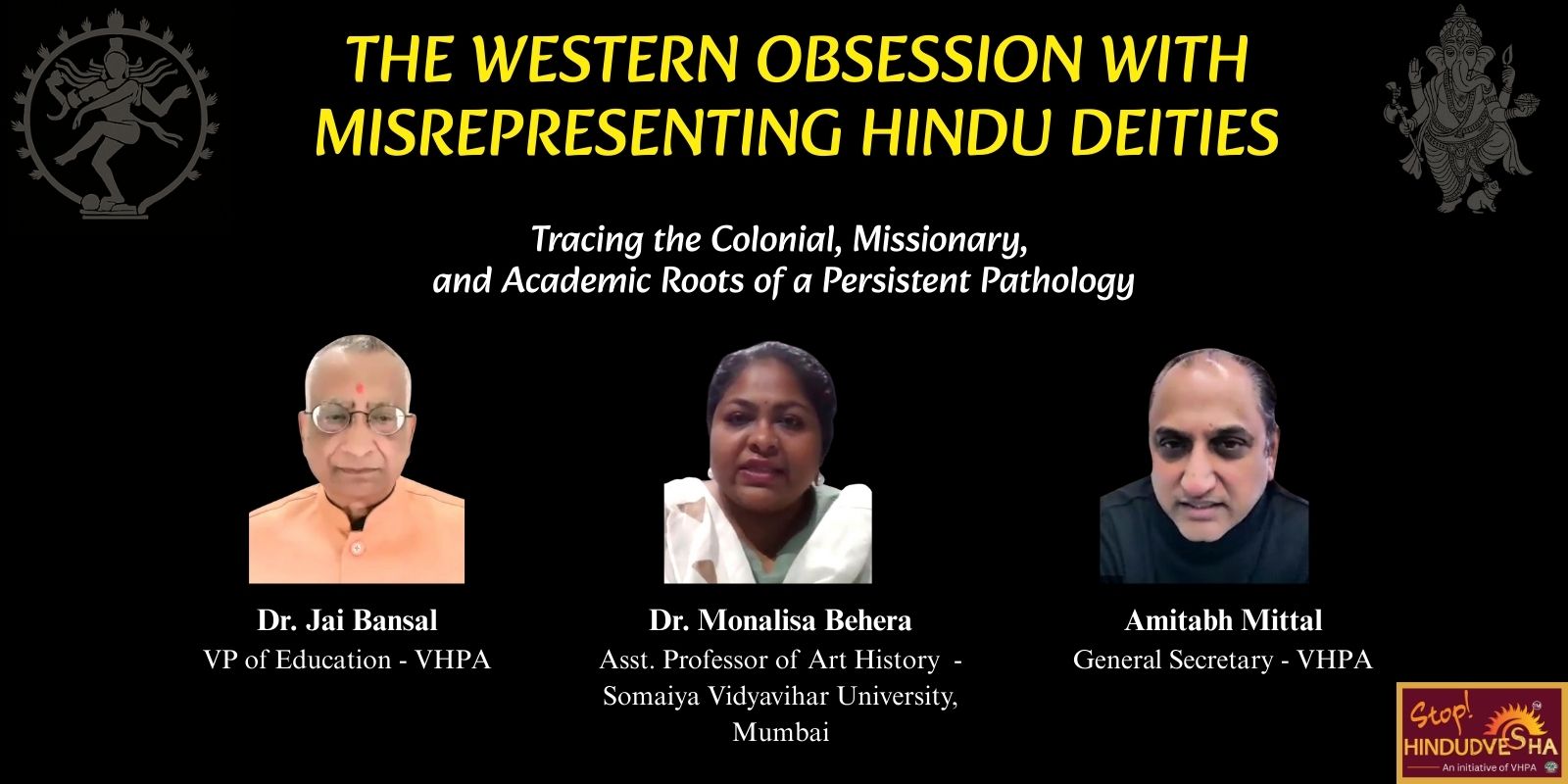
-
Western interpretations of Hindu deities have long been shaped by colonial-era theological and cultural frameworks that privileged abstraction while dismissing lived, image-based Hindu practice as inferior, irrational, or superstitious.
-
Early missionaries and later Orientalist scholars projected Christian moral dualism onto Hindu iconography, labeling non-literal, symbolic, or hybrid forms as grotesque, demonic, or primitive, often to justify cultural domination.
-
Deities such as Shiva and Kali were especially demonized because they challenged Western norms around death, destruction, sexuality, and power, which Hindu philosophy understands as cyclical, sacred, and transformative rather than evil.
-
These misreadings persist today through academic discourse and popular culture, where Hindu symbols are sexualized, trivialized, or commodified, reflecting a continued colonial impulse of selective extraction without responsibility.
-
There is growing reason for optimism, as scholars, students, and younger generations increasingly question these narratives, reclaim indigenous frameworks, and engage Hindu traditions with curiosity, confidence, and intellectual rigor.
For centuries, murtis of Hindu deities have been interpreted through intellectual and theological frameworks that were never designed to comprehend them on their own terms. From the colonial period onward, Western observers approached Hindu sacred imagery with their inherited religious assumptions, rigid moral hierarchies, and civilizational prejudices. These lenses shaped not only how Hindu deities were described, but also how Hindu religious life itself was judged.
Colonial writers such as James Mill dismissed Hindu religious art as irrational and morally inferior, treating it as evidence of a degraded civilization. Missionaries like Abbé Dubois went further, describing Hindu deities as grotesque or obscene, often without any serious engagement with their symbolic, ritual, or philosophical meanings.
The more enduring damage, however, came from scholars who claimed sympathy for Hindu thought. Figures such as Max Müller professed admiration for Vedantic philosophy while simultaneously framing Hindu deities as primitive nature gods and positioning murti worship as a lower, less evolved stage of religion. Monier-Williams, despite his deep study of Hindu texts, continued to describe image worship as superstition in need of reform.
Even philosophers like Paul Deussen, who respected Vedanta, quietly marginalized temples, icons, and lived devotional practices, treating them as intellectually inferior to abstract philosophy. Texts were elevated and praised, while embodied Hindu practice was diminished. Abstraction was respected; sacred images were treated with suspicion or disdain.
Fierce and complex deities such as Shiva and Kali were especially vulnerable to this interpretive framework. Filtered through Christian moral dualism, destruction was read as evil, power as violence, and feminine divinity as threatening or aberrant. The symbolic language of Hindu theology was flattened into moral binaries that could not accommodate its depth.
What is striking is that this pattern has not disappeared. Contemporary scholarship often reproduces the same impulses under more modern guises. Writers such as Wendy Doniger continue to sexualize Hindu deities, reducing sacred forms to metaphors, provocations, or psychological projections. Taken together, this trajectory looks less like a series of innocent misunderstandings and more like a persistent Western fixation, even a pathology, in the way Hindu divinity is perceived and represented.
To understand how these misreadings emerged, why they endure, and what they obscure about Hindu theology, art, and lived practice, we turn to the work of Dr. Monalisa Behera. Drawing on art history, visual culture, and civilizational studies, her scholarship offers the conceptual clarity needed to unpack this phenomenon and to recover Hindu sacred imagery on its own philosophical and experiential terms.
What follows is a carefully paraphrased and structured rendering of a conversation between the host and Dr. Monalisa Behera. While the form has been refined for clarity and flow, the ideas, arguments, and insights remain faithful to the substance of the original discussion, which examined the historical, theological, and cultural roots of Western misinterpretations of Hindu deities. A complete video recording of the webinar is available here: WEBINAR.
How did early European travelers and missionaries come to describe Hindu deities as monstrous or demonic, and were these portrayals the result of genuine misunderstanding or deliberate instruments of cultural domination?
The early European portrayals of Hindu deities emerged from a combination of unfamiliarity and ideological conditioning. Initial encounters undoubtedly produced confusion and aesthetic shock. However, over time, these reactions were no longer incidental. They hardened into deliberate narratives that served broader projects of cultural domination.
When Hindu deities are consistently described using terms such as monstrous, grotesque, or demonic, the issue extends far beyond misunderstanding. Such language does not arise in a vacuum. It is rooted in a Christian visual and theological framework in which divinity is expected to conform to a narrowly defined human norm. Forms that depart from this ideal, especially those that incorporate hybridity, multiplicity, or symbolic distortion, are read not as sacred but as signs of moral decay or evil.
This explains the recurring vocabulary found in early European accounts. The descriptions often verge on the fantastical, to the point where exaggeration replaces observation. In some cases, these authors appear to have internalized their own inventions. One Portuguese missionary, for example, describes a ruler on the Kerala coast as intelligent yet allegedly devoted to demonic worship, complete with lurid claims of human sacrifice and ritual violence. No evidence of such practices exists in Indian historical records. These stories are confined to European imagination rather than Indian reality.
What occurred was a projection of fear and theological discomfort onto Hindu sacred forms. Anything that could not be reconciled with Western notions of the “natural” or the acceptable was transformed into something monstrous, and monstrosity was automatically equated with evil. Hindu gods and goddesses were thus recast as demonic figures.
This was not merely a failure to grasp symbolism. It was a reflex shaped by doctrine. While misunderstanding played a role, the greater issue was a sustained refusal to engage seriously with Hindu religious logic. Hindu temples, icons, and devotional practices provoked deep anxiety because they challenged Christian assumptions about what divinity should look like and how it should be worshipped.
Within this framework, such deities could not be acknowledged as divine. Their appearance, their symbolism, and the intensity of devotion they inspired were all deemed unacceptable. The conclusion followed predictably: these figures must be corrupt, dangerous, and in need of erasure. What resulted was a process of intellectual cleansing, designed to neutralize what could not be assimilated or controlled.
Is the Western mockery of Hindu iconography merely the result of an aesthetic gap rooted in artistic realism, or does it reflect a deeper ideological resistance to symbolic and non-literal forms of divinity?
There is undoubtedly an aesthetic gap at play. Many Europeans encountering Hindu imagery for the first time had never seen such forms before. However, this alone cannot explain the reaction. Western traditions were not unfamiliar with abstraction, symbolism, or hybridity. Greek art contains composite figures, and Biblical narratives are rich with allegory and non-literal imagery.
The issue, then, is not ignorance but how that ignorance was mobilized. Claims of incomprehension became a convenient justification: look at what these people worship, therefore, they must be corrected. Selective misunderstanding and distortion were elevated into moral judgments.
Hindu sacred images were often acknowledged as visually striking or exotic, but rarely accepted as true or real. They were treated as symbolic representations rather than as living presences. In Hindu traditions, the murti is not merely an object; it embodies divinity. The temple is understood as the deity’s dwelling, and ritual life reflects an ongoing relationship with the divine.
By reducing these forms to stone idols or unnatural exaggerations, their legitimacy was undermined. Multiplicity itself became a source of anxiety. Multiple arms or heads were interpreted literally, stripped of symbolic meaning, and dismissed as irrational.
While early missionary encounters might be attributed to unfamiliarity, the persistence of such caricatures is harder to explain. Even today, figures like Ganesha are flattened into crude labels such as the “elephant god” in popular culture, where reverence gives way to parody.
Ultimately, the aesthetic gap is only part of the story. There has also been a sustained effort to weaken the authority of Hindu iconography. Mockery serves this purpose well. By making the sacred appear strange, childish, or ridiculous, it is rendered powerless and unworthy of serious engagement.
Why were Shiva and Kali, more than other Hindu deities, singled out for demonization by colonial observers, and how did Western theological insecurity and moral dualism shape their portrayal as violent or evil figures?
To grasp why Shiva and Kali were so intensely demonized, one must first understand how these deities are imagined within Hindu thought. Much of the discomfort they provoked stems from their iconography and the philosophical meanings embedded in their forms.
Kali, in particular, resists simplification. She embodies multiple, seemingly opposing qualities at once. She can destroy and nurture simultaneously, yet her destructive aspect is neither cruel nor chaotic. It is intentional and protective. She is radically autonomous, neither passive nor ornamental, and she stands outside conventional norms of femininity. In doing so, she redefines power, agency, and womanhood itself.
Shiva, too, exists beyond social boundaries. As ajanma, the unborn, he is associated with liminality, asceticism, and those on the margins of society. Both deities are linked to spaces and practices such as cremation grounds, ash, and death that appear unsettling or impure through a Western lens.
These associations trigger deep anxieties rooted in Western religious and cultural traditions. Historically, female independence has often been viewed with suspicion rather than reverence, while idealized femininity has been tied to restraint and obedience. Figures like the Virgin Mary exemplify this ideal. Kali shatters it entirely. Her nudity, her presence in cremation grounds, her skull garland, her lolling tongue, and her symbolic trampling of Shiva all defy expectations of how a goddess should appear or behave.
Shiva’s ash-smeared body and intimate association with death provoke similar unease. Yet within Hindu philosophy, death is not taboo or final. It is sacred, cyclical, and inseparable from renewal. Kali herself embodies time as an endless cycle, where destruction enables rebirth rather than negating it.
This worldview directly contradicts Western theological assumptions. A god associated with death or destruction is immediately suspect. Acts of annihilation are read as violence rather than as a necessary transformation. Kali’s form becomes especially incomprehensible: a nude goddess who is powerful, wrathful, and autonomous does not fit accepted categories of divinity.
Judged through rigid moral binaries, these deities are inevitably misread. Goddesses are expected to be gentle and subdued; wrath is equated with cruelty rather than protection. Shiva’s liberation lies beyond order and control, while Kali’s power refuses containment.
It is here that demonization takes hold. These figures represent forms of freedom that challenge Western notions of morality, hierarchy, and authority. Because they cannot be assimilated into those frameworks, they are rejected, feared, and recast as threatening or evil.
Given the deep differences in worldview, such as linear versus cyclical conceptions of time and the misreading of texts like the Bhagavad Gita as promoting violence, how should we assess the legacy of Orientalist and Indological scholars who both preserved Hindu texts and yet framed Hindu traditions through categories like myth, superstition, and primitivism?
It is fair to acknowledge that Orientalist scholars played a role in preserving important Sanskrit texts and advancing their translation. That contribution cannot be dismissed outright. At the same time, their scholarship was deeply shaped by selective comfort and, often, by ideological agendas that led to the exoticization of Hindu gods and goddesses.
A clear hierarchy emerged in how Hindu traditions were classified. The Upanishads were elevated as philosophy and therefore treated as legitimate, while the Puranas were relegated to the realm of myth. This persistent labeling raises fundamental questions about who decides what counts as philosophy and what is dismissed as mythology. Such rigid categorization became a defining feature of Orientalist thought and did significant harm to the integrity of Hindu religious understanding.
While these scholars engaged enthusiastically with abstract metaphysics, they remained deeply uneasy with Hindu images. The visual and ritual dimensions of Hinduism were treated as secondary or even embarrassing, despite the fact that murtis are themselves embodiments of the philosophical principles being praised. This disconnect was rarely acknowledged.
As a result, sacred images were dismissed as imaginative, ornamental, or unreal. Deities were described as excessively decorated, overly embellished, or disturbingly sensual. Sexual symbolism was sensationalized without any attempt to understand its metaphysical or cosmological significance. Weapons were interpreted solely as signs of violence rather than as symbols of protection, power, or order.
Ironically, abstraction was readily accepted in other cultural contexts but denied legitimacy in Hindu iconography. In this way, Orientalist scholarship helped construct Western perceptions of Hindu deities that aligned neatly with colonial narratives of cultural superiority.
The contrast between how figures were treated is revealing. The Buddha was embraced as calm, rational, and acceptable. Shiva, by contrast, was unsettling and threatening. Some scholars avoided such figures altogether, while others leaned into exaggerated exoticism. Tantra became a particularly convenient framework through which misunderstanding and sensationalism could flourish.
These interpretive choices also created internal hierarchies within Hindu traditions. Vishnu appeared less problematic because he resembled European ideals of kingship and order. Shiva did not. An ash-smeared deity with matted hair, associated with cremation grounds and those on society’s margins, defied Western expectations. Rather than confronting that challenge, it was easier to marginalize or demonize him.
Taken together, these patterns reveal how Orientalist scholarship, even when well-intentioned, often reinforced distorted and hierarchical views of Hindu divinity that continue to shape global perceptions today.
In a global consumer culture where Hindu symbols are routinely commodified on clothing, merchandise, and especially through commercialized yoga branding, do you see this as simple ignorance or as a continuation of colonial patterns of appropriation and trivialization?
This phenomenon is best understood as a continuation of the colonial mindset rather than a matter of ignorance. In an age where information is readily accessible, lack of knowledge is no longer a credible defense. What we see instead is a willful refusal to engage seriously with a culture while simultaneously feeling entitled to use it.
Hindu traditions are often perceived as non-threatening and endlessly malleable, something that can be picked up, altered, and repackaged without consequence. There is an underlying assumption that these symbols have no living constituency and that no objections will be raised. As a result, sacred images are appropriated, distorted, and commercialized with little restraint.
This is evident across popular culture and fashion, and especially in the commodification of yoga. The sacred is flattened into style. Krishna becomes a visual trope or aesthetic mood rather than a complex philosophical presence. What is taken is whatever appears attractive or fashionable, while the deeper ethical, spiritual, and metaphysical foundations are ignored.
Yoga undergoes a similar reduction. It is stripped down to physical postures and breathing techniques, detached from the moral discipline, philosophical grounding, and spiritual rigor that define it as a system of practice.
This kind of selective borrowing reflects a deeply colonial impulse: extract what is pleasing, discard what demands responsibility or depth, and reshape it for consumption. Engagement that requires humility, discipline, or ethical commitment is avoided, while surface-level appropriation is normalized.
How can Hindus engage Western institutions in a spirit of dialogue while firmly defending the integrity of their symbols, iconography, and civilizational values against misrepresentation or dilution?
Engagement has to begin from a position of self-clarity. The problem often starts when even committed Hindus describe their own traditions using terms like “myth,” which already carry dismissive assumptions. Without a language rooted in our own philosophical frameworks, meaningful dialogue becomes impossible. We cannot defend what we ourselves have not fully understood or articulated.
Developing an indigenous vocabulary is therefore essential. Before negotiating with external institutions, we must first deepen our understanding of our own deities, symbols, and practices. Borrowed categories distort more than they explain, and relying on them weakens any attempt at serious engagement.
At the same time, misappropriation cannot go unchallenged. This does not require censorship, but it does require clarity and firmness. Artistic freedom must be accompanied by responsibility. Hindu sacred forms are not open-ended aesthetic material to be endlessly altered or repackaged without comprehension.
This is because Hindu deities are not symbolic stand-ins; they are experienced as living presences. Treating them as mere representations erases their ontological status. Drawing boundaries around how these images are used or interpreted is therefore necessary, and those boundaries must be stated confidently.
A related concern is the museumization of Hindu icons. When sacred images are reduced to artifacts or antiquities, their living context is stripped away. Labels play a critical role here. Describing Nataraja simply as “Dancing Shiva” collapses a profound cosmological vision into a superficial description. What is being depicted is not a dance in the ordinary sense, but the dynamic unfolding of the universe itself. The limitation lies in the label, not in the image.
Ultimately, education is the key lever. When academic spaces begin to approach Hindu traditions through civilizational and philosophical lenses, there is room to correct entrenched misreadings. But this process begins with us. Establishing and insisting on our own conceptual language is not optional; it is foundational.
From a civilizational perspective, do you see meaningful shifts in the intellectual and cultural space that suggest we are beginning to challenge entrenched misrepresentations of Hindu traditions, and are there genuine reasons for optimism?
I am sincerely optimistic. The shift has already begun. More people are willing to challenge misrepresentations and speak up when distortions occur. That willingness itself marks an important change.
I see particular promise within academic spaces and among students. Some of the most engaged and curious learners I encounter come from technical backgrounds, especially engineering. Their interest is not superficial. They want to understand context, meaning, and history.
Recently, students who visited the Elephanta Caves undertook detailed research and are now building a digital platform to communicate the deeper significance of the site. They are beginning to see Elephanta not as a generic cave complex, but as a carefully conceived sacred landscape, envisioned as the abode of Shiva and a symbolic manifestation of Kailasa.
This kind of informed, self-driven engagement suggests that a more confident and rooted intellectual culture is taking shape, and that gives me real reason for hope.
Given the rise of dharmic tourism and cultural initiatives among Hindu youth, do you see signs among Gen Z and Gen Alpha that suggest a renewed curiosity and engagement with Hindu traditions, and reasons for optimism for the future?
Yes, very much so. What I see most clearly among younger generations is curiosity, and that is an encouraging sign. They are eager to explore Hindu culture and religious traditions in ways that feel authentic to them.
Their modes of engagement may differ from earlier generations. They may not always begin with formal texts, but they want to participate in the conversation and understand why these traditions matter. There is a growing sense that this cultural inheritance is worth paying attention to.
Not everyone needs to become a specialist. Even basic awareness represents a meaningful step forward. As an educator, my aim is simply to nurture curiosity and help sustain that interest, and from that perspective, I remain strongly optimistic.
Dr. Behera, thank you so much for sharing your time, scholarship, and thoughtful insights with us today. Your clarity and depth have helped us better understand how misrepresentations of Hindu traditions emerged and why they continue to persist. We truly look forward to continuing this conversation with you in the future. Namaste.
Thank you.
Brief Biography of Dr. Monalisa Behera
Dr. Behera is an art historian and curator who currently serves as Assistant Professor of Art History at the Somaiya School of Civilizational Studies in Mumbai. Her teaching spans visual and material culture, Indian art history from the pre-modern to the contemporary, aesthetics, and cultural studies.
She earned her PhD in Visual Studies from the School of Arts and Aesthetics at Jawaharlal Nehru University, Delhi, and has been a visiting doctoral fellow at both University College Dublin and the Chester Beatty Library in Dublin.
Her research examines the intersections of ritual practice, iconography, and architecture, with a particular emphasis on the visual and material cultures of the feminine divine in ancient and medieval Bharat. She is especially interested in how sacred images and spaces shape religious experience and express structures of power.

Donate to HINDUDVESHA
Our Mission is to explore and expose Hindudvesha through research analysis, education and response.
SUPPORT US