
The Global Right Turn: What It Means for Hindus Worldwide
 Rati Agnihotri · 04/06/2025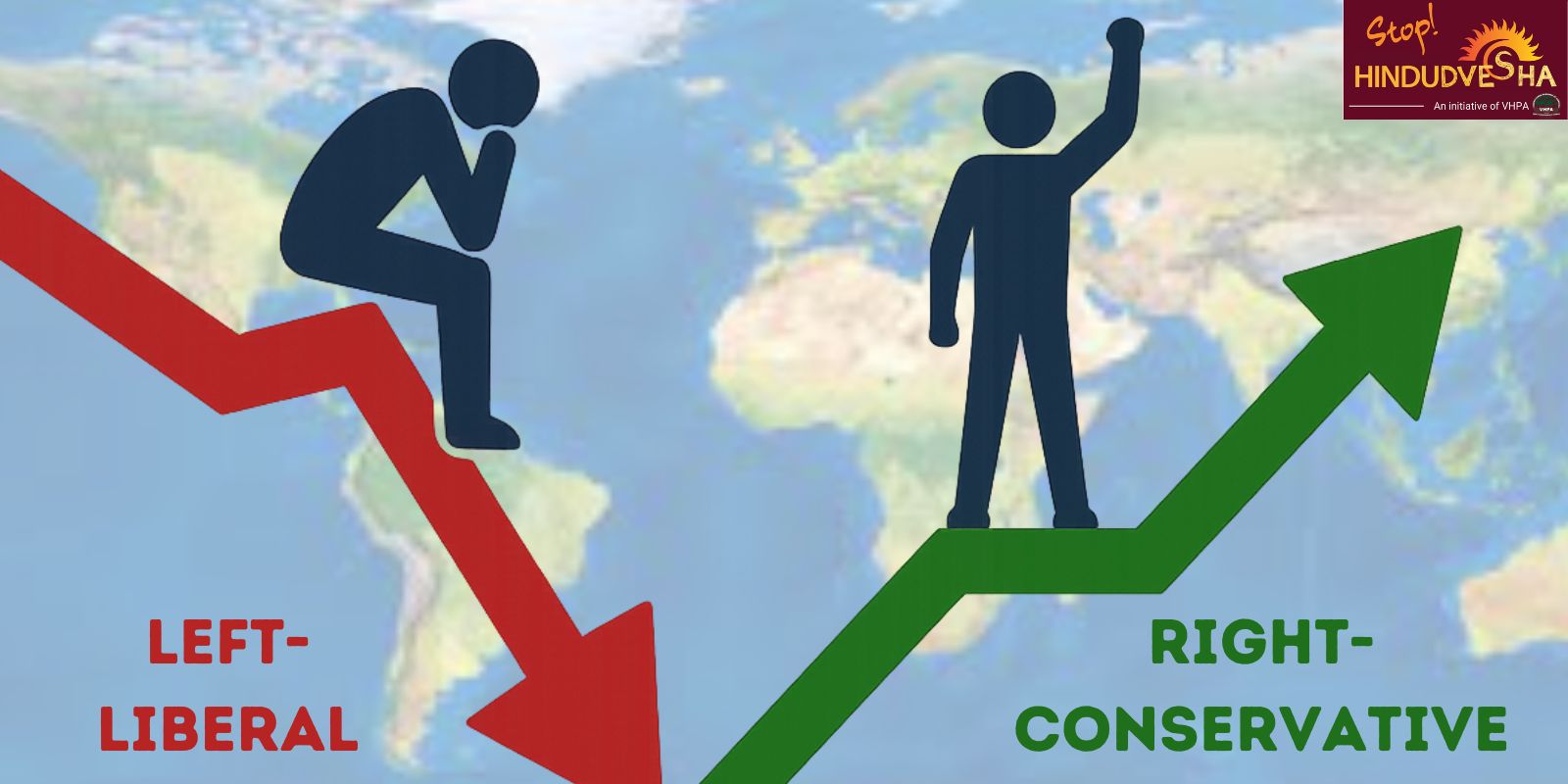
- Nationalist governments in the West are actively cracking down on the woke leftist ecosystem, which not only opposes classical Western values but has also been hostile to Hindu civilizational and cultural values.
- These governments are also adopting a tough stance against radical Islamic extremism and terrorism—developments that carry positive implications for the safety and security of Hindu communities globally.
- The inclusion of Hindu Americans in key positions within the Trump administration is likely to significantly influence how Hindu issues are perceived and addressed within U.S. politics.
- Efforts by nationalist governments to dismantle the George Soros network are especially noteworthy, as weakening this ecosystem would undermine a major source of global anti-Hindu narratives.
- India can strategically leverage the shifting contours of the global order to elevate the visibility of Hindu concerns and shape international policymaking in ways that align with its civilizational interests.
The global order is undergoing a significant transformation, marked by unpredictable shifts and novel alignments. With multiple stakeholders now influencing global affairs and the rise of the Global South as a collective force, the traditional dominance of the Global North—particularly the West—is increasingly being challenged. Parallel to this development is the decline of the long-standing left-liberal ideological framework as nationalist or non-left-wing governments rise to power across the world, especially in Western nations.
Currently, at least six European countries—Italy, Hungary, Finland, Croatia, Slovakia, and the Czech Republic—are governed by right-leaning administrations.[1] In the United States, the recently elected Trump government has taken a firm stand against what it sees as the “global deep state,” an international leftist network often associated with figures like billionaire philanthropist George Soros. [2]
As the left-liberal and “woke” narratives come under scrutiny, the emerging world order appears to favor a return to traditional social values and ethics. This shift holds important implications for the global Hindu community, as the rise of the Right may help dismantle the toxic agenda of the leftist ideologies that have not only been at odds with classical Western values but also inimical to the Hindu civilizational and cultural values.
That said, segments of the far-right continue to espouse Hinduphobic views, often aligning with White supremacist and evangelical rhetoric. The Hindu community, therefore, finds itself navigating a complex landscape. Nevertheless, as most nationalist governments remain focused on domestic priorities and patriotic narratives, this new climate may offer Hindus some relief from the aggressive, anti-Hindu discourse perpetuated by the global left nexus.
Moreover, the alliance between radical Islamism and far-left activism, often unified under the banner of wokeism, may weaken under the new paradigm. Since nationalist regimes tend to adopt strict measures against Islamist extremism,[3] [4] [5] [6] this shift could enhance the global Hindu community’s safety and influence.
The following sections will explore these dynamics in greater depth.
Trump Government Implications for Hindu Issues
One of the major outcomes of Indian Prime Minister Narendra Modi’s visit to the United States in February was the renewed commitment between India and the U.S. to jointly combat radical Islamic terrorism. During the bilateral meeting, President Donald Trump announced the upcoming extradition of Tahawwur Rana, a former Pakistani Army doctor involved in the 2008 Mumbai terror attacks. Trump also emphasized the shared objective of both nations to address “the threat of radical Islamic extremism.” [7]
The joint statement released after the meeting reiterated this focus, underscoring the importance of strengthening counter-terrorism cooperation. Both leaders expressed their intent to act against terror groups such as ISIS, Al-Qa’ida, Lashkar-e-Taiba, and Jaish-e-Mohammad. The statement also called on Pakistan to ensure accountability for the perpetrators of the 26/11 Mumbai and Pathankot attacks and to prevent its territory from being used for cross-border terrorism. [8]
Beyond this meeting, the Trump administration has taken a notably hard stance against radical Islamist extremism, marking a sharp departure from the woke rhetoric of its predecessors. Among its measures was the decision to freeze USAID globally—a move expected to significantly curb the funding networks of radical Islamic terror groups. Media investigations have suggested that USAID funds, supposedly designated for development and cultural projects in countries like Pakistan, were often misused to support terror activities.[9] A report by OpIndia sheds further light on how the USAID helped terrorist organizations ranging from the LeT in Pakistan to Hamas in Gaza via its vast network of NGOs.[10]
The Trump administration’s firm stance on radical Islamic terrorism is a welcome development from the perspective of the global Hindu community. It signals a stronger commitment to ensuring the safety and security of Hindus worldwide. One of the most impactful moves in this regard has been the dismantling of USAID funding networks, which have previously been linked to supporting organizations with a history of anti-Hindu sentiment. By drying up these financial channels, the administration has helped to curtail both the material and ideological machinery that fuels Hindudvesha—the systemic hostility toward Hindu beliefs, culture, and civilization.
While it would be unrealistic to expect the anti-Hindu ecosystem to be dismantled overnight, the disruption of its funding sources is a significant first step. This weakening of the ecosystem offers a degree of respite to Hindus, who have long been subject to misrepresentation and targeted narratives at the global level.
Moreover, when a global power such as the United States adopts a definitive stance against radical Islamic extremism, it creates new avenues for Hindus to engage with and influence international policymaking, particularly on issues concerning their rights and representation.
The increasing presence of Indian Americans in influential political positions further strengthens this shift. Two prominent Hindu Americans currently serving in the Trump administration are FBI Chief Kash Patel and the U.S. Director of National Intelligence, Tulsi Gabbard. Gabbard, a devout Vaishnavi from the Brahma Madhva Gaudiya Sampradaya, is the first Hindu elected to the U.S. Congress and the first to take her oath of office on the Bhagavad Gita. [11] Kash Patel, born in New York to Gujarati parents, also openly embraces his Hindu identity. During his Senate Judiciary Committee confirmation hearing, he greeted his parents with “Jai Shri Krishna” and touched their feet in a traditional gesture of respect—an act that resonated widely within the Hindu diaspora. [12]
The presence of practicing Hindus in senior roles within the Trump administration has raised hopes regarding its approach to issues facing the Hindu-American community. Concerns such as the rise in anti-Hindu hate crimes, the vilification of Hindu practices under the pretext of addressing caste discrimination, the misrepresentation of Hinduism in U.S. school textbooks, and the overall spread of Hinduphobia are gaining increasing attention.
That said, regarding the United States’ official position on Hindu-related concerns at the global level, expectations must remain realistic. Even prominent Hindu figures such as Tulsi Gabbard and Kash Patel are, first and foremost, public servants accountable to the American people. Their policy priorities will naturally align with U.S. national interests. However, their roles’ symbolic and practical significance cannot be underestimated. Their presence reflects a broader shift in how Hindu identity is perceived and engaged within the corridors of power. It lays the foundation for greater cultural sensitivity toward Hindu traditions, values, and practices within U.S. institutions.
The Hindu heritage of Usha Vance, the first Indian American and Hindu Second Lady of the United States, further reinforces this shift. Her visibility on the national stage is expected to contribute meaningfully to the recontextualization of Hindu culture in America and to challenge long-standing negative stereotypes.
During a recent visit to India, Tulsi Gabbard, in an interview with ANI, reflected on the profound influence of the Bhagavad Gita in her life, highlighting how Lord Krishna’s counsel to Arjuna has provided her with strength and clarity, whether navigating conflict zones or complex professional challenges.[13]
Thus, under the Trump administration, U.S.-India relations appear to be undergoing a notable reset, particularly in intercultural diplomacy. This renewed engagement holds promise for the global representation of Hindu issues, offering space for greater cultural exchange and recognition. However, beyond symbolic gestures and high-profile appointments, it remains to be seen how these developments will translate into concrete policymaking.
On the other hand, it is important to acknowledge the challenges that persist within certain segments of the American political landscape. A faction within the MAGA movement has been associated with far-right rhetoric, including white supremacist and racist undertones. This became evident when names of potential Hindu American appointees to the Trump administration began circulating, triggering a wave of online racism targeting the community. Notably, entrepreneur Vivek Ramaswamy, initially expected to co-lead the Department of Government Efficiency (DOGE) alongside Elon Musk, faced intense racist trolling. Although his eventual removal from consideration may not have been directly caused by this backlash, the timing of events has sparked debate and raised concerns.[14]
Similarly, in January, the appointment of Sriram Krishnan, a Chennai-born tech expert, as Senior White House Policy Adviser on Artificial Intelligence led to a surge in xenophobic remarks across social media platforms. These instances reveal that a section of American society remains resistant to diverse representation despite institutional inclusion. [15]
However, such racist episodes should not be seen as reflective of American society as a whole. The appointments of Tulsi Gabbard, Kash Patel, and Sriram Krishnan to influential roles within the Trump administration suggest that anti-Hindu sentiments within MAGA are likely confined to a fringe minority. Ultimately, the trajectory of these dynamics—whether inclusive or exclusionary—will shape the future of U.S. engagement with Hindu issues – domestically and globally.
Global Right-Wing Surge Implications for Hindus
To begin with, we’d like to clarify that the term “right-wing” is used here purely for convenience. The term carries heavy historical baggage, including associations with fascism and tyranny. The current wave of rising nationalism in global politics cannot be adequately described using the simplistic binary of left-wing vs. right-wing. Therefore, the term “non-left-wing” or “nationalist government” is more appropriate to explain the emergence of regimes that pose a significant challenge to entrenched left-liberal narratives.
What kind of impact will the global surge of “right-wing” politics have on Hindu issues? In the context of nationalist governments in the Western world, the effects may not be immediately visible—certainly not in any easily measurable sense. For instance, the governments of Giorgia Meloni in Italy and Viktor Orbán in Hungary are unlikely to take direct action to address Hindu concerns. Their priorities remain primarily domestic: safeguarding their populations, spurring economic growth and employment, and managing immigration. However, since many of these governments have taken a firm stance against wokeism—the ideological root of much global anti-Hindu propaganda—their crackdown on such ideas will indirectly weaken the anti-Hindu ecosystem.
The West has become a major epicenter of anti-Hindu propaganda. Western media, academia, and think tanks have played an influential and often malign role in reinforcing the structures of Hindudvesha. A serious pushback against this ecosystem is, therefore, likely to result in at least a noticeable decline in toxic narratives targeting the Hindu community, if not their complete cessation.
For example, Hungarian Prime Minister Viktor Orbán has vowed to protect Europe from NGO networks led by Hungarian-American billionaire philanthropist George Soros, claiming that these groups are shifting their focus to Belgium following the crackdown on USAID under U.S. President Donald Trump.[16]
As various media reports have highlighted, the Soros-linked NGO network has been at the forefront of spreading anti-India and anti-Hindu narratives. [17] Such subversive activities are often cloaked in the language of human rights advocacy. The West is the primary funding source for these initiatives, with countries like India serving as soft targets. As more nationalist governments gain power across the West, such anti-Hindu ecosystems will likely be dismantled at the source.
In January, Italian Prime Minister Giorgia Meloni stated that George Soros interferes in the internal affairs of other countries and uses his wealth to destabilize nations. Her remarks came in response to criticism directed at Elon Musk over his alleged involvement in the domestic politics of European countries. Meloni invoked the Soros example to highlight the contrast between the two, suggesting that the negative portrayal of Musk may stem from the fact that he is not aligned with the left. [18]
Nationalist governments around the world have long been on George Soros’s radar. His modus operandi typically involves engineering regime change by manipulating public opinion and fostering internal discord. The Soros network has become a haven for various anti-Hindu elements, including woke activists, radical Islamists, and the Khalistani nexus. As such, the global dismantling of this network is a critical first step toward breaking down the ecosystem responsible for spreading anti-Hindu narratives.
Another key aspect of the rise of nationalist governments in the West is their uncompromising stance against radical Islamic extremism and terrorism. Hindus have suffered at the hands of radical Islamic terrorism for centuries. There was a time when Western governments turned a blind eye to India’s concerns about cross-border terrorism originating from Pakistan. However, the current geopolitical climate is markedly different. India, led by a nationalist government now in its third term, occupies a stronger position on the global stage. Moreover, left-liberal dominance in Western politics has waned. The rise of Donald Trump in the U.S., along with other nationalist leaders across Europe, has led to a renewed emphasis on developing joint strategies to combat radical Islamic terrorism. This development presents a win-win scenario for the Hindu community.
During her recent visit to India, U.S. Director of National Intelligence Tulsi Gabbard remarked that Islamic terrorism poses a common threat to India, the U.S., and several Middle Eastern countries. She noted that Prime Minister Modi and President Trump are working together to “defeat the threat.” [19] Gabbard also condemned the persecution of Hindu minorities in Bangladesh, stating that the Trump administration is deeply concerned about these atrocities and is committed to confronting Islamist terrorism globally. [20]
India’s Defense Minister Rajnath Singh also raised the issue of Khalistani extremists operating from American soil during his meeting with Gabbard. He urged the U.S. government to take decisive action against the Khalistani group Sikhs for Justice (SFJ), which is banned in India for its anti-national activities. [21]
Overall, the rise of nationalist governments has led to a marked shift in the West’s approach to Islamic terrorism. This transformation could significantly impact efforts to counter the radicalization of Indian Muslims, who are increasingly being targeted by terrorist organizations through online grooming networks. A firm Western stance against radical Islamic terrorism will ultimately aid in addressing several pressing issues faced by Hindus in India and beyond.
Repositioning of the UN: Impact on Hindu Issues
Under the Trump administration, the United States—a major stakeholder in global affairs—appears to be growing increasingly impatient with the United Nations. America has already withdrawn from the World Health Organization (WHO) under Trump’s leadership. In February, the U.S. President ordered a halt to American engagement with several UN agencies, including the United Nations Human Rights Council (UNHRC), and initiated a sweeping review of the country’s financial contributions to the UN as a whole. Trump has also reportedly criticized the organization, stating bluntly that it is not functioning effectively and needs to get its act together. He has openly highlighted the UN’s failure to resolve long-standing global conflicts—something that, in his view, should have been one of its core purposes. [22]
This decision to reassess and potentially reduce funding to the UN aligns with the Trump administration’s broader agenda of curbing wasteful expenditure. The U.S. government has expressed serious concerns about what it sees as glaring disparities in how different countries contribute to the UN financially and in terms of commitment. The administration believes that American taxpayers are unfairly burdened, subsidizing a global institution that often does not align with U.S. national interests. [23]
In March, Tesla CEO and DOGE figurehead Elon Musk stirred controversy when he responded “I agree” to a social media post advocating for the U.S. to withdraw from both NATO and the UN. [24] While a complete American withdrawal from the UN may seem far-fetched at this stage, it is plausible that the Trump administration could further reduce funding, which would inevitably affect the UN’s functioning and reach. Interestingly, such a move might not be entirely negative when viewed from the lens of Hindu concerns.
In its present form, the United Nations often appears to function like a shadow government aligned with the global deep state. It exhibits a pronounced bias in favor of radical Islamic elements while routinely ignoring or downplaying the safety and human rights of Hindu communities. The UN has yet to officially acknowledge the existence of Hinduphobia, even though it recognizes other religious phobias such as Islamophobia, anti-Christian hate, and antisemitism. Its failure to take a clear and decisive stance on the persecution of Hindu minorities in countries like Bangladesh further underlines this one-sidedness.
The United Nations has increasingly become a dysfunctional and corrupt institution that consistently turns a blind eye to Hindu issues. As such, any weakening of the UN’s influence would inevitably diminish the power of the anti-Hindu forces that currently hold the organization hostage—an outcome that would be favorable for the global Hindu community.
If the UN’s sphere of relevance continues to contract, India could seize the opportunity to amplify the role of alternative, less biased, and more pro-Hindu platforms. One such avenue is India’s active engagement with the Global South, which could be strategically leveraged to build a broad-based consensus around Hindu concerns and narratives.
Another possibility is that the Trump administration’s assertive, action-oriented approach may catalyze an institutional overhaul of the UN. Such reform could help rebalance the global body and weaken the dominance of the left-liberal and Islamist nexus that currently shapes its orientation. Under Trump’s leadership, the United States and India have already committed to working jointly against radical Islamic extremism. India should build on this strategic convergence to push for a more inclusive and balanced global policy framework that acknowledges and addresses Hindu issues on an international level.
Conclusion
The rise of nationalist governments across the West has provided Hindu-majority India with significant leverage to initiate a radical overhaul of the global discourse surrounding Hindu Dharma and culture—one that aligns with the interests and aspirations of its practitioners.
With a nationalist government at the helm for a third consecutive term, India holds a clear democratic mandate to reshape its national narrative through the lens of its ancient civilizational and cultural ethos. Strengthening India’s Hindu narrative, along with its assertive global projection, is bound to have a positive and far-reaching impact on the lives of Hindus across the world.
Citations
[1] Mapped: Europe’s rapidly rising right – POLITICO; https://www.politico.eu/article/mapped-europe-far-right-government-power-politics-eu-italy-finalnd-hungary-parties-elections-polling/
[2] Trump screwed Soros funding – EADaily, February 2nd, 2025 – Politics, Russia; https://eadaily.com/en/news/2025/02/02/trump-screwed-soros-funding
[3] Trump pledges action against Islamic terrorists, Khalistani subversives – The Times of India; https://timesofindia.indiatimes.com/world/us/trump-pledges-action-against-islamic-terrorists-khalistani-subversives/articleshow/118253332.cms
[4] Viktor Orban: Hungary doesn’t want ‘Muslim invaders’ – POLITICO; https://www.politico.eu/article/viktor-orban-hungary-doesnt-want-muslim-invaders/
[5] Islam was ‘Never Part of Europe’: Hungary’s Viktor Orban; https://www.ndtv.com/world-news/islam-was-never-part-of-europe-hungarys-viktor-orban-1233239
[6] No place for Islamic culture in Europe, says Italy’s Giorgia Meloni at far right event – The Economic Times; https://economictimes.indiatimes.com/news/international/world-news/italy-pm-giorgia-meloni-makes-loaded-comment-on-islam-at-far-right-event/articleshow/106079509.cms?from=mdr
[7] Trump pledges action against Islamic terrorists, Khalistani subversives – The Times of India; https://timesofindia.indiatimes.com/world/us/trump-pledges-action-against-islamic-terrorists-khalistani-subversives/articleshow/118253332.cms
[8] India-US. Joint Statement ( February 13, 2025); https://www.mea.gov.in/bilateral-documents.htm?dtl/39066
[9] India-US factor, freezing of USAID hits ISI’s notorious plans in Bangladesh; https://organiser.org/2025/02/24/279708/world/india-us-factor-freezing-of-usaid-hits-isis-notorious-plans-in-bangladesh/
[10] From LeT to Hamas: Read how USAID has been funding terror organisations across the globe through intermediary NGOs; https://www.opindia.com/2025/02/usaid-stands-exposed-under-trump-how-it-helped-terrorist-organisations-from-let-in-pakistan-to-hamas-in-gaza-via-ngos/
[11] ISKCON News | Tulsi Gabbard Becomes First Hindu to Lead U.S. Intelligence, Drawing Strength from Vaishnava Teachings | ISKCON News; https://iskconnews.org/tulsi-gabbard-becomes-first-hindu-to-lead-u-s-intelligence-drawing-strength-from-vaishnava-teachings/
[12] Why Kash Patel, FBI Chief Pick, Said “Jai Shri Krishna” At Senate Hearing; https://www.ndtv.com/world-news/donald-trump-fbi-chief-pick-kash-patel-greets-parents-with-jai-shri-krishna-at-us-senate-hearing-7600337
[13] ‘Turn to Lord Krishna’s teachings in Bhagavad Gita in hard times’: US spy chief Tulsi Gabbard | India News- The Times of India; https://timesofindia.indiatimes.com/india/turn-to-lord-krishnas-teachings-in-bhagavad-gita-in-hard-times-spy-chief-tulsi-gabbard-donald-trump-pm-modi-tariff-reciprocal-hindu-bilateral-ties/articleshow/119110391.cms
[14] Why MAGA will never fully embrace Usha Vance or Vivek Ramaswamy | World News – The Times of India; https://timesofindia.indiatimes.com/world/us/why-maga-will-never-fully-embrace-usha-vance-or-vivek-ramaswamy/articleshow/117488533.cms
[15] Explosion of racism against Indians reflects ineptitude and irreversible decay of Western society – Firstpost; https://www.firstpost.com/opinion/explosion-of-racism-against-indians-reflects-ineptitude-and-irreversible-decay-of-western-society-13850189.html
[16] Soros Network Fleeing To Europe After Trump’s USAID Crackdown? Hungary PM Says ‘Won’t Let Them…’ News 18; https://www.news18.com/world/soros-network-fleeing-to-europe-after-trumps-usaid-crackdown-hungarys-pm-says-wont-let-them-9232253.html
[17] How George Soros is fueling anti-India narrative through media and NGOs; https://www.opindia.com/2021/07/how-george-soros-fund-open-society-foundation-anti-india-narrative-media-ngos/
[18] George Soros Indulges in Political Interference: Italy’s Giorgia Meloni; https://www.ndtv.com/world-news/george-soros-indulges-in-political-interference-italys-giorgia-meloni-7443886
[19] ‘Islamist Terrorism Impacting People in India’: Tulsi Gabbard On Pakistan-Sponsored Terror – News18; https://www.news18.com/india/islamist-terrorism-impacting-people-in-india-tulsi-gabbard-on-pakistan-sponsored-terror-pm-modi-donald-trump-9264552.html
[20] Persecution, killing of Hindus in Bangladesh a concern for US: Tulsi Gabbard | Latest News India – Hindustan Times; https://www.hindustantimes.com/india-news/persecution-killing-of-hindus-in-bangladesh-a-concern-for-us-tulsi-gabbard-101742223750159.html
[21] India tells US to crackdown on anti-India activities of Khalistani terror outfit SFJ: Report | India News – The Times of India; https://timesofindia.indiatimes.com/india/india-tells-us-to-crackdown-on-anti-india-activities-of-khalistani-terror-outfit-sfj-report/articleshow/119111830.cms
[22]Donald Trump Halts US Involvement With UN Rights Body Over “Anti-American Bias”; https://www.ndtv.com/world-news/donald-trump-halts-us-involvement-with-un-rights-body-over-anti-american-bias-7636974
[23] Ibid.
[24] ‘I agree’: Elon Musk supports US withdrawal from NATO and United Nations – What could it mean? – World News | The Financial Express; https://www.financialexpress.com/world-news/i-agree-elon-musk-supports-us-withdrawal-from-nato-and-united-nations-what-could-it-mean/3765074/

Donate to HINDUDVESHA
Our Mission is to explore and expose Hindudvesha through research analysis, education and response.
SUPPORT US