

Secular in Name, Anti-Hindu in Practice: India’s Legal Double Standards
 K. Sindhu · 06/30/2025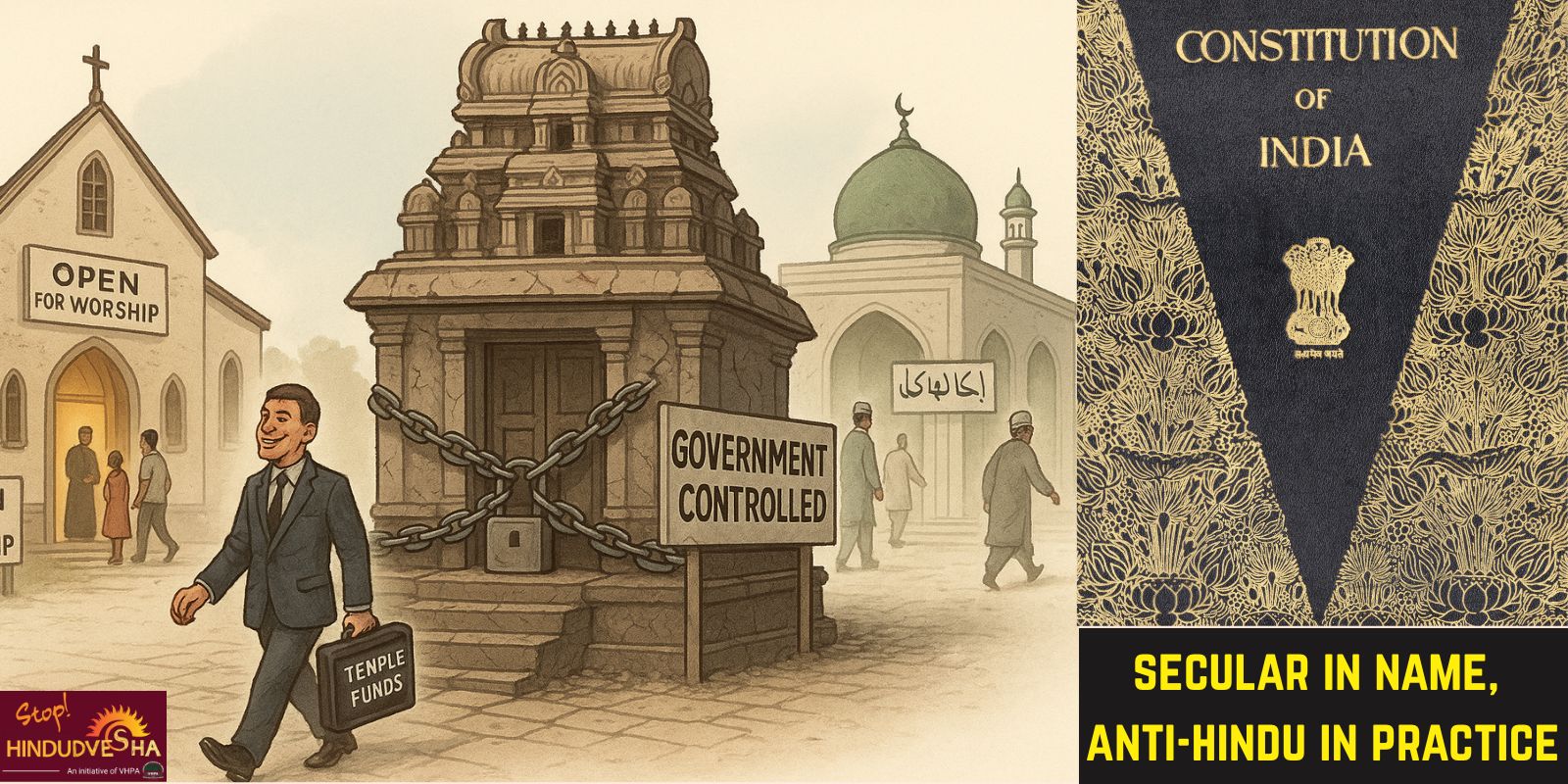
- Hindu temples are unfairly subjected to government control over finances and administration, while other religious institutions remain autonomous.
- Temple donations meant for religious purposes are diverted to secular projects and, in some cases, support institutions of other faiths.
- Articles 25 and 26 are routinely undermined for Hindus, restricting their right to propagate, manage, and sustain their faith.
- Bureaucratic interference dilutes temple traditions, appoints non-believers, and suppresses cultural expression vital to Hindu identity.
- Restoring temple self-governance is essential not just for fairness, but for preserving Hindu Dharma and resisting coercive conversions.
The Preamble to the Constitution of India proclaimed the nation to be secular by explicitly inserting the word “secular” in 1976. It also pledges to uphold “liberty of thought, expression, belief, faith, and worship” and “equality of status and of opportunity.” As the Preamble serves as the guiding spirit and interpretive lens of the Constitution, it implies that the Indian State must remain detached from religion, treat all faiths impartially, and guarantee every citizen the freedom to believe, worship, and access equal opportunities.
Yet, when we turn to Article 25 of the Indian Constitution, a glaring contradiction emerges. While Article 25(1) assures every individual the fundamental right to freedom of conscience and the right to profess, practice, and propagate religion, Article 25(2) permits the State to regulate any financial, economic, or other secular activities linked with religious practice. It is through this clause that governments routinely intrude into Hindu religious institutions, cloaking interference in the rhetoric of regulating “secular affairs.”
This article investigates how this constitutional right, especially the right to propagate religion, is increasingly detrimental to Hindus in a country that claims to be secular. It will analyze the barriers Hindus face in practicing and propagating their faith, the extent of State control over their institutions, and the broader consequences of such interference on Hindu spiritual and cultural life. A historical analysis of pre- and post-independence legislation curbing temple autonomy and earlier movements for temple liberation has already been covered in Stop Hindudvesha ‘s previous articles[1][2] and is thus not repeated here.
Government Control: Obstructing Hindu Religious Freedom
For any institution to function autonomously, it must have the authority to manage its own affairs. In the case of Hindu temples, however, it is an open secret that most are under direct government control. This control, especially over finances, has severely restricted their ability to fund the promotion of Hinduism, undermining the community’s constitutionally protected right to propagate its faith. Temples are forced to rely on the State even for basic operations, stripping them of independence and dignity. Only a small portion of temple funds is spent on essential religious needs like salaries for pandits, pujaris, and support staff. The bulk is diverted to so-called “secular activities” such as building roads, airports, or, ironically, aiding other religions.[3]
The result is grim: resources meant to sustain and spread Hindu dharma are siphoned off, while thousands of temples are left in financial disrepair. Many cannot afford daily pujas or even basic offerings. Countless small temples are on the verge of shutting down—or already have. In 2020, the Tamil Nadu government informed the Madras High Court that 11,999 temples had ceased rituals due to lack of revenue. Another 34,000 had only one person managing all affairs. An alarming 37,000 temples reported annual incomes under ₹10,000. The forecast was equally bleak: over 12,000 temples were expected to vanish in the coming years.[4] These figures lay bare how State control has crippled temple autonomy and hollowed out the right to religious propagation in what is called a secular republic.
The irony is glaring. Once self-sustaining and community-driven, Hindu temples now face financial ruin as their funds are channeled into State projects—expenditures that should come from public revenue, not sacred donations. Worse, this redirection of wealth often masks misappropriation, vote-bank politics, and opaque dealings. It is not merely a legal failure—it is a civilizational betrayal.
Misuse of Temple Funds
Devotees offer donations to temples—and through them, to the Divine—with the clear belief that these funds will support the care of deities, maintain temple spaces, and promote Sanatana Dharma. When the government appropriates these sacred offerings, it betrays that trust. Such diversion is not just a misuse of public donations—it strikes at the core of religious freedom and institutional sanctity.
What makes this worse is the double standard. If temple funds were used to support Hindu causes—reviving rituals, aiding poor Hindus, or promoting Dharma—there would be uproar from so-called secularists (including many secular Hindus), political elites, and international critics, claiming that secularism is under threat. But when those same funds are redirected to secular infrastructure—or even to benefit institutions of other religions—there is near-total silence. Instead, public figures often mock temple traditions and ridicule Hindu devotion. This is Bharat’s tragic paradox: the majority community is routinely denied full religious and financial autonomy, while minority institutions like mosques, churches, gurudwaras, and Jain or Buddhist centers remain untouched by such State control.
This selective application of “secularism” reveals its hollow core. It raises urgent questions about why Hindus, in their own homeland, face such systemic discrimination.
Violation of Secularism and Equal Treatment Laws
Secularism, in its true essence, rests on the principle of Sarv Dharma Sambhav—equal respect for all religions—and the imperative that the State remains neutral, refraining from interference in religious matters. Yet, the government’s treatment of Hindu temples starkly contradicts this foundational ideal. While mosques, churches, and gurudwaras enjoy full autonomy, Hindu temples remain under tight state control. Article 26 of the Indian Constitution explicitly guarantees every religious denomination the right to manage its own affairs. However, in practice, this right is curtailed almost exclusively for Hindu institutions. The justification often cited—regulation of “secular affairs” under Article 25(2)—fails to hold water when such control is not applied uniformly across all religious bodies.
This selective, discriminatory, and disadvantageous treatment amounts to a gross violation of both the spirit and the letter of the Constitution. It undermines the principle of secularism, which demands equal treatment of all faiths, and violates the fundamental rights to equality (Article 14)[5] and non-discrimination on the grounds of religion (Article 15)[6]. In effect, what is presented as secular governance becomes a tool for religious inequality, one that burdens Hindus with restrictions while exempting others entirely.
Violation of Murti’s Legal Rights
In Indian jurisprudence, a temple murti is regarded as a legal minor—a living entity under the age of eighteen. By law, a minor’s property must be managed by a trustee, who is obligated to use it solely for the minor’s “beneficial interest[7].” Any transaction that fails this test can be legally overturned.
In fact, Indian law treats the murti as a juristic person—one capable of owning property, entering into legal proceedings, and being represented in court. A notable instance reaffirming this principle came from the Madras High Court, which on July 30, 2024, ordered the reopening of the Sri Muthalamman and Sri Mariyamman temples in Uthapuram village, Madurai district. These temples had remained closed for over a decade. Justice G.R. Swaminathan, delivering the judgment, observed that depriving the deity of customary poojas and sequestering the temple premises was akin to imprisoning the deity. He pointedly remarked that even prisoners are entitled to food and basic dignity, yet here, the deities were denied their most fundamental offerings and worship.[8]
“Against this backdrop, it is deeply troubling that State governments are brazenly diverting temple assets—often unlawfully—for purposes such as building roads, bridges, and airports, bolstering the exchequer, or worse, promoting other religions.”[9]
Dharma and Arth: An Intricate Link in Hinduism
In Hindu philosophy, Dharma and Artha are inseparably linked. The practice of Dharma—rituals like havan, prasada, and daily pooja—requires material resources, which come through Artha (wealth). Conversely, the ethical management of Artha depends on Dharma, which instills values like integrity, restraint, and accountability. This interdependence is reflected in the Hindu trinity (Tridev), where Bhagwan Vishnu—sustainer of the universe—draws strength from Mata Lakshmi, the goddess of wealth, as his ardhangini (better half). Without Artha, Dharma cannot act; without Dharma, Artha degenerates into greed or misuse. Chanakya’s maxim—Sukhasya Moolam Dharmah, Dharmasya Moolam Arthah (“Dharma is the root of happiness, and wealth is the root of Dharma”)—elegantly captures this vital principle, i.e., economic autonomy is not optional for temples; it is essential for their dharmic mission.
Seen in this light, temples’ dependence on government-controlled funds severely limits their ability to perform rituals, build institutions, or support projects for cultural and spiritual renewal. Financial subjugation reduces Hindu mandirs to mere extensions of the State. To nourish the civilizational soul, temples must first reclaim control over their own material resources.
Government Interference in Temple Administration
The government’s control over temple administration goes far beyond the diversion of funds—it strikes at the very core of Hindu religious autonomy. When the State arrogates the power to appoint priests and key officials in Hindu temples, it replaces spiritual integrity with bureaucratic manipulation. Appointments are made not on the basis of devotion, scriptural knowledge, or dharmic discipline, but through political favoritism, caste calculus, or personal loyalty. This paves the way for individuals who neither practice Hinduism nor respect its sanctity, and may even belong to other faiths, to assume control over sacred responsibilities.
The consequences are not hypothetical. At Tirupati, one of Hinduism’s holiest sites, the Tirumala Tirupati Devasthanams (TTD) recently took action against 18 employees caught participating in non-Hindu religious practices while actively involved in temple rituals and festivals.[10] This alarming breach reveals a systemic failure: there is no mechanism ensuring that those entrusted with Hindu religious institutions actually believe in or uphold Hindu Dharma.
To preserve the spiritual sanctity of temples, full autonomy in appointments is non-negotiable. Those managing worship, rituals, and administration must be practicing Hindus—grounded in the faith and dedicated to the temple’s ethos. Anything less is a betrayal of religious freedom.
This is not mere mismanagement; it is a direct affront to religious and cultural integrity. When the State appoints even the archaka (head priest), it crosses from governance into ideological intrusion. Worse still, it creates channels for quiet proselytization or erosion of tradition from within. The idea that appointing priests is a “secular affair” is not only flawed—it is dangerously subversive.
Regulating Secular Activities: An Overreach?
The State’s interference in Hindu religious customs and temple affairs—often justified under the pretext of regulating “secular activities”—remains a deeply contentious issue. While the government may argue that such regulation is necessary to safeguard public order, morality, or health, in practice, it often amounts to an overreach into Hinduism’s spiritual domain.
The fundamental problem lies in the blurred distinction between the secular and the sacred in Hindu Dharma. Unlike Abrahamic traditions that compartmentalize religion, Hinduism integrates the spiritual with the material, the ritual with the routine. Recognizing this complexity, Indian courts have attempted to draw boundaries through the “doctrine of essential religious practices.” According to this doctrine, the State may not interfere with what is deemed essential or intrinsic to a religion, but retains authority over what it considers “non-essential” or secular. This legal framework creates an inherent paradox: Hindus are allowed to practice only a court-defined subset of their religion, while other communities enjoy broader, less-contested religious freedoms. The result is a discriminatory regime that curtails Hindu religious expression more severely than that of other communities—undermining both Article 25’s guarantee of religious freedom and the Constitution’s commitment to secular neutrality.”[11]
As Advocate J. Sai Deepak insightfully observes, Hinduism’s seamless integration of spiritual and worldly activities defies artificial legal separation. The very assumption that the State can regulate the “secular” aspects of temple functioning without affecting the religious core is fundamentally flawed. Consider this simple example: if a temple’s land is leased to a non-Hindu who opens a slaughterhouse nearby, the temple’s sanctity would be unquestionably violated. Yet legally, the lessee’s fundamental right to trade would prevail[12], and devotees would be left without recourse[13]. This is not a hypothetical fear—it exposes the deep conflict and imbalance that can arise when the government assumes authority over what it labels as “secular” in Hindu institutions. Such interference, masked as regulation, endangers both the cultural coherence and the sacred autonomy of Hindu dharmic life.
Implications of Government Interference For Hindus
Despite constitutional promises of secular neutrality, the State frequently crosses constitutional boundaries – under the pretext of managing “secular affairs” – encroaching on Hindus’ fundamental rights under Articles 25 and 26. This overreach is especially egregious given the central role temples play in Hinduism, not merely as places of worship, but as institutions of learning, cultural preservation, and community cohesion. Government control over temples effectively stifles the civilizational heart of Hinduism, undermining the freedom to live and transmit Dharma. The consequences of this intrusion are far-reaching and detrimental to the spiritual and cultural fabric of Hindu society. These include:
- Restrictions on Dissemination of Teachings: With the government in control of temple administration—including timings, events, and activities—spiritual workshops or discourses are often curtailed or altered at bureaucratic whim. Worse, the appointment of non-Hindus or anti-Hindu administrators frequently results in disinterest or even resistance toward promoting Hindu teachings and practices.
- Suppression of Cultural Expression: Traditional Hindu festivals and processions sometimes face arbitrary restrictions under the guise of law and order, diluting the community’s ability to publicly express and celebrate its cultural identity through music, dance, or spiritual gatherings.
- Inhibition of Spiritual Growth: When temple funds are diverted to non-Hindu or secular causes, the resources needed to sustain Hindu spiritual initiatives are depleted. Administrators lacking a grounding in Hindu Dharma often fail to provide meaningful guidance or support to devotees.
- Erosion of Heritage: The State tends to view temples as mere revenue sources, devoid of spiritual significance. This attitude leads to neglect, decay, or even destruction of ancient artifacts and sacred architecture. In some cases, modernization or imposed “secular” norms (like enforced dress codes) further strip temples of their authentic traditions and ritual purity.
- Imposition of Alien Ideologies: Through administrative control, the government can impose values and norms incongruent with Hindu thought, leading to a creeping loss of both cultural identity and institutional autonomy.
These patterns make it abundantly clear: the State’s control over Hindu temples has sweeping implications—not just for daily worship, but for the Hindu community’s ability to practice, preserve, and propagate its Dharma freely and fully.
Need for Temple Autonomy
Granting autonomy to Hindu temples is not just administrative reform—it is vital to protecting their right to self-governance and ensuring temple funds serve dharmic purposes. True autonomy would free temples from State interference and uphold Hindus’ constitutional right to propagate their faith, just as other communities do. This is essential if Bharat is to reflect genuine secularism, not a version that masks anti-Hindu bias.
Giving temples control over their own resources would allow them to directly address the socio-economic vulnerabilities within the Hindu community. Many poor Hindus are targeted by missionaries and mosque networks that exploit their hardship, offering money, food, education, or shelter as incentives for conversion. With financial autonomy, temples could run focused welfare programs that provide essential aid, uphold dignity, and offer support grounded in Dharma. This kind of outreach would not only meet basic needs but also strengthen spiritual connection, reinforce the devotee’s relationship with the temple, and cultivate a deeper sense of belonging.
By using their own funds to support their own people, temples could act as vital defenses against coercive or incentive-based conversions, reaffirming pride in the tradition and building resilience against external pressures. Temple autonomy, therefore, is more than a call for fairness; it is a civilizational necessity.
Call To Action
The secular paradox in India underscores the urgent need for the government to reassess its role in temple management and respect the autonomy of Hindu religious institutions. Upholding true secularism requires that the State guarantee equal religious freedoms for all communities, including Hindus.
The erosion of Hindu religious rights, especially in temple governance, demands immediate and lawful redress. Hindus must collectively call upon all levels of government to relinquish control over temples, allowing them the same freedom that other religious institutions already enjoy. Political parties must be made to understand that the support of Hindu voters will align with those who uphold this principle.
Religious endowments fall under the Concurrent List, giving both levels of government the power to act. A united, legal demand from Hindus could significantly shift policy and correct long-standing inequities. For too long, silence and internal division have enabled systemic discrimination, even though Hindus form the majority.
In a democracy, rights are secured not just by law, but by the collective will of the people. The time has come for Hindus to assert that will—through peaceful, organized effort—and ensure that their institutions are governed with the respect and freedom guaranteed by the Constitution.
Citations
[1] Rati Agnihotri (Stop Hindudvesha), State Control of Hindu Temples in India – A Historical Perspective; https://stophindudvesha.org/state-control-of-hindu-temples-in-india-a-historical-perspective/
[2] Rati Agnihotri (Stop Hindudvesha), ` The Battle for Hindu Temples: Why They Must be Liberated from State Control; https://stophindudvesha.org/the-battle-for-hindu-temples-why-they-must-be-liberated-from-state-control/
[3] Rati Agnihotri (Stop Hindudvesha), The Battle for Hindu Temples: Mobilizing the “Free; Hindu Temples” Movement; https://stophindudvesha.org/the-battle-for-hindu-temples-mobilizing-the-free-hindu-temples-movement/
[4] Why India’s temples must be freed from government control; https://www.firstpost.com/india/why-indias-temples-must-be-freed-from-government-control-9460381.html
[5] Article 14 of the Indian Constitution; https://www.constitutionofindia.net/articles/article-14-equality-before-law/
[6] Article 15 of the Indian Constitution; https://indiankanoon.org/doc/609295/
[7] Section 8 of the Hindu Minority and Guardianship Act, 1956; https://indiankanoon.org/doc/137252432/#:~:text=%281%29%20The%20natural%20guardian%20of%20a%20Hindu%20minor,case%20bind%20the%20minor%20by%20a%20personal%20covenant
[8] Tamil Nadu: Madras High Court orders reopening of temples, decries closure as ‘imprisonment of deity’; https://organiser.org/2024/08/09/250985/bharat/tamil-nadu-madras-high-court-orders-reopening-of-temples-decries-closure-as-imprisonment-of–deity/#:~:text=In%20a%20significant%20ruling%2C%20the%20Madras%20High%20Court,which%20have%20been%20closed%20for%20over%2010%20years
[9] Rati Agnihotri (StopHIndudvesha); The Battle for Hindu Temples: Mobilizing the “Free; Hindu Temples” Movement; https://stophindudvesha.org/the-battle-for-hindu-temples-mobilizing-the-free-hindu-temples-movement/
[10] Retire or Transfer: Tirupati temple management removes 18 employees for not following Hindu practices; https://timesofindia.indiatimes.com/india/retire-or-transfer-tirupati-temple-management-removes-18-employees-for-not-following-hindu-practices/articleshow/117947731.cms
[11] “Treatment of Hindu Dharma by the Supreme Court” | Sai J Deepak, www.youtube.com/@adamarumathalive
[12] Article 25 of the Indian Constitution; https://www.constitutionofindia.net/articles/article-25-freedom-of-conscience-and-free-profession-practice-and-propagation-of-religion/
[13]“Treatment of Hindu Dharma by the Supreme Court”| Sai J Deepak; www.youtube.com/@adamarumathalive

Donate to HINDUDVESHA
Our Mission is to explore and expose Hindudvesha through research analysis, education and response.
SUPPORT US