
Polytheism vs. Pluralism: Dismantling the Colonial Misreading of Hindu Dharma
 Aditi Joshi · 08/08/2025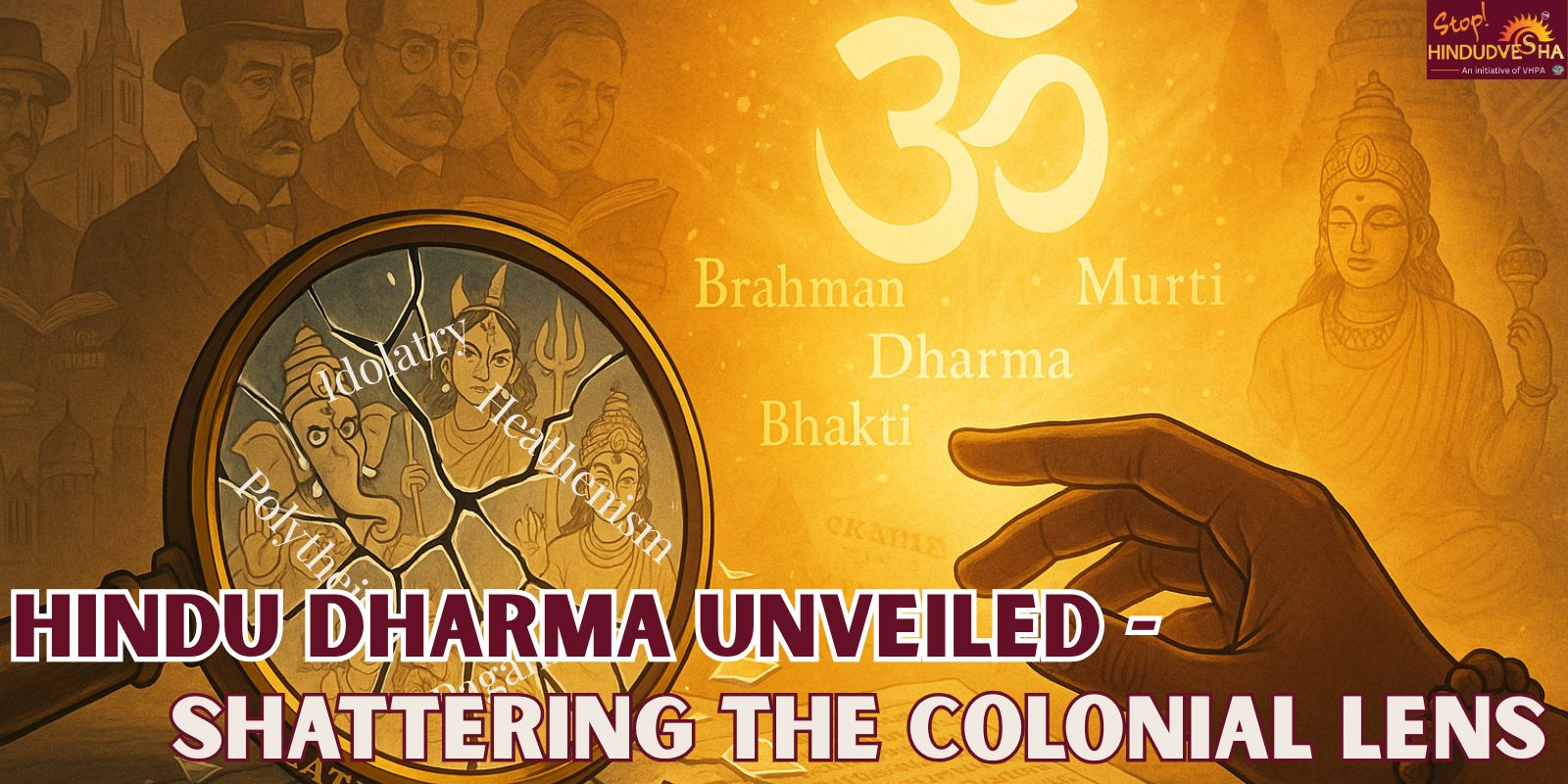
- Hindu Dharma is often mischaracterized as polytheistic due to colonial and Abrahamic frameworks that fail to grasp its monistic core and philosophical complexity.
- The 33-crore-gods trope reflects a reductive interpretation that ignores the unity of Brahman and the symbolic nature of Hindu deities.
- Hinduism’s deities are not rival gods but diverse manifestations of one supreme reality, allowing for spiritual pluralism within a monistic metaphysical foundation.
- Colonial missionaries and Orientalist scholars intentionally distorted Hindu theology to portray it as chaotic, primitive, and in need of Western “civilization” and conversion.
- To correct these deep-rooted misrepresentations, Hindus must reclaim original concepts and terms—like Brahman, murti, and Dharma—and dismantle inherited colonial frameworks with philosophical clarity and Shatrubodh (awareness of ideological adversaries).
A common and persistent misunderstanding about Hinduism, both in popular discourse and academic treatments influenced by colonial paradigms, is the assertion that it is inherently polytheistic. This perception, often summarized in the reductive claim that “Hinduism has 33 crore gods,” presumes theological incoherence or primitive religiosity. Such an interpretation emerges from applying Abrahamic or Greco-Roman theological categories to a fundamentally different metaphysical framework.
This article argues that Hindu Dharma is not polytheistic in the Abrahamic sense of the term. Rather, it is a civilizational tradition that articulates a monistic metaphysics—centered on Brahman, the indivisible and infinite reality—alongside a pluralistic expression that honors diverse manifestations of the Divine. To correctly understand Hindu philosophy, one must distinguish between polytheism, as understood in Abrahamic traditions, and pluralism, as embedded in Hindu Dharma.
Reframing Terminology: Polytheism vs. Pluralism
The Western theological framework often categorizes religious systems as either monotheistic or polytheistic. This binary, deeply rooted in Abrahamic traditions, presents a significant hermeneutical challenge when applied to Hinduism. Abrahamic polytheism, as seen in ancient Greek or Roman pantheons, typically features distinct deities with independent wills, often characterized by human-like flaws, rivalries, and specific domains of influence (e.g., Zeus, Hera, Poseidon). These gods operate within a fragmented cosmos, their interactions sometimes leading to conflict or competition.
In stark contrast, Hindu Dharma’s pluralism is not a multiplicity of independent deities, but rather a recognition of diverse paths to, and manifestations of, a singular ultimate reality: Brahman (not to be confused with the ‘Brahmin’ varna). The Devatas (deities) within Hindu Dharma are not autonomous beings with competing agendas, but rather functional aspects, symbolic representations, or emanations of this one supreme, undifferentiated reality. This concept is often articulated through the analogy of the sun and its rays: the sun is one, yet its rays manifest in countless ways, bringing light, heat, and life. Similarly, Brahman is one, but its power and attributes are experienced and conceptualized in various forms to facilitate human comprehension and devotion. This fundamental difference in understanding the nature of divinity underscores why labeling Hinduism as “polytheistic” in the Abrahamic sense is a categorical error that fundamentally distorts its metaphysical coherence.
Colonial Misreadings and Orientalist Interpretations
The colonial encounter profoundly shaped Western perceptions of Hinduism, largely through the lens of a missionary-colonial complex. British administrators and Christian missionaries arrived in India with a pre-existing theological framework of exclusive monotheism, viewing any deviation as primitive, pagan, or idolatrous. They struggled to comprehend a tradition that celebrated a vast array of divine forms while simultaneously asserting an underlying unity. Consequently, terms such as “idolatry,” “heathenism,” and “paganism” were not merely descriptive but pejorative tools of classification, employed to delegitimize Hindu practices and justify colonial rule and evangelization[1].
This Orientalist lens was not merely a misunderstanding but an active construction of knowledge that served political and religious agendas. By portraying Hinduism as chaotic, superstitious, and lacking a coherent theology, it reinforced the perceived need for Western civilizing missions and Christian conversion. This narrative dismissed the profound philosophical depth evident in texts like the Upanishads and the rich diversity of devotional practices as mere “local cults.”[2] Despite the richness of Hindu philosophical texts and the depth of theological debate within the tradition, colonial-era interpretations took root in Western academic discourse and popular imagination. These distorted views continue to persist today, obscuring a more accurate and authentic understanding of Hindu Dharma.[3]
At the very essence of Hindu thought, particularly within the Vedanta tradition, lies the concept of Brahman[4]. Brahman is not a “god” in the anthropomorphic sense, nor is it merely a creator deity. Instead, it is the ultimate, unconditioned, and infinite reality that transcends all conceptual distinctions, qualities, and forms. It is the ground of all being, the source and sustenance of the entire cosmos, yet it remains beyond all phenomenal existence. The Upanishads, the culmination of Vedic thought, articulate this profound non-dualism through seminal Mahavakyas (Great Sayings). “Ekam eva advitiyam” (There is one, without a second) asserts the singular, non-plural nature of ultimate reality. “Aham Brahmasmi” (I am Brahman) and “Tat Tvam Asi” (Thou art That) proclaim the essential identity of the individual self (Atman) with this universal Absolute. These are not merely poetic metaphors, but ontological claims that assert the fundamental unity of existence.
Advaita Vedanta, championed by the philosopher Adi Shankara, systematically articulates this non-dualistic perspective.[5] It posits that the perceived multiplicity of the phenomenal world, with its distinctions of subject and object, is the product of Maya, a mysterious power of Brahman that projects the illusion of diversity while Brahman remains eternally undifferentiated. The realization of the Atman-Brahman identity is the pinnacle of spiritual insight (moksha or liberation), transcending the cycle of rebirth (samsara). This monistic foundation fundamentally distinguishes Hindu theology from polytheistic systems by positing a singular, ultimate reality from which all apparent diversity arises.
Furthermore, Hindu philosophy offers the dual perspectives of Nirguna Brahman (Brahman without attributes) and Saguna Brahman (Brahman with attributes). Nirguna Brahman represents the absolute, formless, unmanifest reality, beyond all conceptualization and accessible primarily through intellectual and meditative paths (jnana yoga). Saguna Brahman, conversely, is Brahman as manifest, endowed with qualities, forms, and personality (e.g., as Vishnu, Shiva, Devi). This aspect of Brahman is the focus for devotional traditions (bhakti yoga), providing a relatable form for worship and a pathway to connect with the Divine. This bifurcation is not a contradiction but a sophisticated recognition of the human need for both form and formlessness in spiritual experience, allowing different temperaments and stages of spiritual development to engage with the Absolute effectively.
Deities and Murti Puja: Functional Manifestations and Symbolic Engagement
Building upon the monistic foundation of Brahman, Hindu Dharma’s rich pantheon of deities is understood not as a collection of independent gods but as functional manifestations or personalized aspects of the one Brahman. These Devatas embody specific cosmic functions, divine energies, or philosophical principles, making the abstract concept of Brahman accessible and comprehensible to the human mind. For instance, the Trimurti – Brahma (the creative principle), Vishnu (the preserving principle), and Shiva (the transformative or dissolving principle) – are symbolic representations of the cyclical nature of the universe, all stemming from the same ultimate reality. Similarly, goddesses like Saraswati (knowledge), Lakshmi (prosperity), and Durga (divine power) personify the multifaceted energies (Shakti) of Brahman.
The relationship among these deities is fundamentally non-competitive and harmonious. A devotee’s choice of an Ishta Devata (chosen deity) is a pragmatic and deeply personal path to focus one’s devotion and spiritual energy, not an exclusive allegiance that denies the validity of other forms. This allows for diverse devotional practices without theological conflict, recognizing that different individuals may resonate more strongly with particular aspects or forms of the Divine on their journey towards the ultimate unity.
A critical aspect of Hindu practice that is often profoundly misunderstood is murti puja, the worship through images or consecrated statues. The term “murti” literally means “form,” “manifestation,” or “embodiment,” not “idol” in the pejorative sense of a false god or an object worshipped for its own sake.[6] In Hindu ritualism, the murti serves as a symbolic conduit, a sacred focal point for communion with the Divine. It is not the inert stone or metal that is worshipped, but the consciousness or divine presence invoked and perceived within it through rituals (prana pratishtha – consecration) and the devotee’s faith. This practice is a form of Upasana – a meditative and contemplative approach that utilizes a tangible form to transcend form, allowing the mind to concentrate and connect with the formless Infinite. The murti acts as a powerful mnemonic device, helping the devotee visualize, reflect upon, and eventually internalize the attributes of the Divine. This sophisticated symbolic mode of worship is deeply rooted in Hindu philosophical texts, which acknowledge the psychological necessity of tangible forms for human beings to grasp abstract spiritual concepts, ultimately guiding the aspirant towards a direct, formless realization of Brahman.
Unity in Diversity: Philosophical and Cultural Pluralism
Hindu Dharma’s inherent pluralism extends far beyond its understanding of divine manifestations; it is a fundamental principle woven into the philosophical fabric and cultural expression of the tradition. The celebrated Vedic dictum, “Ekam Sat Vipra Bahudha Vadanti” (Truth is one, the wise call it by many names), encapsulates this spirit of profound epistemic humility and doctrinal inclusivity. This verse is not merely a statement of tolerance but an active recognition that the ultimate truth, being infinite, cannot be fully grasped by any single perspective or nomenclature.
This philosophical openness is reflected in the diverse paths to liberation (moksha) recognized within Hinduism: Jnana Yoga (the path of knowledge and intellectual inquiry), Bhakti Yoga (the path of devotion and surrender), Karma Yoga (the path of selfless action), and Raja Yoga (the path of meditative discipline). Each path is considered valid and efficacious, suited to different temperaments and spiritual inclinations. Furthermore, even within the broad framework of Vedanta, multiple schools of thought—such as Advaita (non-dualism), Vishishtadvaita (qualified non-dualism), and Dvaita (dualism)—coexist. These schools engage in rigorous philosophical debates and offer distinct metaphysical interpretations; yet, they generally do not invalidate each other, but instead represent different vantage points or stages of understanding the same ultimate reality.
Culturally, this pluralism is evident in the remarkable regional diversity of Hindu practices, temple traditions, and festivals. There is no single centralized authority, no “Hindu Pope,” and no uniform dogma that dictates worship practices across the vast subcontinent. Instead, local customs, regional deities, and specific textual traditions thrive, contributing to a vibrant tapestry of spiritual expression. This is not a chaotic amalgamation, but an organic evolution rooted in the principle that the Divine can be approached and experienced in myriad ways. This inherent pluralism fosters a spirit of profound inclusivity, allowing for a richness and adaptability that sets Hindu Dharma apart.
Modern Confusion and Shatrubodh
Despite centuries of scholarship and the inherent sophistication of Hindu philosophy, contemporary discourse, particularly from atheistic and Abrahamic perspectives, continues to perpetuate significant mischaracterizations of Hindu beliefs. Dismissive phrases like “sky daddy” for Brahman or “superstition” for murti puja reflect not merely a lack of understanding, but often a conceptual poverty and epistemological humility. These critiques typically operate within reductionist frameworks that fail to engage with the complex theological, metaphysical, and symbolic layers of Hindu traditions. They project Western monotheistic or secular materialist biases onto a spiritual system that operates on entirely different premises.[7]
To effectively counter these persistent misrepresentations, there is a growing imperative for Shatrubodh among adherents of Hindu Dharma. Shatrubodh, in this context, signifies a conscious awareness and understanding of the historical, ideological, and conceptual distortions that have shaped global perceptions of Hinduism. It involves recognizing the colonial legacies embedded in the very vocabulary used to describe Hindu practices and beliefs. Part of this essential self-awareness involves reclaiming and consistently utilizing Sanskritic terminology that accurately conveys Hindu concepts: using “murti” instead of the loaded term “idol,” “Bhagavan” (the Resplendent One, or Divine Person) instead of the often anthropomorphic “god,” and “Dharma” (righteous conduct, cosmic law, spiritual path) instead of the narrower “religion.” This linguistic precision is not merely semantic; it is crucial for ensuring that the profound nuances of Hindu thought are communicated without being filtered through culturally alien and often distorting interpretive lenses. By fostering Shatrubodh, Hindus can actively participate in re-educating the global discourse and presenting their tradition with intellectual integrity and authenticity.
Cosmic Symphony of the One and the Many
Hindu Dharma fundamentally transcends the simplistic binary of monotheism and polytheism. Its enduring strength and spiritual profundity lie in its simultaneous embrace of monistic metaphysics and pluralistic expression. It firmly asserts the absolute reality of Brahman—the One without a second—as the singular, ultimate ground of all existence. Yet, it equally honors the countless names, forms, and symbols through which human beings, with their diverse temperaments and spiritual needs, approach and apprehend that one ultimate reality.
This is not a theological confusion or a lack of coherence, but rather a profound spiritual sophistication. It embodies a worldview where apparent dualities—form and formlessness, immanence (the Divine present within creation) and transcendence (the Divine beyond creation), devotion and knowledge—are not seen as contradictory but as complementary pathways to the same ultimate truth. The Divine in Hindu Dharma is not a singular ruler detached from creation but the very essence, the animating principle, and the pervasive consciousness of existence itself. Just as a cosmic symphony draws its richness from countless distinct notes played by various instruments, all contributing to a unified composition, so too are the many deities in Hinduism understood as diverse expressions and refractions of the same infinite Reality, each contributing to the grand, unified cosmic play (lila) orchestrated by Brahman.
To genuinely engage with Hindu Dharma, therefore, one must move beyond the limiting confines of colonial caricatures and Western theological categories, approaching it instead with intellectual honesty, historical awareness, and a profound philosophical openness to its unique and expansive understanding of the Divine.
Citations
[1] Why do colonial-era errors about Hinduism persist, even among anti-colonial activists and academia? | Indu Viswanathan & Suhag Shukla | That’s So Hindu Podcast ; https://www.everand.com/podcast/589328832/Why-do-colonial-era-errors-about-Hinduism-persist-even-among-anti-colonial-activists-and-academia-Indu-Viswanathan-Suhag-Shukla-In-this-episode
[2] A Bhattacharya (2006), Hindu Dharma: Introduction to Scriptures and Theology
[3] Patrick Olivelle (2014), The Early Upanishads, Oxford University Press
[4] Ayam Atma Brahma: Self is the Absolute Entity – Classic Yoga; https://www.classicyoga.co.in/2019/02/ayam-atma-brahma/amp/
[5] The Advaita Vedânta; https://www.advaita-vedanta.org/avhp/
[6] Murti Puja: Image Worship in Hinduism; http://londonmandir.baps.org/worship/murti-puja-image-worship-in-hinduism/
[7] Scholarship or Sabotage? How Western Academia Seeks to Erase Hindu Thought; https://stophindudvesha.org/scholarship-or-sabotage-how-western-academia-seeks-to-erase-hindu-thought/#:~:text=Academic%20departments%2C%20popular%20media%2C%20and,lens%20that%20ignores%20its%20philosophical

Donate to HINDUDVESHA
Our Mission is to explore and expose Hindudvesha through research analysis, education and response.
SUPPORT US