

Scholarship or Sabotage? How Western Academia Seeks to Erase Hindu Thought
 Aditi Joshi · 05/09/2025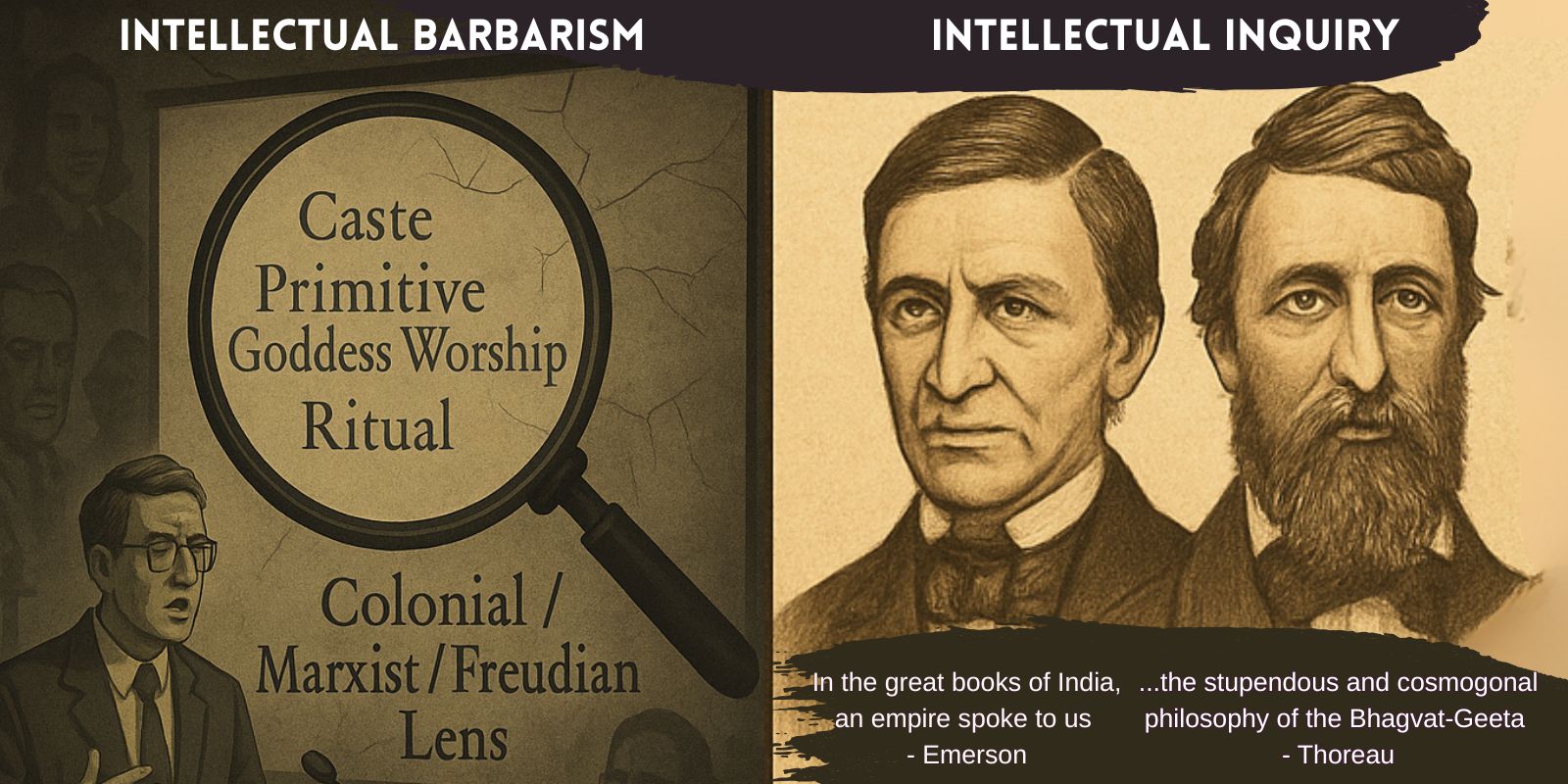
- Hindu thought has been mangled by Western academics, who weaponize theory to reduce a living tradition to superstition, patriarchy, and caste.
- Colonial contempt never ended—it just put on academic robes, continuing the erasure of Sanatana Dharma under the banner of “critical scholarship.”
- Hindus are silenced in conversations about their own faith, while self-appointed experts with zero lived experience monopolize authority.
- Sacred texts are twisted into perverse caricatures, filtered through Freud, Marx, and missionary bias, with zero regard for dharmic context.
- The age of passive tolerance is over—Hindus are now calling out this intellectual ethnocide and reclaiming their narrative without apology.
For decades, a significant segment of Western Indologists and ideological critics has attempted to reduce Hinduism—more accurately known as Sanatana Dharma—to a patchwork of mythology, caste oppression, and exotic rituals. These mischaracterizations, often rooted in colonial bias, theological antagonism, or postmodern cynicism, cast Hinduism as a regressive tradition in need of reform, appropriation, or erasure. Academic departments, popular media, and missionary scholars alike have routinely depicted Hinduism through a reductionist lens that ignores its philosophical rigor, moral pluralism, and spiritual sophistication.
Intellectual Vandalism in the Name of Education: Recent Examples
Recently, a notable instance of academic bias occurred at the University of Texas at Austin, where the course titled “Introduction to Hinduism” drew significant backlash from students and members of the community. The course description brazenly referred to Hindu beliefs as rooted in “superstition” and described the caste system as one of the “central pillars” of the tradition, without acknowledging the complexity and historical evolution of caste or the internal reform movements within Hinduism. Such framing simplified and vilified an entire civilization’s spiritual legacy. When students and Hindu advocacy groups protested and called for a more nuanced and scholarly representation, their appeals were largely dismissed. The curriculum remained steeped in reductive narratives, often emphasizing either Christian theological superiority or Marxist class struggle paradigms, thereby ignoring the indigenous epistemologies and philosophical frameworks of Hinduism. Rather than fostering understanding, the course reinforced harmful stereotypes under the guise of academic critique. [1][2]
Another troubling example involved a prominent professor—celebrated in Indology circles—who publicly derided the sacred feminine concept of Shakti, labelling it as “primitive goddess worship.” This depiction severed Shakti from her rich philosophical roots in Tantric metaphysics and Advaita Vedanta, where she represents not just a deity but the very essence of cosmic energy and consciousness. Though wrapped in academic jargon, such dismissals reveal a profound misunderstanding- or a deliberate misrepresentation- of Hindu theological concepts. These portrayals reduce intricate metaphysical ideas to cultural oddities, reinforcing Orientalist tropes that view non-Western religions as either quaint or regressive. The result is an intellectual caricature, where the depth and sophistication of Hindu thought are eclipsed by patronizing labels and shallow analogies. [3]
At the University of Houston, a course given by Professor Ullrey titled “Lived Hindu Religion” faced criticism from a student who alleged that the course content was “Hinduphobic” and distorted India’s political landscape. The student claimed that the professor characterized Hinduism as not an “ancient, lived tradition,” but rather as a “political tool” weaponized by “Hindu nationalists” and a system of oppression against minorities. The university defended the course, stating that it values academic freedom and that the course is grounded in the academic discipline of religious studies, which uses specific terminology to analyze religious movements across traditions. [4][5]
A particularly egregious example unfolded at a California public high school, where the textbook content on Hinduism painted the tradition as a chaotic assortment of polytheistic deities, linking it to animal worship, ritual pollution, and social discrimination. In stark contrast, Christianity was portrayed as a morally advanced, monotheistic faith that unified its followers and championed social justice. This clear asymmetry in representation did not go unnoticed. Hindu parents and advocacy groups had to intervene, demanding the revision of textbooks and educational materials to provide a fair and accurate portrayal of Hinduism. The episode highlighted a systemic pattern in Western education, where Abrahamic traditions are often framed through theological depth and moral clarity, while Dharmic traditions are exoticized, oversimplified, or stigmatized. [6]
Reductionism Masquerading as Scholarship
The common thread across these incidents is not merely ignorance but the perpetuation of a colonial gaze—one that insists on interpreting Hinduism through the frameworks of Abrahamic theology or materialist critique. Ritual becomes superstition; caste becomes the defining feature; metaphysics becomes escapism.
In contrast to these caricatures, Sanatana Dharma offers a vast, internally consistent worldview built upon concepts such as dharma (righteous duty), karma (action and consequence), moksha (liberation), and atma-vidya (knowledge of the Self). Yet these foundational tenets are often excluded or distorted in Western textbooks and lectures, where psychoanalysis, feminism, and Marxism become the default interpretive tools—even when they are incompatible with the dharmic ethos.
Academic Gatekeeping and Ideological Policing
When it comes to Hindu thought, Western academia has built an echo chamber where only its own voice matters. Practicing Hindus or traditional scholars are often dismissed as “too biased” or lacking in critical distance, while Western scholars with minimal grounding in lived experience are seen as more “objective.” This inversion has led to a situation where those most immersed in the tradition are rendered voiceless, while outsiders—often hostile or indifferent to the culture—set the terms of discourse.
Notably, scholars such as Wendy Doniger have displayed a deeply antagonistic stance toward Hindu Dharma, routinely presenting its sacred texts through a lens that is overtly sexualized, reductive, and sensationalist—stripping them of their spiritual depth and philosophical integrity. Doniger’s method often reframes sacred scriptures like the Ramayana and the Bhagavad Gita not as spiritual or philosophical revelations but as cultural products to be psychoanalyzed through Freudian or feminist lenses. This approach disregards the traditional exegesis and sacred authority that these texts hold for practicing Hindus. For instance, in her book The Hindus: An Alternative History, Doniger includes interpretations that many found offensive—such as depicting revered deities in overtly sexual terms and suggesting that Ganesha’s elephant head is a Freudian symbol of castration. Such readings may titillate a Western academic audience but alienate and anger the very communities whose traditions are being interpreted.
In his book The Battle for Sanskrit, Rajiv Malhotra critiques how Western scholars like Doniger often operate within a framework that fetishizes and exoticizes Hinduism while simultaneously denying Hindus the right to interpret their own traditions through their native categories of understanding (adhyātma, dharma, moksha, etc.).
The severe backlash to Doniger’s work resulted in her book The Hindus: An Alternative History was withdrawn from circulation in India in 2014 after a civil suit alleged that the book “hurt religious sentiments” and violated Indian law. While the incident sparked global debates around free speech and censorship, it also drew attention to the deep disconnect between Western academic interpretations of Hinduism and the lived realities of Hindu practitioners. [7][8]
Doniger’s style of scholarship reflects a broader problem: a persistent colonial gaze masked in academic language. By presenting Hinduism as a repository of arcane rituals, exotic deities, and repressed sexuality, such work fails to acknowledge the philosophical sophistication, ethical frameworks, and spiritual aspirations embedded in the tradition. This pattern not only distorts Hinduism’s image globally but also marginalizes Hindu voices within academic discourse about their own faith. The end result is a form of intellectual imperialism where the native tradition is explained to its followers through foreign constructs, often in a tone that is dismissive or patronizing.
One of the greatest ironies is that a tradition as pluralistic and introspective as Sanatana Dharma is often accused of being intolerant or backward. This distortion arises from an unwillingness to engage with the metaphysical complexity of Hindu thought, where multiple deities, philosophies, and paths are not signs of confusion but expressions of a higher unity.
Concepts like Ishta Devata (personal deity), Advaita (non-dualism), and Bhakti (devotion) are frequently simplified into false binaries: monotheism vs. polytheism, faith vs. reason, East vs. West. These binaries do violence to the intricate tapestry of Hindu metaphysics.
Not All Western Thinkers Were Blind
“Only a person of worth can recognize the worth in others.”
— Thomas Carlyle (1795–1881), British Historian and Philosopher
This section stands as a direct challenge to the distortions, misrepresentations, and often calculated hostility with which many European Indologists have historically treated Hinduism. Far from objective scholarship, much of their work was an intellectual arm of colonial domination, casting India’s ancient wisdom as primitive, its spiritual traditions as superstition, and its people as subjects in need of “civilization.” Many of these so-called scholars never set foot on Indian soil, yet passed sweeping judgments that shaped generations of Western ignorance and condescension.
However, this is not the whole story. Running parallel to this imperialist narrative was another, quieter current—one of respect, reverence, and awe. Thoughtful non-Indian thinkers and visionaries, often standing outside the machinery of empire, saw in India not a land of backwardness but a cradle of profound spiritual and philosophical insight. Historical context is crucial to understanding their appreciation.
While Chinese, Persian, and Arab civilizations had long acknowledged India’s foundational contributions to mathematics, astronomy, medicine, and metaphysics, Europe remained largely ignorant until the 16th century. When direct contact finally began, some early European scholars approached Indian traditions with genuine curiosity and admiration, founding institutions like the Asiatic Society (1784) and undertaking serious translations of Sanskrit texts. But by the mid-19th century, that spirit of inquiry was overtaken by a more sinister agenda: the need to intellectually subjugate India to justify its political conquest. And so, the colonial project demanded not understanding, but belittlement.
Yet, amid the din of dismissal, another current quietly persisted—embodied by Western thinkers of intellectual honesty and moral clarity. The voices highlighted here stand in stark contrast to colonial Indology. They saw in India not inferiority to be corrected, but a profound civilization to be learned from. Their reflections affirm that India’s contributions to human thought are not only worthy of respect but central to any serious global understanding of philosophy, science, and spirituality. [9]
Ralph Waldo Emerson, American author and thought leader
In the great books of India, an empire spoke to us, nothing small or unworthy, but large, serene, consistent, the voice of an old intelligence, which in another age and climate had pondered and thus disposed of the questions that exercise us. (The Journals and Miscellaneous Notebooks of Ralph Waldo Emerson. Vol. 10: 1847–1848)
Henry David Thoreau, American author and philosopher
In the morning, I bathe my intellect in the stupendous and cosmogonal philosophy of the Bhagvat-Geeta, since whose composition years of the gods have elapsed, and in comparison, with which our modern world and its literature seem puny and trivial. (Walden; or, Life in the Woods. Boston: Ticknor and Fields, 1854)
Mark Twain, American author and humorist
India is the cradle of the human race, the birthplace of human speech, the mother of history, the grandmother of legend, and the great-grandmother of tradition. Our most valuable and most instructive materials in the history of man are treasured up in India only. (Following the Equator: A Journey Around the World. Hartford, CT: American Publishing Company, 1897)
Paul Deussen, German Philosopher and Orientalist
Whatever may be the discoveries of the scientific mind, none can dispute the eternal truths propounded by the Upanishads. Though they may appear as riddles, the key to solving them lies in our heart, and if one were to approach them with an open mind, one could secure the treasure as did the Rishis of ancient times. (Outlines of Indian Philosophy, Berlin: K. Curtius, 1907)
Romain Rolland, French Writer, 1915 Nobel Laureate in Literature
Religious faith in the case of the Hindus has never been allowed to run counter to scientific laws; moreover, the former is never made a condition for the knowledge they teach, but they are always scrupulously careful to take into consideration the possibility that by reason both the agnostic and atheist may attain truth in their own way. Such tolerance may be surprising to religious believers in the West, but it is an integral part of Vedantic belief. (The Life of Ramakrishna. Vedanta Press & Bookshop, 1929)
Hermann Keyserling, German Philosopher and Author
The absolute superiority of India over the West in philosophy; poetry from the Mahabharata, containing the Bhagavad-Gita, ‘perhaps the most beautiful work of the literature of the world. (The Huston Smith Reader. Edited by Jeffery Paine, University of California Press, 2012)
Will Durant, Eminent American historian
India was the motherland of our race, and Sanskrit the mother of Europe’s languages: she was the mother of our philosophy; mother, through the Arabs, of much of our mathematics; mother, through the Buddha, of the ideals embodied in Christianity; mother, through the village community, of self-government and democracy. Mother India is in many ways the mother of us all. (The Case for India. New York: Simon and Schuster, 1931)
AL Basham, Historian
For long it was thought that the decimal system of numerals was invented by the Arabs, but this is certainly not the case. The Arabs themselves called mathematics “the Indian art” (Hindisat), and there is now no doubt that the decimal system…was learnt by the Muslim world either through merchants trading with the west coast of India or through Arabs who conquered Sind in 712CE. (The Wonder That Was India: A Survey of the Culture of the Indian Sub-Continent Before the Coming of the Muslims. London: Sidgwick & Jackson)
Guy Sorman, French Author and Philosopher
Temporal notion in Europe were overturned by an India rooted in eternity. The Bible had been the yardstick of measuring time, but India’s infinitely vast time cycles suggested that the world was much older than anything Bible spoke of. It seems that if the Indian mind was better prepared for the chronological mutation of Darwinian evolution and astrophysics. Hindu cosmography, for example, born in hoary antiquity, strikes one in certain ways as surprisingly modern. India has never limited its conception of time a few crowded millennia. Thousands of years ago, India’s sages computed the earth’s age at little over two billion years, our present era being what is called the seventh Manuvantra. This is a staggering claim. Consider how much scientific evidence has been needed in the West before men could even imagine so enormous a time scale. (The Genius of India. New Delhi: Macmillan India Ltd., 2001)
Erwin Schrödinger, Quantum Physicist and Nobel Prize 1933
There is no kind of framework within which we can find consciousness in the plural; this is simply something we construct because of the temporal plurality of individuals, but it is a false construct…The only solution to this conflict, insofar as any is available to us all, lies in the ancient wisdom of the Upanishads. (My Life, My Worldview. Edited by Svetla Petkova and Vesselin Petkov. Montreal: Minkowski Institute Press, 1961)
Werner Heisenberg, Nobel Prize in Physics 1932
After the conversations about Indian Philosophy, some of the ideas of Quantum Physics that had seemed so crazy suddenly made more sense. (Capra, Fritjof. Uncommon Wisdom: Conversations with Remarkable People. New York: Simon & Schuster, 1988)
Robert Oppenheimer, Father of the Atomic Bomb
The Bhagvad Gita…is the most beautiful philosophical song existing in any known tongue. (DeLuca, Dave, ed. Sacred Jewels of Yoga: Wisdom from India’s Beloved Scriptures, Teachers, Masters, and Monks. Novato, CA: New World Library, 2011)
Carl Sagan, Astronomer & Astrophysicist
The Hindu religion is the only one of the world’s great faiths dedicated to the idea that the cosmos itself undergoes an immense, indeed an infinite, number of deaths and rebirths. It is the only religion in which the time scales correspond to those of modern scientific cosmology. (Cosmos, published 1980, Chapter 10 – “The Edge of Forever”)
Paul Steinhardt, Albert Einstein Professor of Science at Princeton University, and Neil Turok, Director of Perimeter Institute, Waterloo, Ontario, Canada
They have just fired their latest volley at that belief, saying there could be timeless cycle of expansion and contraction. It’s an idea as old as Hinduism, updated for the 21st century. The theorists acknowledge that their cyclic concept draws upon religious and scientific ideas going back for millennia -echoing the “oscillating universe” model that was in vogue in the 1930s, as well as the Hindu belief that the universe has no beginning or end, but follows a cosmic cycle of creation and dissolution. (A cyclic model of the universe. Science, 296(5572), 1436–1439)
In our own times, Tulsi Gabbard offers a powerful counterexample to the widespread academic and media portrayal of Hinduism as fatalistic, hierarchical, or detached from worldly action. As the first Hindu elected to the U.S. Congress and a former presidential candidate, Gabbard embodies a living, dynamic expression of Sanatana Dharma, rooted in equality, selfless service, and spiritual clarity. Her deep engagement with the Bhagavad Gita, especially the teaching of nishkama karma (action without attachment to results), has shaped her decisions both on the battlefield and in political life. Rather than distancing herself from her Hindu identity in a predominantly secular or Abrahamic cultural environment, she has consistently drawn moral strength from it, publicly citing the Gita as her compass during times of crisis. Her gifting of the Gita to Prime Minister Narendra Modi was not mere diplomacy, but a declaration of its enduring global relevance. [10][11][12]
Closing Remarks
Western Indological narratives about Hinduism have often functioned less as academic inquiry and more as tools of epistemic colonization. These critiques reflect more about the critics’ limitations than the tradition they attempt to dissect. The time has come to shift the lens—from external judgment to internal coherence, from ideological distortion to experiential understanding.
While many prominent Western philosophers and thought leaders have acknowledged the profound philosophical depth and global contributions of Hindu Dharma, Sanatana Dharma does not need validation from the outside world. Its enduring truths are not dependent on foreign approval but are evident in the lived experiences of its followers, the vast intellectual wealth of its Sanskrit texts, and the unbroken continuity of its traditions over millennia. Together, these form a living rebuttal to the narrow, often distorted portrayals offered by many Western scholars. Rather than being defined through colonial or academic filters, Sanatana Dharma speaks for itself—through its practice, its literature, and its timeless relevance.
Rather than questioning whether Hinduism can withstand critical scrutiny, it is time to ask whether modern academia can withstand exposure of its own ideological biases and intellectual dishonesty. The real challenge is not Hinduism’s relevance, but the credibility of those who have long misrepresented it. Reclaiming the narrative starts with reclaiming our voice—unapologetically—and insisting that anyone who speaks of Sanatana Dharma does so with scholarly rigor, cultural respect, and a rooted understanding, not through colonial frameworks or career-driven condescension. The age of passive acceptance is over; accountability is long overdue.
Citations
[1] Hindu on the Forty Acres – navigating challenges and seeking equality; https://thedailytexan.com/2023/11/06/hindu-on-the-forty-acres-navigating-challenges-and-seeking-equality/
[2] Anti-Hindu propaganda in a US university course “Intro to South Asia”; https://hindupost.in/history/intro-to-south-asia-anti-hindu-propaganda-in-a-us-university-course/
[3] Women, Earth, and the Goddess: A Shākta-Hindu Interpretation of Embodied Religion; https://onlinelibrary.wiley.com/doi/full/10.1111/j.1527-2001.1994.tb00650.x
[4] US university responds after India Today report on row over ‘Hinduphobic’ course; https://www.indiatoday.in/world/us-news/story/university-of-houston-lived-hindu-religion-course-controversy-academic-freedom-complex-topics-response-student-hinduphobic-2700934-2025-03-29
[5] University of Houston defends ‘Lived Hindu Religion’ course amid ‘Hinduphobia’ controversy – Here’s what it said; https://www.financialexpress.com/world-news/university-of-houston-defends-lived-hindu-religion-course-amid-hinduphobia-controversy-heres-what-it-said/3793573/
[6] Hindu Students Say Misinformation In Textbooks Led To Bullying; https://www.cbsnews.com/sacramento/news/hindu-textbook-india-bullying/
[7] Outcry as Penguin India pulps ‘alternative’ history of Hindus; https://www.theguardian.com/world/2014/feb/13/indian-conservatives-penguin-hindus-book
[8] Sex, Lies and Hinduism: Why A Hindu Activist Targeted Wendy Doniger’s Book; https://time.com/6601/sex-lies-and-hinduism-why-a-hindu-activist-targeted-wendy-donigers-book/
[9] Jai G. Bansal, Kalyan Vishwanathan; “Hinduism And America: How Hindu Dharma is Transforming the West”; pp 42-53.
[10] ‘Our family was raised with the important value of karma yoga’, says Democrat Tulsi Gabbard; https://economictimes.indiatimes.com/opinion/interviews/our-family-was-raised-with-the-important-value-of-karma-yoga-says-democrat-tulsi-gabbard/articleshow/16404480.cms
[11] In this chaotic time, find strength and peace in Bhagvad Gita: Tulsi Gabbard to students; https://timesofindia.indiatimes.com/world/us/in-this-chaotic-time-find-strength-peace-in-bhagavad-gita-tulsi-gabbard-to-students/articleshow/76354477.cms
[12] PM’s US Visit: Narendra Modi gets Bhagavad Gita as gift from Tulsi Gabbard; https://economictimes.indiatimes.com/news/politics-and-nation/pms-us-visit-narendra-modi-gets-bhagavad-gita-as-gift-from-tulsi-gabbard/articleshow/43796454.cms?from=mdr

Donate to HINDUDVESHA
Our Mission is to explore and expose Hindudvesha through research analysis, education and response.
SUPPORT US