

Making a Silk Purse Out of a Sow’s Ear: The Yashica Dutt Caste Crusade
 Dr. Jai G. Bansal · 05/13/2026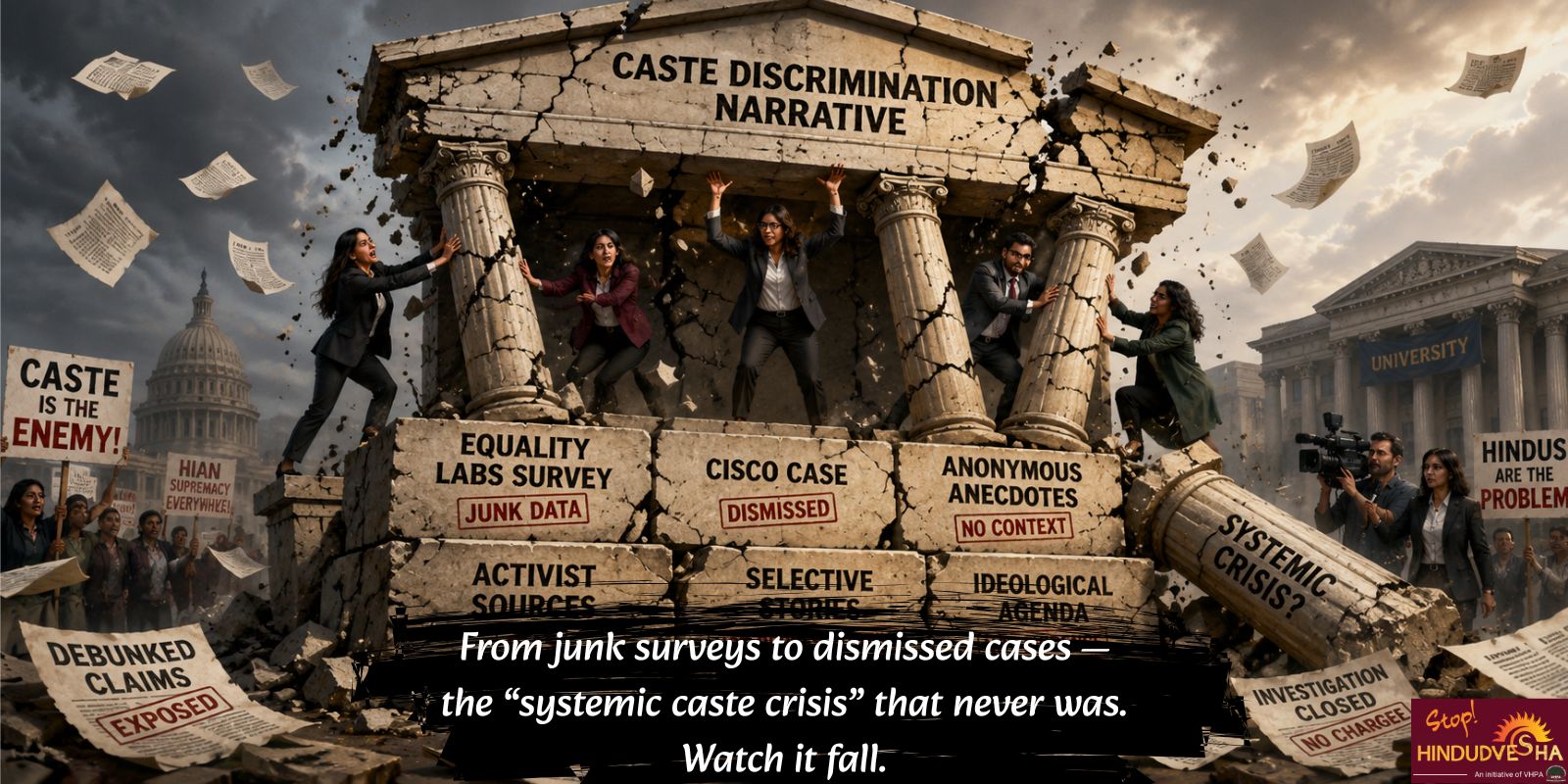
Summary
Yashica Dutt’s Prism Reports article pushing a New York caste discrimination bill is classic activist journalism masquerading as news. Built on the discredited Equality Labs survey, collapsed cases like Cisco and BAPS, and thin anecdotes, the piece recycles tired anti-Hindu tropes — “Hindu supremacists,” “Brahmin privilege,” and Nazi smears — while labeling mainstream groups like VHPA a “national security risk.” “Hindu fundamentalism” is exposed as an oxymoron, yet activists weaponize it to mean any organized Hindu identity or pride. In reality, their rhetoric edges toward eliminationist fantasies reminiscent of a final solution for Hindu presence in America. This is not about justice. It is a calculated campaign to import caste warfare, stigmatize one of America’s most successful immigrant communities, and Balkanize the country along imported fault lines.
When an activist poses as a journalist, readers should immediately lower their expectations. The latest piece from Prism Reports, “New York bill confronts caste discrimination residents face at work and in public institutions, advocates say,” perfectly proves the point.[1] Its author, Yashica Dutt, is a professional Dalit activist who has spent years popularizing “caste” as the central fault line of Hindu society and pushing to institutionalize that narrative in the West. For her to write a supposedly objective article on a New York “caste discrimination” bill is like asking a lifelong member of the Ku Klux Klan to deliver a neutral investigation into racial discrimination in America.
In classic activist-journalism style, Dutt crams every tired anti-Hindu trope into one article: “Hindu supremacists,” “right-wing Hindu groups,” “Hindutva,” “Brahmin managers,” “caste privilege,” and the usual parade of victim anecdotes. She tries to weave these scattered threads into the appearance of a systemic crisis demanding urgent legislation. But no amount of skillful prose can transform weak evidence, biased sources, ideological underpinnings and unbridled zeal into credible journalism.
You cannot make a silk purse out of a sow’s ear, no matter how finely you try to weave it.
The Usual Suspect Ecosystem and the Junk Data Foundation
Instead of fresh evidence or rigorous reporting, Dutt recycles the same tired cast of characters and discredited sources that have propped up this narrative for years.
At the center of the entire “caste in America” campaign sits the infamous 2018 Equality Labs “Caste Survey”[2] [3] — a self-selected, activist-crafted online poll riddled with leading questions, massive selection bias, and zero statistical validity. Professional pollsters and social scientists have repeatedly torn it apart, yet it remains the sole foundation for claims of widespread caste discrimination in the United States. When your entire case rests on one piece of junk science, you don’t have a crisis. You have a script.
Dutt also gives prominent space to Swati Sawant, the immigration lawyer notorious for pushing sensational caste-and-forced-labor allegations against the BAPS temple in Robbinsville, New Jersey. That case spectacularly collapsed after multiple complainants withdrew, claiming they had been misled. The Department of Justice quietly closed the investigation with no charges. Still, Sawant is presented as a credible expert.[4]
The article further elevates Hindus for Human Rights (HfHR), a fringe outfit with almost no following in the broader Hindu American community. HfHR specializes in attacking mainstream Hindu temples and organizations, running deplatforming campaigns, and aligning with far-left causes. They are, in essence, communists in progressive drag — wrapping themselves in Hindu identity while working aggressively against Hindu interests. Their preferred tools are cancellation, guilt-by-association, and inflammatory rhetoric, not honest dialogue or evidence.
By depending almost exclusively on this narrow, ideologically driven ecosystem of activists, lawyers, and professional grievance peddlers, the article exposes itself: this is not journalism. It is coordinated advocacy wearing the costume of news.
Collapsed Cases and Anecdotal Hyperbole
With real evidence in short supply, the article quickly pivots from shaky data to dramatic anecdotes and legal claims that have already fallen apart under scrutiny.
The most cited “proof” of systemic caste discrimination has been the California CRD’s flagship Cisco case. For years, activists paraded this lawsuit as ironclad evidence of Brahminical oppression in Silicon Valley. The court saw otherwise. The case against the two Indian engineers was dismissed, the agency was sanctioned for its mishandling, and countersuits are proceeding.[5]
The accuser — referred to as “John Doe” during the litigation — turned out to be a highly compensated engineer who continued receiving a substantial salary and stock grants. Court records revealed he had not even applied for the promotions he claimed were denied due to caste. Far from a victim of discrimination, he appears to have been an underperformer with performance issues that HR had flagged long before caste became the convenient explanation. Once the facts came out, the grand narrative of systemic Hindu oppression crumbled.
When the big cases evaporate, the story shifts to even thinner personal anecdotes. Dutt spotlights the story of a Nepali woman allegedly turned down for a childcare job. From this single disputed grievance, she leaps to a sweeping condemnation of Hindu society in America. One rejected nanny application becomes “proof” of pervasive caste bigotry across more than five million Hindu Americans.
This is the core weakness of the piece: isolated grievances, stripped of context and nuance, are inflated into evidence of a national emergency. Such thin stories are then wrapped in heavy ideological language — “Hindu supremacists,” “caste privilege,” and “right-wing Hindu groups” — to manufacture the illusion of crisis.
The Recycled Nazi Smear and the Obsessive Targeting of Hindu Organizations
When all else fails, pull out the ultimate smears: Nazis and national security threats.
Dutt and her fellow travelers love to ritualistically wave around a single controversial passage from M.S. Golwalkar’s obscure 1939 book We or Our Nationhood Defined. Written by a young man long before the world fully understood the horrors of the Holocaust, this one line is endlessly recycled to paint the entire global Hindu movement — and by extension, every Hindu organization in America — as “Nazi-inspired.”
This is intellectual fraud of the highest order. Golwalkar later distanced himself from many early formulations in that book, and it was never adopted as official RSS doctrine.[6] VHPA has never endorsed or acted on any such views. Yet this decades-old quotation is treated like original sin.
Not content with the Nazi smear, Dutt goes even further, declaring VHPA a “national security risk” for the United States. This outrageous claim rests on two pathetic props: an eight-year-old, long-deleted footnote in an old CIA World Factbook (that was quietly removed)[7] and a non-binding recommendation from the partisan U.S. Commission on International Religious Freedom (USCIRF) regarding the RSS in India.
Let’s be clear: VHPA is an independent, transparent, law-abiding American 501(c)(3) that has operated for 55 years with zero violations of U.S. law, zero terrorism links, and zero national security incidents. Calling it a security threat is not journalism — it is malicious defamation designed to intimidate and demonize an entire community.
The breathtaking hypocrisy should not go unmentioned. If we are going to permanently damn people and organizations for views expressed in a different era, then half of America’s Founding Fathers would need to be dug up and put on trial. But of course, that standard is conveniently reserved only for Hindus.
But why does the article — and this entire campaign — obsessively drag VHPA into the debate at every turn? Is it a reflexive twitch, or a deliberate strategy to besmirch every visible Hindu organization and delegitimize the entire community?
“Hindu Fundamentalism” — An Oxymoron Designed to Criminalize Normalcy
The piece, like so many others in this genre, leans heavily on the specter of “Hindu fundamentalism” and “Hindu supremacism.” This is one of the most dishonest rhetorical tricks in the activist playbook.
The term is an oxymoron. Unlike many other faiths, Hinduism has no single founder, no single prophet, no single holy book that must be followed literally, no prescribed mode of worship, and no central authority to declare heresy. In such a tradition, “fundamentalism” has no coherent meaning.
However, if such a thing even meant something, for Hindus it would simply mean the fundamental right to exist with dignity, to live in peace with our neighbors and coworkers, to practice our diverse traditions without apology, and to contribute mightily to our adopted society — which Hindu Americans have done at extraordinary levels.
The real question is – what do our adversaries actually mean when they invoke “Hindu Fundamentalism”?
Do they mean any organized assertion of Hindu identity? Any resistance to the false caste narrative? Any defense of Hindu temples and organizations? Any pride in Hindu civilizational achievements?
Or does it go a little further — like Hitler’s “Final Solution” for Hindu identity in America?
The Real Agenda: Nihilism Disguised as Justice
At its core, this article — and the larger campaign it represents — is not about protecting victims from discrimination. It is a calculated political project designed to import caste warfare into American society and permanently stigmatize one of the most successful immigrant communities in the country.
Yashica Dutt, Swati Sawant, Hindus for Human Rights, Equality Labs, and their aligned progressive outlets love to cloak themselves in comforting labels: “progressive,” “liberal,” “woke,” and “human rights advocates.” But strip away the branding and you see the classic nihilist pattern — experts at tearing down, never at building. Their only consistent skill is destruction: deplatforming, lawfare, guilt-by-association, and the relentless manufacture of grievance.
They demand that Hindu Americans be judged, shamed, and regulated for ancient social practices from another continent and from another era. If we are to judge societies and communities by their historical mistakes on the eve of America’s 250th anniversary, then perhaps we should begin by putting many of the Founding Fathers in jail. Yet this standard is applied with surgical precision only to Hindus — never to other groups with far more recent and documented baggage.
This is not liberalism. Real liberalism believes in individual dignity, equal protection under the law, and judging people by their actions — not by inherited group identity from thousands of miles away. Real progress celebrates integration and success. What we are witnessing instead is an aggressive effort to Balkanize America along newly imported fault lines, punishing Hindu Americans for the alleged sins of their ancestors while ignoring their extraordinary contributions to this country.
You cannot make a silk purse out of a sow’s ear. No matter how artfully the tropes are woven, no matter how many victim anecdotes or activist quotes are strung together, the underlying material remains weak, biased, and ideologically rotten. The so-called “caste discrimination crisis” in America is a manufactured narrative built on junk surveys, collapsed lawsuits, fringe activists, and selective outrage.
Hindu Americans have earned their success through merit, family values, and hard work. They deserve to be treated as individuals, not as perpetual carriers of ancestral guilt. On America’s 250th anniversary, the nation should be focused on unity and renewal — not on importing and institutionalizing old-world divisions.
It is time to call this campaign what it truly is: anti-Hindu bigotry dressed up as social justice.
Citations
[1] Yashica Dutt, “New York Bill Confronts Caste Discrimination Residents Face at Work and in Public Institutions, Advocates Say,” Prism Reports, May 11, 2026, https://prismreports.org/2026/05/11/new-york-caste-discrimination-bill/
[2] Equality Labs. 2018. Caste in the United States: A Survey of Caste Among South Asian Americans. Equality Labs. https://www.equalitylabs.org/castesurvey
[3] Stop Hindu Dvesha. 2023. “A Critical Review of the 2018 EQL Caste Survey.” October 2, 2023. https://stophindudvesha.org/a-critical-review-of-the-2018-eql-caste-survey/
[4] Tried by Media Now Cleared by DOJ Verdict.” Stop Hindu Dvesha, October 12, 2025. https://stophindudvesha.org/tried-by-the-media-vindicated-by-doj-the-baps-forced-labor-case-and-a-failure-of-fairness/
[5] “Cisco’s Engineering Role: Caste Discrimination Claim,” Stop Hindu Dvesha, June 25, 2023, https://stophindudvesha.org/head-of-engineering-position-at-cisco-john-doe-claims-caste-discrimination-for-was-first-offered-to-another-dalit-candidate/
[6] The Times of India. 2006. “RSS Officially Disowns Golwalkar’s Book.” March 9, 2006. https://timesofindia.indiatimes.com/india/rss-officially-disowns-golwalkars-book/articleshow/1443606.cms
[7] Stop Hindu Dvesha. 2025. “Dismantling IAMC’s Fabricated Smear Campaign against VHPA.” 2025. https://stophindudvesha.org/dismantling-iamcs-fabricated-smear-campaign-against-vhpa-part-7-of-8-manufacturing-a-national-security-threat/

Donate to HINDUDVESHA
Our Mission is to explore and expose Hindudvesha through research analysis, education and response.
SUPPORT US