

Liberal Orthodoxy’s Fear of Rooted Hindus: Responding to Nevin Kallepalli’s Deracinated Critique
 Dr. Jai G. Bansal · 06/18/2025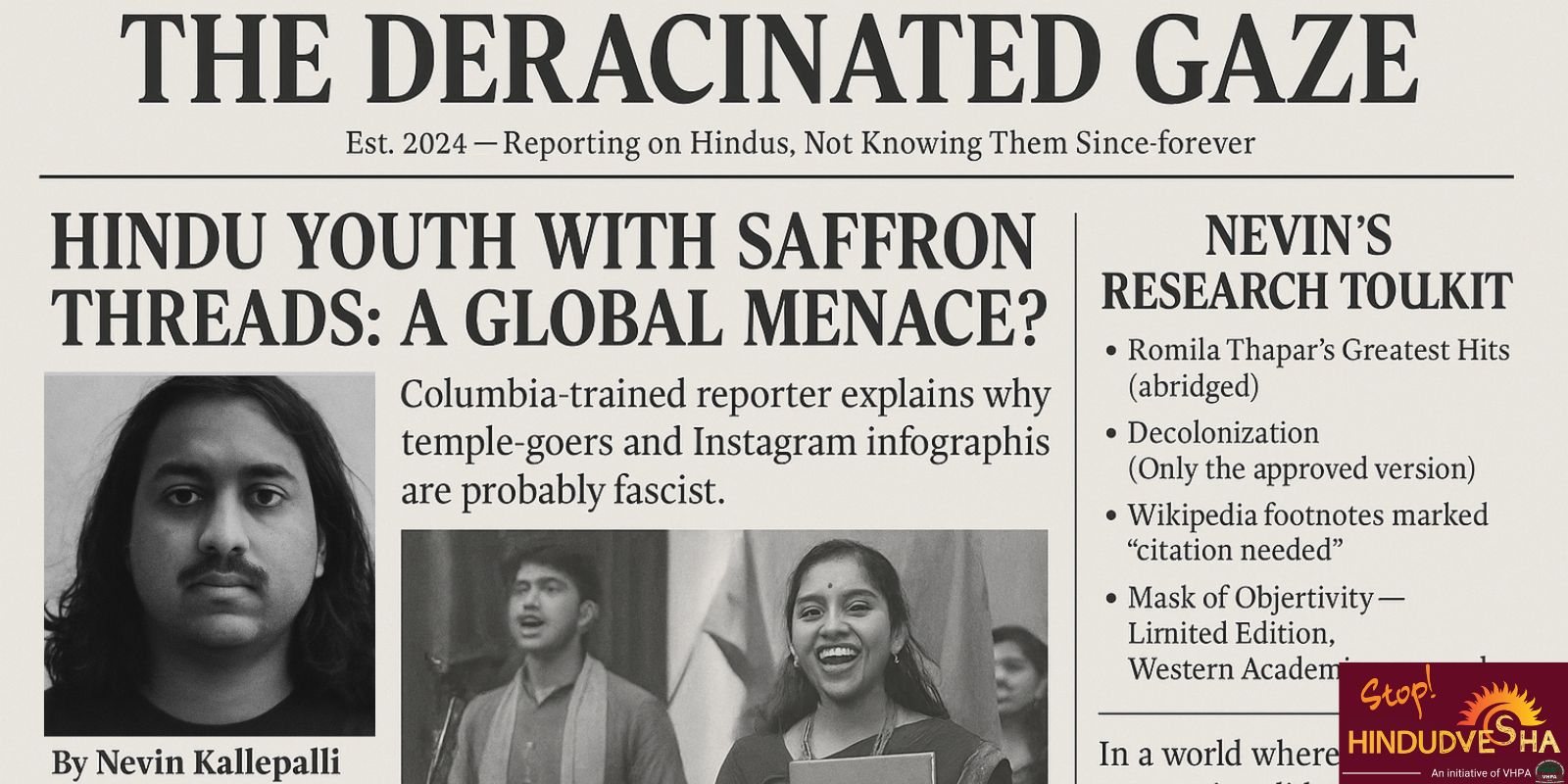
- The article rebuts Kallepalli’s claim that Hindu on Campus (HoC) promotes extremism, arguing instead that it provides a legitimate platform for Hindu youth to express identity, resist erasure, and counter Hinduphobia.
- It highlights the selective outrage in Western academia, which downplays Islamic conquests and Marxist distortions of Indian history while mocking Hindu efforts to reclaim civilizational memory.
- The write-up defends HoC’s depiction of Hindu persecution in Bangladesh and Kashmir with well-documented evidence, criticizing the article’s casual dismissal of real suffering and demographic decline.
- It challenges the portrayal of Narendra Modi and the RSS as fascist, citing Supreme Court exoneration and the RSS’s broad educational and welfare work.
- The article asserts that what alarms critics is not extremism but a new generation of rooted, unapologetic Hindu voices challenging the old narrative monopoly of secular-left academia.
In December 2024, The Baffler published an article titled “University of Hindutva”[1] by Nevin Kallepalli, which launched a sweeping attack on Hindu on Campus (HoC) and other diaspora Hindu organizations, accusing them of “supremacist extremism” and likening their activism to fascist ethno-nationalism. Cloaked in the rhetoric of anti-colonialism and progressive justice, Kallepalli’s piece exemplifies a deeper pattern in Western liberal discourse, where expressions of Hindu identity, especially by young diaspora voices, are met not with curiosity or balance but with suspicion, derision, and distortion. This essay serves as a detailed rebuttal from a Hindu civilizational perspective, grounded in academic scholarship, historical facts, and first principles. Its aim is not only to refute Kallepalli’s claims but also to reclaim the right of Hindu students to articulate their identity and history without being pathologized.
Columbia-trained journalist, Nevin Kallepalli, exemplifies a deracinated generation—born to Hindu parents[2] but culturally detached from the civilizational depth of their heritage. This disconnect often shapes his reporting, which tends to approach Hindu identity and tradition through a critical, Westernized lens shaped by secular liberal academia. His article “University of Hindutva” typifies this posture, where Hindu youth activism is pathologized as dangerous or extremist, while religious nationalism in other traditions is treated with nuance, if not sympathy.
This essay will demonstrate how Kallepalli’s article selectively interprets history, misrepresents Hindu activism, and recycles colonial-era tropes under the guise of social justice, revealing less about Hindu students and more about the ideological echo chamber that shapes such narratives.
Hindu Youth Expression: Not Supremacism, But Self-Assertion
The article portrays HoC as a breeding ground for “Hindu supremacist extremism,” complete with comparisons to Zionist lobbying and white nationalism—a rather dramatic leap, to say the least. In reality, HoC functions like any other student affinity group: it gives Hindu youth a platform to speak on identity, heritage, and discrimination. As Rajiv Malhotra outlines in Being Different: An Indian Challenge to Western Universalism (2011)[3], Hindu identity is not monolithic or militant—it is pluralistic, non-proselytizing, and spiritually inclusive. HoC’s activism arises in response to a genuine context of erasure, stereotyping, and increasing Hinduphobic rhetoric in Western academic spaces.[4]
One might wonder: if Black, Palestinian, Muslim, and Indigenous students can organize around historical trauma and cultural pride without being accused of extremism, why are Hindus the exception? The logic that upholds every group’s right to self-definition while labeling Hindu organizing as a threat isn’t progressive—it’s just selectively regressive.
The Bangladesh Hindu Exodus: Documented, Not Invented
The article goes out of its way to mock HoC’s use of the term “Hindu genocide” in Bangladesh and even ridicules infographics highlighting the demographic decline of Hindus in the region, as if turning centuries of trauma into a meme is some intellectual triumph. But here’s the inconvenient truth: the statistical and ethnographic evidence for this decline is not speculative; it is overwhelming. As Richard L. Benkin meticulously documents in A Quiet Case of Ethnic Cleansing [5], the Hindu population of what was once East Pakistan has plummeted from 30% in 1947 to under 9% today. The 2001 Bangladesh census itself recorded that around 11.2 million Hindus were effectively “missing”—displaced, erased, or silenced.
This isn’t some fringe conspiracy theory. Reputable human rights organizations like Amnesty International and Human Rights Watch have documented countless cases of land grabs, forced conversions, temple desecrations, and targeted violence against Hindus in Bangladesh [6][7]. To casually brush aside this painful and well-documented history as nothing more than a fantasy cooked up by “diasporic fascists” isn’t just factually wrong—it’s morally callous. It erases the lived trauma of millions of people and reveals a troubling double standard: that some victims of religious persecution are worthy of empathy, while others can be dismissed because they don’t fit the ideological script.
Hypocrisy in Historical Framing
HoC’s portrayal of Hindus as “native” to the Indian subcontinent is mocked in the article as a supposed co-optation of indigenous discourse. But this criticism reflects not just intellectual laziness—it reveals a deep misunderstanding (or perhaps deliberate avoidance) of India’s civilizational continuity. The Rig Veda—widely regarded as the oldest book known to humanity—emerged from a settled, advanced civilization in the Indian subcontinent, not from invading nomads. That the author ignores this is unsurprising, given his academic conditioning under the outdated Aryan Invasion Theory. Despite scholars like Witzel clinging to a 1500 BCE dating, newer research in archaeology and Sanskrit studies places Vedic culture several millennia earlier. Yet colonial-era narratives persist, especially among those still reading Indian history through 19th-century European anxieties.
The article is also conspicuously silent on the millennium-long invasions and Islamic conquests—from Arabs to Persians to Turks—that fundamentally reshaped India’s religious and demographic landscape. This wasn’t a cultural exchange. It was civilizational violence: marked by mass killings, forced conversions, the destruction of temples and libraries, and the dismantling of native institutions. K.S. Lal, in his landmark work Growth of Muslim Population in Medieval India (1973)[8], conservatively estimated that the Hindu death toll across these centuries ran into the millions. The demographic, religious, and cultural consequences are not “fascist revisionism”—they are matters of historical record.
So yes, Hindus today—especially youth—remember. They commemorate. They speak. They build infographics. They organize. Not because they want to erase others, but because they are tired of being erased. That a Hindu student might see herself as the heir of a 5,000-year-old civilization is not a threat to pluralism. It’s a threat only to those whose worldview cannot accommodate a confident, decolonized Hindu voice.
To label this civilizational memory as “supremacism” says more about the author’s ideological priors than it does about the movement he critiques. But given the classroom he came from, one can’t really blame him. After all, it’s hard to see the truth of the Rig Veda when your syllabus still thinks Max Müller was doing science.
Caste Legislation: Targeting Hindus Under a Progressive Guise
The article accuses the HoC and other Hindu organizations of defending caste discrimination, particularly in the context of the failed 2023 California caste bill. But Hindu groups never denied the problem of caste-based exclusion. Their objection lay in the vague, race-based language of the bill, which unfairly targeted Hindus and Indians, presuming guilt by cultural association.
Scholars like Nicholas Dirks[9] and Susan Bayly[10] argue that the rigid, hierarchical notion of caste was intensified—and in many ways, created—as a classification tool by British colonial ethnographers. Even Harvard scholar Diana Eck (India: A Sacred Geography, 2012) acknowledges that caste as practiced in Indian villages today is far more fluid and complex than Western media portrayals suggest.[11]
To equate Hindu pushback against flawed legislation with a defense of discrimination is a lazy smear tactic, not a principled critique.
Hinduphobia: Real, Documented, and Growing
The article mocks HoC’s tracking of “Hinduphobia,” dismissing it as a manufactured grievance. But the evidence speaks for itself—and is increasingly documented by initiatives like StopHinduDvesha.org, which tracks anti-Hindu incidents globally. Consider:
- Over the last several years, Hindu temples have been vandalized in Australia, the UK, and Canada with anti-Modi and anti-Hindu slogans.[12]
- In the U.S., multiple Hindu students have reported being ostracized or harassed for expressing pro-Hindu views[13], particularly after advocating for recognition of Hinduphobia in DEI policies.
- A Rutgers student petitioned to have Professor Audrey Truschke reprimanded[14] for repeatedly comparing Hindu texts to Mein Kampf and calling the Ramayana “violent propaganda.”
Imagine the outrage if similar slurs were directed at Jewish or Muslim scripture. Yet when Hindus object, they are painted as authoritarian.
Kashmir: A Selective Narrative
The article repeats the tired tropes about Kashmir being an “ultra-militarized occupation.” But it fails to mention the 1990 ethnic cleansing of over 350,000 Kashmiri Pandits by Islamist insurgents. [15] Nor does it address the Pakistani-backed jihadist militancy that has claimed thousands of lives since 1989.
HoC, like many Hindu groups, supports integration and development in Kashmir, not occupation. To frame this civilizational and humanitarian concern as fascism while ignoring decades of radical Islamist terror is intellectual dishonesty.
On Modi, the RSS, and the “Fascist” Label
The article paints Narendra Modi as a lifelong fascist, leaning heavily on his RSS background and the 2002 Gujarat riots. But in doing so, it either carelessly overlooks—or knowingly suppresses—a crucial fact: in 2012, the Supreme Court of India exonerated Modi after a decade-long investigation found no evidence to warrant prosecution.[16] That’s not a trivial footnote; it’s a foundational detail. Ignoring it doesn’t just weaken the argument—it reveals a deeper problem. Usually, this kind of selective framing takes years to master in the world of ideological journalism. But full credit to the author, for he’s picked it up remarkably fast in just a couple of years.
Meanwhile, the reality on the ground tells a very different story. Modi has governed India for over a decade, overseeing record-breaking economic growth, large-scale infrastructure expansion, and a significant boost in global diplomatic stature (World Bank, 2023).[17] But of course, that doesn’t fit the caricature—so it’s conveniently left out.
The same goes for the RSS, which the article lazily dismisses as a monolithic paramilitary force. In truth, the RSS is a sprawling civil society network with thousands of educational, relief, and welfare initiatives across India. Even Christophe Jaffrelot—no friend of Hindutva—acknowledges this in Modi’s India (2021).[18] Reducing such a vast and multifaceted organization to a single, sinister label may be useful for ideological framing, but it’s intellectually shallow and factually indefensible.
Diaspora Hindu Advocacy: Not a Conspiracy
The article rolls out the tired trope of a global “Hindutva lobby” supposedly manipulating U.S. policy and radicalizing Hindu youth. It sounds dramatic, but lazy and out of step with reality. What actually exists is a scattered, grassroots network of Hindu organizations, mostly volunteer-run, powered by local donations and a genuine desire to protect their identity in a society that often misunderstands or misrepresents them.
These groups aren’t secretive operatives. They engage in normal civic work—interfaith events, legal advocacy, cultural programs, and dialogue with lawmakers. They raise legitimate concerns about temple desecrations, hate crimes, biased textbooks, and media stereotypes. That’s not subversion. That’s democracy. But because they do it unapologetically—without colonial shame—they’re quickly branded “extremists.” Why? For being proud of their roots?
Meanwhile, actual anti-Hindu organizations—like Equality Labs, Hindus for Human Rights, ICNA, and CAIR—are rarely questioned. Some are funded by billionaires like George Soros. Others have links to radical Islamist groups or push questionable data. ICNA, for example, has ties to Jamaat-e-Islami, involved in war crimes during Bangladesh’s liberation.[19] Yet they’re treated as legitimate voices, while Hindu students posting infographics are demonized. That’s not fairness—it’s ideological bias.
As Koenraad Elst writes in Decolonizing the Hindu Mind (2001)[20], Hindu activism isn’t about domination—it’s a natural response to centuries of distortion and today’s cultural hostility. When young Hindus speak up, reclaim their narrative, and stop apologizing for their existence, it unsettles people. Instead of honest dialogue, critics retreat into old labels: fascist, supremacist, dangerous.
But here’s the truth: there’s nothing extreme about wanting dignity. When Hindus ask to be treated with the same respect as every other community, and that’s seen as a threat, it says more about the accuser than the accused.
Historical Revisionism: Who is Revising What?
The article accuses HoC of promoting “pseudo-history,” but the real problem isn’t falsehood—it’s the disruption of an old, comfortable narrative. For decades, Indian and Western academia have curated a version of history that downplays Islamic conquests, whitewashes Mughal atrocities, and sidelines Hindu resistance. Textbooks shaped by Marxist historians like Romila Thapar often omitted temple desecrations, forced conversions, and civilizational trauma, reducing resistance movements by the Marathas, Rajputs, and Sikh Gurus to footnotes. [21]
In that context, HoC’s infographics—though simplified for Instagram—serve a powerful purpose: they restore erased memory. They invite young Hindus to question, explore, and rediscover what was hidden in plain sight. And that makes some people uncomfortable. The outrage from academic gatekeepers has little to do with historical truth and everything to do with narrative control. These students aren’t waiting for permission—they’re telling their own story, proudly and unapologetically.
Calling this movement “pseudo-history” is a deflection. The real distortion lies in decades of ideological bias and colonial hangovers. What HoC challenges isn’t history—it’s the monopoly over who gets to speak for it. And for those used to defining Hindus from the outside, that challenge feels like a threat. But for many, it’s a long-overdue awakening.
Concluding Remarks
In the end, Nevin Kallepalli’s article is less an exposé of so-called Hindu extremism and more a reflection of the anxiety felt by certain ideological circles when young Hindus assert their identity with clarity, pride, and autonomy. Hindu on Campus and similar groups are not paramilitary cells in disguise—they are student collectives grappling with cultural erasure, historical distortion, and rising Hinduphobia in academic and media spaces. Their infographics, campaigns, and advocacy may be simplified for social platforms, but the emotions they channel are real: a desire to belong, to be understood, and to no longer be spoken for by others.
What unnerves critics is that this generation of Hindus is no longer content with inherited shame or colonial narratives. They refuse to apologize for being rooted, spiritual, or civilizational conscious. And that, to the self-appointed guardians of “progressive” discourse, is deeply threatening. The selective empathy—where every minority can narrate its pain except Hindus—is finally being challenged.
To call this awakening “fascism” is not just inaccurate—it’s a way of avoiding uncomfortable questions. Who gets to define identity? Who controls history? And why does Hindu dignity unsettle so many? These are the questions this moment demands. And this time, Hindus aren’t waiting for permission to answer them.
Citaitons
[1] Nevil Kattepali, The University of Hindutva; https://thebaffler.com/latest/university-of-hindutva-kallepalli
[2] Nevin Kallepalli, UC Berkley Journalism; https://fellowships.journalism.berkeley.edu/cafellows/fellow/nevin-kallepalli/?utm_source=chatgpt.com
[3] Rajiv Malhotra, Being Different: An Indian Challenge to Western Universalism (2011); https://archive.org/details/being-different-an-indian-challenge-to-western-universalism-2011
[4] Audrey Truschke, Aurangzeb: The Man and the Myth (2017); https://archive.org/details/aurangzeb-the-man-and-the-myth-hardcovernbsped.Audrey-Truschke
[5] Richard L. Benkin, A Quiet Case of Ethnic Cleansing: The Murder of Bangladesh’s Hindus (2007); https://books.google.com/books/about/A_Quiet_Case_of_Ethnic_Cleansing.html?id=OmthMwEACAAJ
[6] Human Rights Watch and Amnesty International reports on Bangladesh minorities (2001–2015); https://www.hrw.org/world-report/2006/country-chapters/bangladesh
[7] Amnesty International 2013 Press Release: “Wave of violent attacks against Hindu minority;” https://www.amnesty.org/en/latest/press-release/2013/03/bangladesh-wave-violent-attacks-against-hindu-minority/
[8] K.S. Lal, Growth of Muslim Population in Medieval India (1973); https://archive.org/details/GrowthOfMuslimPopulationInMedievalIndiaAd10001800
[9] Nicholas Dirks, Castes of Mind (2001); https://www.academia.edu/48688784/Castes_of_Mind_Colonialism_and_the_Making_of_Modern_India
[10] Susan Bayly, Caste, Society and Politics in India from the Eighteenth Century to the Modern Age (1999); https://archive.org/details/castesocietypoli0000bayl
[11] Diana Eck, India: A Sacred Geography (2012); https://archive.org/details/indiasacredgeogr0000eckd
[12] Rati Agnihotri, Hindu Festivals and Temples Under Siege: A Systemic Global Assault on Hindu Identity; https://stophindudvesha.org/hindu-festivals-and-temples-under-siege-a-systemic-global-assault-on-hindu-identity/
[13] Jurist News, Hindu-American advocacy group files civil rights complaint against US university over caste-based discrimination report; https://www.jurist.org/news/2024/09/hindu-american-advocacy-group-files-civil-rights-complaint-against-us-university-over-caste-based-discrimination-report/?utm_source=chatgpt.com
[14] Diverse: Issues in Higher Education, Rutgers Supports Professor Facing Online Attacks After a Hindu Student Petition; https://www.diverseeducation.com/latest-news/article/15108769/rutgers-supports-professor-facing-online-attacks-after-a-hindu-student-petition?utm_source=chatgpt.com
[15] Rahul Pandita; Our Moon has Blood Clots (Random House India, 2013); https://archive.org/details/our-moon-has-blood-clots-rahul-pandita
[16] Supreme Court of India SIT Report on Gujarat Riots (2012); https://cjp.org.in/wp-content/uploads/2017/05/SIT%20report%20on%20TEHELKA%20_3.7.pdf
[17] World Bank data on Indian economic growth (2023); https://data.worldbank.org/indicator/NY.GDP.MKTP.KD.ZG?locations=IN
[18] Christophe Jaffrelot, Modi’s India: Hindu Nationalism and the Rise of Ethnic Democracy (2021); https://dokumen.pub/modis-india-hindu-nationalism-and-the-rise-of-ethnic-democracy-9780691223094.html
[19] Jai G Bansal, ICNA (Islamic Circle of North America) Deconstructed; https://stophindudvesha.org/icna-islamic-circle-of-north-america-deconstructed/
[20] Koenraad Elst, Decolonizing the Hindu Mind (2001); https://archive.org/details/decolonizing-the-hindu-mind-1-by-koenraad-elst-z-lib.org
[21] Rajiv Malhotra and Aravindan Neelakandan, Breaking India (2011); https://archive.org/details/breakingindia_201908

Donate to HINDUDVESHA
Our Mission is to explore and expose Hindudvesha through research analysis, education and response.
SUPPORT US