

India’s Hidden Battlefield: The Rising Threat of the 0.5 Front War
 Rakesh Krishnan Simha · 05/22/2025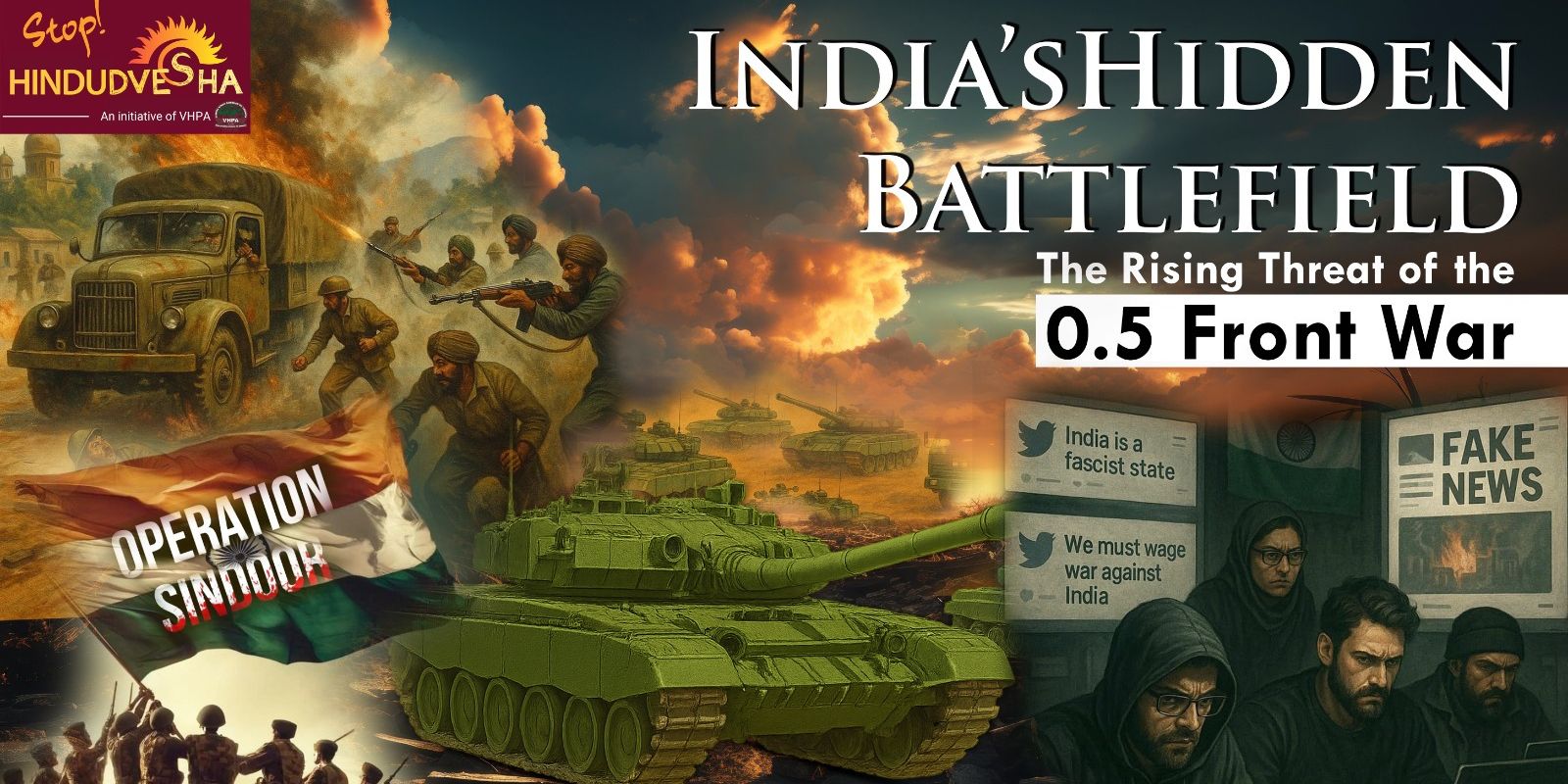
- The “0.5 Front” threat refers to internal enemies—radical Islamists, urban naxals, cyber saboteurs—activated during wartime to create unrest, sabotage infrastructure, and weaken India from within, alongside external wars with Pakistan and China.
- Historical and recent examples highlight how radicalized individuals have disrupted military efforts, spied on key assets, or incited violence during national crises, often escaping consequences due to political or judicial leniency.
- Psychological warfare and misinformation—fueled by fake news from media outlets, activists, and foreign propaganda—can destabilize morale and public trust, multiplying the damage during wartime.
- Grey zone warfare by China and Pakistan includes hybrid tactics like cyberattacks, propaganda, and proxy terrorism to weaken India without open conflict—tactics cultivated over decades and inspired by strategic doctrine.
- India’s response must be robust: reform weak laws, curtail judicial overreach, improve intelligence coordination, promote media responsibility, and—where needed—pursue covert and decisive action against traitorous actors to preserve national integrity.
When a nation goes to war, the most visible threats are external — enemy forces, missile strikes, and battles on land, sea, and air. But for India, an equally potent and insidious menace comes from within. This internal vulnerability was referred to by the late General Bipin Rawat, India’s first Chief of Defence Staff, as the “0.5 Front.”[1]
The term 0.5 Front is part of the “two-and-a-half front war.” In this nightmarish scenario, the Indian armed forces have to simultaneously fight conventional wars against China to the north and Pakistan to the west while having to battle internal enemies. Although less visible, these enemies can be just as damaging as a conventional attack.
The 0.5 Front is not defined by uniforms or organized battalions. Instead, it is made up of elements like sleeper cells, pro-Pakistan Islamists, cyber saboteurs, urban naxals, and those who exploit social divisions. During wartime, hostile forces can activate or manipulate these elements to create internal unrest, disrupt communication lines, and divert national attention and resources. India’s sheer size and diversity make it particularly susceptible to these internal fault lines being manipulated at critical moments.
According to a report by the Manohar Parrikar Institute for Defence Studies and Analyses, a two-and-a-half front war is “the worst case scenario” that India could face and would come about if there is a total breakdown of political, diplomatic, economic, and other efforts to resolve the situation. “It also points towards a breakdown of various administrative and other processes in the concerned state/states of the union, consequent to which insurgency has taken root therein.”[2]
Pakistan within India
A significant component of the 0.5 Front is the presence of radicalized individuals and sleeper cells within the country. These groups can be silently embedded in society until activated, carrying out sabotage, orchestrating terror attacks, or inciting violence to weaken the country from within.
Senior journalist Pushpendra Kulshrestha has narrated a chilling incident about the 1965 War in which pro-Pakistani elements blocked an Indian Army convoy that was traveling to the front. The convoy was departing from Rampur cantonment and heading towards the western border when it was stopped in its tracks while passing through Uttar Pradesh because a group of 50 radicalized Muslims pelted stones at the troops and dug up the highway.[3]
Kulshreshtha, an alumnus of Aligarh Muslim University, stated that the group of Muslims was led by a college student named Azam Khan. Khan was beaten by the public, arrested, and hospitalized for his actions. While in the hospital, he was reportedly ordered by the local Intelligence Bureau officer to leave Rampur. Khan subsequently moved to Aligarh, enrolled at AMU, and eventually rose to become a minister in the Samajwadi Party, where he is currently a senior leader. The identity of these Rampur traitors was known to the authorities as these saboteurs lived and worked alongside the highway, but in the name of secularism, they were not prosecuted.
More recently, during Operation Sindoor, when the Indian armed forces were conducting air strikes against Pakistan, the police in the southern state of Kerala arrested Mujeeb Rahman for making a phone call to the strategic Kochi Naval Base, posing as an official in the Prime Minister’s Office, and seeking information about the GPS coordinates of the aircraft carrier INS Vikrant.[4]
Across the country, people witnessed numerous incidents of violence, arson, and vandalism by Muslims. Another shocking incident took place in Shahjahanpur, Uttar Pradesh, where Moeed Khan stabbed a 12-year-old Hindu boy named Surjeet for merely discussing Operation Sindoor.[5]
Motivated by jihadi fervor, such individuals can target not only Hindu individuals but also military bases, supply lines, power grids, dams, and public services, often with little warning, causing confusion and potentially widespread panic.
Battle for the Mind
Adding to these dangers is the rise of misinformation and psychological warfare. Fake news, doctored images, and provocative messages shared on social media can confuse the public and fuel panic. Hostile powers understand that in the digital era, wars are fought as much in the mind as on the battlefield. The goal is often to destabilize a country not through bombs but by eroding morale, undermining trust in institutions, and turning citizens against one another.
On May 7, 2025, when India launched airstrikes on Pakistan as part of Operation Sindoor, the Pakistani military and several Pakistani channels claimed that three Indian Air Force jets had been shot down in Kashmir. They shared old images from a 2024 Rajasthan accident to support the narrative. These were unrelated to Operation Sindoor.
The Hindu’s official X account posted a tweet claiming three Indian jets crashed in Jammu & Kashmir, citing a government source and including photos alleged to be from crash sites. The tweet was false, not published on their website, and was later deleted. However, the Chinese propaganda outlet China Daily amplified the claim, citing The Hindu to lend credibility and spread the narrative globally.[6]
Although The Hindu is a habitual fake news peddler and has lost quite a bit of credibility, it remains one of India’s largest circulated newspapers and, therefore, has a huge readership. By pushing Chinese propaganda against the Indian Air Force during wartime, The Hindu’s lies enabled Pakistan to sell its story to the world while impacting morale in India.
Other unsavory characters were also doing their bit for the enemy. For instance, in a bid to embarrass the government, senior lawyer and activist Prashant Bhushan, known for his trenchant Hinduphobia, posted on X that India “lost multiple fighter jets including the latest Rafales to Pakistan’s Chinese made fighters.” He added: “The blame for our present debacle squarely rests on our political leadership.”[7]
Similarly, Indian journalist Karan Thapar put out fake news about Indian aircraft losses, which were amplified by the Pakistani media. Being a defense writer, I received a barrage of messages from friends and readers who were confused and upset at leftist Indian news outlets claiming heavy Indian aircraft losses. Almost everyone who wrote to me said they didn’t trust Pakistani propaganda, but when these Indian news outlets began toeing the Pakistani and Chinese line, it began to impact their morale. What The Hindu and Thapar are doing is not journalism but treason.[8]
Individuals such as Bhushan and Thapar—though not always directly violent—can erode public trust in the government and military, especially during national emergencies. In times of conflict, this internal dissent can take on a much more dangerous tone, creating divisions when unity is most needed.
By spreading misinformation, India’s adversaries can ignite riots or violent protests, further straining security forces. These internal disturbances don’t just harm social cohesion — they stretch the military and police thin, forcing them to handle domestic crises instead of focusing entirely on external defense.
Border regions like Jammu and Kashmir, parts of the Northeast, and tribal areas are particularly vulnerable during wartime. These areas already contend with insurgencies and separatist movements, which can escalate significantly under foreign influence during times of external conflict. In such scenarios, the internal front becomes a force multiplier for the enemy, doing more damage collectively than a direct assault ever could.
Why India’s Adversaries Cultivate Saboteurs
Given the significant costs of engaging India in combat and the growing range of indirect and non-military tools at their disposal, both Pakistan and China are seeking ways to achieve relative gains without triggering escalation. From fake news and online troll farms to terrorist financing and paramilitary provocations, these approaches often lie in the contested arena somewhere between routine statecraft and open warfare – the “grey zone.”
According to the Center for Strategic & International Studies, “The grey zone phenomenon is also called hybrid threats, sharp power, political warfare, malign influence, irregular warfare, and modern deterrence. Although it reflects an age-old approach, it is newly broad in its application. Today, the toolkit for coercion below the level of direct warfare includes information operations, political coercion, economic coercion, cyber operations, proxy support, and provocation by state-controlled forces.”[9]
Peter Layton of the Lowy Institute writes that grey zone actions don’t just happen. “China, for example, has implemented a well-orchestrated campaign approved and controlled by the highest levels of the Chinese Communist Party and the People’s Liberation Army. Grey zone actions are not those of tactical commanders freelancing. They are purposefully constructed to side-step military escalation – crafted as a form of carefully scripted brinkmanship.”[10]
Layton identified China as the “largest country undertaking grey zone actions.” Whether in the South China Sea, the East China Sea, or on its border with India, China has employed innovative and imaginative grey zone tactics in its quest for a persistent strategic advantage over others, he writes.
Pakistan has learned well from its master. Pakistani author and columnist F.S. Aijazuddin writes in his book ‘From a Head, Through a Head, To a Head – The Secret Channel Between the US and China Through Pakistan’ that in the early 1960s, Chinese Premier Zhou-Enlai had traveled to Pakistan and suggested to President Ayub Khan that Islamabad should prepare for a prolonged conflict with India instead of short-term wars, and raise a militia force to act behind Indian lines. Heeding China’s advice, the Pakistanis went on to create terrorist groups like the Lashkar to wage an undeclared war against India.
Countering the 0.5 Front
The dangers posed by the 0.5 Front are not just theoretical. They can have very real consequences, weakening national resolve through internal division. In a worst-case scenario, internal chaos could delay or undermine India’s ability to respond effectively to external attacks.
Modern India has two choices. It can stumble and plodder towards chaos, with numerous enemies such as communists, Maoists, radical Islamists, fundamentalist Christians, seculars, liberals, and urban naxals working tirelessly to pull it down.
Or it can systematically identify, isolate, and cut down its internal adversaries. First up, India must take a comprehensive and proactive approach. Intelligence sharing between the military, police, and intelligence agencies must be seamless and swift. Cyber defenses need constant strengthening and public awareness programs that help citizens recognize and reject misinformation. Engaging with marginalized communities and addressing their concerns can reduce the risk of radicalization. At the same time, legislation must be used judiciously to target genuine threats without stifling civil liberties. The media also has a crucial role to play in maintaining responsibility during times of national stress.
India will also need to implement legal and administrative reforms to combat this asymmetrical warfare. Many laws are currently vague, allowing the judiciary ample opportunities to dismiss cases, lessen the gravity of crimes, and award Mickey Mouse sentences to anarchists, vandals, and rioters.
There should be mandatory sentencing laws so that judges don’t have the discretion to lower sentences given to traitorous individuals and other criminals. India’s Supreme Court is notorious for opening its doors at midnight to hear the bail pleas of hardened criminals and terrorists. During Operation Sindoor, when the government blocked the YouTube channel 4 PM News for peddling fake news, the Supreme Court ordered its unlocking within hours. A habitual offender was thus able to duck the ban and continue its anti-India tirade on YouTube.[11] Clearly, India needs to curb judicial overreach because, in way too many cases, the higher judiciary is undoing the work of the police by going soft on those who wage war against the nation.
It is time for India to end the soft approach. The political leadership must accept that the country’s self-interests and security are above all else. Eliminating internal enemies should be a primary task. This will involve tracking down suspected treasonable individuals and groups and infiltrating and manipulating them. This strategy is essential against the urban naxals who have grown deep roots in India’s colleges and universities and are poisoning young minds against the nation and its values. Indian journalists in the pay of foreign intelligence agencies can be easily ferreted out using technology and humint – human intelligence.
More dangerous individuals – such as terrorists and those who encouraged, trained, and supported them in any way – should be eliminated by all necessary means. There is nothing outrageous about this – nations do this routinely. How else do you think Osama bin Laden was eliminated? It is known as “permissible self-defense targeting.”[12]
Conclusion
An American author once wrote: “A nation can survive its fools and even the ambitious. But it cannot survive treason from within. An enemy at the gates is less formidable, for he is known and carries his banner openly. But the traitor moves amongst those within the gate freely, his sly whispers rustling through all the alleys, heard in the very halls of government itself. The traitor appears not a traitor; he speaks in accents familiar to his victims, and he wears their face and their arguments; he appeals to the baseness that lies deep in the hearts of all men. He rots the soul of a nation, he works secretly and unknown in the night to undermine the pillars of the city, he infects the body politic so that it can no longer resist. A murderer is less to fear.”[13]
India’s history is replete with instances of our own people opening the doors of the citadel for the enemy and transforming an imminent victory into a disastrous defeat. From the very first Islamic invasion of India in 711 CE to the British colonization of India, nearly all the major setbacks suffered by Indians were due to internal disunity and betrayal. The harsh truth is that Indians must be lucky every time, while the enemy has to be lucky only once.
Ultimately, General Rawat’s warning about the 0.5 Front is a wake-up call. Modern warfare is no longer just about guns and tanks — it’s about minds, networks, ideologies, and the strength of the social fabric. India’s ability to emerge victorious in a future conflict will depend not just on the courage of its soldiers but on the resilience and unity of its people.
“This is a proxy war, and proxy war is a dirty war. It is played in a dirty way,” said General Rawat. “The rules of engagement are there when the adversary comes face to face and fights with you. It is a dirty war…That is where innovation comes in. You fight a dirty war with innovations.”[14]
Citations
[1] Some of the most badass things Gen Bipin Rawat said have set the bar high for the next CDS (TFI Post, 2021); https://tfipost.com/2021/12/some-of-the-most-badass-things-gen-bipin-rawat-said-have-set-the-bar-high-for-the-next-cds/
[2] Prashant Mishra asked: What is ‘two-and-a-half front war’ and is India prepared for it? (Manohar Parrikar Institute for Defence Studies and Analysis); https://www.idsa.in/askanexpert/prashant-mishra-asked-what-is-two-and-a-half-front-war-and-is-india-prepared-for-it-2
[3] Azam Khan was a traitor from the very beginning – Pushpendra Kulshreshtha (YouTube); https://www.youtube.com/watch?v=Kce3GN_DfWA
[4] Kozhikode man who called up the navy and sought INS Vikrant’s location arrested in Kochi (Times of India); https://timesofindia.indiatimes.com/city/kochi/kozhikode-man-who-called-up-navy-and-sought-ins-vikrants-location-arrested-in-kochi/articleshow/121115652.cms
[5] Shahjahanpur: Enraged over a 12-year-old’s comments on ‘Operation Sindoor’, Moeed Khan stabs the Hindu child, raises Pakistan Zindabad slogan (OpIndia, 2025); https://www.opindia.com/news-updates/shahjahanpur-enraged-over-a-12-year-olds-comments-on-operation-sindoor-enraged-moeed-khan-stabbed-the-hindu-child-raised-pakistan-zindabad-slogan/
[6] Information Warfare post Operation Sindoor: From The Hindu to The Wire, are journalists running an anti-India campaign? (Organiser, 2025); https://organiser.org/2025/05/09/291126/bharat/information-warfare-post-operation-sindoor-from-the-hindu-to-the-wire-are-journalists-running-an-anti-india-campaign/
[7] Amidst information coming from International media & defence analysts (Not denied by our Air Force spokesman) that we lost multiple fighter jets including Rafales to Pakistan’s Chinese made fighters, the focus must also shift to our infamous Rafale deals. (Prashant Bhushan, X); https://x.com/pbhushan1/status/1922117509484081553
[8] Karan Thapar पाकिस्तानी मीडिया में हीरो बन चुके हैं। ये पत्रकारिता नहीं, देशद्रोह है। (X, 2025); https://x.com/Pamphlet_in/status/1921250232550953112
[9] Gray Zone Project (Center for Strategic and International Studies); https://www.csis.org/programs/gray-zone-project
[10] China’s grey-zone provocations: Time to reciprocate (The Interpreter, 2025); https://www.lowyinstitute.org/the-interpreter/china-s-grey-zone-provocations-time-reciprocate
[11] Ban On 4PM YouTube Channel Lifted, Supreme Court Told (NDTV, 2025); https://www.ndtv.com/india-news/ban-on-4pm-youtube-channel-lifted-supreme-court-told-8404395
[12] Permissible Self-Defense Targeting and the Death of Bin Laden Permissible Self-Defense Targeting and the Death of Bin Laden (Denver Journal of International Law and Policy); (https://digitalcommons.du.edu/cgi/viewcontent.cgi?article=1176&context=djilp
[13] https://www.goodreads.com/quotes/33210-a-nation-can-survive-its-fools-and-even-the-ambitious
[14] Need innovation to fight dirty war in J&K: army chief (Deccan Herald, 2017); https://www.deccanherald.com/india/need-innovation-fight-dirty-war-2007183

Donate to HINDUDVESHA
Our Mission is to explore and expose Hindudvesha through research analysis, education and response.
SUPPORT US