

India’s Diplomatic Outreach Shines Light on Pakistan’s Global Terror Network
 Rati Agnihotri · 06/26/2025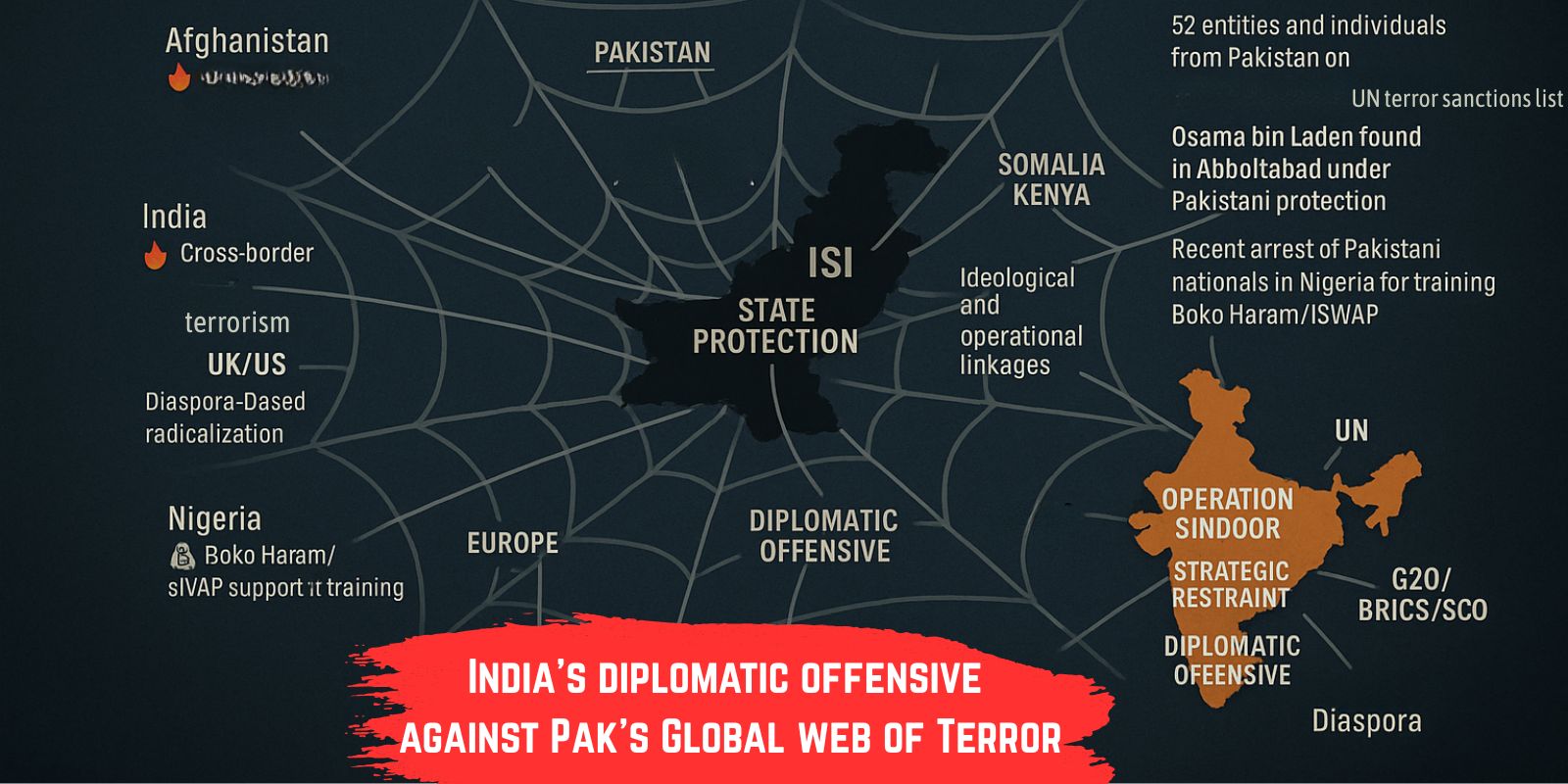
- The menace of radical Islamic extremism and terrorism in regions like Africa largely ignored by the mainstream Western media and various powerful stakeholders of the global community.
- India’s global diplomatic outreach in the aftermath of Operation Sindoor serves the larger purpose of restructuring global narratives on radical Islamic extremism and terrorism.
- India consolidating the Global South in its fight against terror, all-party delegations achieved concrete objectives in aligning various countries of the Global South with India’s policy on terror.
- Western countries continue to appease Pakistan, the evidence of which is the dual act of their continued silence on the complicity of the Pakistani state in fuelling terrorism and the indirect incentivizing of the country’s terror machinery by various international organizations.
- The majority of the mainstream Western media has acted as the de facto mouthpiece of the Pakistani establishment by continuously peddling Pakistani propaganda on Operation Sindoor
The Nigerian army recently arrested four Pakistani nationals over alleged ties to terrorism. The arrested Pakistanis were suspected of providing strategic and tactical training to the terrorists of Boko Haram and the Islamic State West Africa Province (ISWAP). [1] Yet, how many international news reports did you come across giving prominent coverage of this news?
In December 2023, a terrorist attack against Christians in Nigeria led to the loss of almost 200 lives, yet the incident was mostly ignored by the mainstream global media, despite the gut-wrenching statistics of casualties.[2] [3] What’s even more intriguing is the fact that most accounts of the coverage attempt to camouflage the possible motives behind the attack by referring to terrorists as “gunmen” and, in general, trying to evade the context of the attacks.
Numerous such terrorist attacks in Africa have been conveniently ignored by mainstream Western media. While the global left-liberal ecosystem highlights terrorism in the Western world, it often turns a blind eye to violence in regions like West Africa and South Asia. It reflects the left-liberal reluctance to address radical Islamic extremism in Africa, even as it whitewashes Hamas’s brutality by presenting a heavily biased view of the Israel-Gaza conflict.
It is against this backdrop of the global malaise of terrorism that India’s proactive global outreach against terrorism in the aftermath of Operation Sindoor becomes very significant.
In a one-of-its-kind initiative, the Indian government recently sent seven All-Party Delegations of Members of Parliament to countries across the world. The delegation, comprising 51 senior political leaders across party lines, visited 32 countries, and the European Union (EU) headquarters were in Brussels.[4]
This outreach campaign represents a strategic shift in not just India’s response to cross-border terrorism emanating from Pakistan but also serves the larger purpose of restructuring global narratives on radical Islamic extremism and terrorism.
In the following sections, we explain how India’s distinctive global approach to counterterrorism makes it a key player in the fight against terror. This approach moves the conversation beyond the narrow Western perspective and encourages a more balanced and inclusive dialogue that also reflects the national security concerns and citizen safety priorities of the Global South.
India’s Fight Against Terrorism Goes Global
India’s all-party delegations leveraged the expertise of seasoned political leaders, such as Shashi Tharoor, who has extensive experience in international diplomacy, including prominent positions at the UN, to communicate its decisive stand against the menace of terrorism.
The participation of an all-party Indian delegation sent a clear message to the global community about India’s internal unity and consistent national stance when it comes to condemning terrorism.
In a gesture rich with symbolism, the delegation led by Congress leader Shashi Tharoor visited the 9/11 Memorial in New York, reinforcing the call for global unity and shared resolve in the fight against terrorism.[5] This part of the visit sent a clear message to the West that it can no longer afford to be selective in its condemnation of terrorism.
The multi-party delegations also leveraged the power of the Indian diaspora to draw a consensus on the fight against global terrorism. It exposed not only the links of the Pakistani state with the Pahalgam terror attacks but also reminded the world of its complicity in the planning and orchestration of terror attacks the world over. While speaking at an event in Johannesburg, South Africa, the BJP delegate Anurag Thakur emphasized that Pakistan is the only country in the world where 52 entities and individuals have been named in the UNSC list over their connection to terrorism.[6]
Another delegate, Manish Tewari reminded the world of Pakistan’s involvement in shielding Osama Bin Laden – “A state which could suck money out of the global coalition against terror led by the USA and shelter, the biggest enemy of the USA (Osama bin Laden) and someone who is being hunted by the entire world, is the greatest testimony to Pakistan’s doublespeak”, he said. [7]
Former Indian Ambassador to the US, Taranjit Singh Sandhu, speaking for the all-party delegation, emphasized that India is fighting the battle against terrorism on behalf of the world, especially the US, since the terrorists and terrorist organizations posing a threat to India’s unity and integrity are the ones in conflict with the US as well.[8]
In short, after Operation Sindoor, India’s global outreach focused on highlighting a shared global experience of suffering from jihadi terrorism. By stressing that terrorism is a widespread global issue, Indian delegations questioned the narrow Western view. Every briefing also repeated two key points from Operation Sindoor: (a) The strikes were targeted and only hit terror camps linked to UN-designated terrorists and groups, (b) India can no longer overlook how deeply terrorism is embedded in the Pakistani state system.
Operation Sindoor was not just a response to the Pahalgam attacks—it signaled a major shift in India’s counterterrorism approach. The Indian Prime Minister made it clear that Operation Sindoor now represents India’s official policy: any future terror act by Pakistan will be seen as an act of war and responded to accordingly. This marks a new model of dealing with terrorism—focused, intelligence-driven strikes instead of full-scale war. It also sets a precedent for a broader strategy that combines military action with diplomatic and economic pressure to counter terror on multiple fronts.
The world has much to learn from India’s Operation Sindoor. John Spencer, Chair of Urban Warfare Studies at the Modern War Institute, praised the operation in a detailed post on X, describing it as a “massive victory” and noting that the operation is still “not completely over” despite the abrupt cessation of hostilities that followed it. He stated, “India’s restraint is not weakness – it is maturity. It imposed costs, redefined thresholds, and retained escalation dominance. India didn’t just respond to an attack. It changed the strategic equation.”[9]
An analysis of Operation Sindoor published by the Royal United Services Institute argues that while engaging in precision strikes targeting terrorist-linked infrastructure in Pakistan, India displayed unprecedented restraint and even accepted heightened operational risks to stick clearly to its strategic objective of dismantling terror infrastructure.[10] This, as the piece argues further, signifies a new kind of warfare where the clarity of strategic messaging becomes as important as achieving victory.
At a deeper level, Operation Sindoor reflects a multi-layered approach to warfare grounded in the principles of Dharma, where moral considerations guide strategic decisions, such as avoiding even military targets unless absolutely necessary. This stands in stark contrast to the West’s aggressive, often indiscriminate misadventures in Iraq, Afghanistan, Syria, etc.
Over the past decade, India has proactively used its bilateral and multilateral engagements, along with its presence in the UN, not just to raise the issue of Pakistan-sponsored terror but to bring the world’s attention to terrorism as a challenge for global peace and security. This includes
- Efforts to curb terror financing.
- Focus on fostering intelligence-sharing mechanisms in its bilateral partnerships.
- Efforts to bring the issue of terrorism to the forefront of various multilateral groupings like BRICS, SCO, G20, etc.
- Leveraging the United Nations to build a broad consensus on key global peace and security issues.
Thus, India’s global diplomatic efforts after Operation Sindoor should be seen as a continued part of its broader policy against global terrorism.
Consolidating the Global South Against Terrorism
A key aspect of India’s foreign policy in the past decade has been uniting the Global South as a collective voice. As India recently overtook Japan to become the world’s 4th largest economy, its rise comes at a time when the old, Western-dominated world order is quickly fading. While the shape of the new global order is still unclear, India is playing a crucial role in helping define it by bringing the Global South together on important global issues.
Apart from addressing political leaders, members of the diaspora, and other dignitaries in Western countries and the Middle East, India’s all-party delegations also visited nations in the Global South including South Africa, Brazil, Panama, Guyana, Columbia, Sierra Leone, Algeria, Democratic Republic of Congo, Liberia, Ethiopia, and Egypt.[11]
While the Western countries visited by the delegations, including the US, UK, Germany, etc., largely paid their usual lip service to India’s concerns, India’s mission achieved remarkable success in the countries representing the Global South.
In a significant development, Colombia officially withdrew its earlier statement expressing condolences over deaths in Pakistan following India’s Operation Sindoor, and firmly backed India’s position on terrorism.[12] The President of Panama, Jose Raul Mulino Quintero, also extended his support to India’s resolute stand against terrorism. [13] Guyana has also affirmed its support against terrorism[14] to the All-Party Delegation, and especially appreciated India’s unity as displayed through the delegation’s visit, cutting across party lines. In a symbolic show of solidarity, a moment of silence was observed in the Parliaments of Sierra Leone and Liberia to honor the memory of the victims killed in the Pahalgam terror attack. [15]
Former Indian envoy Sujan Chinoy highlighted the significance of India’s diplomatic outreach to Africa in the backdrop of the rising threat of terrorism in the region. “The African Union comprises a very large number of countries, and recent UN reports suggest that this continent is no longer immune to global terrorism. Pakistan-sponsored terrorism has its tentacles spread across the world. The terrorist networks afflicting Africa also have linkages with networks based in Pakistan. In recent years, Africa has emerged as a major centre for global terrorism, with groups like Boko Haram in Nigeria, al-Shabaab in Somalia, Tanzania, and Kenya, as well as many others operating out of Mozambique. Particularly, the Sahel region of Africa has experienced a significant spike in terrorist incidents,” he said. [16]
A thought-provoking piece by Stephen S. Enada, published in Newsweek, critiques what it sees as the West’s disproportionate focus on conflicts in Israel and Ukraine, while ignoring the reality of terrorist violence in Africa, and instead, peddling a narrative “that blames climate change for religious conflicts in Africa”.[17]
Another piece published by AfricLaw critically interrogates the silence of the global community on the proliferation of radical Islamic extremism and terrorism in Africa. It argues that West Africa has turned into a new battleground for Jihadists, and terrorism in the region has risen sharply from 2012 to 2022. The piece gives the example of Mozambique, where terrorists “from the Islamic State groups are trying to create a new caliphate”. Laying out alarming statistics regarding the prevalence of Jihadi terrorism in Africa, the write-up urges the global community to immediately intervene and take necessary steps.[18]
As the Western world continues to sideline Africa, India finds itself in a strong position to strengthen its ties with African nations and build common ground on sensitive issues like terrorism. While China also has major interests in Africa, its approach is largely transactional and indifferent to human rights concerns. In contrast, India is well-placed to deepen its bilateral relationships across the continent and build broader regional partnerships—alliances that can be effectively used at global platforms like the UN to advance the fight against global terrorism.
West’s Double-Speak on Pak Terrorism
In geopolitics and international diplomacy, moral posturing can often be a matter of strategic convenience. The West seems to have mastered the tricks of the trade, vociferously condemning terrorism when it suits its purpose and nonchalantly looking the other way when the victims of terrorism do not fall within the ambit of its field of strategic interest.
The West’s response to the Pahalgam terror attacks and its support for India’s right to self-defence have been mostly lukewarm. Though many Western countries have formally condemned the attacks and expressed sympathy, these gestures ring hollow in the absence of any direct criticism of Pakistan’s terror machinery. On the contrary, Western countries continue to appease Pakistan, evident in their ongoing silence about the Pakistani state’s role in supporting terrorism, and the indirect encouragement of its terror network through aid and support from various international organizations.
Pakistan has been appointed as the Chair and Vice-Chair of two important United Nations Security Council (UNSC) committees – the Taliban Sanctions Committee and the Counter Terrorism Committee.[19] Pakistan was elected as a non-permanent member of the UNSC in June 2024, a position it will hold till December 31, 2026. Although the country’s lead role in these committees is merely procedural, the fact that none of the major world powers made even the slightest attempt to question the decision is telling of the West’s abject apathy towards India’s national security concerns.
Pakistan is likely to use its positions in these committees to twist the narrative on terrorism. While its actual influence may be limited, its close ties with China and growing rapport with the Trump administration could embolden it to misuse its chairmanship roles. Pakistan may try to falsely accuse India of backing terrorist attacks on its soil, especially by Baloch groups, and is also expected to once again raise the Kashmir issue at the UN.
Moreover, despite India raising multiple alarms over the issue, the International Monetary Fund ( IMF) sanctioned a $ 1 billion bailout package to Pakistan. Even as Defence Minister Rajnath Singh emphasized that the aid sanctioned to Pakistan is a “form of indirect funding to terror”, the IMF defended its decision, arguing that its Board found that Pakistan had met all the targets and had made progress on some of the reforms and deserved the bailout approval.[20]
Furthermore, a section of the mainstream Western media has acted as the de facto mouthpiece of the Pakistani establishment by continuously peddling Pakistani propaganda on Operation Sindoor.[21] The Washington Post recently published a smear article accusing mainstream Indian media of spreading falsehoods and fake news during its coverage of Operation Sindoor[22], without offering any concrete evidence or credible sources to back its claims, relying instead on vague assertions and unsupported allegations. Viciously targeting India’s electronic media, it further laments – “Some of India’s largest channels now routinely echo government talking points, analysts say — out of ideological alignment with the ruling Bharatiya Janata Party or as a result of pressure from the state, which has prosecuted journalists under terrorism, sedition and defamation laws, and has used regulatory threats and tax probes to silence critical voices”.
Amid ongoing anti-India propaganda after Operation Sindoor, India’s global diplomatic push holds key importance. The all-party delegation visits have helped reset the narrative, and even after their conclusion, India continues using bilateral and multilateral platforms to highlight the threat of global terrorism.
Wrapping Up
India has faced Pakistan-sponsored terrorism since its independence, but for years, it avoided directly confronting Pakistan or exposing its terror links on the global stage.
Operation Sindoor marks a clear shift, establishing a “new normal” in India’s response to terrorism. By positioning itself both as a victim and a strategic leader in counterterrorism, India now holds stronger ground to unite the world in the fight against global terror.
Citations
[1] Europe To Africa: Pakistan’s Terror Exports Aren’t India’s Problem Alone; https://www.ndtv.com/opinion/europe-to-africa-pakistans-terror-exports-arent-indias-problem-alone-8593928
[2] Where is the Outrage Over the Jihadist Attacks Against Black Africans? | Opinion- Newsweek; https://www.newsweek.com/where-outrage-over-jihadist-attacks-against-black-africans-opinion-1862041
[3] Nearly 200 Nigerians killed in Christmas Eve Massacre – International Christian Concern; https://www.persecution.org/2023/12/28/nearly-200-nigerians-killed-in-christmas-eve-massacre/
[4] India’s Operation Sindoor outreach with all-party delegation: Who will brief which country – Full list | India News – Times of India; https://timesofindia.indiatimes.com/india/indias-operation-sindoor-outreach-with-all-party-delegation-who-will-brief-which-country-full-list-shashi-tharoor-nishikant-dubey-owaisi/articleshow/121239733.cms
[5] All Party delegation led by MP Shashi Tharoor highlights India’s precise & calibrated response during Op Sindoor; https://www.newsonair.gov.in/all-party-delegations-reaching-various-countries-to-convey-indias-zero-tolerance-stand-against-terrorism/
[6] India’s zero tolerance stance on terrorism hailed at all-party delegation address in South Africa – The Economic Times; https://economictimes.indiatimes.com/news/india/indias-zero-tolerance-stance-on-terrorism-hailed-at-all-party-delegation-address-in-south-africa/articleshow/121461569.cms?from=mdr
[7] “Litany of Pakistan’s crimes is endless”, says all-party delegation member Manish Tewari – The Economic Times; https://economictimes.indiatimes.com/news/india/litany-of-pakistans-crimes-is-endless-says-all-party-delegation-member-manish-tewari/articleshow/121612181.cms?from=mdr
[8] India fighting battle on behalf of world, especially US: Ex-envoy Taranjit Singh Sandhu (The Economic Times); https://economictimes.indiatimes.com/news/india/india-fighting-battle-on-behalf-of-world-especially-us-ex-envoy-taranjit-singh-sandhu/articleshow/121636706.cms?from=mdr
[9] Operation Sindoor: US Military Expert John Spencer On Why Op Sindoor Is A Decisive Victory In Modern Warfare; https://www.ndtv.com/world-news/operation-sindoor-us-military-expert-john-spencer-on-why-op-sindoor-is-a-decisive-victory-in-modern-warfare-8544411
[10] Calibrated Force: Operation Sindoor and the Future of Indian Deterrence | Royal United Services Institute; https://www.rusi.org/explore-our-research/publications/commentary/calibrated-force-operation-sindoor-and-future-indian-deterrence
[11] Kiren Rijiju on X; https://x.com/KirenRijiju/status/1923790854168137909/photo/4
[12] Colombia Withdraws Statement On Pakistan Casualties After India’s Objections; https://www.ndtv.com/world-news/colombia-withdraws-statement-on-pakistan-casualties-after-indias-objections-8550982
[13] Operation Sindoor outeach: Panama backs India’s stance against terrorism during Tharoor-led delegation’s visit; https://ddnews.gov.in/en/operation-sindoor-outreach-panama-backs-indias-stance-against-terrorism-during-tharoor-led-delegations-visit/#:~:text=Panama%20President%20Jose%20Raul%20Mulino,by%20Congress%20MP%20Shashi%20Tharoor.
[14] Guyana affirms support against terrorism to All-Party Delegation led by Shashi Tharoor; https://www.aninews.in/news/world/us/guyana-affirms-support-against-terrorism-to-all-party-delegation-led-by-shashi-tharoor20250528121102/
[15] After Sierra Leone, Liberia Observes Silence In Memory Of Pahalgam During All-Party Team’s Visit – News18; https://www.news18.com/india/after-sierra-leone-liberia-observes-silence-in-memory-of-pahalgam-during-op-sindoor-all-party-teams-visit-ws-l-9365100.html
[16] Pakistan-sponsored terrorism has tentacles across the world: Ambassador Sujan Chinoy on India-Africa counterterror push – The Tribune; https://www.tribuneindia.com/news/world/pakistan-sponsored-terrorism-has-tentacles-across-the-world-ambassador-sujan-chinoy-on-india-africa-counterterror-push/
[17] Where is the Outrage Over the Jihadist Attacks Against Black Africans? | Opinion – Newsweek; https://www.newsweek.com/where-outrage-over-jihadist-attacks-against-black-africans-opinion-1862041
[18] Decoding the ignorance of the world towards rising terrorism in Africa: A new Jihadist battlefield? | AfricLaw; https://africlaw.com/2022/01/17/decoding-the-ignorance-of-the-world-towards-rising-terrorism-in-africa-a-new-jihadist-battlefield/
[19] Pakistan’s UNSC posts present diplomatic challenge for India’s fight against terror | The Indian Express; https://indianexpress.com/article/opinion/columns/pakistans-unsc-posts-present-diplomatic-challenge-for-indias-fight-against-terror-10057082/
[20] Days After India’s Message, IMF Defends Bailout Package To Pakistan; https://www.ndtv.com/world-news/days-after-indias-message-imf-defends-bailout-package-to-pakistan-8485567
[21] NYT downplays India’s Operation Sindoor, calls it a draw, quotes Menon to justify inaction, and equates India with terror-exporting Pakistan; https://www.opindia.com/2025/05/nyt-bats-for-pakistan-denounces-op-sindoor-quotes-menon-to-defend-inaction/#google_vignette
[22] How misinformation overtook Indian newsrooms amid conflict with Pakistan – The Washington Post; https://www.washingtonpost.com/world/2025/06/04/india-news-channels-misinformation-pakistan-conflict/

Donate to HINDUDVESHA
Our Mission is to explore and expose Hindudvesha through research analysis, education and response.
SUPPORT US