

Hindu Unity Under Siege: Exposing the Agenda Behind the Sarna Religion Demand
 K. Sindhu · 09/16/2025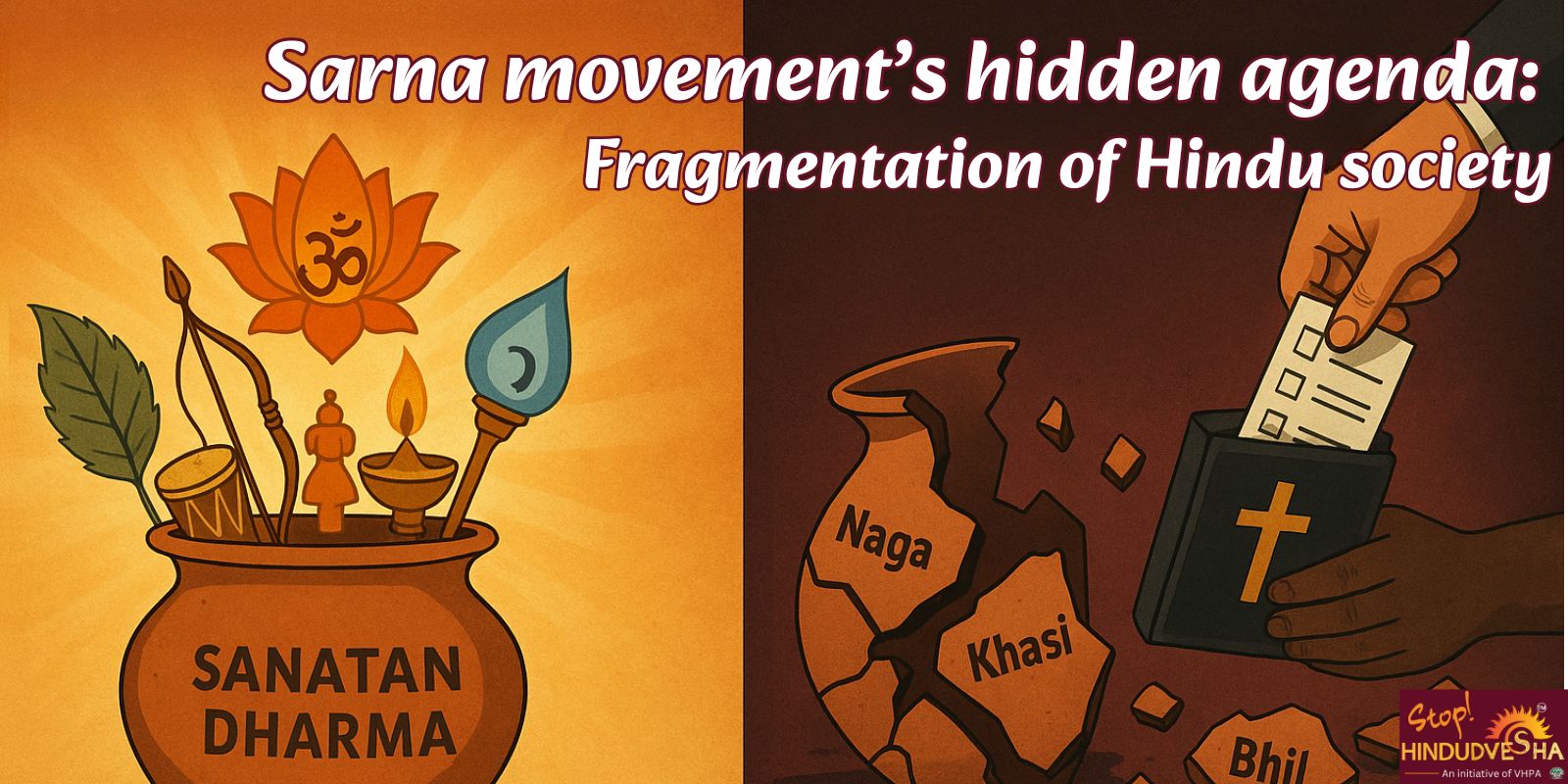
- Tribals such as Santhal, Munda, Oraon, and others are an integral part of Hindu Dharma. Their traditions of nature worship, reverence for family and village deities, and community rituals are deeply rooted in Dharmic culture.
- The recent push for a separate “Sarna religion” is driven more by political interests, electoral strategies, and conversion agendas than by genuine concern for tribal welfare.
- The distinct culture and practices of tribals are already safeguarded by the Constitution and various laws, ensuring their customs and traditions remain protected.
- The vanavasis of Bharat have historically lived within Hindu Dharmic traditions. The Vanaprastha Ashram, the Aranyakas, and other scriptures reflect that tribal ways of life and worship have always been part of Sanatan Dharma.
- Recognizing Sarna as a separate religion would divide tribal society itself, since not all tribes follow Sarna practices. Other groups, such as the Nagas, Khasis, and Bhils, could also demand separate identities, leading to further disunity.
Recently, a new controversy has erupted across India’s tribal-dominated states—Jharkhand, Odisha, West Bengal, Madhya Pradesh, and Assam—over the recognition of “Sarna” as a separate religion for tribals.[1] ‘Sarna’ refers to the sacred groves [2] of certain tribal communities, including Santhal, Munda, and Oraon, who have traditionally worshipped nature and their local deities. In November 2020, the Jharkhand government passed a resolution in a special assembly session, urging that Sarna be included as a distinct religion in the national Census. [3] With the upcoming Census still pending, political parties, activists, and some intellectual groups are mobilizing to push for a separate religious classification.
The move, if approved by the Union government, will classify millions of Bharat’s tribal population as followers of a so-called “Sarna religion” instead of Hindu Dharma. At first glance, this might appear to be a benign recognition of tribal identity, but beneath it lies a more sinister agenda—one that seeks to divide Hindus, weaken the civilizational fabric of Sanatan Dharma, and create fertile ground for mass conversion.
The issue is not whether tribal traditions deserve respect; they certainly do. The real issue is whether they should be alienated from the Hindu Dharmic mainstream and projected as a separate religion. For centuries, tribals have been recognized as Vanvasi Hindus—an integral part of the Hindu Dharmic family. Their practices, festivals, and worldviews are not different from Sanatan Dharma but expressions of it. The Sarna Code Bill, however, seeks to institutionalize a colonial-missionary narrative that tribals are ‘not’ Hindus. This is not just a census exercise; it is a civilizational battlefront.
Against this backdrop, this article explores the historical, cultural, and legal context of this demand, examining the intrinsic link between tribal faiths and Hindu Dharma. It highlights how the push for a separate Sarna identity—framed as a struggle for tribal rights—risks dividing Hindu society, fragmenting tribal communities, and facilitating ideological manipulation under the guise of religious recognition. By analyzing history, constitutional safeguards, and Hindu-tribal shared traditions, this article demonstrates why the demand for a separate Sarna religion is both unnecessary and strategically harmful to Hindu unity.
Sarna: A Colonial Legacy
The roots of the conspiracy to divide Hindus go back to the British colonial rulers, following their infamous policy of ‘divide and rule’. The British understood that Hindu unity was the greatest obstacle to their imperial project. To weaken Hindu society, they promoted artificial divisions—caste as a rigid hierarchy, Aryans vs. Dravidians, and Hindus vs. tribals. They targeted the most vulnerable communities, the tribals and forest dwellers of Bharat.
During colonial censuses, the British deliberately categorized forest-dwellers as animists, aboriginals, or tribal religions[4], rather than as Hindus. This was not ethnography—it was a devious strategy. These terms were not derived from tribal self-understanding, but were imposed colonial categories, designed to separate tribals from mainstream Hindus. Missionary writings of that period are replete with such terminologies, painting tribals as “lost souls” ripe for conversion. By labelling them as ‘non-Hindus’, the British could target them for Christian conversion.
The word Adivasi (indigenous people) itself was popularized in the 20th century for imperialist politics. This term created several narratives, [5]:
- Reinforcing the discredited Aryan Invasion Theory—that tribals were “original” inhabitants, while Hindus were foreign.
- Creating an identity vacuum furthers the cause of evangelical proselytization.
- Feeding separatism and secessionism, causing long-term threats to national security.
The colonial ploy was clear: divide Hindus, detach tribals, and convert them. Once separated on paper, tribals became the first target for missionary expansion. Missionaries saw Vanvasis as a ‘blank slate’—unprotected by Hindu institutions, economically vulnerable, and geographically accessible. British administrators often assisted this process, granting missionaries access to tribal areas, schools, and resources. The result was a systematic campaign to tell tribals that they were “not Hindus” and that Christianity was their natural refuge.
The recent demand to make Sarna a separate religion is nothing but a repackaging of this colonial plot. What the British began in the Census of 1871 is now being advanced through politics and legislation in independent Bharat.
Manufactured Justifications and The Real Agenda
The advocates of a separate Sarna religion argue that it is essential to preserve the unique identity of tribal communities that practice nature worship. They claim that the traditions of Sarna followers differ from Hindu Dharma or any other religion and hence deserve independent recognition.[6] They maintain that inclusion under the broader Hindu fold leads to cultural dilution and threatens their unique rituals centered on sacred groves, local deities, and community festivals. A separate religious code, they insist, would not only protect these traditions but also counter conversions, ensure their distinct identity in official records, and help them claim constitutional safeguards and welfare benefits that are otherwise obscured when they are classified under “Others” in the Census. The demand is further fueled by identity politics, with regional parties projecting the Sarna Code as a symbol of tribal pride and autonomy.
While these justifications, prima facie, may appear convincing, they collapse under closer scrutiny. Tribal traditions are not outside Hindu Dharma but deeply embedded within it [7]—whether through nature worship, reverence of local deities, or their shared spiritual ethos with Vedic thought and Sanatani practices. The Constitution and other legislations already provide ample safeguards for preserving their unique culture and traditions, without needing to detach them from Hindu Dharma. Moreover, recognizing Sarna as a separate religion will not unify but fragment the tribal community itself: while some follow Sarna groves, other tribals like Nagas, Khasis, and Bhils have distinct practices. If every such tribal group demands a separate religion, then the whole tribal community will disintegrate into micro-religions – eroding their collective strength. Worse, such fragmentation serves the hidden agenda of weakening Hindu society from within, leaving tribal communities vulnerable to missionary conversion drives. In fact, the Sarna demand is less about protection and more about a politically engineered wedge that endangers both Hindu unity and tribal well-being.
Moreover, political opportunism has deepened this problem. Several regional parties in tribal-rich states like Jharkhand, Odisha, and West Bengal are aggressively pushing this demand to secure tribal vote banks. By projecting themselves as champions of tribal distinctiveness, they seek electoral gains while ignoring the civilizational and cultural unity that binds tribals with the broader Hindu society.
Simultaneously, missionary organizations—driven by ideological prejudice against Sanatan Dharma—promote the narrative that tribals are not Hindus. This false claim is a calculated strategy to weaken Hindu Dharma from within, create identity crises among tribals, and eventually ease their path to conversion – from division to conversion. The underlying motive can be summarized as follows:
- Divide: First, convince tribals that they are not Hindus.
- Convert: Then, present Christianity as their “true” faith – offering education, healthcare, and economic incentives.
- Weaken Hindu Dharma: Even if not all tribals convert, the very act of separating them from Hindu Dharma on paper weakens Hindu society by reducing its numbers and unity.
This strategy is neither new nor accidental. It has already been deployed with great success in many African nations[8], where indigenous communities were encouraged to see themselves as distinct from their cultural continuum. The result was the large-scale conversion of native peoples into Christianity or Islam, with global missionary institutions profiting enormously from this “business of faith.” Foreign missionaries, international NGOs, and their ideological partners in India have long seen Bharat’s tribal belt as fertile ground for expansion.
Safeguards for Tribal Rights Already in Place
The claim that tribal identity and customs cannot be protected unless a separate Sarna religion is officially recognized is deeply misleading. India’s Constitution already grants extensive recognition and safeguards to tribal communities. Under Article 342, the President formally designates Scheduled Tribes, giving them access to a wide range of protections. Reservations in education[9] and public employment [10] ensure opportunities for advancement and representation. In addition, the Fifth and Sixth Schedules of the Constitution provide unique administrative structures for tribal areas, allowing governance that respects local needs and traditions. The Forest Rights Act of 2006[11] further secures their traditional livelihood by granting rights to use and enjoy forest produce. State laws in many regions [12] prevent the transfer of tribal land to outsiders, thus preserving ownership and the cultural connection to ancestral land.
Personal laws also recognize the distinctiveness of tribal communities. Hindu personal laws do not automatically apply to Scheduled Tribes unless specifically directed by the central government. [13] This exemption allows tribes to follow their own customary practices regarding marriage, divorce, succession, adoption, and other family matters. Together, these provisions firmly protect tribal ways of life within the broader framework of Hindu Dharma, without the need for a separate religious identity.
It is true that certain practices or concerns may not yet be fully addressed. However, the proper constitutional remedy is to enact new laws or amend existing ones, not to carve out a separate religion. Recognition of Sarna as distinct from Hindu Dharma would neither strengthen nor preserve tribal traditions. Instead, it risks fragmenting the Hindu fold, creating divisions even within tribal society, and advancing the agendas of forces intent on weakening Sanatan Dharma.
Despite this robust legal framework, some groups continue to campaign for a separate Sarna code. Their efforts rely on protests, media campaigns, electoral slogans, and political propaganda. The issue has been deliberately politicized, especially in states with significant tribal populations such as Jharkhand, Odisha, and West Bengal. In 2020, the Jharkhand Assembly passed the Sarna Code Bill, with West Bengal adopting a similar approach. [14] Public Interest Litigations have also been filed in Odisha seeking recognition of Sarna as a separate religion. [15] These moves show how political, social, and legal instruments are being exploited to fracture Hindu society. Far from serving tribal interests, the Sarna code movement ultimately aligns with missionary-driven attempts to destabilize and divide.
False Fear Tactics
A common falsehood spread by those demanding a separate Sarna religion is that if tribals continue to identify as Hindus, they will lose their constitutional benefits, such as reservation. [16]. This claim is deliberately misleading. The Constitution provides reservation benefits to the Scheduled Tribes as a community, irrespective of religion, to ensure their collective upliftment and protection from historical disadvantages. Religion is not a criterion for reservation. If it were, then OBCs (other backward classes), who primarily identify as Hindus, would not enjoy reservation benefits, nor would EWS (economically weaker sections) quotas apply to sections of the general Hindu population. These examples clearly show that reservation is based on social and economic considerations, not on religious labels. The propaganda that tribals must separate from Hindu Dharma to safeguard their rights is nothing but a fear-mongering tactic – designed to fracture Hindu society and push tribals away from their civilizational roots.
Shared Traditions Between Hindus and Tribals
The alleged gulf between tribals and Hindus disappears once we look at their actual practices:
- Nature Worship: Tribals worship jal, jangal, zameen(water, forest, land)—echoing the Vedic reverence for the five essential elements (Panchbhuta or Panchtatva, which consists of earth, water, fire, air, and space).
- Mother Earth: Tribals treat Earth as their mother, exactly as in Hindu Dharma. The Atharva Veda declares [17]: “Mata bhumiḥ putro’haṃ pṛithivyaḥ” — “The Earth is my mother and I am her son.”
- Village and Family Deities: Both worship Kul Devta(family deity), Gram Devta (village deity), and Sthan Devta (local deity).
- Snake Worship: A common denominator in both traditions, reflected in pan-Indian festivals like Nag Panchami.
- Sacred Rivers and Groves: Rig Veda, other ancient Hindu scriptures call rivers divine, and Hindus, like the tribals, worship them as their mother[18], while the Sarna groves are analogous to sacred spaces in Hindu villages and akin to Hindu dev van (sacred divine forests) mentioned in Puranic texts.
- Festivals like Sarhul (celebrating the ‘sal’ tree) and Karma resonate with Hindu festivals and nature worship.
- The practice of venerating ancestors mirrors Hindu shraddha rituals.
The Rig Veda declares [19]: “Ekam sat viprah bahudha vadanti”—Truth is one, expressed in many forms. Tribal traditions are precisely such forms—diverse expressions of the same Dharma. To project them as an alien religion is to deny their true essence. Even the claim that tribals do not follow the Vedas collapses upon inspection. Their worship of forests, rivers, and the whole nature (“Prakriti”) is explicitly described in Vedic texts.
Perhaps nowhere is the seamless blending of tribal and Hindu culture more evident than in Odisha – a land with one of the richest tribal heritages in Bharat. Odisha is not only home to dozens of vibrant tribal communities, but also to the sacred temple of Lord Jagannath at Puri. Who was the first to worship Lord Jagannath? Not an elite priest, but a Sabar Raja—a tribal king. The grand tradition of the Rath Yatra, celebrated for thousands of years, has its roots in this tribal devotion. Even today, the Daitapatis (descendants of that tribal lineage) remain indispensable sevayats (servitors) in the Jagannath temple’s rituals. [20]
The connection is not limited to Odisha. In the Ramayana, Bhagwan Sri Ram eats the berries offered by the tribal devotee Shabari – a symbol of the inseparable bond between the so-called “tribal” and the larger Hindu Dharmic fold. Tribes such as Santals, Mundas, Mizos, and Bhils all have their own versions of the Ramayana in their culture [21]-– testifying to their deep civilizational links.
From Lord Ayyappa at Sabarimala in Kerala to Balaji at Tirupati in Andhra Pradesh, and from Gupteswar temple in Koraput to Maa Deuri Durga temple in Jharkhand [22], tribal participation in Hindu worship is not incidental—it is foundational. The joint worship of village deities, the honoring of family gods, and the ritual sharing of prasad are all practices that reflect the wider Sanatani tradition.
If tribal rituals are so deeply enmeshed with Hindu Dharma, who benefits from portraying them as “non-Hindus”? The answer lies in the politics of separation, guided by those who seek to exploit tribal simplicity for ideological and commercial gain.
Forests, Vanaprastha, and the Tribal Connection
The Hindu worldview has always revered the forest as a sacred and civilizational space. In Hindu tradition, life is divided into four ashramas: Brahmacharya, Grihastha, Vanaprastha, and Sannyasa. [23] During Vanaprastha, householders, after fulfilling their worldly duties, would retire to the forest for spiritual practice. Kings, queens, nobles, and commoners alike embraced this stage of life. Many took residence in forest hermitages, alongside rishis and sages who made the forests their permanent home.
The Aranyakas—a distinct category of Hindu scriptures—were composed specifically for those living in the forests. The very word “Aranyaka” means ‘that which belongs to the forest.’ They form the bridge between the ritualistic Sanhitas and the philosophical Upanishads. [24] For instance, the Brihadaranyaka Upanishad, attributed to sage Yajnavalkya, literally means the “Great Forest Upanishad” and contains profound discourses on the Self (Atman) and ultimate reality (Brahman).
Forests were not wilderness outside Hindu Dharm—they were its living heart. Rishis, hermits, and seekers worshipped nature, performed yajnas, meditated, and passed down wisdom in these sacred spaces. Worship of the five elements (Pancha Tatva), the sun, rivers, trees, serpents, and countless village or forest deities was—and always remains—integral to Sanatan Hindu Dharma.
The Vanavasis—forest dwellers—carried forward this sacred lifestyle as an integral part of Sanatan Dharma. They are those who chose the forest as their home, just as the sages and seekers of ancient times did. When today’s tribals worship sacred groves (Sarna), sacred places, trees, rivers, or hills, they are continuing the very forest traditions sanctified in various Hindu scriptures like the Aranyakas and the Upanishads. To detach these practices from the Sanatan fold is not only historically false but also a dangerous attempt to sever tribals from their own civilizational roots.
Judicial Recognition of Hindu Dharma’s Inclusivity
The Supreme Court in Shastri v. Muldas [25] (1966) held that Hindu Dharma is not confined to one form of worship. The Court observed that even when a sect arises through the efforts of a saint or reformer seeking to remove distortions or undesirable elements that may have entered into practice, it remains within the fold of Hindu Dharma so long as it upholds its core philosophical foundations. [26] This judicial reasoning is particularly relevant to the current debate over recognizing Sarna as a separate religion. The Sarna community’s nature-centric traditions—reverence for forests, rivers, village deities, and ancestors—do not place it outside Hindu Dharma. Rather, they echo the same spiritual essence found in the Vedas, Aranyakas, Puranas, and other Hindu scriptures.
To demand a separate religion on this basis disregards both historical continuity and the judicial recognition of Hindu Dharma’s inclusive and comprehensive character.
Lessons from the Past: Fragmentation Weakens Dharma
History shows us how granting separate religious status to communities within Sanatan Dharma has created division and confusion. Under Hindu personal laws—the Hindu Marriage Act, 1955, Hindu Succession Act, 1956, Hindu Adoption and Maintenance Act, 1956—Sikhs, Jains, and Buddhists are all legally recognized as Hindus. Similarly, Article 25 of the Constitution explicitly clarifies that references to Hindus include these traditions. In law, they are part of the same Hindu Dharmic fold.
However, in practice, the story is very different. Census forms, government classifications, and political narratives list Hindus, Sikhs, Jains, and Buddhists as distinct religions. Over time, this separation has led sections of these communities to perceive themselves as outside the fold of Hindu Dharma. Further, Sikhs, Buddhists, and Jains have been accorded minority religion status[27], despite their shared origin in Sanatan Dharma. If the law recognizes them as Hindus, why are they simultaneously treated as separate minorities? This inconsistency has only deepened divisions within the larger Hindu community.
A similar and dangerous precedent now looms with regard to the Sarna tradition. Granting Sarna the status of a separate religion would artificially sever tribal communities from Hindu Dharma. Such a move is not only contrary to historical reality but also damaging to civilizational integrity, as it would create divisions among groups that have always belonged to the Hindu fold. Just as the separate categorization of Sikhs, Jains, and Buddhists weakened Hindu unity, the proposed Sarna code would deepen fragmentation—this time striking at Hindu society’s very roots.
The Flawed Logic of a ‘Sarna Religion’
Even if, hypothetically, tribal traditions were to be treated as a separate religion, the use of the term ‘Sarna’ is deeply flawed.
- ‘Sarna’ simply refers to a sacred grove or place of worship for some tribal communities, primarily in central and eastern India. Not all tribal groups identify with the Sarna tradition.[28] The Nagas, Khasis, Bhils, Mizos, and many others have distinct practices and do not worship at “sarna sthals.”
- If Sarna is recognized as a religion, other tribal groups will also demand their own separate religion.
This would only serve to fragment the tribal community into numerous competing micro-religions, leaving them politically divided and vulnerable to manipulation by external forces.
Census Politics and the ‘Other’ Column
One of the most insidious strategies behind the Sarna demand is the manipulation of the Census. For years, the so-called activists/separatists have encouraged tribals to select “Other” in the religion column of census forms instead of “Hindu.” This has the following effects[29]:
- Pressure on the Government: By encouraging large numbers of tribals to mark “Other,” campaigners can manufacture the appearance of widespread demand for a new religious category.
- Future Leverage: Even if Sarna is not granted recognition in the current Census, the inflated “Other” figures can later be used as evidence to claim, “Millions of tribals have rejected Hindu Dharma; the government must now recognize Sarna as a separate religion.”
This is not a spontaneous assertion of identity—it is a carefully crafted conspiracy to alter census data and undermine Hindu unity. Once recognized, the numbers game will be used to further shrink the Hindu percentage in national statistics, with dangerous political and civilizational consequences.
Wrapping Up
The demand for recognizing Sarna as a separate religion is not merely a regional or political question; it is a test of Hindu civilizational unity and foresight. Accepting it would institutionalize the falsehood that tribals are outside Hindu Dharma, artificially reduce Hindu numbers in the Census, fragment the broader fold, and open the door to mass conversions. It is, in essence, the colonial strategy of divide and rule repackaged in the language of identity politics.
The tribals of Bharat are not outsiders. They are the living custodians of Sanatan Dharma, preserving ancient traditions of nature worship and ancestor reverence that form the very core of Hindu civilization. To classify them as a “separate religion” would be a betrayal of their heritage and of our shared civilizational bond.
Opposing the Sarna demand is not about denying tribal distinctiveness; it is about affirming it within the expansive and eternal framework of Sanatan Dharma. Hindu unity is Dharma’s shield, while division is its greatest weakness. The path forward lies in strengthening solidarity with tribal communities—not treating them as separate but embracing them as part of one family. Only then can we ensure that the colonial playbook of division and weakening does not succeed once again. As the Vedic seers recognized long ago, diversity of worship is not outside Dharma but a vital expression of its vastness.
Citations
[1] Why and who is propagating Tribal people as non-Hindu? https://hindupost.in/dharma-religion/why-and-who-are-propagating-tribals-as-non-hindu/#
[2] The role of “Sarna” in forest conservation and wildfire prevention: An indigenous tribal religion of India; https://blogs.lse.ac.uk/religionglobalsociety/2023/12/the-role-of-sarna-in-forest-conservation-and-wildfire-prevention-an-indigenous-tribal-religion-of-india/
[3] Jharkhand Assembly passes resolution on Sarna Code; https://www.thehindu.com/news/national/other-states/jharkhand-assembly-passes-resolution-on-sarna-code/article33081116.ece
[4] Adivasi Movement for a Separate Sarna Code in Indian Census; https://participedia.net/case/13432
[5] Vanvasi or Adivasi – Mapping the Contours and Grammar of Belonging Among India’s Tribals; https://swarajyamag.com/books/of-tribes-nation-and-laws
[6] Demand for Sarna code by Adivasis; https://www.adivasilivesmatter.com/post/demand-of-sarna-code-by-adivasi
[7] Are Tribals Hindus? https://pragyata.com/are-tribals-hindus/
[8] Why and who is propagating Tribal people as non-Hindu? https://hindupost.in/dharma-religion/why-and-who-are-propagating-tribals-as-non-hindu/
[9] Article 15(5) of the Indian Constitution; https://indiankanoon.org/doc/609295/
[10] Article 16(4) of the Indian Constitution; https://indiankanoon.org/doc/68038/
[11] The Scheduled Tribes and Other Traditional Forest Dwellers (Recognition of Forest Rights) Act, 2006; https://www.indiacode.nic.in/bitstream/123456789/2070/1/200702.pdf
[12] The Chota Nagpur Tenancy Act, 1908; https://www.indiacode.nic.in/bitstream/123456789/7796/1/the_chota_nagpur_tenancy_act%2C1908.pdf
[13] Section 2(2) of The Hindu Marriage Act, 1955; https://indiankanoon.org/doc/1922953/
[14] The Sarna Code: A Movement for a Tribal Religion; https://theoryofabrogation.com/the-sarna-code/
[15] Why Are Tribals Demanding The ‘Sarna’ Religion Code; https://mojostory.com/ground-reports/why-are-tribals-demanding-the-sarna-religion-code-214298
[16] ibid
[17] Earth is my mother; https://www.sanskritikrashtravad.com/politics/1845/
[18] The Hindu Worship of Rivers; https://hinduscriptures.com/hindu-worship-rivers/
[19] Ekam Sad Vipra Bahudha Vadanti: A Vedic Consciousness of God; https://www.sieallahabad.org/hrt-admin/book/book_file/fd756770f9122be1b484f12c5ffbe828.pdf
[20] Why and who is propagating Tribal people as non-Hindu? https://hindupost.in/dharma-religion/why-and-who-are-propagating-tribals-as-non-hindu/#
[21] ibid
[22] ibid
[23] The Vanaprastha-asrama and its practical application by Jaya Gaurasundara dasa; https://iskcondesiretree.com/profiles/blogs/the-vanaprastha-asrama-and-its-practical-application
[24] Aranyakas – Decoding Secret Wisdom; https://aboututtarakhand.com/aranyakas/
[25] 1966 AIR 1119; https://indiankanoon.org/doc/145565/
[26] Book- “Modern Hindu Law” by Dr. Paras Diwan (page no. 2-3); Who is a Hindu under Hindu Law? https://lawbhoomi.com/who-is-a-hindu-under-hindu-law/
[27] State-Wise Grant of Minority Status; https://www.scobserver.in/cases/ashwini-kumar-upadhyay-union-of-india-state-wise-grant-of-minority-status-case-background/
[28] Adivasi Movement for a Separate Sarna Code in Indian Census; https://participedia.net/case/13432
[29] Why and who is propagating Tribal people as non-Hindu? https://hindupost.in/dharma-religion/why-and-who-are-propagating-tribals-as-non-hindu/#

Donate to HINDUDVESHA
Our Mission is to explore and expose Hindudvesha through research analysis, education and response.
SUPPORT US