

Exploring Heritage Through Harmony: An Interview with Omer Ghazi
 Dr. Jai G. Bansal · 11/25/2024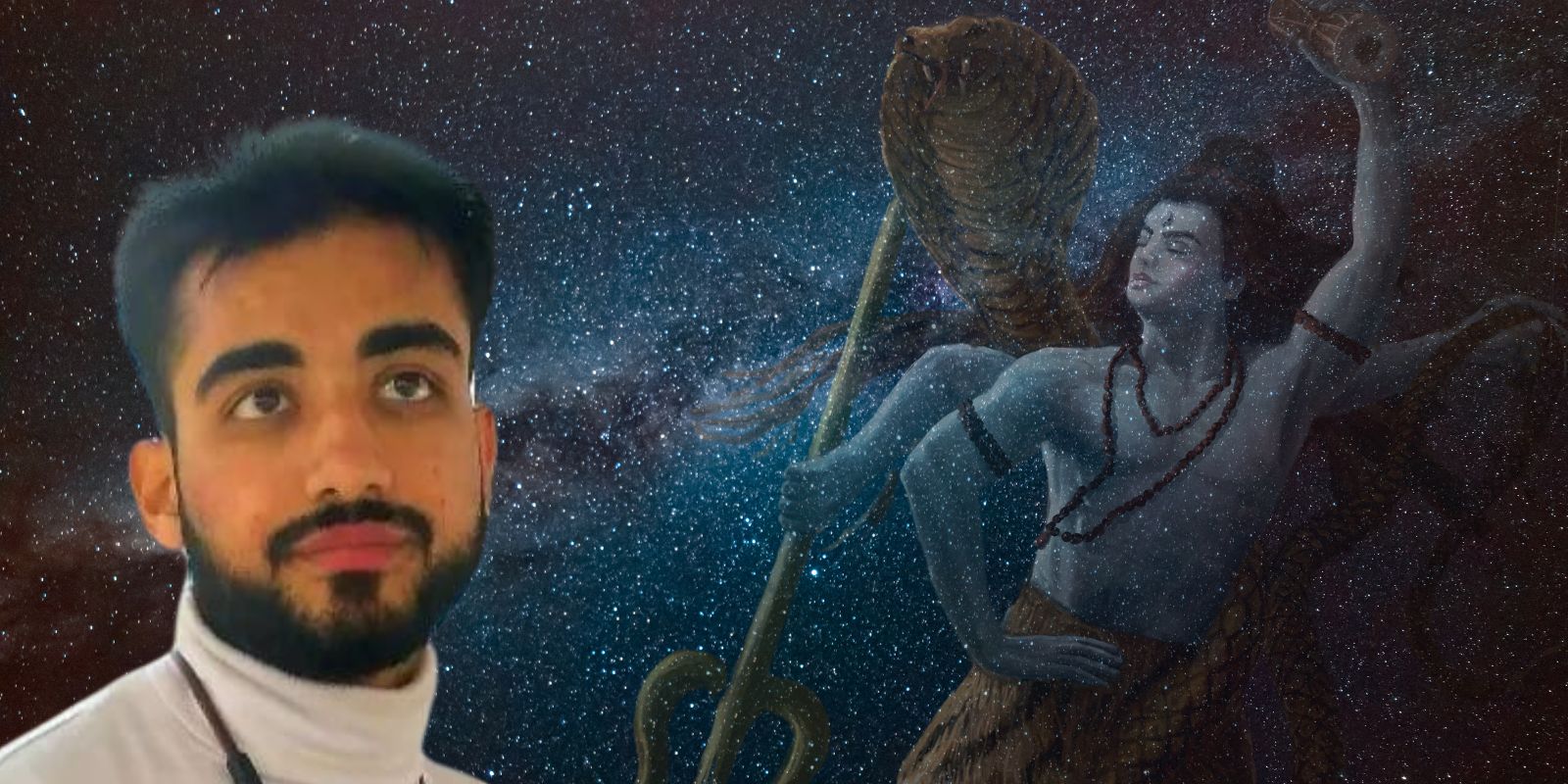
- Omer Ghazi discusses his journey into literature, philosophy, and geopolitics, leading to his role at a public policy think tank.
- He talks about his book “The Cosmic Dance,” which blends ancient Indic wisdom with modern science and is inspired by Adi Shankaracharya and Shiva’s cosmic dance.
- Omer stresses reconnecting with cultural roots, exploring ancient Indian philosophical concepts, and linking them to modern science.
- He addresses the Muslim community’s identity crisis, advocating for balanced religious and national identities and distancing from violent historical figures.
- Omer highlights positive changes within the Muslim community and society, driven by increased interaction, education, and political shifts, fostering inclusivity and harmony.
Omer Ghazi is a research associate at a public-policy think tank. He represented India at the Best Diplomats Dubai Conference 2023 and is known for his columns on history, culture, and geopolitics. On the creative side, Omer is a drummer and a rap artist performing under the stage name MC Esquare, a take on Einstein’s famous equation. He has also written a book, “The Cosmic Dance, ” which represents a tribute to the confluence of ancient Indic wisdom and modern science. He describes himself as “an Indic Muslim who is exploring his cultural heritage through music, science, and philosophy.”
This article is based on an interview with Omer Ghazi on Dharma Explorers. The full video recording of the interview can be accessed here.
Could you briefly describe your childhood, family, and professional journey and any specific influences that have shaped your worldview?
I grew up in Delhi and studied at Aligarh Muslim University (AMU). From a young age, I was strongly interested in debates about philosophy and the nature of reality. I was an avid reader, enjoying fiction, novels, and poetry, which nurtured my love for literature and philosophy early on. As I grew older, I delved into Hellenistic philosophy from ancient Greece and contemporary Western philosophers, including Bertrand Russell. My literary interests included classical English literature, especially works by Samuel Taylor Coleridge and H.G. Wells.
This passion led me to a career in teaching. I completed a course in teaching English as a foreign language and taught at various institutions. My interest in writing and geopolitics also grew, leading me to contribute to various contemporary platforms.
Eventually, my writing and interest in international relations helped me secure a public policy think tank position. For the past four or five years, I have worked as a research associate there while continuing to pursue my writing career by contributing columns on various topics.
You’ve also written an intriguing book, “The Cosmic Dance.” Could you tell us a bit about the book and its subject?
From a young age, I was deeply interested in literature and philosophy. However, for a long time, I didn’t know much about the rich traditions of Indian literature and philosophy. It’s unfortunate that many people of my generation, regardless of religion, aren’t very connected to our cultural roots. However, I had been writing poetry on science and philosophy for years. One poem in my book explores the idea that humans question reality like a fish asking, “Where is the water?” Of course, the answer is all around us, but we often fail to see it.
My poetry has always been spontaneous and varied; I never imagined compiling it into a book. However, I discovered Adi Shankaracharya’s works in the past few years. His poetry, rhythm, and profound philosophical questions, written over 1400 years ago, fascinated me. His ability to discuss deep concepts through rhythmic poetry was eye-opening.
Alongside my poetry, I have always been passionate about music, especially drums, percussion instruments, and rhythm. I had never seen a blend of philosophy and rhythm until I encountered Shankaracharya’s work. Ancient Greek philosophers, for example, discussed philosophy without rhythm, and poets rarely delved deeply into philosophy. This confluence in Shankaracharya’s work drew me in, and I began to explore ancient Indian scriptures more deeply.
I became particularly interested in Shiva’s cosmic dance, which symbolized constant creation and dissolution, a concept deeply imbued with profound wisdom. This idea of continuous change captivated me. I aimed to reflect this ancient tradition of inquiry, doubt, and scientific exploration in my poetry.
This inspiration led me to compile my poetry into a book. I wanted to pay tribute to the thousands of years of tradition that question, explore, and seek answers. That’s why I named my book “The Cosmic Dance.” It represents my connection to this timeless tradition and extends its legacy through my work.
Of course, combining philosophy with music is an old Indian tradition, beginning with the Sama Veda. Indeed, a vast majority of our ancient texts were composed in verse form. This connection to music is deeply rooted in our tradition. I congratulate you for reaching this realization early in life.
Given that ancient Indian wisdom encompasses both Apara vidya (practical concerns) and Para Vidya (self-discovery), which aspect does your book focus on, or does it explore all of it?
I believe our ancient scriptures contain fundamental principles that deserve deeper exploration. Often, people misunderstand the science within ancient Indic scriptures, interpreting it in a superficial manner that is easily dismissed. It’s important to clarify that I do not claim that modern scientific gadgets existed thousands of years ago in India. Such a view is a crude and simplistic interpretation of ancient science. Instead, I’ve tried to connect with these principles on a more fundamental level.
For example, the concept of “Spanda Karika,” which translates to the divine rhythm or vibration of creation, is fascinating. This idea suggests that all matter and physical reality consist of vibrations and rhythms. Only in recent times, with advancements in subatomic research, string theory, and quantum mechanics, have we come to understand the significance of vibrations and frequencies in physical reality. Nikola Tesla, for instance, emphasized the importance of thinking in terms of frequency and vibration in understanding the universe. It is remarkable how ancient thinkers had insights aligning with modern scientific discoveries.
Another intriguing aspect is the Vedantic emphasis on the observer. Vedanta suggests that the observer is primary, and the observed world is secondary, meaning that our perception projects reality around us. This notion contrasts with the traditional scientific view, which holds that the universe exists objectively, regardless of observation. However, Young’s double-slit experiment revealed that reality does not exist as a concrete objective entity until observed, highlighting the observer’s role in shaping reality. Even today, this concept is challenging to grasp and explain, yet it aligns perfectly with Bharat’s ancient wisdom. Through meditation and other techniques, ancient seers seemed to have a profound understanding of reality that modern science is only beginning to uncover.
Another fascinating concept is the cosmic dance, symbolizing the constant rhythm of creation and destruction. This can be likened to the dance of subatomic particles within an atom. The quantum world exhibits a continuous dance of creation and annihilation. The presence of Lord Nataraja’s statue at CERN in Geneva recognizes the deep symbolic relationship between Shiva’s cosmic dance and the scientific pursuit to understand subatomic particle behavior.
These examples illustrate that ancient wisdom encompassed sophisticated understandings of reality. While I am still a novice in this exploration, I am continuously discovering new facets of this ancient knowledge. It is crucial to delve deeper into these principles to appreciate the advanced thinking of our ancestors.
Every day, I uncover more about these profound concepts, and I believe they hold valuable insights that can enrich our modern understanding of science and philosophy. By exploring and understanding these ancient principles, we can bridge the gap between past wisdom and contemporary scientific inquiry, creating a more holistic view of reality. This journey into the depths of ancient knowledge is both humbling and inspiring, revealing the timeless nature of human curiosity and the quest for understanding.
You bring together many interesting concepts, such as how our Rishis discovered universal truths through thought experiments, much like Einstein’s theory of relativity. It’s not outlandish to think that people 2,000 or 5,000 years ago had similar realizations through thought experiments.
Changing the direction of our conversation, the Hindu soul, dormant for over 1,200 years, is awakening as people become more aware of their civilizational narrative. You’ve beautifully articulated your discoveries in this area, and many others are also reconnecting with their roots. From a personal perspective, do you see this awakening as threatening to the Muslim ecosystem? How does the Muslim community at large perceive this civilizational reawakening?
There are different ways to approach this question.
First, we need to define what we mean by the Muslim ecosystem. If we refer to a segment of the Muslim community with an agenda for India that diverges from the broader Indian society and its progressive values, then it might feel threatened. This is because its values may conflict with constitutional principles, the Universal Declaration of Human Rights, and gender equality.
However, if by Muslim ecosystem we mean Muslims who are integrated into the national framework and prioritize their identity as Indian citizens while also practicing their faith, then this group should not feel threatened. These individuals balance their religious identity with their national identity, respecting constitutional values while practicing religion privately. They perform their religious duties, such as offering namaz and celebrating festivals, without any conflict with their national identity.
This segment of the Muslim community, however large or small, aligns with the constitutional framework and does not pose a confrontation with the Hindu majority. Therefore, there is no reason for them to feel threatened by the change occurring in Hindu society. In fact, this inclusive and integrated ecosystem is growing as more Muslims find a balance between their religious practices and their role as Indian citizens. This growth is a positive sign for a harmonious and progressive society where different identities coexist without conflict.
Given that many Muslims like to play up the minority card, do you see yourself as a minority? In the Indian context, considering the concept of the Ummah in Islam, should the Muslim community be considered a minority?
According to the Indian constitution, all religious groups are considered equal. Legally speaking, there should be no distinction between majority and minority. Personally, I don’t identify as a minority because I think it’s a divisive way to view society. However, it’s a fact of life that in India, Muslims are often considered a minority, and Hindus are seen as the majority.
Regarding how minorities, especially Muslims, are treated in India, my perspective might be controversial. I believe that Muslims in India are one of the most pampered minorities globally. Here’s why: The partition of India happened along communal lines, with the Muslim League demanding a separate country based on religion, which resulted in the creation of Pakistan. Regardless of Jinnah’s vision for a secular or liberal society, the partition was fundamentally about religion.
In contrast, India chose to govern itself based on human rights and constitutional values rather than a theocracy. Hindu laws were codified into the Constitution, but Muslim laws were not, allowing Muslims to follow Sharia law for civil matters. This decision, whether a mistake by the contemporary political leadership or a result of the prevailing socio-political dynamics, led to Muslims being able to govern themselves in some respects, a privilege not extended to others.
Decades later, the Shah Bano case (1985) highlighted a conflict between Sharia law and the Indian Constitution. The Indian government made significant efforts to accommodate Muslim sensitivities. Since then, various welfare schemes, minority institutions, and boards like the Muslim Personal Law Board have supported Muslim communities. Despite this, there is a persistent narrative on social media, often propagated by Muslim intellectuals, claiming that Muslims have not received their due since independence. I find this narrative misleading and disturbing.
Now, about the concept of the Ummah, which suggests that all Muslims worldwide form a single community with shared loyalties. In practice, this has often not been the case. For example, the separation of Bangladesh from Pakistan shows that linguistic, cultural, and regional bonds can be stronger than religious unity. It’s natural for people to feel a closer connection to those who share their language, region, and geography. For instance, I feel more connected to my Hindu neighbor in western UP than someone living in Norway or Syria.
Muslim communities in different countries need to root themselves in their national contexts while maintaining their faith. This means that the practice of Islam in each country will have unique cultural influences. This rootedness is more practical and organic than global loyalties.
Do you think India is ready to implement a single law applicable to every citizen, given that the Muslim community has been pampered since independence for various reasons?
India should be prepared to make significant changes, and I believe we are waiting for the right political moment to do so. Many Muslims like me, who believe in progressive values, are hopeful and ready for this change. Any outdated medieval laws that contradict basic human rights need to be abolished. There’s no point in debating cultural sensitivities or religious texts when they infringe on human rights, particularly women’s rights.
Women are real people who have suffered and continue to suffer under these outdated laws. Every day that passes without addressing these issues is a disservice to them. We must take this issue seriously and act swiftly. If India doesn’t lead the way in this regard, who will? India has the potential to set an example for other countries, showing that progress and justice are possible and must be pursued.
Considering the Waqf Board’s role in society, do you think it acts responsibly within Indian society, and do you believe it is needed?
I find it puzzling. On one hand, there’s a claim that Muslims in India have been oppressed and denied their basic rights since independence. Yet, we have the Waqf Board, the third-largest landowner in the country. These two narratives don’t align. How the Waqf Board has acquired such extensive land holdings is deeply concerning. This situation seems outdated and problematic. We cannot continue to allow this. I see no justification for a religious institution to wield such control over large land areas.
Hearteningly, many progressive voices like yours are emerging within the Indian Muslim community. We also see phenomena like Smt. Smriti Irani visiting Medina, a major temple being built in Abu Dhabi, and Imam Illyasi participating in the Ram Mandir ceremony. Do you think these are just random coincidences, or is there a significant shift happening within the Muslim ecosystem?
There are two aspects to consider: the cultural and the political.
The interaction between communities, facilitated by the internet and social media, is a significant factor on the cultural front. Growing up, many people are exposed to biased stories about other communities without direct interaction during the early formative years of their lives. This lack of understanding breeds fear, and fear leads to bigotry.
However, through social media and personal interactions, people can see that others, regardless of their religious practices, are just human beings connecting with the Divine in their own ways. This understanding helps dilute and potentially eliminate feelings of fear, bigotry, and ignorance. Everyone’s journey is different—some use social media positively, while others spread negativity and communal tension. Despite this, the phenomenon of progressive Muslim voices integrated into the broader Hindu society is growing. This is largely due to increased interaction and education about history, leading to a better understanding of each other’s perspectives.
Politically, changes are also noticeable. For instance, the Arab world, including places like Saudi Arabia and the UAE, is opening up. This was unimaginable 10-15 years ago. The Arab countries realize that their closed societies of the past several decades were confrontational to global society and, therefore, not sustainable.
They find that allowing more cultural diversity is beneficial as they open up. For example, if India can have over 500,000 mosques, why can’t Saudi Arabia have some temples, especially given the large Hindu population contributing to its economy? This shift is partly political and economic, recognizing that maintaining good relations with India is beneficial. India is emerging as a significant global power, mediating in conflicts like Israel-Palestine and Russia-Ukraine. The Arab world wants strong ties with India, including cultural exchanges.
I hope this trend continues, leading to even better relations with the Arab world. During my visit to the UAE last year, I met many Arab Muslims with positive views of India and Hinduism. This was refreshing and showed a growing openness and understanding.
On the flip side, there’s also a rise in Islamic radicalization in India. As a student of history, I look for examples where opposing ideologies have intersected. In the 17th century, we had Dara Shikoh, a progressive Muslim who studied Hindu scriptures, and Aurangzeb, who was hell-bent on destroying Hindu society and culture. Do you think this kind of comparison is relevant in the current context? And do you share my hope that history does not repeat itself?
Radicalization is a serious issue affecting society, and not everything is as positive as we hope. While some people use the internet and their political power to promote positive change, many others use these tools to create divisions and spread negativity. In the Muslim community, radicalization has deep roots and has been a problem for a long time. Organizations like the Popular Front of India (PFI) have agendas that are harmful to the core values of Indian society. For example, a document from last year revealed their vision for India in 2047, completely contrary to what India stands for.
This problem of radicalization is not limited to any single organization; it is deeply embedded in the larger Muslim community. Many madrasas and mosques promote radical ideas, which infiltrate the minds of common people. When such ideas are spread among thousands, some individuals inevitably act on them, leading to violence. Efforts are being made to address and contain this issue, but it remains a significant challenge.
There is an interesting phenomenon in the Muslim community regarding their historical legacy. On one hand, some claim pride in the Muslim rulers who built monuments like the Taj Mahal and ruled over India for centuries. However, when confronted with the atrocities committed by figures like Aurangzeb or Babur, the same people often disassociate from that history, claiming they have nothing to do with the past and only identify with the post-independence era. Such hypocrisy cannot stand. If one takes pride in historical achievements, one must also acknowledge the darker aspects of that history.
A reasonable alternative would be for contemporary Muslims to dissociate themselves from historical figures who perpetrated violence and instead embrace figures who fostered harmony. No one is asking today’s Muslims to take responsibility for the actions of historical rulers, but it is important to clearly and vocally distance themselves from those ideologies. Failure to do so will continue to create friction in the society.
Clearly, not all Muslim rulers were violent oppressors. Figures like Dara Shikoh, who had a positive and inclusive relationship with Indian society, can be better role models. The Muslim community must choose their heroes wisely and declare their stance on historical violence. By clearly stating their disassociation from violent figures and embracing inclusive ones, they can help reduce societal tensions and foster a more harmonious coexistence.
Today, the responsibility lies with the Muslim community to clarify who their heroes are and what values they stand for. This involves rejecting the violent ideologies of the past and promoting figures who represent peace and inclusivity. Only by doing this can the community address the issues of radicalization and societal friction effectively.
Do you believe there is an identity crisis within the Indian Muslim society? How does this impact individuals and society? Does this identity crisis drive people to seek connections with Arab or Turkish identities, among others?
Absolutely, there is an identity crisis. When a person is completely disconnected from their historical and cultural roots, it affects their personality and can manifest as frustration, violence, self-hate, and even hatred towards their neighbors. Imagine someone who has changed their religion and is now taught to despise everything about their ancestors and heritage. On a superficial level, you can claim to be whatever you want, but you can’t change your DNA, language, skin color, dietary preferences, hair color, or the fundamental nature of your being.
Pakistan is a good example of this identity crisis morphing into a larger societal crisis. The country was founded on communal lines and has struggled with an identity crisis ever since. Many Pakistanis try to associate themselves with Arabs or Turks, but this doesn’t work because there are no real similarities. Arabs and Turks do not consider them their own and often view them as inferior. In Arab countries, even after living there for 20 years, they won’t grant you citizenship.
Understanding your own roots and becoming rooted in them is beneficial for your own self-discovery and realization. The ancient Indian tradition focuses on the discovery of self, with the fundamental question being “Who am I?” and even deeper, “What am I?” To solve the broader existential questions, you must first answer “Who am I?” at cultural, political, and personal levels.
This identity crisis has existed since independence, but it is taking an interesting turn now. Previously, radical Muslims in India looked to the Arab world as their ideological parent, with the Arab world promoting Wahhabism through various means. However, the Arab world is now changing direction for economic, political, and strategic reasons. Leaders like Mohammed bin Salman in Saudi Arabia are driving rapid change, creating a shift.
As the Arab world changes, Indian Muslims who viewed it as their ideological guide are now feeling orphaned. This has led to two main reactions. Some radicals now claim that Arabs are no longer true Muslims, accusing leaders like Mohammed bin Salman of being in cahoots with Israel. The more sensible reaction is a deeper introspection, leading to questions about their own identity.
This introspection involves recognizing that, despite being Muslim, their ancestors might have converted willingly or forcibly centuries ago. Their DNA remains the same as their Hindu neighbors. Accepting and making peace with this reality is the only way to resolve the identity crisis. However, this realization won’t happen overnight; it will take decades. The ideology that has been ingrained in Indian Muslims over the years will take time to unravel, but it is bound to happen eventually.
Thank you so much. It’s inspiring to see young voices like yours realizing their place in the world and understanding that this is their home and future. Thank you for sharing your thoughts and being so generous with your time. I enjoyed our conversation.
Once again, thank you so much for having me. I am truly grateful for the opportunity to share my observations from my life so far. It has been refreshing to engage in this conversation. The main point I’ve tried to convey in recent years, including today, is the importance of dialogue. In the process of nation-building, this should be the primary goal for every individual. Everything else—our religion, philosophy, and personal lives—should align with this concept of nation-building. This approach helps resolve societal frictions.
If we stay focused on this goal, our society will have a positive future marked by synergy and a constructive outlook. As a member of this society, as an Indian, and as an Indian Muslim, I am hopeful for such a future. Thank you again for having me and for being such a wonderful host.

Donate to HINDUDVESHA
Our Mission is to explore and expose Hindudvesha through research analysis, education and response.
SUPPORT US