

Dismantling IAMC’s Fabricated Smear Campaign Against VHPA (Part 1 of 8) – The Playbook
 Dr. Jai G. Bansal · 05/08/2026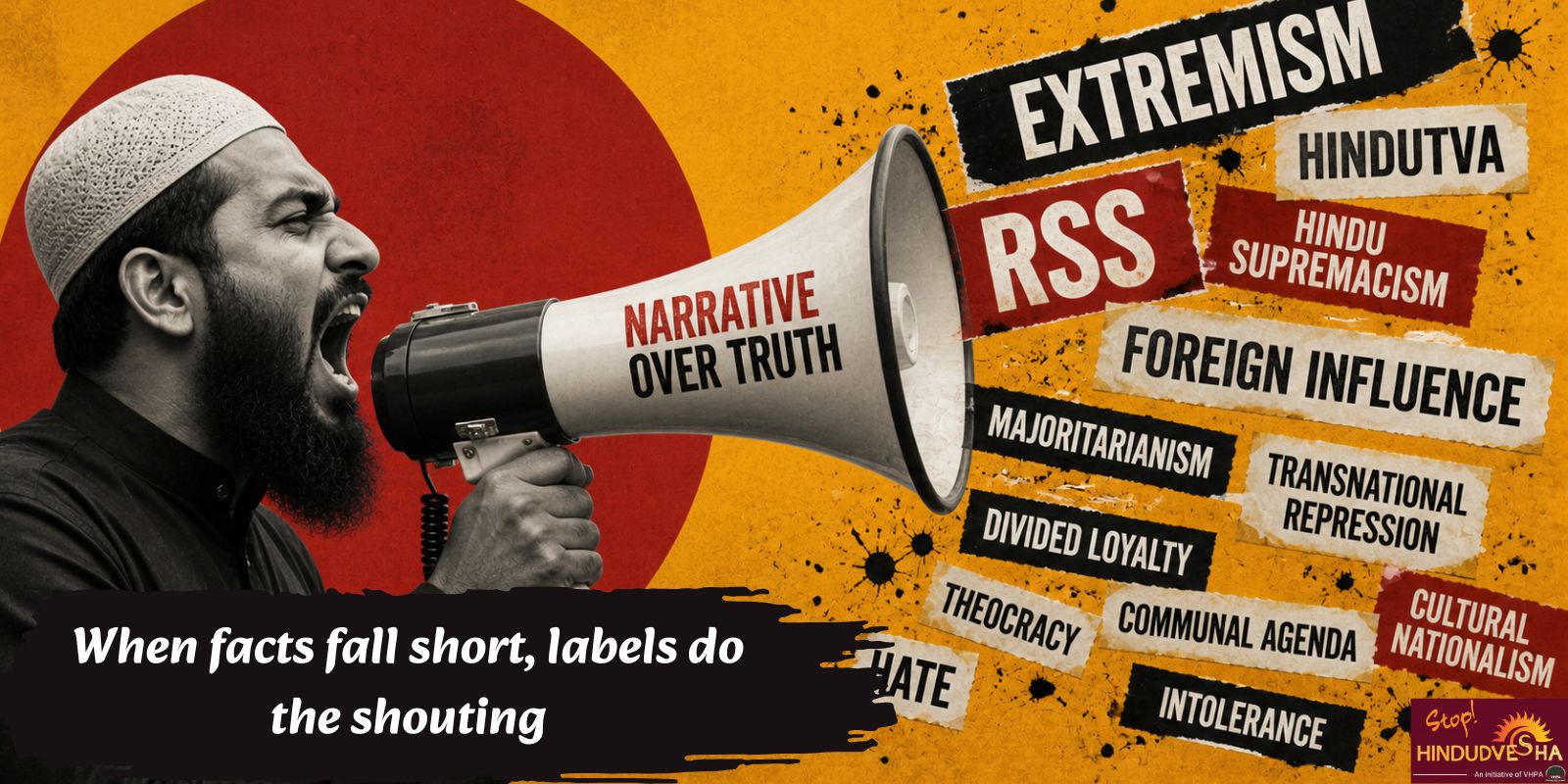
“Umr bhar Ghalib yahi bhool karta raha, Dhool chehre par thi aur aaina saaf karta raha.” (All my life, I kept making the same mistake: I kept cleaning the mirror, not ever realizing that the dirt was on my own face.)
The couplet, popularly attributed to the 19th-century Urdu poet Mirza Ghalib, is an apt lens through which to view the opinion piece “VHPA’s Unholy Connection with India’s Hindu Nationalists”[1] by Rasheed Ahmed, executive director of the Indian American Muslim Council (IAMC), published in New India Abroad. Masquerading as investigative journalism, the article reads less as inquiry and more as a calculated ideological attack on the Vishwa Hindu Parishad of America (VHPA).
From the very first paragraph, the article does not present evidence of wrongdoing — it begins with a guilty verdict. VHPA is declared guilty by association, smeared through historical links, and painted as a sinister “foreign appendage” without a single proven violation of U.S. law. No criminal charges. No financial scandals. No illegal activity. Just guilt by Indian cultural connection.
This write-up, prepared on behalf of the Vishwa Hindu Parishad of America, offers a clinical examination of the methods and framing techniques employed by writers such as Rasheed Ahmed and presents VHPA’s response to his principal claims. It also challenges a broader pattern of selective suspicion in which Hindu organizations are subjected to levels of scrutiny rarely applied to other religious or ethnic communities in the United States.
Anatomy of the Manufactured Narrative Playbook
This narrative-manufacturing playbook follows a predictable four-step formula:
- Introduce highly charged terms — RSS, Hindutva, “Hindu supremacism,” and majoritarianism — to establish guilt by association from the outset.
- Link the target organization to this narrative through history, ideology, or cultural ties, regardless of whether those links demonstrate wrongdoing.
- Collapse distinctions so that cultural identity becomes political ideology, cultural connection becomes political control, and participation in American civic life is portrayed as evidence of divided loyalty.
- Recast ordinary Hindu cultural and religious activity in America — temples, language classes, youth camps, and charitable work — as inherently suspect, reframing them as proof of hidden or sinister intent, including claims of “transnational repression.”
No actual evidence of illegal conduct, financial wrongdoing, or violations of U.S. nonprofit law is required; mere association is treated as sufficient. Once the framework of suspicion is established, the burden shifts to the ‘target’ to disprove allegations embedded in a narrative already presumed to be true.
These tactics reflect a broader, recurring pattern employed by advocacy groups such as the Indian American Muslim Council, Hindus for Human Rights, and their aligned networks. Through coordinated petitions, open letters, media amplification, and institutional pressure campaigns, they reinforce particular narratives through repetition, creating the appearance of consensus and legitimacy.
Viewed through this framework, Rasheed Ahmed’s article follows the playbook almost step for step. It opens with loaded terminology, builds guilt through association, blurs the line between cultural identity and political intent, and reframes ordinary Hindu religious and civic activity as evidence of something suspect. No demonstration of illegality, misconduct, or violation of law is required; insinuation suffices. The conclusion is assumed at the outset, and the narrative is constructed backward to justify it. What emerges is not an investigation grounded in evidence, but a manufactured indictment designed to appear analytical.
VHPA’s Public Record vs. the Narrative Construction
A credible assessment of any organization should begin with one basic question: What does it actually do? Rasheed Ahmed’s article devotes almost no space to answering this. It prefers guilt by association over evidence of wrongdoing.
For 56 years, the Vishwa Hindu Parishad of America (VHPA) has operated as a transparent, law-abiding 501(c)(3) nonprofit dedicated to cultural education, community service, youth development, and disaster relief. Its programs are public, recurring, and thoroughly ordinary by American standards — the same kinds of activities that churches, synagogues, mosques, gurdwaras, and ethnic organizations nationwide run.
VHPA’s flagship Bal Vihar program, launched in 1974, has educated thousands of Hindu American children in language, ethics, scriptures, festivals, yoga, and character-building. These are cultural incubators that help immigrant families transmit heritage while their children excel in American schools and society. The program has produced generations of confident, rooted Hindu Americans, many of whom now lead temples, organizations, and professions across the country.
Its Support-A-Child (SAC) initiative, started in 1985, has provided education, housing, and care to thousands of underprivileged children in India through transparent, volunteer-driven fundraising. VHPA’s Seva efforts have raised millions for disaster relief — from the 2001 Gujarat earthquake and 2004 tsunami to Hurricane Katrina, California wildfires, and COVID-19 medical supply coordination.
VHPA has served as a powerful incubator for other landmark institutions:
Ekal Vidyalaya, which now runs thousands of schools serving more than 2 million rural and tribal children annually.
Hindu University of America, advancing authentic Hindu studies.
Hindu Mandir Empowerment Council (HMEC), strengthening temples nationwide.
Hindu Heritage Month, now officially recognized in over half the U.S. states and numerous cities across the nation. .
These are not shadowy operations. They are visible, accountable, community-facing programs that have enriched both Hindu Americans and the broader society. VHPA’s nonprofit filings, tax-exempt status, and decades of public activity are all matters of public record.
Yet Ahmed’s piece largely skips this documented history. Why? Because an honest look at VHPA’s actual record — educational programs, youth leadership, disaster relief, cultural preservation — would make the entire smear collapse. So the article does what such pieces always do: it bypasses reality and judges the organization not by its deeds, but by ideological guilt-by-association.
A serious critique would demonstrate illegal conduct, financial misconduct, or deviation from its stated mission. Ahmed offers none. He simply demands that readers view normal Hindu religious and cultural life in America — temples, language classes, youth camps, heritage programs — as inherently suspect.
The Double Standard — Why Hindu Organizations Are Singled Out
Diaspora communities have always maintained deep cultural, religious, and emotional ties to their ancestral homelands. This is not unusual — it is profoundly human.
Jewish American organizations actively support Israel. Irish Americans fund and advocate for causes in Ireland. Armenian groups lobby vigorously on issues concerning Armenia. Muslim American organizations routinely engage with governments, charities, and institutions across the Middle East, South Asia, and beyond. These connections are almost never portrayed as evidence of disloyalty or hidden agendas.
But for Hindu Americans, a glaring double standard suddenly kicks in.
For VHPA and similar organizations, any connection to India or Hindu civilizational networks is not accepted as legitimate cultural continuity. It is reflexively branded as dangerous political infiltration. Teaching children their language, festivals, and religious identity is twisted into “supremacism.” Supporting local temples is recast as “transnational repression.” Simply existing as a proud, unapologetic Hindu organization in America is treated as inherently suspect.
In a pluralistic society, cultural preservation cannot be a legitimate right for some communities and an automatic cause for suspicion for others. Equal standards are not optional in a free society. Selective suspicion dressed up as “concern” is not journalism — it is prejudice with better grammar.
Read Part 2: Manufactured Victimhood Strategy
Citations
[1] Rasheed Ahmed, “VHPA’s Unholy Connection with India’s Hindu Nationalists,” New India Abroad, April 27, 2026, https://www.newindiaabroad.com/english/opinion/vhpas-unholy-connection-with-indias-hindu-nationalists

Donate to HINDUDVESHA
Our Mission is to explore and expose Hindudvesha through research analysis, education and response.
SUPPORT US