

Decolonizing India: The Panic of the Lutyens-Macaulay Elite
 Rati Agnihotri · 04/05/2026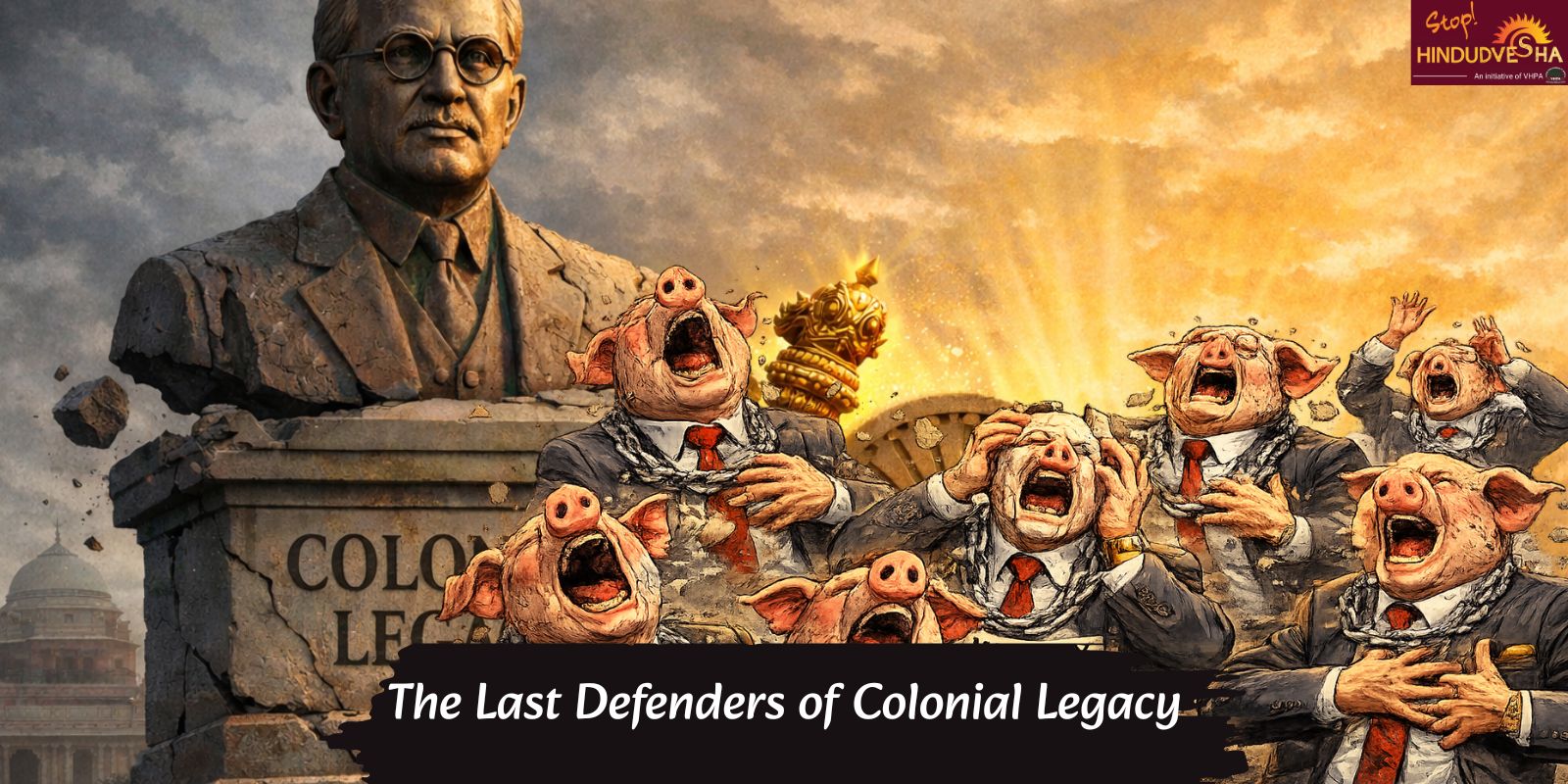
Summary
India’s recent decision to remove Edwin Lutyens’ statue from Rashtrapati Bhavan has reignited debate over the country’s colonial legacy. While critics from the Lutyens–Macaulay ecosystem portray such moves as attempts to erase history, the episode reflects a broader national effort to reassess symbols inherited from colonial rule. The article argues that sections of India’s intellectual elite continue to romanticize colonial figures while dismissing indigenous civilizational frameworks. By examining the controversy around Lutyens, the ongoing renaming of colonial institutions, and Prime Minister Modi’s critique of Macaulay’s legacy, the piece highlights India’s growing push to shed colonial mindsets and reclaim cultural confidence rooted in its own civilizational heritage.
In Indian discourse, “Lutyens’ elite” refers to a self-styled intellectual class that routinely derides India’s cultural inheritance while celebrating Western values with unquestioning admiration. A related tendency within this ecosystem is the habit of tracing India’s accomplishments, and even elements of its identity, to successive waves of invasion and colonial domination—whether Islamic or European. Even as India has witnessed a remarkable civilizational and cultural resurgence over the past decade, this old guard of colonial apologists has by no means lost its influence.
The government recently replaced the statue of Edwin Lutyens, the British architect who designed Rashtrapati Bhavan, with that of C. Rajagopalachari, the first Governor-General of independent India. The decision provoked sharp criticism from a familiar ecosystem, where outrage quickly followed the well-worn pattern of defending colonial legacies while accusing the government of giving India’s civilizational history a “right-wing” spin.
But what lies at the core of Lutyens’ legacy? Beneath the façade of colonial elegance stands a harsher reality: entrenched racism, rule justified as reform, and civilizational disruption framed as modern progress. The following sections consider how, even as this colonial structure erodes, an ecosystem continues to romanticize its remnants and treats criticism of Macaulay as hostility toward English itself.
Lutyens’ Legacy and India’s Colonial Hangover
India’s continued reliance on colonial structures of governance, both physical and metaphorical, even decades after independence, is a curious phenomenon. Part of the explanation lies in the limited interest shown by successive governments in developing an entirely new framework of governance and infrastructure rooted in indigenous values. Yet such a simple explanation does not fully capture the more complex dynamics of the post-independence Nehruvian ecosystem, which tended to imagine India’s modern identity as firmly anchored in Western ideals and values—in effect, within the framework of a continuing “colonial legacy.”
In 2007, the Lutyens Trust organized an exhibition and study tour in New Delhi in collaboration with INTACH. The exhibition, titled “Rashtrapati Bhavan in Context: The Work of Sir Edwin Lutyens O.M.”, traced the evolution of Lutyens’s earlier work, the story of how he designed New Delhi, and examples of the influence of Delhi’s architecture on his later projects. According to information available on The Lutyens Trust website, the Office of the President of India even loaned several items from Rashtrapati Bhavan for the exhibition [1].
The uncritical celebration of Lutyens’ legacy reflects a troubling tendency within the post-Nehruvian ecosystem, which often softened or overlooked racism directed at Indians and treated colonial narratives of Western superiority as legitimate markers of India’s cultural and civilizational identity. Edwin Lutyens, frequently glorified by certain circles for shaping the architectural landscape of modern India, was in fact such an unabashed racist that even many in the West would struggle to defend his recorded views.
“They ought to be reduced to slavery…beaten like brute beasts and shot like man-eaters,” wrote Lutyens in letters to his wife Emily Eden, referring to Indian laborers. Nor did he leave much room for ambiguity in his views about Indians more broadly. “They do not improve with acquaintance…the average Indian seems a hopeless creature,” he famously remarked [2].
When Prime Minister Modi recently announced the removal of the Lutyens bust from the central courtyard of Rashtrapati Bhavan, he said, “Today, the country is leaving behind the symbols of slavery and has begun to value symbols related to Indian culture”. Following the Prime Minister’s announcement, a statue of C. Rajgopalachari, the first Indian Governor-General of independent India, was unveiled the very next day by President Droupadi Murmu [3].
The Predictable Outrage Over the Lutyens Statue
The decision to remove Lutyens’ statue from Rashtrapati Bhavan turned so controversial overnight that the great-grandson of Edwin Lutyens, Matt Ridley, vehemently criticized the action. “Sad to read that the bust of Lutyens (my great-grandfather) is to be removed from the presidential palace he designed in Delhi. Here I am with it last year. I wondered at the time why his name had been removed from his plinth”, he wrote on X [4]. Several opposition leaders also politicized the government’s decision, accusing it of forcefully effacing history and heritage, and dismantling the legacy of the “nation’s lived history [5]”.
While Ridley’s emotional connection to his ancestor’s statue is understandable, his sharp reaction underscores an uncomfortable reality—the continued effort by the post-Nehruvian ecosystem to uphold and glorify the colonial legacy in India. Had successive governments gradually moved over the decades to distance India from the symbolic remnants of British rule, this awkward controversy might well have been avoided.
What stood out even more was the predictable reaction of the left-liberal establishment, revealing and unsettling in equal measure. Within days, editorials and opinion columns condemning the move surfaced across Indian media. “Edwin Lutyens’ bust is removed for ‘decolonisation’. Do we need to erase the past that shapes us?” ran a headline in The Indian Express [6].
Another article published by ArchitectureLive! rhetorically claimed that the government’s decision to remove Lutyens’ statue could perhaps be viewed as an attempt to rewrite history: “The current Indian government replaced Edwin Lutyens’ bust with freedom fighter C. Rajgopalachari’s at Rashtrapati Bhavan, framing it as decolonization. But symbolic gestures don’t dismantle colonial mindsets embedded in governance, caste, and institutions [7].”
The removal of Lutyens’ bust was also criticized in The Hindu in an article titled “British Architect Sir Edwin Lutyens and His Madras Connection,” where the author wrote: “While I welcome Rajaji’s statue being installed at Rashtrapati Bhavan, the removal of Sir Edwin Lutyens’ bust from the premises is deplorable. Yes, he was undoubtedly racist. But there is no doubt that he was a brilliant architect who gave our capital city character”. The eulogy continues with a nostalgic reflection on Lutyens’s connection to Chennai, seemingly untroubled by the casual acknowledgment and quiet dismissal of the colonial architect’s virulent racism [8].
Another article, “Modi’s New India – The Politics of Erasure,” published in Indian Currents, claims that the administration is reshaping history through measures such as the removal of Lutyens’s bust from Rashtrapati Bhavan. The author conspicuously ignores Lutyens’s virulent racism, maintaining instead that he was an architect rather than a colonizer [9].
It is striking that a step which should have been welcomed by Bharatiyas as a long-overdue act of civilizational self-respect instead became fodder for noisy television debates [10] [11]. Pro-Lutyens panelists rushed to defend the supposed virtues of British “colonial legacy,” seemingly oblivious to the irony that many of their own forefathers gave their lives resisting that very legacy.
StopHinduDvesha has documented what it calls the “brown sepoy” syndrome, whereby Western media institutions strategically promote Indian-origin journalists who help propagate biased narratives about India [12]. The Lutyens’ elite response to the statue episode captures this syndrome well. Quick to deride their own civilizational heritage, they readily defend colonial relics—racism included. Television debates soon followed, with Lutyens’ elites echoing the rhetoric of the “white man’s burden” and lecturing fellow Indians on the supposed virtues of colonial legacy.
India’s Decolonization and Civilizational Reawakening
Over the past 10-12 years, India has been actively dismantling colonial structures and replacing these with those embedded in the dynamics of its ancient civilizational and cultural ethos. In May 2023, India took a culturally radical step by inaugurating its new Parliament building, effectively erasing the edifice of the old Parliament building designed by British architects Herbert Baker and Edwin Lutyens from the recesses of its civilizational memory.
The installation of the Sengol in the new Parliament was also a moment of civilizational reckoning. The Sengol, a golden scepter, is a traditional symbol of righteous and just rule, once used by the Chola kings as a symbol of fair governance. The Sengol was originally presented to India’s first Prime Minister, Jawaharlal Nehru, but it found its rightful place in the seat of governance only seventy years later—symbolizing India’s shift from colonial frameworks toward models rooted in its ancient Dharmic values and civilizational ideals [13].
Similarly, in February 2026, Prime Minister Modi inaugurated the new Prime Minister’s Office (PMO), effectively dismantling the colonial legacy of the old PMO, also known as South Block, designed by British architect Herbert Baker. Inaugurating the new PMO, called Seva Teerth, the Indian Prime Minister said it was critical for the country to shed every trace of colonial mindset as it moves towards achieving the goal of Viksit Bharat (developed India) by 2047. [14]
Modi observed that even after independence, India remained framed by colonial symbols—such as Race Course Road for the Prime Minister’s residence and Rajpath leading to Rashtrapati Bhavan, a name unbefitting a democracy. He stressed that as India advances through the 21st century, the vision of a developed nation must be reflected not only in policy but also in its buildings and public spaces [15].
The term “Lutyens’ Delhi” did not arise by accident. It became a tongue-in-cheek reference to a capital whose identity long remained steeped in colonial symbols. Roads leading to the heart of power carried names such as Curzon Road, Race Course Road, Aurangzeb Road, Kirby Palace, and Kitchener Road—labels that read like entries from a neocolonial manual. That the political core of independent India was casually defined through figures like Curzon and Aurangzeb was a striking cultural anomaly, yet New Delhi lived with it for decades. The irony was hard to miss.
Over the past decade, many of these names have been changed, much to the discomfort of the so-called “Lutyens’ elite.” Race Course Road was renamed Lok Kalyan Marg in 2016, Rajpath was renamed Kartavya Path in 2023, and the Central Secretariat building was renamed Kartavya Bhavan the same year [16].
The Indian Army recently undertook a massive exercise to replace 26 British-era names in military zones. The colonial-era names of roads, buildings, and facilities across military establishments were replaced with names of Indian war heroes. In Delhi Cantonment, Kirby Place (Officers’ Accommodation) has been renamed Kenuguruse Vihar, while Mall Road has been renamed as Arun Khetrapal Marg. [17]
Challenging Macaulay: The Battle Over India’s Intellectual Identity
Prime Minister Modi has repeatedly criticized Macaulay’s colonial legacy of mental servitude, urging India to reclaim an identity rooted in its own cultural and civilizational frameworks. In several recent speeches, he has called for a conscious break from what he described as Macaulay’s racist intellectual legacy.
He addressed the issue at length while delivering the 6th Ramnath Goenka Lecture in November 2025, calling for a national resolve to “free ourselves from the mindset of slavery that Macaulay imposed on India.” Modi was referring to Macaulay’s Minutes of 1835, which reshaped India’s education system to serve the colonial project. “Macaulay broke our self-confidence and filled us with a sense of inferiority. He threw our entire way of life into the dustbin in one stroke. That was when the belief took root that Indians must adopt foreign ways to achieve anything,” he said, adding that this mindset persisted even after independence.
Modi argued that Macaulay’s policies systematically dismantled India’s indigenous education traditions, replacing them with British thinking and language. As a result, he said, India increasingly looked outward for models of knowledge, innovation, and governance rather than drawing from its own civilizational foundations [18].
Commenting on the acute colonization of the Indian psyche, the Indian Prime Minister contrasted India’s devaluation of its own civilizational heritage with the attitude of other countries, where people take pride in their historical heritage. He also raised the issue of Macaulay’s legacy, leading to an ecosystem in which people disrespected their own languages due to a sense of inferiority. [19]
Modi’s sharp criticism of Macaulay stirred a hornet’s nest. In a polity long shaped by the Anglophilic Lutyens elite, a prime minister openly calling for dismantling Macaulay’s colonial legacy was bound to provoke backlash. The reaction was predictable. Television panelists rushed to defend Macaulay, implying that the Prime Minister was attacking the English language and the opportunities it brought to Indians. Rather than engage with the substance of his argument, debates quickly turned into defenses of English itself. Some even drifted into familiar praise for colonial rule—crediting the British with social reform and the supposed introduction of modernity through English education [20] [21] [22].
The Prime Minister’s call to dismantle Macaulay’s legacy triggered a flood of media articles with sharp, often toxic headlines. Many framed Macaulay as the supposed savior of the “downtrodden” while recasting the debate through the familiar rhetorical lens of “Hindutva.” A few of these headlines illustrate the pattern:
- “When RSS-Modi Attack Macaulay and English, They Attack Upward Mobility of Dalits, Shudras, Adivasis”, The Wire, December 2025 [23].
- “An inverted Macaulay”, The Frontline, December 2025 [24].
- “PM Modi’s ‘Macaulay Mindset’ Is a Myth’, The Real Fight Is Over India’s Ideas”, The Quint, December 2025 [25].
- “How Ambedkar and Nehru’s Words Debunk Modi’s Prejudiced Understanding of the ‘Macaulay Mindset’, The Wire, November 2025 [26].
- “Macaulay and English Education: Where PM Modi’s Account Falls Short”, Impact and Policy Research Institute, December 2025 [27].
- “Western Education Has lifted India”, The Wall Street Journal, December 2025 [28].
Much of the criticism from the “Lutyens’ elite” of the Indian Prime Minister’s remarks on Macaulay reduces the issue to a simplistic “Modi vs. Macaulay” frame. In doing so, it sidelines the broader question of India’s intellectual decolonization and recasts it as merely another element of Modi’s “political project.” The familiar narrative quickly follows: any attempt to reposition India within its own civilizational and cultural framework is dismissed as “Hindutva politics.”
At the same time, many such arguments lapse into an uncritical celebration of the English language, claiming that without Macaulay, India would have remained on the margins of the world. These assumptions are not only speculative but also reflect the very Macaulayan mindset of intellectual dependency that the Prime Minister criticized. In effect, a debate about Macaulay’s colonial legacy was reduced to a superficial binary—English versus regional languages, civilizational values versus modernity—ironically framed within the same paradigm Macaulay himself promoted.
Wrapping up
The West’s purported “gift” of modernity to India through the introduction of the English language is often invoked to undermine India’s ongoing efforts at decolonization and its broader civilizational and cultural reawakening. A certain intellectual ecosystem implicitly suggests that European colonization conferred a supposed benefit upon India, portraying imperial rule as a formative intervention rather than a system of domination. In doing so, they frequently construct hypothetical doomsday scenarios, implying that India would have remained intellectually and politically adrift had Macaulay not intervened.
India, however, does not require validation from the “Lutyens’ elite” or from Western opinion in its efforts to dismantle the remnants of colonial legacy and reclaim its civilizational identity. Nor is India alone in pursuing such a course. Several countries across Africa and the Caribbean have similarly taken steps in recent years to distance themselves from colonial symbols by renaming institutions, revising public spaces, and restructuring aspects of governance.
A nation’s historical identity cannot be reduced to a colonial episode imposed upon it. To suggest that India had no meaningful history prior to the cycles of invasion and colonization is itself a form of discursive colonization. Above all, a nation’s decision to dismantle colonial symbols should not be mistaken for an attempt to erase history.
Citations
[1] The Lutyens Trust New Delhi Exhibition and Study Tour – October 2007 – The Lutyens Trust; https://www.lutyenstrust.org.uk/portfolio-item/the-lutyens-trust-new-delhi-exhibition-and-study-tour-october-2007/
[2] Opinion | From Pride to ‘Bust’: The Congress Ecosystem’s Performative Wokeness | Opinion News – News18; https://www.news18.com/opinion/opinion-from-pride-to-bust-the-congress-ecosystems-performative-wokeness-ws-kl-9927516.html
[3] Lutyens’ bust gone: Why New Delhi’s British architect ended up on Modi’s anti-colonial purge list | India News; https://www.hindustantimes.com/india-news/lutyens-statue-removal-latest-in-modis-anti-colonial-project-know-who-he-was-and-how-his-name-came-to-spell-elitism-101771836346823.html
[4] Great-grandson of Edwin Lutyens in the UK criticises removal of Lutyens’ bust from Rashtrapati Bhavan – The Times of India; https://timesofindia.indiatimes.com/world/uk/great-grandson-of-edwin-lutyens-in-the-uk-criticises-removal-of-lutyens-bust-from-rashtrapati-bhavan/articleshow/128761558.cms
[5] ‘Aurangzeb Zindabad Mindset’: BJP Slams Opposition For Criticising Lutyens’ Bust Removal | Politics News – News18; https://www.news18.com/politics/aurangzeb-zindabad-mindset-bjp-slams-opposition-for-criticising-lutyens-bust-removal-9925836.html
[6] Decoding Rashtrapati Bhavan: How Edwin Lutyens Created a Landmark of Cultural Synthesis; https://indianexpress.com/article/opinion/columns/edwin-lutyens-decolonisation-lutyens-delhi-rajaji-10548948/
[7] “Changing The Statue Does Not Change the Room” – Geethu Gangadhar on Edwin Lutyens’ Bust Removal; https://architecture.live/on-edwin-lutyens-bust-removal-geethu-gangadhar/
[8] British Architect Sir Edwin Lutyens and his Madras connection – The Hindu; https://www.thehindu.com/news/cities/chennai/british-architect-sir-edwin-lutyens-and-his-madras-connection/article70672524.ece
[9] Modi’s New India: The Politics of Erasure A.J. Philip: Indian Currents: Articles; https://www.indiancurrents.org/article-modis-new-india-the-politics-of-erasure-a-j-philip-2954.php
[10] Rajaji Replaces Lutyens: Decolonise or Delete History? – YouTube; https://www.youtube.com/watch?v=dn_CV6Ayxto
[11] Centre Replaces Lutyens’ Statue With Rajaji’s Bust; I.N.D.I.A – ns Can’t Erase ‘Macaulay Mindset’? – YouTube; https://www.youtube.com/watch?v=dUocVlDq754
[12] Indian-Origin Journalists’ Role in Fueling Anti-India bias; https://stophindudvesha.org/role-of-indian-origin-journalists-in-spreading-biased-narratives-against-india/
[13] India’s Civilizational Narrative Reshapes Global Image; https://stophindudvesha.org/indias-civilizational-narrative-reshaping-its-internal-image-and-external-positioning/
[14] ‘India must be free of colonial mindset’: PM Narendra Modi on new PMO inauguration | India News; https://www.hindustantimes.com/india-news/india-must-be-free-of-colonial-mindset-pm-narendra-modi-on-new-pmo-inauguration-seva-teerth-101771023775897.html
[15] PM addresses the inaugural event of Seva Teerth and Kartavya Bhavan – 1 & 2 in New Delhi | Prime Minister of India; https://www.pmindia.gov.in/en/news_updates/pm-addresses-the-inaugural-event-of-seva-teerth-and-kartavya-bhavan-1-2-in-new-delhi/
[16] PM Modi’s decolonisation odyssey: Complete catalog of colonial name changes since 2014 | India News – India TV; https://www.indiatvnews.com/news/india/pm-modi-decolonisation-odyssey-complete-catalog-of-colonial-name-changes-since-2014-2026-02-13-1030186
[17] Indian war heroes, gallantry awardees replace 246 British-era names in military zones | – The Times of India; https://timesofindia.indiatimes.com/defence/news/indian-war-heroes-gallantry-awardees-replace-246-british-era-names-in-military-zones/articleshow/128129287.cms
[18] Free India from Macaulay’s slavery mindset: PM Modi sets 10-year roadmap – India Today; https://www.indiatoday.in/india/story/free-india-from-macaulays-slavery-mindset-pm-modi-sets-10-year-roadmap-2821827-2025-11-18
[19] Ibid.
[20] (1) Modi vs Macaulay: Dalrymple, Tripathi Debate English Education and India’s ‘Slavery Mindset’ – YouTube; https://www.youtube.com/watch?v=-o2SS4bABV4&t=1099s
[21] NewsToday Debate: PM Modi’s Attack On Macaulay Sparks ‘India vs Bharat’ Debate – YouTube; https://www.youtube.com/watch?v=UDOVjOKyyXo
[22] PM Modi News | PM Modi’s War On Macaulay: Historian Faceoff – YouTube; https://www.youtube.com/watch?v=iSMXbldI0J8
[23] When RSS-Modi Attack Macaulay and English, They Attack Upward Mobility of Dalits, Shudras, Adivasis – The Wire; https://thewire.in/caste/when-rss-modi-attack-macaulay-and-english-they-attack-upward-mobility-of-dalits-shudras-adivasis
[24] Modi and Macaulay: The Politics Behind India’s English Debate – Frontline; https://frontline.thehindu.com/columns/modi-macaulay-debate-and-politics-of-english-education/article70345175.ece
[25] PM Modi’s ‘Macaulay Mindset’ is a Myth. The Real Fight Is Over India’s Ideas | Opinion; https://www.thequint.com/opinion/modi-macaulay-mindset-colonialism-claim-hindutva-narrative
[26] How Ambedkar and Nehru’s Words Debunk Modi’s Prejudiced Understanding of the ‘Macaulay Mindset’ – The Wire; https://thewire.in/history/how-ambedkar-and-nehrus-words-debunk-modis-prejudiced-understanding-of-the-macaulay-mindset
[27] Macaulay And English Education: Where PM Modi’s Account Falls Short – IMPRI Impact and Policy Research Institute; https://www.impriindia.com/insights/macaulay-and-english-education/
[28] Western Education Has Lifted India – WSJ; https://www.wsj.com/opinion/western-education-has-lifted-india-388889e5

Donate to HINDUDVESHA
Our Mission is to explore and expose Hindudvesha through research analysis, education and response.
SUPPORT US