

Ayodhya Dhwajarohan 2025: The Ceremony that Exposed the Anti-Hindu Establishment’s Hypocrisy
 Rati Agnihotri · 12/18/2025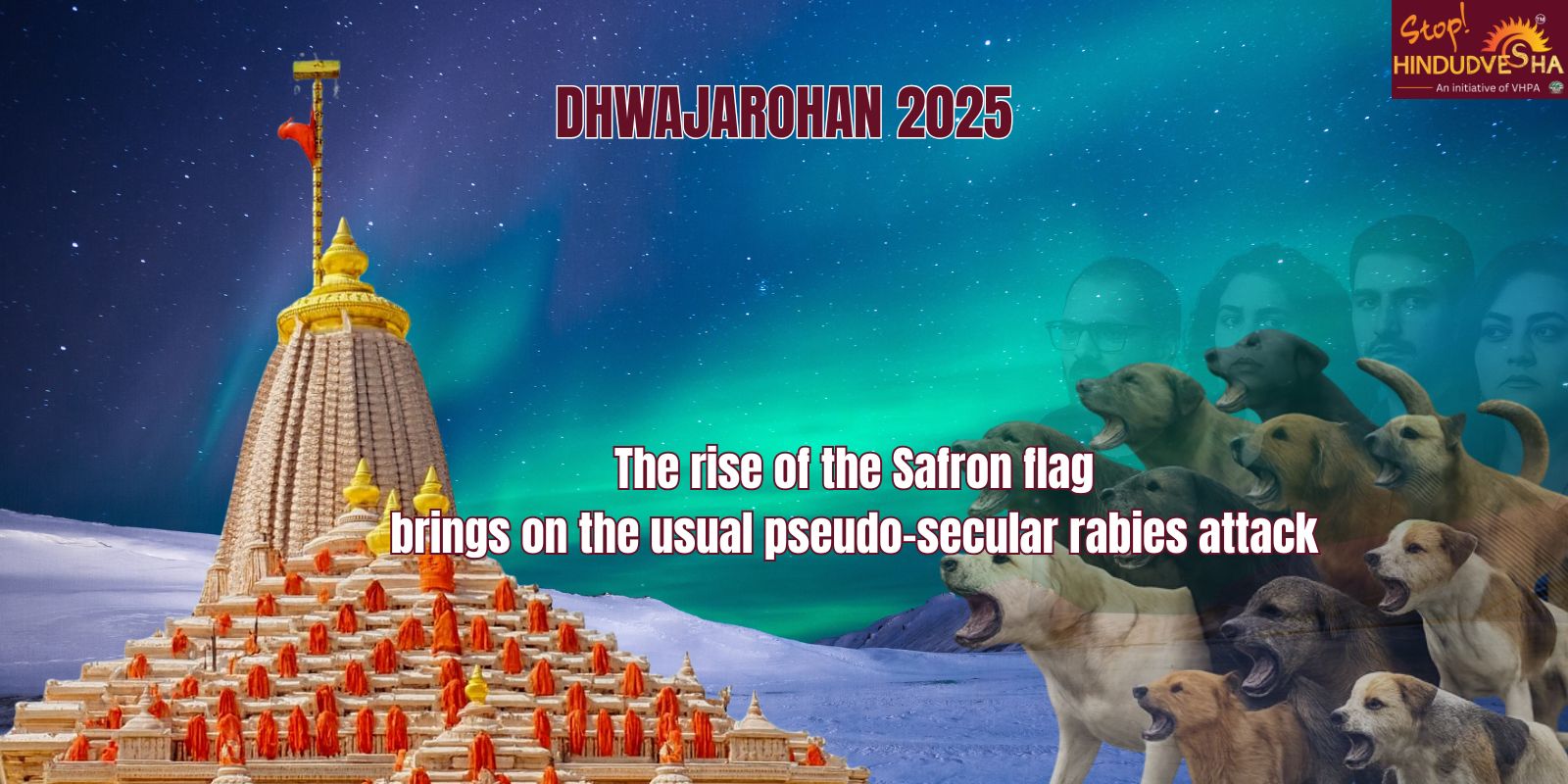
- The flag-hoisting at the Ayodhya Ram Mandir triggered predictable outrage from the left-liberal and radical Islamist ecosystem, which again mocked Hindu beliefs using the familiar rhetoric of “Hindutva supremacy,” “majoritarianism,” “Islamophobia,” and a distorted idea of secularism.
- Pakistan lodged an official protest against the ceremony, framing it as an attempt to erase India’s Muslim heritage.
- Left-liberal media outlets reignited the secularism debate, filtering the Dhwajarohan through narratives of “Islamophobia” and “Hindu nationalism,” and reducing the sentiments of Hindus to a mere political ploy.
- Attacks on the ceremony, presented as a defence of secularism and minority rights, are in fact thinly veiled attempts to undermine India’s civilizational resurgence.
The inauguration of the Ayodhya Ram Mandir in January 2024 marked a paradigm shift in the civilizational narrative of Bharat. With the reclamation of the birthplace of Bhagwan Ram and the dismantling of decades of anti-Hindu narratives, the civilizational Atman of Bharat, characterized by the praxis of Dharma, witnessed a homecoming of sorts.
The Dhwajarohan or the sacred flag-hoisting ceremony held at the Ayodhya Ram Mandir in November 2025 marked a logical continuum to that moment of civilizational reckoning. The hoisting of Dharma Dhwaj, bearing three symbols – Om, the Sun, and the sacred Kovidar tree, was a moment of great civilizational pride for India. It was also a bold civilizational statement. As the Dharma Dhwaj was hoisted amid chants of “Jai Shri Ram,” India signalled to the world that its civilizational narrative is anchored in the ancient cultural and spiritual legacy of Sanatan Dharma.
Predictably enough, following the sacred flag-hosting ceremony, the left-liberal and the radical Islamist cabal began to cry foul. India’s civilizational rise has always “offended” a certain ecosystem. This time too, they came out in predictable outrage on the pretext of saving secularism.
Their real target – India’s civilizational rise and Dharmic awakening. An India proudly creating its own grand narrative in the light of its ancient civilizational and cultural ethos runs antithetical to their thinly veiled motives aimed at dumbing down Bharat’s Hindu heritage and packaging it as a civilizational colony of the Islamic invaders and British colonizers.
The following sections examine the recurring surge of virulent Hinduphobia that accompanies every pivotal moment in Bharat’s civilizational reset. They take a critical look at the spread of anti-Hindu rhetoric across segments of civil society, the media, politics, and the self-styled intellectual ecosystem in the aftermath of the Ayodhya Ram Mandir Dhwajarohan ceremony.
Ecosystem’s Predictable Fury
The Indian Prime Minister described the Dhwajarohan ceremony as a moment of civilizational healing. “Today, the city of Ayodhya is witnessing another pinnacle of India’s cultural consciousness. Today, the entire India, the entire world is immersed in Ram. There is unparalleled contentment in every Ram devotee’s heart. There is immense gratitude. There is boundless divine bliss. Wounds of centuries are healing. The pain of centuries is coming to an end today. The resolve of centuries is achieving fulfillment today”, he said. The Prime Minister also emphasized that Ram is not merely a deity but an entire value system, encompassing the ideals of Dharma, quintessential for making India developed by 2047 and bettering the capabilities of Indian society. [1]
However, as often happens, the idea of viewing Indian polity and society through the ideals of Ram Rajya did not sit well with the left-liberal establishment and the radical Islamist ecosystem. They quickly revived the familiar accusations of the state promoting “Hindutva supremacy” and “Hindu majoritarianism” as the sacred flag was unveiled. Several anti-Hindu commentators went further, suggesting that participation in the ceremony violated the constitutional principle of separation between state and religion.
Even as the construction of the Ayodhya Ram Mandir and the subsequent flag hoisting ceremony stand equipped with a constitutional and legal mandate, in the light of a verdict by the country’s apex court, radical Islamists continued to play the archetypal victim card: “Modi sending out Constitution Day homilies barely 24 hours after his saffron spectacle at the Ram Temple, built on the demolished Babri masjid. More than 1000 killed in the carnage that followed the Babri demolition, labelled a criminal act by the Supreme Court” – Rana Ayyub on X [2]
Far-left activist Arfa Khanum Sherwani, known for her Hinduphobic posts, took to mocking the nationalist electronic media coverage of the event, taking the occasion to lecture on the ethics of journalism: “And one is witnessing how Hindi journalism transformed into ‘Hindu journalism’. Journalists turned into soldiers of Dharma, instead of fulfilling their original role as sepoys of the pen. It’s disgusting indeed!“ – Arfa Khanum Sherwani on X, Original Post in Hindi [3]
Leftist social media influencer Dhruv Rathee didn’t directly refer to the ceremony; however, he mocked the rising visibility of Hindu issues in the public sphere through a vicious post on X. Sharing a couple of pictures depicting the alleged crackdown on protestors by the police without any context and background, Rathi lamented the supposed double standards of the government in its “failure” to hold ‘fraud babas’ accountable: “There’s literally a fraud baba doing an open rally demanding a Hindu Rashtra. It goes against the republic. It goes against the Constitution. It goes against the nation. But will the police treat him with same brutality? Actually, does the police treat rapists, corrupt politicians, murderers with the same brutality? …” – Dhruv Rathee on X [4]
The period following the flag-hoisting ceremony also witnessed the large-scale demonization of the RSS on social media. A recent social media post by Hinduphobic comedian Kunal Kamra, featuring a t-shirt with the image of a dog, alongside a reference to the RSS, was shared widely by various left-leaning and Hinduphobic networks. The post prompted strong reactions from various BJP leaders, who warned of police action against the comedian [5]
An OpIndia report offers a detailed account of the wave of anti-Hindu posts that swept social media after the Ayodhya ceremony. It highlights how several Indian television journalists were aggressively targeted by leftist and radical Islamist groups for presenting positive, nationalistic coverage of the event. These groups would have perhaps preferred that journalists disparage Hindu Dharma and portray the Mandir as a stain on India’s civilizational legacy rather than acknowledge it as a historic achievement. The report also documents how extremists trolled celebrities and intellectuals who praised the ceremony, dismissing the Dhwajarohan as a “spectacle.” Far-left commentators escalated their rhetoric, alleging that hoisting the saffron flag violated India’s secular and pluralistic constitutional ethos. [6]
Opposition Outrage and Double Standards
Stop Hindudvesha has extensively covered how the politics of minority appeasement in India has consistently led to the public denunciation and bad-mouthing of Hindu Dharma and Bharat’s civilizational heritage,[7], all in the garb of secularism. India’s political discourse has long been marred by some of the most degrading anti-Hindu tropes, including outrageous analogies that liken Sanatan Dharma to diseases such as dengue and malaria.
Following the Dhwajarohan ceremony, opposition leaders raked up the secularism debate, claiming that the Prime Minister’s participation in the ceremony didn’t sit well with the secular ethos of the Constitution. Most leaders questioned the sacred ceremony itself, with comments bordering on Hinduphobia. Congress leader Rashid Alvi criticized the ceremony, saying that India had no state religion, and thus, the Prime Minister was flouting constitutional norms by hoisting the saffron flag on a temple. “Will he hoist a flag on a mosque, Gurudwara, or a church? He wants to hoist the flag on the Ram Mandir for political benefit so that he can benefit in the UP elections, instigating religious sentiments in the country. He should learn secularism from Pandit Jawaharlal Nehru,” he said. The Uttar Pradesh Congress Chief Ajay Rai accused the government of politicizing religion and using it as a marketing gimmick. [8]
The politicization of the event also involved the invoking of the caste card as Ayodhya MP Awadhesh Prasad claimed he was not invited to the ceremony because of his Dalit identity. [9] The opposition had earlier politicized the Ayodhya Ram Mandir Pran Pratishtha ceremony held in January 2024, rejecting invitations on alleged grounds that the ceremony was a “political” event.
At first glance, the opposition’s outbursts may appear to be routine political criticism directed at the ruling BJP. A closer examination, however, reveals a consistent pattern: a marked discomfort with the public assertion of India’s Hindu identity and its civilizational reawakening. When political leaders mock Sanatan Dharma, ridicule Hindu deities, issue derogatory remarks about Hindu spiritual figures, and insist that even discussing a Hindu Rashtra is unconstitutional, it reflects a deeper trend of institutionalized Hinduphobia. The pattern becomes clearer when these same leaders engage in overt minority appeasement, downplay radical Islamic extremism, and apply the idea of “freedom of speech” selectively in ways that disproportionately target Hindus.
Pakistan Cries Islamophobia
In a rather comical turn of events, Pakistan officially protested the Dhwajarohan ceremony at the Ayodhya Ram Mandir, labelling it as an attempt to erase India’s Muslim heritage. [10]
It also accused India of discriminating against minorities. The situation became even more farcical when Pakistan’s Ministry of Foreign Affairs appealed to international bodies, including the United Nations, to intervene and “protect” Islamic heritage. India’s Ministry of External Affairs rejected the allegations outright, citing Pakistan’s own long record of persecuting minorities and disregarding democratic norms. The ruling party further remarked that Pakistan’s professed concern for minority rights in India was comparable to Osama bin Laden delivering a lecture on world peace. [11]
In recent months, Pakistan has made a concerted effort to invert the narrative on terrorism by promoting the fiction of “saffron terrorism” and casting itself as a victim through familiar claims of “Hindutva terror” and “Hindu majoritarianism.” Its Hinduphobic outbursts after the Dhwajarohan ceremony fit neatly into this pattern. Yet Pakistan’s response appears even more disingenuous when viewed against the virtual absence of minority rights and the continuing persecution of Hindus within its own borders. [12] [13]
The striking resemblance between Pakistan’s rhetoric attacking India’s civilizational resurgence and that employed by the left-liberal establishment within India is especially troubling. In an environment where Hindu concerns are routinely dismissed and discussions of Hindu persecution are suppressed, Pakistan’s denunciation of India’s cultural reclamation functions as an implicit invitation to normalize anti-Hindu prejudice, hostility, and even violence.
Left-liberal Media Propaganda
The global left-liberal media, along with a segment of the Indian press, has consistently framed the Ayodhya Ram Mandir issue through the lens of Hindutva and Islamophobia. In the months leading up to the January 2024 inauguration, outlets such as the BBC, Al Jazeera, Deutsche Welle, The Guardian, and The Economist published a steady stream of opinionated and selective coverage. These pieces portrayed the temple’s construction as an expression of “Hindu majoritarianism” and a threat to “minority rights,” while largely disregarding both the substantial archaeological evidence and the Supreme Court verdict that formed the legal foundation for the temple’s reconstruction. [14]
Coverage of the inauguration was marked by a pronounced Hinduphobic tone, often resorting to crude caricatures of Hindu beliefs and depicting the Ayodhya Ram Mandir as an “oppressive” emblem of “Hindu majoritarianism.” The Washington Post described the Pran Pratishtha ceremony as “the inauguration of Modi’s controversial Hindu temple.” [15] The Guardian published an implicitly hostile opinion piece lamenting the rise of “right-wing Hindu nationalism” and asserting that “Modi’s supporters treat secularism as a foreign imposition and as camouflage for the mistreatment of Hindus.” [16] Deutsche Welle adopted a similar line, reducing the temple to a political symbol of “Hindu nationalism” associated with the BJP. [17]
Most Western coverage of the Ayodhya Ram Mandir Pran Pratishtha ceremony relied on similar narrative frames. Referring to the site primarily as the location where the Babri Masjid was “demolished,” these reports sidestepped the complex historical record and the extensive archaeological evidence presented in court demonstrating the existence of a pre-existing temple.
By dismissing the sacrifices of Kar Sewaks and the long civilizational struggle of millions of Bharatiyas as a mere “political gimmick” of the BJP, left-liberal outlets fell back on familiar Hinduphobic tropes. Their coverage repeatedly gaslighted Hindu concerns while magnifying allegations of Islamophobia, thereby obscuring the deeper cultural and historical significance of the event.
Left-liberal coverage of the Ayodhya Ram Mandir flag-hoisting ceremony once again revived the debate on secularism. “Is Modi defining India’s constitutional identity through majoritarian narratives?” asked a Deccan Herald opinion headline. The article characterizes India’s civilizational resurgence, including the consecration of the Ayodhya Ram Mandir and the installation of the Sengol in Parliament, as an alleged attempt to undermine constitutional principles. Introducing caste dynamics into the discussion, the writer contends that “the temple project was perhaps seen by the majority of voters as one driven by the upper castes.” The piece also frames the Prime Minister’s recent critique of Macaulayite thought and the colonial mindset as “a covert critique of the Indian Constitution.” [18]
An article in The Wire went so far as to allege that the Prime Minister had violated the spirit of the Constitution by hoisting a saffron flag atop the Ayodhya Ram Mandir. [19] A commentary in the South Asia Journal struck a similar note, condemning India’s civilizational resurgence and recycling familiar claims that the temple is an oppressive reminder of the Babri Masjid’s demolition while casting Hindutva in a hostile light. [20]
The double standards underlying these frequent claims of “violating constitutional norms” are difficult to overlook. When Western heads of state meet the Pope in official ceremonies or when political leaders take their oaths on the Bible, such actions are rarely criticized as breaches of secular principles. Yet the same commentators apply a very different standard to non-Western societies, particularly to a civilization grounded in a non-Abrahamic cultural ethos.
Attacking the Rise of the Bhartiya Civilization
Criticism of the Ayodhya Ram Mandir Dhwajarohan ceremony, presented under the guise of safeguarding secularism or defending minority rights, is, in reality, a thinly veiled attack on India’s civilizational resurgence. It reflects the frustrations of an ecosystem unsettled by Bharat’s cultural revival and the renewed affirmation of its ancient Hindu heritage.
The historical arc of the Ram Janmabhoomi movement has long been reframed through tropes of “Hindutva fascism” and “minority oppression,” a narrative that obscures the genuine struggle of a wounded civilization seeking to reclaim its identity.
Historian Meenakshi Jain highlights these distortions in her book The Battle for Rama: Case of the Temple at Ayodhya. Drawing on extensive historical records and the detailed ASI findings from the 2003 excavations, she demonstrates how leftist historians such as Romila Thapar, Irfan Habib, R. S. Sharma, and Bipan Chandra orchestrated a systematic disinformation campaign to undermine the temple’s historical legitimacy.
The book details how leftist historians constructed unfounded theories to undermine Ayodhya’s standing as the birthplace of Bhagwan Ram. They argued, without evidence, that Valmiki’s Ramayana cannot be treated as an authoritative source for Ram’s existence, and claimed that the worship of Ram in Ayodhya emerged only in the medieval period, gaining prominence in the eighteenth century. They further suggested that the city had primarily Buddhist and Jain influences before this time. Taken together, these assertions formed a coordinated propaganda effort to delegitimize the Ram Janmabhoomi movement and erode its historical foundations:
“In an astonishing act of daring, a handful of Left historians attempted to counter a centuries-old belief, and vociferously assert that Babri Masjid was built on vacant land. They remain undeterred despite the mounting evidence stacked against them. Some of these historians even appeared as experts of the Babri Masjid Action Committee (BMAC) during negotiations between the Vishwa Hindu Parishad (VHP), BMAC, and the Government in 1990-1991. Yet throughout they have maintained the charade of being “independent historians””. [21]
Wrapping Up
The Dhwajarohan at Ayodhya marks far more than a ceremonial milestone. It signals a society reclaiming the clarity of its civilizational roots after centuries of distortion, erasure, and ideological pressure. The intense backlash that followed only reaffirms the scale of this shift. Each wave of Hinduphobic rhetoric, each attempt to reframe a sacred moment as a constitutional transgression or a political maneuver, reflects a deeper anxiety within those who have long controlled the narrative about India and its past.
Yet the response of ordinary Bharatiyas tells a different story. The flag raised at Ayodhya did not divide the nation; it reminded millions of a shared inheritance and a living civilizational memory. As Bharat moves forward, the Ayodhya Ram Mandir stands as a testament to cultural resilience. No volume of manufactured outrage can overshadow a civilization rediscovering its voice.
Citation
[1] Full Text: PM Modi’s Speech At Ram Mandir Dhwaja Rohana Ceremony https://swarajyamag.com/commentary/full-text-pm-modis-speech-at-ram-mandir-dhwaja-rohana-ceremony
[2] Rana Ayyub on X; https://x.com/RanaAyyub/status/1993906070595789213
[3] Arfa Khanum Sherwani on X; https://x.com/khanumarfa/status/1993895260628668654
[4] Dhruv Rathee on X; https://x.com/dhruv_rathee/status/1993239263207477752
[5] BJP warns of action against comedian Kunal Kamra over t-shirt mocking RSS | India News; https://www.hindustantimes.com/india-news/bjp-warns-of-police-action-against-comedian-kunal-kamra-over-t-shirt-mocking-rss-101764132341107.html
[6] Ram Mandir Dhwajarohan: How Pakistan, Islamists and India’s woke brigade united in hatred against Hindu civilisational revival; https://www.opindia.com/2025/11/ram-mandir-dhwajarohan-how-pakistan-islamists-and-indias-woke-brigade-united-in-hatred-against-hindu-civilisational-revival/
[7] Hinduphobia: Politics of Anti-Hindu Rhetoric; https://stophindudvesha.org/hinduphobia-as-playbook-turning-anti-hindu-rhetoric-into-political-capital/
[8] Ayodhya Ram temple | ‘Will PM hoist a flag on mosque’: Congress questions Modi-Bhagwat’s temple ceremony – Telegraph India; https://www.telegraphindia.com/gallery/will-pm-hoist-a-flag-on-mosque-congress-questions-modi-bhagwats-temple-ceremony-photogallery/cid/2134731?slide=3
[9] He is a Dalit Congress MP, Imran Masood lashes out at Awadhesh Prasad for not being invited to Ram Mandir Dhwajarohan – Ram Mandir Dhwajarohan: ‘दलित हैं वो इसलिए…’, https://www.jansatta.com/rajya/he-is-a-dalit-congress-mp-imran-masood-lashes-out-at-awadhesh-prasad-for-not-being-invited-to-ram-mandir-dhwajarohan/4263903/
[10] ‘No moral standing’: India slams Pak for remarks on Ram Temple flag-hoisting | India News; https://www.hindustantimes.com/india-news/no-moral-standing-india-slams-pak-for-remarks-on-flag-hoisting-at-ram-temple-101764161133038.html
[11] ‘No moral standing’: India rubbishes Pakistan’s objection to Dhwajarohan at Ayodhya Ram Temple; https://www.wionews.com/india-news/-no-moral-standing-india-rubbishes-pakistan-s-objection-to-dhwajarohan-at-ayodhya-ram-temple-1764162465871
[12] Pakistan under fire for systematic persecution of Ahmadis, Hindus, and Christians; https://www.aninews.in/news/world/asia/pakistan-under-fire-for-systematic-persecution-of-ahmadis-hindus-and-christians20251004141133/
[13] Persecution of Hindus in Pakistan: HRCP report exposes violence and injustice; https://www.opindia.com/2025/03/minorities-in-danger-hindus-face-murder-assault-forced-conversion-in-pakistan-hrcp-report/
[14] Western media peddles propaganda against Ayodhya Ram Mandir ahead of inauguration; https://hindupost.in/world/western-media-peddles-propaganda-against-ayodhya-ram-mandir-ahead-of-inauguration/
[15] In photos: The inauguration of Modi’s controversial Hindu temple – The Washington Post; https://www.washingtonpost.com/world/interactive/2024/photos-inauguration-modis-controversial-hindu-temple/
[16] The Guardian view on Modi in Ayodhya: an alarming new era for India | Editorial | The Guardian; https://www.theguardian.com/commentisfree/2024/jan/22/the-guardian-view-on-modi-in-ayodhya-an-alarming-new-era-for-hindu-nationalism
[17] India: Modi inaugurates controversial Ayodhya temple – DW – 01/22/2024; https://www.dw.com/en/india-modi-inaugurates-controversial-ayodhya-temple/a-68048499
[18] Modi redefining India’s constitutional identity through majoritarian narratives? ; https://www.deccanherald.com/opinion/is-modi-redefining-indias-constitutional-identity-through-majoritarian-narratives-3812961
[19] A Flag Hoisting Shows it is Again Time to Head Ambedkar’s Warning – The Wire; https://thewire.in/communalism/a-flag-hoisting-shows-it-is-again-time-to-heed-ambedkars-warning
[20] Ram Mandir Saffron Flag Unfurled; India’s Imagined Independence from Foreign Domination | South Asia Journal; https://southasiajournal.net/post/category/60558/ram-mandir-saffron-flag-unfurled-indias-imagined-independence-from-foreign-domination
[21] Meenakshi Jain; The Battle for Rama: Case of the Temple at Ayodhya”; p.5.

Donate to HINDUDVESHA
Our Mission is to explore and expose Hindudvesha through research analysis, education and response.
SUPPORT US