

The Curious Case of the Cockroach Janta Party: Protest Movement or Political Psy-Op?
 Rati Agnihotri · 07/16/2026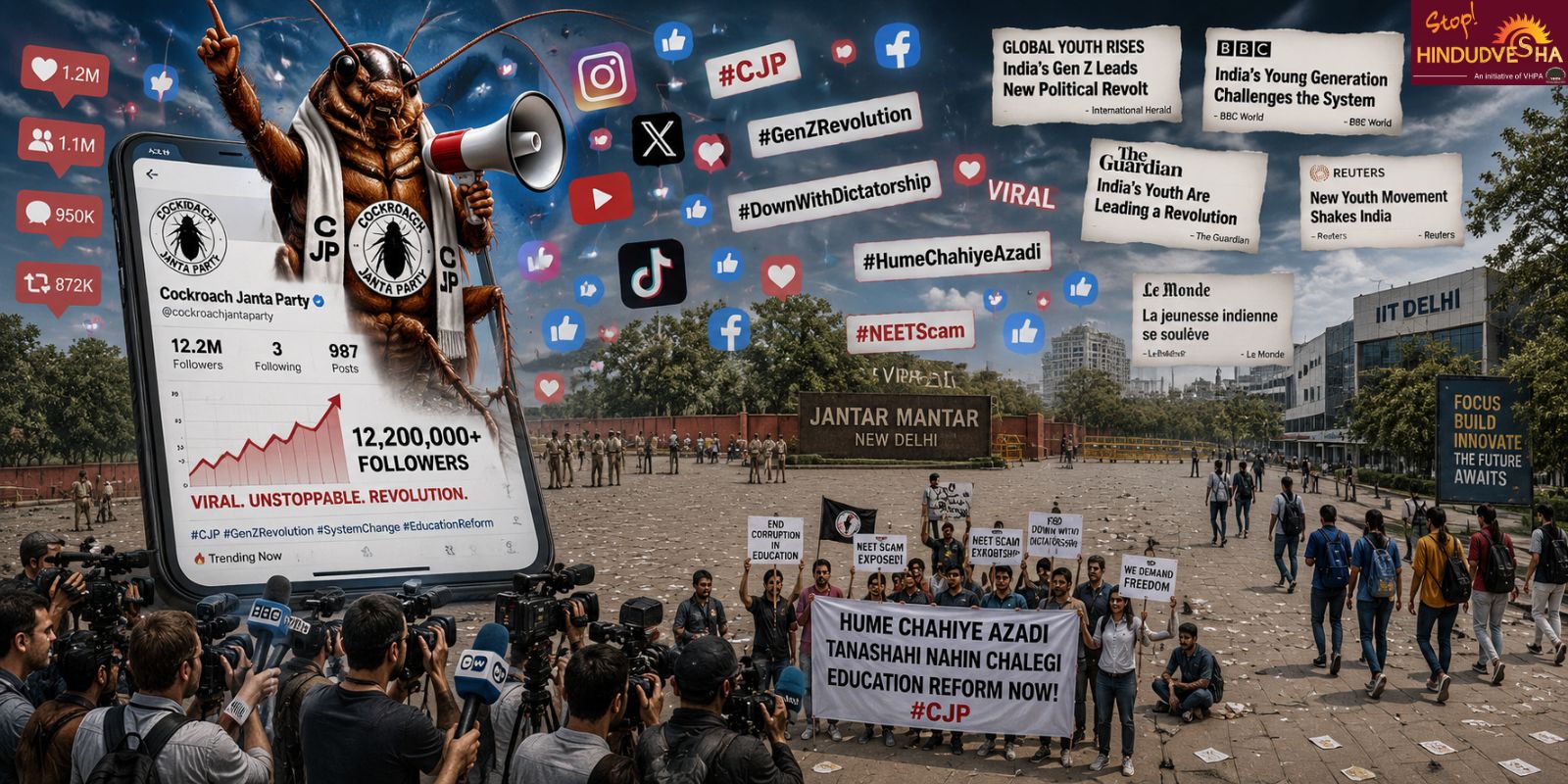
Summary
The Cockroach Janta Party (CJP) was widely promoted as India’s newest Gen Z political phenomenon, attracting extraordinary social media attention and enthusiastic coverage from several Western media outlets. This article argues that the movement was far less organic than its supporters claimed. Examining the CJP’s rapid digital rise, limited grassroots participation, ideological associations, protest tactics, and media amplification, it identifies a pattern increasingly visible across parts of the Global South: highly publicized youth movements portrayed as democratic revolutions despite weak public support. The article further contends that sections of the foreign media romanticized the CJP as the authentic voice of India’s youth while overlooking evidence to the contrary. Ultimately, the limited response from young Indians suggests that the movement failed to gain meaningful traction beyond its media-generated hype.
Genuine socio-political movements are usually rooted in sustained public engagement and grow gradually over time. Whether in India or elsewhere, enduring movements emerge from widespread social concerns, clear objectives, and meaningful grassroots participation.
In recent years, however, a peculiar pattern has emerged across several countries of the Global South. From South Asia to Africa, highly amplified protest movements have appeared with remarkable speed, often packaged as spontaneous Gen Z uprisings against existing political systems. These movements are routinely celebrated by activist networks and sections of the Western media as democratic awakenings and youth revolutions.
What is striking is that this phenomenon appears largely confined to the Global South. One rarely encounters comparable media-driven efforts to mobilize Gen Z against the political establishments of the United States, Britain, France, Germany, or other former colonial powers. Instead, the “Gen Z revolution” template seems disproportionately directed at non-Western societies.
The sudden rise of the Cockroach Janta Party (CJP)[1] in India raises important questions in this context. Is it a genuine youth-driven movement responding to legitimate concerns, or is it another manifestation of a familiar protest model built around social media amplification, ideological activism, and political disruption?
An examination of the CJP’s rise, leadership, narratives, protest methods, and media treatment suggests that the movement may be far less organic than its supporters claim.
Cockroach Janta Party’s Dramatic Rise
The Cockroach Janta Party emerged on social media in May 2026 as a self-described satirical political movement and rapidly became the subject of intense media attention after reportedly crossing 10 million Instagram followers within five days[2] and more than 12 million within a week. Its extraordinary growth sparked widespread debate over whether the phenomenon was organic or driven by aggressive algorithmic amplification[3] [4], with observers pointing to the CJP as a striking example of the power of media narratives and social media algorithms to manufacture viral political visibility.
The founder, Abhijeet Dipke, a Boston University graduate in Public Relations and described in media reports as a political communications strategist, created the CJP page from the United States. [5] He later traveled to India, purportedly for the Jantar Mantar protests, and publicly expressed fears of being arrested upon arrival. [6] Those fears proved unfounded when authorities granted the CJP permission to hold the protests and provided police protection at the venue. [7] [8]
Questions surrounding the Cockroach Janta Party’s meteoric rise intensified when users began circulating screenshots and infographics claiming that a large share of its followers were located outside India, with countries such as Pakistan, Bangladesh, Turkey, and Saudi Arabia reportedly among the top audience locations. [9] Some users alleged that Indian followers accounted for only a small fraction of the total following, while analytics shared online suggested that roughly 63% of followers were from Pakistan and Bangladesh and only 9% from India. [10] Dipke rejected the allegations, claiming that 94.7% of the organization’s followers were Indian. [11] Given the unusually rapid growth in follower numbers, several observers also speculated that a significant percentage of the accounts could be bots.
The wide gap between the CJP’s online popularity and its ground support raises serious questions about the movement’s claims of being organic. Even under generous estimates, attendance at the Jantar Mantar protests was around 1,000 people, including media personnel and social media influencers, while the Cockroaches themselves numbered only in the low hundreds.
Equally striking was the absence of meaningful grassroots mobilization around the issue the CJP claimed to be protesting, namely the NEET paper leaks and the demand for the Education Minister’s resignation. Few affected students were present. Instead, the gathering largely consisted of the familiar cast of left-wing activists, perennial grievance artists, and professional protesters.
Anti-India Narratives and the Deep State Toolkit
The instigator of the Cockroach movement, Abhijeet Dipke, along with several of its prominent members, has come under scrutiny for ideological positions that critics argue are sympathetic to forces inimical to India’s unity, integrity, and sovereignty.
Dipke had earlier faced a complaint over a series of social media posts related to Kashmir. In August 2019, the Legal Rights Observatory filed a complaint with Pune Police alleging that his posts sought to undermine the post-Article 370 status quo and amplify separatist narratives. “Need to stand with Kashmir. Today it’s Kashmir, tomorrow it can be your state,” Dipke reportedly wrote in one post. In another, he allegedly claimed that people in Kashmir were living in constant fear of death. [12]
“His sole purpose, as evident from his Twitter timeline, is to garner support for separatist/terrorist activity in Kashmir. He is relentlessly provoking people through his Twitter account. Being a person with the responsibility of the ruling party, he is in a position to drive propaganda, which may help anti-Indian destructive forces in achieving their goals,” the Legal Rights Observatory stated in its complaint to Pune Police.
With the rise of the CJP movement, these allegations resurfaced, prompting renewed calls for an investigation into Dipke’s alleged links with Kashmiri separatist groups. [13]
Sourav Das, the Cockroach Janta Party’s chief spokesperson, has drawn criticism for what opponents describe as anti-national, anti-Hindu, and pro-secessionist positions on issues ranging from Article 370 and the Ayodhya verdict to Operation Sindoor and terrorism. He has also been a vocal supporter of Delhi riots conspiracy accused Umar Khalid[14], criticized military institutions, defended radicals who raised slogans in support of Maoist commander Hidma, and has been accused of glorifying convicted Maoist-linked figure G.N. Saibaba. [15]
According to media reports, the CJP has attracted left-wing radicals and “Breaking India” enthusiasts seeking to destabilize India under the guise of youth activism. Critics argue that the movement uses Gen Z as cover for a broader agenda of disruption, institutional delegitimization, and social unrest. [16]
The CJP’s rapid rise in digital prominence and swift transition to street protests point to a troubling trend: the weaponization of youth discontent to normalize perpetual agitation. Movements of this kind often follow a familiar radical-left template, marked by anti-national rhetoric and hostility toward India’s civilizational reawakening. In this framework, Gen Z appears less the driving force than the intended instrument.
A similar pattern was visible in neighboring Bangladesh, where legitimate youth grievances were eventually hijacked by extremist elements, leading to widespread unrest and instability.
CJP Protests – Dissemination of Typical Far-Left Narratives
Far-left protests in India tend to follow a familiar formula, regardless of the issue. “Hume chahiye Azadi,” “Tanashahi nahin chalegi” (“We demand freedom” and “Down with dictatorship,” respectively), and similar stock slogans have become recurring features of such demonstrations.
The CJP protests at Jantar Mantar followed a similar pattern, with the venue reportedly filled with “professional” protesters, commonly referred to in Hindi as andolanjeevi.
The protesters raised a host of disconnected issues, from Azadi (freedom) slogans to the government’s handling of ethnic violence in Manipur. If the protest had a clear focus beyond generalized anti-government sentiment, it largely eluded observers. The event soon took on the character of a familiar Delhi left-wing rally, drawing student activists, political organizers, climate activist Sonam Wangchuk, and representatives of groups such as CPI(ML) Liberation and CPI. [17] [18] [19]
Abhijeet Dipke’s theatrics upon arriving at Indira Gandhi International Airport added to the drama. Claiming that he felt he was experiencing his last moments of freedom before landing, while accusing others of having “compromised themselves out of fear of imprisonment,” he declared, “Lekin is desh ka chatra, yuva nahin bika hai” (But this country’s youth has not yet been sold out). [20]
Such rhetoric reflects a familiar left-wing nihilistic toolkit that romanticizes “revolution” and seeks to keep young people in a perpetual state of anger, agitation, and dissent. The emotional overreach and dramatic framing divert attention from substantive debate, replacing it with fearmongering and grievance politics. Underlying both is the notion that democratic institutions have failed and that agitation is the only remaining path forward.
Aggressive Shaming Tactics and Cancel Culture
Video footage from the CJP protests at Jantar Mantar shows journalists and influencers being heckled for asking questions. Protesters frequently responded to opposing viewpoints by branding media personnel as “Godi media,” a term commonly used by the left-wing ecosystem to disparage nationalist and non-left outlets.
In one instance, a journalist was reportedly harassed to such an extent that police had to intervene. [21] Other viral videos appear to show women journalists being verbally abused and harassed by protesters. [22]
The use of intimidation and shaming tactics to silence critics is characteristic of cancel-culture activism. Within this ecosystem, Indians expressing nationalist or pro-Hindu views are routinely dismissed as “Sanghis,” a term often deployed as a slur in place of an argument.
An OpIndia analysis of posts allegedly shared on the CJP’s Discord channel offers further insight into the movement’s ideological ecosystem. According to the report, users portrayed Delhi riots conspiracy accused Umar Khalid as a revolutionary, demanded his release, and sought to recast him as a heroic figure.
If accurate, such discussions raise serious questions about the movement’s claimed focus on educational reform and youth issues. [23]
Protest Tourism and Motivated Foreign Media
StopHindudvesha has previously documented how sections of the Western media manufacture and amplify unrest in countries of the Global South by romanticizing the idea of a “Gen Z Revolution.” A BBC article that effectively encouraged India’s youth to take to the streets exemplified this pattern. Similar narratives emerged in Nepal and Bangladesh, where violent movements were portrayed as democratic “Gen Z revolutions.” [24]
The Western media’s embrace of the CJP can best be described as a form of protest tourism. While much of the Indian media refrained from overstating the significance of the CJP protests, foreign outlets including the BBC, The Guardian, Deutsche Welle, Al Jazeera, Reuters, and France 24 portrayed the relatively modest demonstrations as a defining political moment for India’s youth.
“What if all cockroaches came together? The youth movement threatening to shake up India’s politics,” declared a Guardian headline. The article framed the Jantar Mantar protests as a youth-driven movement posing “one of the most unexpected challenges” to India’s right-wing government. [25]
The BBC, which devoted extensive coverage to the outfit, portrayed the CJP as India’s new political superstar [26] and repeatedly presented it as the authentic voice of Gen Z, while largely overlooking the limited youth participation at Jantar Mantar. One BBC report cited statistics suggesting that nearly 40% of Indians aged 15 to 25 were unemployed and therefore frustrated with politics. [27] The framing is questionable. Including 15-year-olds alongside graduates and job seekers creates a potentially misleading picture of long-term graduate unemployment.
Perhaps the most troubling aspect of the coverage was its portrayal of the movement as evidence of a broad rejection of mainstream politics by India’s youth. Such narratives implicitly glorify political alienation, institutional distrust, and perpetual agitation. Abhijeet Dipke’s remarks in a New York Times interview illustrate this framing: “There is this underlying feeling among them that the current political system just does not care about them, be it the government party or the opposition.” [28] [29]
The message promoted by much of the foreign coverage was not simply that young people were dissatisfied with particular policies. It was that India’s democratic and political institutions themselves had lost legitimacy in the eyes of an entire generation. The limited response to the CJP suggests precisely the opposite.
India’s Gen Z Ignores the Cockroach Janta Party
Even as the Cockroach Janta Party expanded its protests to cities such as Bengaluru and Hyderabad, there was little evidence that it had succeeded in capturing the imagination of India’s youth. The movement was also accused of attempting to hijack legitimate student protests over issues such as the NEET paper leaks. In one widely reported instance, CJP founder Abhijeet Dipke reportedly joined a student protest in Lucknow but left within 30 minutes after receiving little response from the students.[30] [31]
The contrast between the media narrative and reality was striking. While foreign outlets portrayed Jantar Mantar as the beginning of a major Gen Z uprising, the movement struggled to generate meaningful grassroots support. India’s youth remain largely focused on education, entrepreneurship, employment, and upward mobility, with little appetite for imported protest models built around perpetual grievance and agitation.
This is not to suggest that India’s youth are politically homogeneous or uncritical of the government. Far from it. Young Indians frequently express dissatisfaction with specific policies and are willing to protest when legitimate concerns are ignored. However, such activism is typically issue-based and tied to concrete demands rather than broader ideological campaigns built around perpetual agitation.
Perhaps for this reason, the Cockroach Janta Party sought to position itself as a movement focused on educational reform and student concerns. Yet the events at Jantar Mantar exposed an agenda that extended well beyond education reform.
India’s youth appear capable of recognizing this distinction. They may support protest, accountability, and reform, but remain wary of movements that seek to undermine democratic institutions, normalize disorder, or advance anti-national narratives under the guise of dissent.
The limited response to the Cockroach Janta Party’s call for mobilization suggests that, despite the hype, India’s youth have largely rejected its political model.
Conclusion
Across parts of the Global South, highly amplified protest movements are routinely packaged as spontaneous youth revolutions, celebrated by activist networks and sections of the Western media, and projected as evidence of a generational rejection of existing political institutions.
The CJP appears to fit that pattern. Its meteoric rise on social media, limited grassroots support, ideological associations, and enthusiastic foreign media coverage suggest a movement driven as much by narrative construction as by genuine public mobilization. The attempt to present the organization as the authentic voice of India’s Gen Z ultimately collided with a far less dramatic reality.
India’s youth are not politically passive, nor are they unwilling to challenge authority. They protest, organize, and demand accountability when they believe legitimate concerns are being ignored. What they appear less willing to embrace are movements built on perpetual grievance, manufactured outrage, and ideological agitation masquerading as youth activism.
The limited response to the Cockroach Janta Party suggests that India’s Gen Z may be far more discerning than the architects of the latest “Gen Z revolution” anticipated.
Citations
[1] Cockroach Janta Party (CJP): How Abhijit Dipke’s collective became an online sensation; https://www.bbc.com/news/articles/cz72y11jjq1o
[2] Cockroach Janta Party News: CJP beats BJP on Instagram, crosses 10 million followers in 5 days – India Today; https://www.indiatoday.in/india/story/cockroach-janta-party-10-million-followers-on-instagram-bjp-followers-cji-remarks-genz-youth-2914805-2026-05-21
[3] Organic wave or algorithm push? Internet debates “Cockroach Party” after it crosses 12 million followers in under a week; https://www.moneycontrol.com/news/trends/organic-wave-or-algorithm-push-internet-debates-cockroach-party-after-it-crosses-12-million-followers-in-under-a-week-13926332.html
[4] ‘Cockroach Janta Party’: Social Media Frenzy Or Just Hype; https://www.ndtv.com/india-news/cockroach-janta-party-social-media-frenzy-or-just-hype-11528958
[5] Who is Abhijit Dipke? The Brain Behind The Cockroach Janta Party Movement; https://www.brut.media/in/articles/india/politics/who-is-abhijit-dipke-the-brain-behind-the-cockroach-janta-party-movement
[6] ‘ I will most likely be arrested at the airport’, says Cockroach Janta Party founder Abhijeet Dipke on return to India | Delhi News – The Times of India; https://timesofindia.indiatimes.com/city/delhi/i-will-most-likely-be-arrested-at-the-airport-says-cockroach-janta-party-founder-abhijeet-dipke-on-india-return/articleshow/131444211.cms
[7] Delhi Police allowed CJP’s protest to ‘pacify’ burgeoning youth anger; Dipke secured approval in minutes – The Hindu; https://www.thehindu.com/news/national/cjp-founder-applied-for-permission-at-delhi-airport-got-it-within-minutes/article71070751.ece
[8] Six detained during CJP’s Jantar Mantar protest for ‘attempting to create’ disturbance; https://www.newindianexpress.com/states/delhi/2026/Jun/06/six-detained-during-cjps-jantar-mantar-protest-for-attempting-to-create-disturbance
[9] Cockroach Janta Party has 80% Pak-Bangladesh followers, claim netizens; 94% are Indians, says Abhijit Dipke – The Economic Times; https://economictimes.indiatimes.com/news/new-updates/cockroach-janta-party-has-nearly-80-followers-from-pakistan-bangladesh-and-turkey-claim-netizens-potential-bot-activity-suspected/articleshow/131257112.cms?from=mdr
[10] Pakistan angle to ‘Cockroach Janta Party’? Some netizens question foreign followers on Instagram – Founder reacts!; https://www.wionews.com/photos/pakistan-angle-to-cockroach-janta-party-netizens-flag-large-number-of-pak-bangladesh-and-turkey-based-followers-1779363695816
[11] Cockroach Janta Party’s Instagram Followers Mostly From Pakistan, Bangladesh And Turkey? Here’s What The Numbers Reveal | Dailyhunt; https://m.dailyhunt.in/news/india/english/newsx+english-epaper-newsxen/cockroach+janta+partys+instagram+followers+mostly+from+pakistan+bangladesh+and+turkey+heres+what+the+numbers+reveal-newsid-n713219067
[12] EXCLUSIVE | Before Cockroach Janta Party went viral, founder Abhijeet Dipke faced complaint over Kashmir posts – The Statesman; https://www.thestatesman.com/india/exclusive-before-cockroach-janta-party-went-viral-founder-faced-complaint-over-kashmir-posts-1503596698.html
[13] How ‘Cockroach Party’ founder Abhijeet Dipke ‘supported separatists’, spread fear in Kashmir during abrogation of Article 370 | Dailyhunt; https://m.dailyhunt.in/news/india/english/news+bharati-epaper-newsbhar/how+cockroach+party+founder+abhijeet+dipke+supported+separatists+spread+fear+in+kashmir+during+abrogation+of+article+370-newsid-n713195743
[14] Exposing Saurav Das of CJP and his anti-India views; https://organiser.org/2026/06/06/356844/bharat/exposing-cjps-saurav-das-inside-his-controversial-commentary-on-article-370-umar-khalid-nationalism/
[15] Exposing Saurav Das of CJP and his anti-India views; https://organiser.org/2026/06/06/356844/bharat/exposing-cjps-saurav-das-inside-his-controversial-commentary-on-article-370-umar-khalid-nationalism/
[16] Ibid.
[17] Cockroach Janta Party Protest at Jantar Mantar Falls Flat Amid Low Turnout and Routine Slogans | Daily Pioneer; https://dailypioneer.com/news/slug-lite/cjp-protest-at-jantar-mantar-fizzles-out-without-impact?year=2026
[18] Cockroach Janta Party’s supposed protest for students sees random Azaadi slogans one hears at every leftist protest; https://thepamphlet.in/cockroach-janta-partys-supposed-protest-for-students-sees-random-azaadi-slogans-one-hears-at-every-leftist-protest/
[19] From ‘Azadi’ slogans to disrespect of national flag: Inside the Cockroach Janta Party protest at Jantar Mantar – VSK Telangana; https://www.vsktelangana.org/Encyc/2026/6/8/from-azadi-slogans-disrespect-national-flag-inside-cockroach-janta-party-protest-jantar-mantar.html
[20] Cockroach Janta Party Protest at Jantar Mantar Falls Flat Amid Low Turnout and Routine Slogans | Daily Pioneer; https://dailypioneer.com/news/slug-lite/cjp-protest-at-jantar-mantar-fizzles-out-without-impact?year=2026
[21] Journalists pushed around and heckled by CJP supporters during the recent protest at Jantar Mantar; https://www.opindia.com/2026/06/6-incidents-of-cjp-supporters-heckling-journalists-during-the-protest-at-jantar-mantar/
[22] Ashish Kohli on X; https://x.com/dograjournalist/status/2063500159049511254
[23] OpIndia Investigation: How CJP Discord is running a dangerous campaign to support and whitewash Umar Khalid; https://www.opindia.com/2026/06/cjp-discord-umar-khalid-supporters-manipulation-tactics-cockroach-nest/
[24] Gen Z Revolt: Western Media’s Indo-Nepal Play; https://stophindudvesha.org/the-gen-z-experiment-how-western-media-manufactures-revolt-in-india-and-nepal/
[25] ‘What if all cockroaches came together?’ The youth movement threatening to shake up India’s politics | India | The Guardian; https://www.theguardian.com/world/2026/jun/08/cockroach-janta-party-youth-movement-india-politics
[26] Cockroach Janta Party ( CJP): How Abhijeet Dipke’s collective became an online sensation; https://www.bbc.com/news/articles/cz72y11jjq1o
[27] BBC Audio | What in the World | Why India’s Cockroach Janta Party has got people talking; https://www.bbc.com/audio/play/w3ct991z
[28] ‘Cockroach’ movement gives voice to India’s angry youth; https://www.dw.com/en/cockroach-movement-gives-voice-to-indias-angry-youth/a-77391629
[29] The Man Turning the Cockroach Into a Gen-Z Movement in India – The New York Times; https://www.nytimes.com/2026/05/28/world/asia/cockroach-janta-party-india-movement.html
[30] CJP founder Abhijeet Dipke attempts to hijack students’ protest in Lucknow, leaves within 30 minutes; https://www.opindia.com/news-updates/cjp-founder-abhijeet-dipke-attempts-to-hijack-students-protest-in-lucknow-leaves-within-30-minutes/
[31] ‘Will Not Allow To Hijack’: CJP’s Abhijeet Dipke Faces Students’ Ire As He Attempts To Join Lucknow Agitation On CBSE Issue; https://www.thedailyjagran.com/india/will-not-allow-to-hijack-cjp-founder-abhijeet-dipke-faces-students-ire-as-he-attempts-to-join-lucknow-agitation-on-cbse-issue-10316218

Donate to HINDUDVESHA
Our Mission is to explore and expose Hindudvesha through research analysis, education and response.
SUPPORT US