

The Serpents of Aldwych: How the West Nurtured Khalistani Extremism — and Paid the Price
 Som Misha · 07/10/2026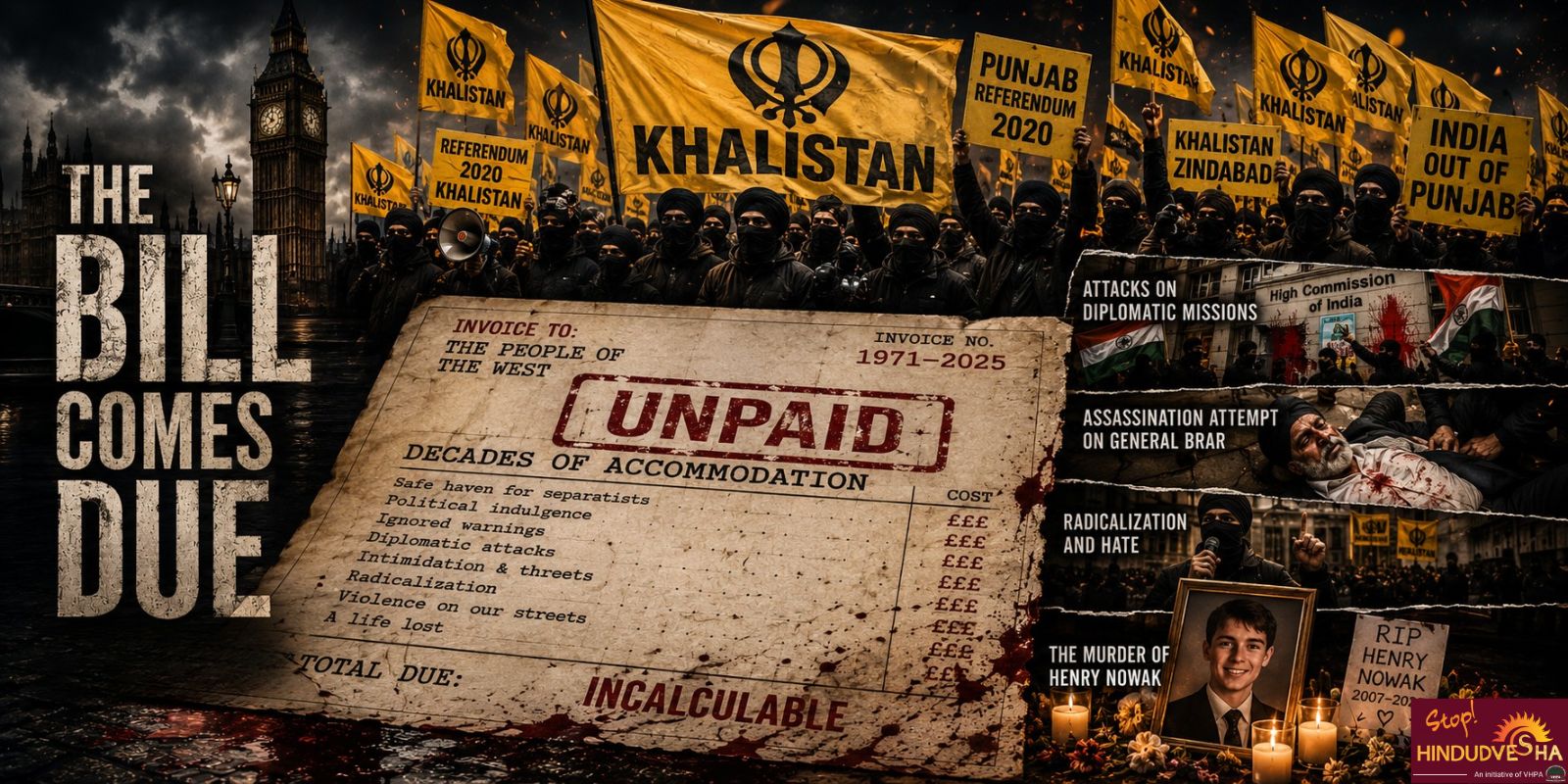
Summary
For decades, Britain and its Western allies tolerated the Khalistan movement as a distant separatist cause, granting space to organizations, activists, and networks that India repeatedly identified as extremist threats. Beginning with Jagjit Singh Chauhan’s London-based “government-in-exile,” Khalistani activism benefited from Cold War calculations, diaspora politics, and a reluctance to confront radicalization framed as political expression. Over time, this permissiveness enabled intimidation, attacks on Indian diplomatic missions, and even assassination attempts such as the 2012 stabbing of General K.S. Brar in London. The 2025 murder of British student Henry Nowak by a Sikh man carrying a large religious dagger exposed the domestic consequences of decades of accommodation. The case raises broader questions about extremism, legal exemptions, and the costs of institutional complacency.
In 1971, an oddball character named Jagjit Singh Chauhan — dentist, former communist student leader, part-time politician, and full-time separatist — moved to Britain and began campaigning for the unlikeliest of outcomes: the creation of the independent country of Khalistan. The territorial ambitions of this pipedream centered around Punjab and included much of northern India and parts of western India. [1]
In May 1980, he proclaimed the establishment of the “Republic of Khalistan” in London and subsequently declared himself its president. He issued symbolic state instruments such as passports, stamps, and currency. He gave press conferences. He issued, in essence, a standing invitation to Sikh militants worldwide to regard the United Kingdom as a safe harbor.
The British government of Margaret Thatcher, then in its first term and preoccupied with Argentina and inflation and the miners, did not shut him down. It barely looked up. When India revoked Chauhan’s passport in 1975, Thatcher provided him travel documents to enter the UK. [2]
How London Became Khalistan’s Safe Harbor
The accommodation of Chauhan and his Council of Khalistan [3] — headquartered, with a kind of theatrical audacity, at “Khalistan House” in London — must be understood in the context of Cold War geopolitics. India under Indira Gandhi had leaned towards Moscow. In the peculiar arithmetic of that era, the enemy of Delhi’s friend was, if not exactly a friend, then at least a tolerable nuisance. Khalistani separatists were anti-Indian, which made them, from certain Whitehall vantage points, strategically convenient, or at worst, benign.
Chauhan was initially sent by the Akali Dal [4] to generate support among British Sikhs and had rather exceeded his brief. He had become the movement’s most visible international impresario, and the UK base provided him with operational security [5] during periods of heightened tension in India, allowing him to formalize structures like the purported Khalistan government-in-exile. From London, he conducted propaganda, raised funds, and built networks among the Sikh diaspora. The British government just watched from the sidelines.
Then came 1984. Operation Blue Star, the Indian Army’s assault — commanded, notably, by a Sikh general [6]— to flush out hundreds of armed terrorists who had taken control of the Golden Temple at Amritsar became the movement’s recruitment windfall. The assassination of Prime Minister Indira Gandhi by her Sikh bodyguards and the anti-Sikh pogroms that followed in Delhi and elsewhere supercharged Khalistani networks across the diaspora. Funds poured in. Anger hardened into ideology. And in the United Kingdom, the machinery of separatism got British state support.
What is remarkable, in retrospect, is how explicit the incitement was allowed to become. In a 1984 BBC interview conducted shortly before Gandhi’s assassination, when asked “Do you actually want to see the downfall of Mrs. Gandhi’s government?,” Chauhan predicted, with a chilling specificity: “Within a few days, you will have the news that Mrs. Gandhi and her family have been beheaded. That is what Sikhs will do.” [7] It was, by any reasonable standard, incitement. Gandhi was murdered weeks later by two of her own bodyguards, who cited Blue Star as their motivation.
When Terror Became Someone Else’s Problem
The story of Khalistani extremism in Britain is about the particular freedoms that come with operating in a jurisdiction whose laws apply imperfectly to activities directed against a foreign country. Groups like Babbar Khalsa International [8]— designated a terrorist organization by both India and the European Union, and eventually listed as a proscribed organization in the UK — nonetheless had functioning networks on British soil for years. The machinery of propaganda, fundraising, and logistics operated in a legal twilight, exploiting the gap between what Britain recognized as terrorism and what India knew it to be.
India repeatedly sought extraditions. The British government repeatedly declined, citing human rights concerns or insufficient evidence — even when New Delhi’s dossiers detailed involvement in terrorism, hijackings, and killings. This pattern was not unique to Britain; it was replicated across the Western world wherever significant Sikh diaspora communities existed. But in Britain, with its large and politically organized British Sikh population, the dynamics were particularly acute. British MPs competed for Sikh votes. Police forces were cautious about appearing to target a minority community. And the violence, when it came, was largely directed at Indians — Hindus and Sikhs who opposed Khalistan alike — which made it, in the tacit hierarchy of concerns that governs Western law enforcement, someone else’s problem.
The Indian High Commission in London became a recurring target. On March 19, 2023, around two thousand protesters waving Khalistan flags descended on India House in Aldwych. [9] Windows were smashed. Two security guards were injured. The Indian flag was torn from its first-floor balcony. A British MP noted in Parliament that this was the sixth such attack in as many years. [10]
Indian investigations later revealed the attacks in March 2023 were part of a larger conspiracy — retaliatory action triggered by Punjab Police’s crackdown on the Khalistani preacher Amritpal Singh. [11] The fact that a crackdown on a radical preacher in Punjab could, within days, result in coordinated violence against Indian diplomatic missions in London, Sydney, and San Francisco suggests the level of organizational sophistication — and the degree to which Western soil has become logistical infrastructure for the movement.
The Night Khalistani Violence Came to London
If there was a single incident that ought to have forced a reckoning with Britain’s tolerance of Khalistani extremism, it was what happened to Lieutenant General Kuldeep Singh Brar on the evening of September 30, 2012.
Brar was seventy-eight years old, a decorated veteran, and — this is not incidental to what happened next — a Sikh who had commanded Operation Blue Star in 1984. He was in London on a private holiday with his wife when a gang of four Khalistani operatives, including a woman, ambushed them on Old Quebec Street, near Marble Arch. His wife was pinned against a wall while the attackers slashed at the general’s throat with a knife. He sustained a thirty-centimeter cut across his jaw and neck and a separate eight-centimeter cut to his jaw. [12] He fought them off — the general was, evidently, still a soldier — and survived.
The court proceedings that followed were, in their way, instructive. The prosecution told Southwark Crown Court that the attack was premeditated. [13] The motive was revenge for Blue Star — an event that had occurred twenty-eight years earlier. All four attackers were convicted and sentenced to terms of between ten and fourteen years. [14]
The question that received less attention than it deserved was: how had an ideology capable of motivating a premeditated assassination attempt against a retired general — on a holiday, unarmed, in the middle of a major European capital — been allowed to incubate, recruit, and organize on British soil for three decades without more decisive intervention?
The Limits of Religious Accommodation
There is a provision of British law that, to many observers, crystallizes the problem of minority accommodation at the expense of universal legal standards. Under Section 139 of the Criminal Justice Act 1988 [15], it is illegal in England and Wales to carry a knife with a bladed edge exceeding three inches in public. There are exemptions, however, for “good reason” and religion is one of them. Baptized Sikhs are legally permitted to carry a kirpan, the ceremonial dagger, in public. When the Offensive Weapons Act 2019 tightened knife legislation in response to rising blade crime, Parliament specifically amended the bill to protect the right of British Sikhs to possess and carry large kirpans. [16] Lobby groups celebrated. The Shiromani Gurdwara Parbandhak Committee, the apex governing body responsible for managing historical Sikh shrines, cravenly expressed its gratitude to the British government.
The kirpan, as a religious symbol, is not inherently problematic. The National Secular Society has pointed out [17] that numerous Sikhs “choose to carry a kirpan which has been made unusable as a weapon, by being blunted or welded into a sheath,” demonstrating that “it is entirely possible for religious practice to adapt in order to be consistent with legal standards intended to protect the public.” The problem, as is so often the case with broad exemptions, is what happens when the exemption meets bad faith.
The question became horribly concrete on the night of December 3, 2025, in Southampton.
Henry Nowak Slaying: The Murder That Forced a Reckoning
Henry Nowak was an 18-year-old first-year accountancy student at the University of Southampton. [18] A footballer who had grown up in Essex to Polish-British parents, he was, by every account, an unremarkable and thoroughly likable young man — out on a December evening with football teammates.
Vickrum Digwa was twenty-three, a baptized Sikh. Shortly before eleven-thirty that night, on Belmont Road in Southampton, Digwa and Nowak became embroiled in a verbal altercation. Digwa maintained at his trial that Nowak had made racist remarks and that he had acted in self-defense. The jury rejected this account comprehensively. What is not contested is what Digwa did: he stabbed Henry Nowak five times with a knife described in court as “a large Sikh dagger” measuring twenty-one centimeters. When police arrived, Digwa pointed to Nowak as his assailant. Officers handcuffed the dying teenager. Nowak died shortly after receiving first aid.
Digwa was convicted of murder on May 28, 2026, and sentenced to life imprisonment with a minimum of twenty-one years. His mother, Kiran Kaur, was found guilty of assisting an offender.
The prosecution told the jury that while Digwa was entitled to wear a small kirpan under his clothing around his neck, he also chose to carry the much larger knife that killed Nowak. It was this second, larger blade — carried for religious reasons as per Digwa — that ended an eighteen-year-old’s life.
One need not be hostile to Sikhism, or to the genuine religious significance of the kirpan, to observe that an exemption designed to accommodate a symbolic article of faith had, in this instance, provided legal cover for carrying a weapon that killed a teenager. The question of whether a twenty-one-centimeter blade serves a religious purpose meaningfully distinct from a much smaller, blunted version is one that the British Parliament has conspicuously declined to address. The National Secular Society argued precisely this point: “accommodating religious practices need not require exemptions from safety laws which should apply equally to all.” [19]
The Henry Nowak case is ultimately a story about institutional failure.
The Five Eyes Blind Spot
Britain’s permissiveness toward the Khalistan movement isn’t uniquely British. Across the Anglosphere — in Canada, the United States, Australia, and New Zealand — Western governments have, at varying speeds and with varying degrees of discomfort, extended to Khalistani organizations the protections and freedoms of liberal democracy while declining to apply to those organizations the scrutiny that genuine security threats ordinarily attract.
The Canadian chapter of this story is the most dramatic. Canada hosts the world’s largest Sikh diaspora outside Punjab, heavily concentrated in the Toronto and Vancouver suburbs. Khalistani politics have long influenced Canadian electoral politics, especially within the Liberal Party. The assassination of Hardeep Singh Nijjar — an individual designated a terrorist by India’s National Investigation Agency [20] and wanted in multiple criminal cases — outside a Surrey, British Columbia, gurdwara in June 2023 triggered a major diplomatic crisis. Then-Prime Minister of Canada Justin Trudeau publicly accused the Indian government of involvement, triggering a sharp diplomatic standoff marked by India’s strong denial and the mutual expulsion of diplomats. [21] The Canadian government’s willingness to allow a man India regarded as a terrorist operative to operate freely on its territory — and then to shield his network with the language of Canadian sovereignty after his death — illustrated the depth of the problem.
The United States has its own ecosystem of Khalistan support. In 1984, at the height of the troubles, one of the accused at the Air India bombing trial put it in his speech at the founding convention of the World Sikh Organization, New York: “Until we kill 50,000 Hindus we will not rest.” [22]
In recent years, the extremist group Sikhs for Justice, which has organized so-called “referendums” on Khalistan in major Western cities, is based in Washington, D.C. [23] Its founder, the comical yet devious Gurpatwant Singh Pannun, has repeatedly issued threats against India, its institutions, and public events in support of the Khalistan movement. These threats have included calls to disrupt national celebrations, warnings directed at Indian aviation, and appeals for separatist activities aimed at establishing an independent Khalistan state. [24]
Australia has seen its own chapter: Khalistani protesters and activists have vandalized Indian diplomatic missions in Sydney and Melbourne, often in coordinated actions timed with attacks in London and North America. [25]
Australia, too, had its Nowak moment. In May 2021, during a fight at a northwest Sydney school, a 16-year-old Australian boy’s back and stomach were ripped open after he was stabbed by a 14-year-old Sikh student. The victim nearly died from injuries to his internal organs. The Australian government immediately imposed a ban on kirpans in schools. It was reversed three months later following aggressive lobbying by the Sikh community. [26]
New Zealand’s experience, while smaller in scale, is particularly illuminating for what it reveals about how Western governments rationalize inaction. In a 2025 interview, Prime Minister Christopher Luxon cited the “free speech” excuse to defend inaction against Khalistanis. [27] The stance highlighted a fundamental gap: activities that Indian security services view as serious threats are treated as legally protected expressions in New Zealand, allowing the Khalistan movement to find safe haven across much of the Western world.
When the Serpents Turned Inward
In October 2011, Secretary of State Hillary Clinton visited Islamabad and, at a joint press conference, delivered one of the more blunt assessments in the history of American diplomacy. “You can’t keep snakes in your backyard and expect them only to bite your neighbors,” she told her hosts. “Eventually, those snakes are going to turn on whoever has them in the backyard.” [28] She was speaking about Pakistan’s support for the Haqqani network.
It is an analogy that travels with uncomfortable ease from Pakistan to the United Kingdom. Britain and its Five Eyes partners have, for decades, kept a version of their own serpents — not with the active intent of weaponizing them against India, necessarily, but through a combination of Cold War calculation, electoral politics, multicultural squeamishness, and plain institutional inertia. The snakes were allowed to grow. The networks were allowed to deepen. The ideology was allowed to radicalize. And the implicit bargain — that the violence would be directed elsewhere, at Indian diplomats and Indian army generals and Indian citizens, and therefore was not quite Britain’s problem — held, more or less, until it didn’t.
General Brar’s slashed throat on Old Quebec Street was a warning. The vandalism at Aldwych was a warning. The coordinated assaults on Indian missions across the Anglosphere in March 2023 were a warning. And Henry Nowak — just eighteen years old — received the bill that had been accumulating across five decades of accommodation.
Free Speech and Selective Blindness
Western governments, when pressed about their tolerance of Khalistani activities, reach instinctively for the language of democratic rights. Free assembly. Free speech. Due process. The rule of law. These are not trivial values; they are what distinguish liberal democracies from the alternatives. But they have also become, in this context, a sophisticated alibi for inaction that serves domestic electoral interests while externalizing the costs of that inaction onto India and, increasingly, onto the citizens of Western countries.
The alibi works, in part, because the Khalistan movement has always been adept at wearing the costume of civil society. Referendums sound democratic. Community organizations sound benign. Religious exemptions sound like tolerance. The language of self-determination sounds — if one does not look too closely at the methods employed to advance it — like the language of freedom movements everywhere.
But the pattern of activity across British soil over the past fifty years — from Chauhan’s government-in-exile to the Brar assassination attempt to the recurring violence at India House to the Southampton killing — does not describe a civil society movement. It describes a transnational infrastructure of radicalization that has operated, with considerable effectiveness, in the gaps that Western democracies have left open for it.
The Ongoing Failure to Name the Problem
In the weeks after Henry Nowak’s murder, what has not yet happened — and what the case makes urgently necessary — is a genuine audit of the accumulated decisions, exemptions, accommodations, and indulgences that created the conditions for this outcome.
At the center of the issue is a broader failure of judgment. Britain and its allies made a series of choices, over many decades, to treat the Khalistan movement as a tolerable presence on their soil — a loud but essentially harmless community of agitators whose grievances were Indian problems to manage. They were wrong. The movement has shown itself willing and able to pursue assassination attempts against individuals on British streets, to organize coordinated attacks on diplomatic premises, to radicalize young men in British cities, and to create legal and social environments in which the carrying of weapons becomes, by an incremental drift of accommodation, normalized.
The bill for those choices is now arriving. Henry Nowak is the most recent entry on it. He will not be the last, unless something changes.
Citations
Secretary Clinton’s snakes, one should note, had a particular quality. They did not simply wait in the backyard. They moved, over time, into the house.
[1] “Explainer: Khalistan Returns to Spook Punjab Again.” India Tribune. https://indiatribune.com/public/explainer-khalistan-returns-to-spook-punjab-again
[2] “How I Was Pushed to Khalistan Movement.” Punjab Monitor, April 2013. https://www.punjabmonitor.com/2013/04/how-i-was-pushed-to-khalistan-movement.html
[3] “Draft of the Constitution of Khalistan.” 1984 Tribute. https://1984tribute.com/draft-of-the-constitution-of-khalistan/
[4] “How I Was Pushed to Khalistan Movement.” Punjab Monitor, April 2013. https://www.punjabmonitor.com/2013/04/how-i-was-pushed-to-khalistan-movement.html
[5] “Jagjit Singh Chohan.” Grokipedia. https://grokipedia.com/page/Jagjit_Singh_Chohan
[6] “Khalistan Documentary/Video.” YouTube. https://www.youtube.com/watch?v=9CLR5-YIxN8
[7] “Explainer: Khalistan Returns to Spook Punjab Again.” India Tribune. https://indiatribune.com/public/explainer-khalistan-returns-to-spook-punjab-again
[8] “Babbar Khalsa International (BKI).” South Asia Terrorism Portal (SATP). https://www.satp.org/satporgtp/countries/india/states/punjab/terrorist_outfits/bki.htm
[9] “UK Officials Vow to Take Security of Indian Mission Seriously After Vandalism by Pro-Khalistani Protesters.” Deccan Herald. https://www.deccanherald.com/world/uk-officials-vow-to-take-security-of-indian-mission-seriously-after-vandalism-by-pro-khalistani-protesters-1201834.html
[10] “Vandalism at Indian High Commission in London Raised in UK Parliament.” NDTV. https://www.ndtv.com/india-news/vandalism-at-indian-high-commission-in-london-raised-in-uk-parliament-3887878
[11] “NIA Arrests Key Accused in 2023 Attack on Indian High Commission in London.” Deccan Herald. https://www.deccanherald.com/amp/story/india/nia-arrests-key-accused-in-2023-attack-on-indian-high-commission-in-london-2995033
[12] “Sikh Gang Guilty of UK Attack on India Temple, Assault on General.” Fox News. https://www.foxnews.com/world/sikh-gang-guilty-of-uk-attack-on-india-temple-assault-general
[13] “Sikhs Convicted in Indian General Stabbing.” Al Jazeera, July 31, 2013. https://www.aljazeera.com/news/2013/7/31/sikhs-convicted-in-indian-general-stabbing
[14] “4 Jailed in Britain Over Slashing Retired Indian General in Revenge Attack.” Fox News. https://www.foxnews.com/world/4-jailed-in-britain-over-slashing-retired-indian-general-in-revenge-attack
[15] “Henry Nowak, Sikh Exemptions and Knife Laws.” The Week. https://theweek.com/law/henry-nowak-sikh-exemptions-knife-laws
[16] “Article.” Hindustan Times (Patiala Edition), December 1, 2018. https://www.pressreader.com/india/hindustan-times-patiala/20181201/281590946630796
[17] “NSS Urges Government to Review Religious Exemptions to Knife Laws.” National Secular Society, June 2026. https://www.secularism.org.uk/news/2026/06/nss-urges-government-to-review-religious-exemptions-to-knife-laws
[18] “Live Coverage.” BBC News. https://bbc.co.uk/news/live/c794g7y3338t
[19] “NSS Urges Government to Review Religious Exemptions to Knife Laws.” National Secular Society, June 2026. https://www.secularism.org.uk/news/2026/06/nss-urges-government-to-review-religious-exemptions-to-knife-laws
[20] “From Nijjar’s Assassination to Diplomatic Strains Between Canada and India: A Timeline.” Outlook India. https://www.outlookindia.com/national/from-nijjars-assassination-to-diplomatic-strains-between-canada-and-india-a-timeline
[21] “How a Killing at a Sikh Temple Led to Canada and India Expelling Each Other’s Diplomats.” PBS NewsHour. https://www.pbs.org/newshour/world/how-a-killing-at-a-sikh-temple-led-to-canada-and-india-expelling-each-others-diplomats
[22] “Pakistan Has Been the Lifeline for the Khalistani Movement.” America Times. https://www.america-times.com/pakistan-has-been-the-lifeline-for-the-khalistani-movement/
[23] “Khalistan Video/Interview.” YouTube. https://www.youtube.com/watch?v=Pnkw5QPpBZ4
[24] “Designated Terrorist Pannun Issues Fresh Threats Ahead of Republic Day.” Business Standard. https://www.business-standard.com/india-news/designated-terrorist-pannun-issues-fresh-threats-ahead-of-republic-day-124011600291_1.html
[25] “Australia and India Should Collaborate to Counter Terrorism.” The Strategist (ASPI). https://www.aspistrategist.org.au/australia-and-india-should-collaborate-to-counter-terrorism/
[26] “18-Year-Old Stabbed by Sikh Man Wielding Ceremonial Blade, Handcuffed by Cops as He Bled to Death.” News.com.au. https://www.news.com.au/lifestyle/real-life/news-life/18yearold-stabbed-by-sikh-man-wielding-ceremonial-blade-handcuffed-by-cops-as-he-bled-to-death/news-story/aec4a2f34dcc850752c7c9a9640f68f7
[27] Instagram post. Instagram. https://www.instagram.com/p/DHWWoBPz2Y5/?img_index=3
[28] “Wisconsin Sikh Temple Shooting.” NBC News. https://www.nbcnews.com/id/wbna44988355

Donate to HINDUDVESHA
Our Mission is to explore and expose Hindudvesha through research analysis, education and response.
SUPPORT US