

Banned at the Gate: Janeu, Institutional Bias, and Hindu Students in Bharat
 K. Sindhu · 06/28/2026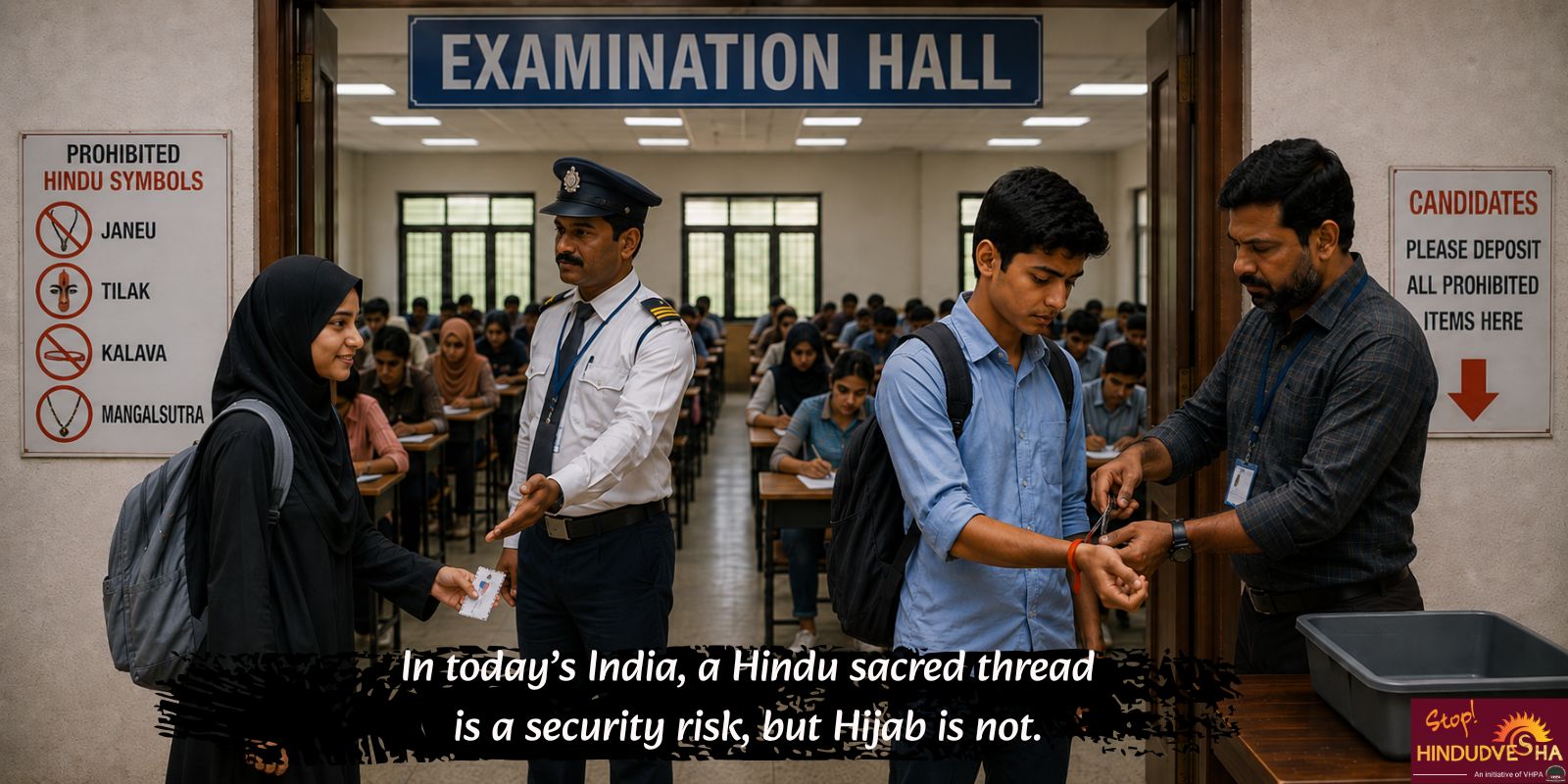
Summary
The Karnataka CET controversy — in which Hindu students were forced to remove their sacred Janeu (Yajnopaveetha) before entering examination halls — has reignited nationwide outrage over the targeting of Hindu religious symbols in public institutions. What was claimed as routine exam protocol quickly exposed a deeper pattern of institutional insensitivity and selective secularism. Sacred threads like the Janeu and Kalava are repeatedly treated as security threats rather than constitutionally protected expressions of faith. Far from a procedural matter, the issue raises serious questions about equality before the law, religious freedom, and personal dignity. This article examines the KCET incident, the civilizational importance of the Janeu, and the growing institutional discomfort with Sanatan practices in Bharat.
Hindu students appearing for the Karnataka Common Entrance Test (KCET) reportedly found themselves forced to choose between educational opportunity and civilizational identity. Several students wearing the Janeu/Yajnopaveetha — the sacred thread central to Hindu samskara and spiritual discipline — were denied entry unless they removed it, despite the absence of any official examination rule prohibiting it. What should have been a routine examination procedure quickly escalated into a national debate, reigniting concerns about the treatment of Hindu religious symbols within public institutions.
Competitive examinations undoubtedly require reasonable security measures to prevent malpractice and preserve fairness. Yet the Karnataka CET controversy exposed a disturbing institutional pattern in which Hindu students are repeatedly subjected to restrictions for adhering to their dharmic traditions. Across multiple states, sacred Hindu symbols such as the Janeu, Mangalsutra, Kalava, toe rings, and tilaks have increasingly been treated as objects of suspicion or administrative inconvenience, while institutions often display far greater caution and accommodation toward the religious practices of other communities.
The issue, therefore, extends far beyond examination protocol. It raises serious constitutional, cultural, and civilizational questions concerning religious freedom, equality before the law, selective secularism, and the place of Hindu identity within contemporary institutional spaces.
Karnataka’s Shame: Sacred Thread Banned
The incident took place at an examination center in Bengaluru during the Karnataka Common Entrance Test, conducted for admission into professional courses. Several Hindu students appearing for the CET were asked to remove their Janivara/Janeu before entering the examination hall.[1] Some students further alleged that the invigilators also removed the red-and-yellow sacred wrist thread commonly known as Kalava, Mauli, or Raksha Sutra.[2]
For practicing Hindus, particularly within the Brahmin community, the Janeu is not an optional ornament or decorative accessory. It is a sacred symbol deeply connected to the Upanayana samskara and lifelong spiritual discipline. Yet students standing at the gates of a career-defining examination found themselves forced to choose between faith and future.
The incident triggered immediate outrage among students, parents, community members, and Hindu organizations.[3] Complaints were filed, protests emerged, and widespread criticism followed across Karnataka and beyond. Concerned state authorities subsequently clarified that no such directive existed in the official examination guidelines, raising serious concerns about arbitrary procedural overreach at the ground level.[4]
The college administration suspended certain staff members, police complaints were registered, and the Karnataka government ordered an inquiry into the incident. The Karnataka government reportedly described the incident as a violation of human rights and privacy.[5]
The controversy eventually reached the Karnataka High Court through a Public Interest Litigation (PIL), highlighting the growing constitutional dimensions of the issue.[6]
More Than Just a Thread
The Janeu, also known as Yajnopaveetha, is not merely a cotton thread casually worn around the body. It is one of the oldest surviving symbols of Sanatan Dharma and holds deep spiritual, philosophical, and cultural significance within Hindu tradition. The wearing of the Janeu is an intrinsic part of the Upanayana samskara — one of the sixteen fundamental samskaras in Hindu tradition — marking the formal beginning of a child’s spiritual and educational journey. During the ceremony, the child receives the Gayatri Mantra from his father or guru and symbolically commits to a life guided by discipline, learning, self-restraint, ethical conduct, and dharma. [7]
In the Sanatan tradition, the Upanayana ceremony represented initiation into formal, disciplined educational and social responsibility, making the Janeu inseparable from the Hindu conception of education itself. It serves as a lifelong reminder that the wearer remains dedicated to knowledge and disciplined learning, and that he will keep his mind free from distraction. [8] The sacredness of the Janeu is reflected even in the Hanuman Chalisa, where Bhagwan Hanuman is reverentially depicted as “kandhe munj janeu saje” [9] — ‘adorned with the sacred thread upon His shoulder’. The phrase reflects the deep reverence traditionally associated with the Janeu in Sanatan Dharma.
It is also believed in Hindu traditions that the Janeu should not be casually removed. [10] Forcing Hindu students to remove the Janeu moments before entering the examination center, therefore, carries consequences far beyond procedural inconvenience. It becomes an experience of emotional injury, religious humiliation, and symbolic erasure of identity. Treating such a sacred symbol as a prohibited object at examination centers reflects not merely administrative insensitivity but a profound ignorance of Hindu civilizational practices and dharmic consciousness.
The same restrictions apply to other Hindu symbols such as the Mangalsutra, Kalava, and toe rings. These are not merely ornaments or aesthetic choices. They are sacred markers of marriage, spirituality, protection, continuity, and identity deeply embedded within Hindu cultural and spiritual consciousness. Reducing such sacred symbols to “security concerns” reflects not merely ignorance of Hindu traditions, but a deeper institutional insensitivity toward Sanatan practices themselves.
Institutional Bias Against Sanatan Dharma
The Karnataka CET controversy is not an isolated incident. Over the past few years, similar controversies have repeatedly surfaced across multiple states, revealing a disturbing pattern in which Hindu students are subjected to restrictions for adhering to their religious traditions.
In Rajasthan in March 2025, a candidate appearing for a recruitment examination was compelled to remove his Janeu. Community voices argued that the sacred thread, being non-metallic, posed no security risk and questioned the rationale behind such directives.[11] Similarly, in May 2024 in Assam’s Barpeta district, Hindu students were reportedly forced to remove their sacred threads and kalava before an entrance examination, triggering outrage from Hindu organizations.[12] Comparable incidents emerged during NEET and KCET examinations in Karnataka last year, where Hindu students faced restrictions for wearing the Janeu.[13] Hindu candidates have also been asked to remove Mangalsutras, toe rings, and other traditional Hindu markers before entering examination halls in Karnataka and Telangana.[14]
What intensified public anger during many of these controversies was the unequal institutional treatment. While Hindu candidates were compelled to remove sacred symbols integral to their religious and cultural identity, institutions often displayed greater accommodation toward the religious practices of other communities. [15] This asymmetry transformed isolated incidents into a broader debate over unequal institutional standards for Hindu traditions.
As similar incidents continued to emerge across different states and examinations, a recurring pattern became increasingly difficult to ignore. Public outrage would erupt, inquiries would be ordered, officials would be temporarily suspended, and remedial assurances would be issued — yet such incidents continued to recur elsewhere. The pattern itself has now become the central concern. It increasingly suggests that these incidents are not merely accidental acts of administrative excess, but symptoms of a deeper institutional mindset in which Sanatan symbols and practices are subjected to exceptional suspicion, inconvenience, or scrutiny within spaces constitutionally expected to remain neutral.
Hijab Allowed, Janeu Banned
The repeated targeting of Hindu symbols at examination centers raises serious constitutional concerns under Articles 14, 21, and 25 of the Constitution of India. Article 25 explicitly guarantees all people the freedom of conscience and the right freely to profess, practice, and propagate religion. Explanation I to Article 25 specifically protects the wearing and carrying of the Kirpan as part of Sikh religious identity. [16] The same constitutional logic necessarily extends to the Hindu practice of wearing the Janeu. Forcing students to remove it raises grave concerns regarding freedom of religion.
Article 14 guarantees equality before the law and equal protection of the laws. Yet repeated incidents across multiple states increasingly demonstrate that institutional authorities often apply constitutional principles selectively. Public concern has intensified because similar security protocols are not uniformly enforced across communities. Institutions frequently conduct reasonable checking procedures while accommodating the religious or cultural practices of one community, but Hindu students are often compelled to remove their sacred symbols altogether before being permitted entry. If hijab-wearing candidates can be accommodated through appropriate security checks, then why not Janeu-wearing students? [17] Equality before the law cannot operate selectively. A secular constitutional framework cannot extend accommodation to one faith while treating Hindu practices and traditions as disposable inconveniences.
Article 21 further protects dignity, privacy, and personal liberty. Forcing anxious students appearing for high-stakes examinations to remove their dharmic identity moments before entry causes not only emotional distress but also spiritual humiliation.
Bharat has historically been a civilization where spirituality and public life coexisted harmoniously. Indic civilization evolved through a cultural framework in which dharma permeated education, ethics, law, social conduct, and collective identity. Hindu markers were never viewed as threats to public order; they were extensions of personal discipline, moral duty, and civilizational continuity. No constitutionally valid framework can selectively restrict traditional Hindu practices while extending accommodation to others, as such unequal treatment would directly violate the above-mentioned fundamental rights.
Institutional Bias Against Sanatan Dharma
The persistent recurrence of such incidents reveals a deeper problem of selective secularism and institutional bias. In practice, secularism increasingly operates asymmetrically. Institutions often display extreme caution in dealing with faith-based practices and religious markers of non-Hindu communities, while Hindu symbols are repeatedly treated as negotiable, inconvenient, or disposable.
This contradiction became particularly evident in Karnataka itself. During controversies surrounding the Hijab in 2022, significant political and institutional energy was mobilized around accommodation, sensitivity, and minority rights. Yet Hindu students wearing non-metallic sacred threads or Kalavas are denied entry unless they remove them entirely. The issue, therefore, is not examination integrity alone. It is the unequal application of institutional sensitivity.
The larger concern becomes even more troubling when one considers that many of these incidents occurred despite the complete absence of any official rule prohibiting the Janeu or other dharmic identifiers. This means the discriminatory conduct frequently arises not from written law — which, in any event, would struggle to withstand constitutional scrutiny, particularly under Article 13 — but from an administrative mindset itself. An institutional culture appears to be developing where Sanatan symbols and practices are increasingly perceived as administratively inconvenient. They are reduced to objects of suspicion, while practices of other communities are handled with greater caution and accommodation. Such differential treatment ceases to be neutral.
Vote Bank Politics Fuels Anti-Hindu Bias
The controversy also exposes the contradictions embedded within contemporary vote-bank politics and the growing institutional hostility toward Hindu identity. Political parties frequently engage in symbolic outreach toward Hindu communities during elections, yet often remain conspicuously silent when their dharmic traditions encounter discrimination in public spaces.
The silence of the Congress leadership during the Karnataka CET controversy was particularly striking in this regard. Critics point out that symbolic displays of Hindu identity and the Janeu frequently become prominent during election campaigns and public outreach efforts aimed at Hindu voters. Yet when Hindu students in Congress-ruled Karnataka were forced to remove the very same sacred thread before entering examination centers, no significant condemnation emerged from the party’s central leadership or its prominent national figures. [18]
Had strong public condemnation emerged from the party’s central leadership, it would likely have exerted immediate pressure on the Karnataka administration to ensure exemplary accountability and prevent recurrence of similar incidents. [19] Instead, the response largely remained confined to temporary suspensions, inquiries, and assurances after public outrage had already escalated. These measures may calm immediate public anger, but the recurring nature of such incidents suggests that administrative correction alone is insufficient without a clear political willingness to address the issue decisively. When symbolic Hindu outreach during elections is not matched by an equal willingness to defend Hindu traditions within public institutions, accusations of political appeasement inevitably gain greater force.
Psychological Warfare on Hindu Youth
The consequences of these incidents extend far beyond examination centers. When Hindu students repeatedly encounter hostility toward their sacred dharmic traditions during formative educational experiences, the psychological and cultural consequences become increasingly severe. A generation of Hindu students is gradually internalizing the message that dharmic symbols invite stigma, outward expressions of dharma are institutional inconveniences, and professional advancement demands symbolic surrender.
This is how civilizational weakening gradually begins — not through overt destruction alone, but through the normalization of humiliation, concealment, and cultural surrender.
A Hindu student forced to remove the Janeu learns an unspoken lesson: your dharma has no legitimate place within public institutions. A Hindu woman compelled to remove her Mangalsutra receives another message: your sacred traditions are secondary to bureaucratic comfort. Over time, such repeated humiliations create cultural alienation and historical disconnect. Students begin to perceive their religious practices not as sources of pride, continuity, and civilizational identity, but as obstacles requiring concealment or abandonment within institutional life.
The damage becomes especially severe when educational spaces — institutions supposedly devoted to knowledge, dignity, and constitutional equality — themselves become sites where Hindu students feel pressured to suppress their faith.
A civilization does not collapse only when its temples are destroyed. It also weakens when its children are conditioned to view the sacred traditions preserved by their ancestors for thousands of years as obstacles to be concealed rather than upheld with pride. These incidents are therefore not minor administrative errors. They shape civilizational confidence itself.
Time for Strong Action and Vigilance
Addressing this growing problem requires far more than temporary outrage and symbolic corrective action. Clear nationwide examination guidelines must explicitly protect legitimate religious symbols across all communities. Administrative discretion at the ground level cannot be allowed to override legally protected religious freedoms.
Equally important, institutions must apply uniform standards to all communities. Secularism cannot mean the selective suppression of Hindu identity alone. Constitutional neutrality demands equal treatment, equal scrutiny, and equal accommodation.
Strict accountability mechanisms are also necessary. Mere suspensions, transfers, or temporary inquiries are insufficient if repeated anti-Hindu discrimination and administrative bias continue unchecked. Officials who arbitrarily interfere with these religious practices must face strong legal and administrative consequences.
Educational institutions, examination authorities, and invigilators must be provided with greater constitutional awareness and cultural sensitization regarding Hindu traditions and sacred symbols. Much of the recurring controversy stems not from written rules or official orders, but from institutional discomfort and procedural overreach.
Ultimately, Hindu society itself must remain vigilant. Rights do not survive through legal text alone; they endure through cultural confidence, civilizational continuity, social awareness, and the collective action to lawfully defend and preserve them. Silence and passive acceptance only encourage further encroachment upon religious freedoms and civilizational identity.
At the same time, these concerns do not negate the legitimacy and importance of reasonable security measures designed to prevent malpractice, such as concealing unauthorized devices during examinations. Examination integrity remains a legitimate institutional objective. However, such procedures must operate uniformly, proportionately, and constitutionally across all communities rather than selectively imposing restrictions upon Hindu religious practices alone.
Conclusion: Reclaiming Hindu Identity in Public Spaces
The repeated targeting of the Janeu, Kalava, and other dharmic markers is not merely a controversy about examination protocols. It reflects a deeper crisis concerning the place of visible Hindu identity within contemporary educational institutions and administrative culture.
These incidents reveal how pseudo-secular administrative culture increasingly treats Hindu civilizational markers as negotiable, inconvenient, and institutionally problematic. Under the guise of examination protocol and security, Hindu students are repeatedly subjected to humiliation that no constitutional democracy committed to genuine equality should tolerate.
The Janeu is not merely a thread, nor is the Kalava merely a colored band. They are living embodiments of Sanatan dharma, sacred continuity, and historical memory. These Hindu traditions survived invasions, colonization, forced conversions, and centuries of cultural assault. It would be a tragic irony if, in independent Bharat itself, Hindu students are increasingly conditioned to believe that these symbols must be hidden, removed, or abandoned in order to access education and opportunity.
A nation that compels its children to leave their dharma outside institutional gates risks severing itself from the very civilizational foundations that gave the nation its soul.
Citations
[1] “Sacred Thread Removed During CET Exam in Bengaluru Sparks Massive Outrage.” Mathrubhumi English, April 2026. https://english.mathrubhumi.com/news/india/row-sacred-thread-removal-cet-bengaluru-bjp-congress-controversy-pajqjs63
[2] “Row after Brahmin Students Asked to Remove Sacred Thread at CET Center in Bengaluru.” India Today, April 24, 2026. https://www.indiatoday.in/india/karnataka/story/bengaluru-cet-sacred-thread-row-brahmin-students-asked-to-remove-fir-teachers-suspended-controversy-bjp-congress-2901190-2026-04-24
[3] “Bengaluru Police Book 3 Staff Members of Private College for Forcing Students to Remove ‘Janivara’ before Entering CET Exam Hall.” The Hindu. https://www.thehindu.com/news/national/karnataka/bengaluru-police-detain-3-staff-members-of-private-college-for-forcing-students-to-remove-janivara-before-entering-cet-exam-hall/article70902354.ece
[4] “Attack on Hindu Identity: Exam Frisking or Cultural Friction?” The Narrative World, May 2, 2026. https://www.thenarrativeworld.in/Encyc/2026/5/2/attack-on-hindu-identity-exam-frisking-or-cultural-friction.html
[5] “CET Student Alleges He Was Asked to Remove ‘Janeu’ at Bengaluru Exam Center: ‘I Could Not Write…’” Moneycontrol. https://www.moneycontrol.com/news/trends/cet-student-alleges-he-was-asked-to-remove-janeu-at-bengaluru-exam-center-i-could-not-write-13899265.html
[6] “Karnataka High Court Issues Notice on PIL Regarding Students Forced to Remove Sacred Thread During CET.” Times of India. https://timesofindia.indiatimes.com/city/bengaluru/karntaka-high-court-issues-notice-on-pil-regarding-students-forced-to-remove-sacred-thread-during-cet/articleshow/120651411.cms
[7] “Why Should Janeu Be Worn?” Sanatan. https://sanatan.in/blogs/dharma-prastuti/why-should-janeu-be-worn
[8] “Importance of Janeu in Hinduism.” ServDharm. https://servdharm.com/blogs/post/importance-of-janeu-in-hinduism
[9] “Chalisa Hanuman.” India Temple. https://www.indiatemple.org/chalisa-hanuman.php
[10] “Why Should Janeu Be Worn?” Sanatan. https://sanatan.in/blogs/dharma-prastuti/why-should-janeu-be-worn
[11] “Attack on Hindu Identity: Exam Frisking or Cultural Friction?” The Narrative World, May 2, 2026. https://www.thenarrativeworld.in/Encyc/2026/5/2/attack-on-hindu-identity-exam-frisking-or-cultural-friction.html
[12] Assam: The Teacher Removes ‘Janeu’ of a Hindu Student before Entering the Exam Hall.” HinduPost. https://hindupost.in/dharma-religion/assam-the-teacher-removes-janeu-of-a-hindu-student-before-entering-the-exam-hall/
[13] Attack on Hindu Identity: Exam Frisking or Cultural Friction?” The Narrative World, May 2, 2026. https://www.thenarrativeworld.in/Encyc/2026/5/2/attack-on-hindu-identity-exam-frisking-or-cultural-friction.html
[14] Peak Secularism in Karnataka – Students Permitted to Wear a Hijab but Mangalsutra Banned.” HinduPost. https://hindupost.in/news/peak-secularism-in-karnataka-mangalsutra-banned/
[15] Janeu Row: Hindu Religious Symbols Being Targeted in Karnataka; Three Arrested as Forced Removal of Janeu during KCET Examination Sparked Outrage.” HinduPost. https://hindupost.in/dharma-religion/janeu-row-hindu-religious-symbols-being-targeted-in-karnataka-three-arrested-as-forced-removal-of-janeu-during-kcet-examination-sparked-outrage/
[16] “Article 25 in Constitution of India.” Indian Kanoon. https://indiankanoon.org/doc/631708/
[17] “Janeu Row: Hindu Religious Symbols Being Targeted in Karnataka; Three Arrested as Forced Removal of Janeu during KCET Examination Sparked Outrage.” HinduPost. https://hindupost.in/dharma-religion/janeu-row-hindu-religious-symbols-being-targeted-in-karnataka-three-arrested-as-forced-removal-of-janeu-during-kcet-examination-sparked-outrage/
[18] Janeu Row Hits Bengaluru | Students Asked to Remove Sacred Thread, FIR Filed, Staff Suspended.” YouTube Video. https://www.youtube.com/watch?v=QlHMqFjOpiw
[19] ibid

Donate to HINDUDVESHA
Our Mission is to explore and expose Hindudvesha through research analysis, education and response.
SUPPORT US