

The Girmitiyas Survived Indenture — Can Hindu Americans Survive Prosperity?
 Aditi Joshi · 06/22/2026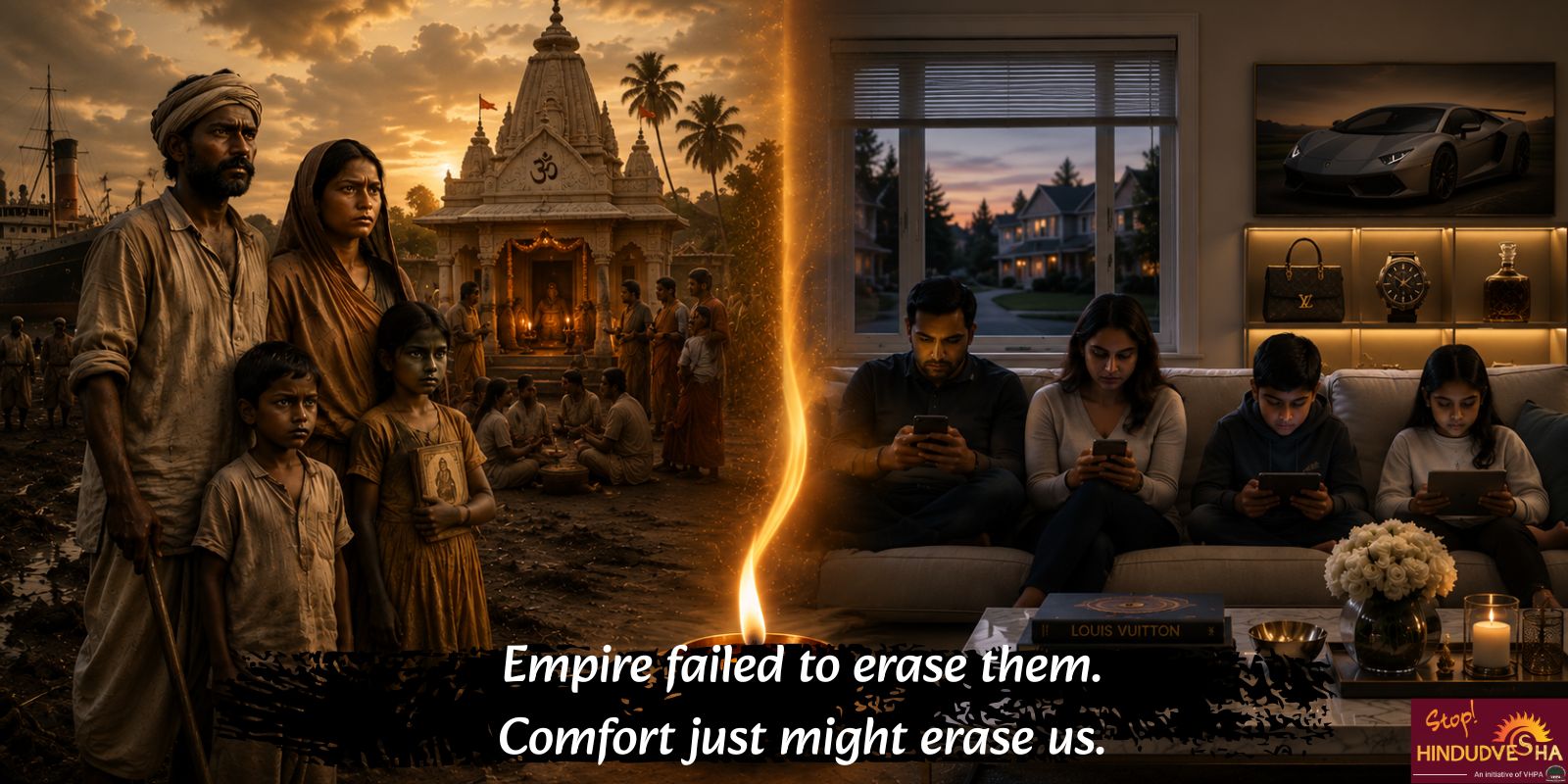
Summary
This article tells the largely forgotten story of Hindu communities in Fiji, Guyana, and Trinidad — descendants of indentured laborers who crossed the kala pani and preserved Sanatan Dharma through immense hardship, displacement, and colonial disruption. Despite rebuilding temples, festivals, and traditions against extraordinary odds, many of these communities now face gradual but serious erosion: weakening transmission, institutional decline, and cultural thinning. Their experience carries a sobering warning for the prosperous Hindu diaspora in the United States. The same subtle forces — intergenerational drift, assimilation, and institutional fragility — are now active in American suburbs, where material success and modernity threaten what poverty and empire could not destroy.
This is a clarion call: Prosperity must not become the new kala pani. The time for passive inheritance is over. Conscious civilizational renewal is now urgent.
Across the Pacific islands and Caribbean plantation societies lies a largely overlooked chapter of Hindu history. [1] In Fiji, Guyana, and Trinidad, indentured laborers arrived with little material wealth but carried something far more precious: their deities, festivals, sacred memory of Bharat, and a profound commitment to Sanatan Dharma. [2]
Their journey was one of rupture and resilience. Uprooted from ancestral lands, families, languages, and sacred rhythms, they crossed the kala pani into societies that valued their labor but offered almost no protection for their civilizational inheritance. Yet through prayer, memory, and collective determination, they rebuilt fragments of home in alien soil. Mandirs rose from modest beginnings. Festivals like Diwali and Ramleela regained communal power. Devotional traditions sustained continuity across generations—not because conditions favored survival, but because ordinary people refused to let their Dharma dissolve.
Today, however, many of these communities face a quieter but deeply alarming crisis: the gradual erosion of institutions, language, ritual participation, and intergenerational transmission. This weakening is too often dismissed as inevitable modernization. It is not. It results from colonial disruption, postcolonial neglect, migration, conversion pressures, and the slow decay of the structures that once sustained Dharma.
This story is no longer distant history — it is an urgent warning for the Hindu diaspora in the West, especially the United States. Despite remarkable material success, professional achievement, and religious freedom, many prosperous Indo-American communities are experiencing the same subtle erosion: weakening language transmission, declining ritual depth, shallow scriptural knowledge, and a growing gap between cultural identity and lived practice. The same forces that quietly undermined Girmitiya societies — intergenerational drift, institutional fragility, and powerful cultural assimilation — are now active, often more insidiously, in suburban America.
Communities that survived displacement, plantation hardship, and imperial rupture now risk losing in comfort what they preserved through suffering. Their experience raises a sobering civilizational question that demands immediate attention: how do traditions endure when memory is no longer consciously replenished — especially when prosperity itself becomes the greatest threat?
Indenture and Displacement
The story of the Hindu diaspora in Fiji, Guyana, and Trinidad begins with displacement rather than choice. [3] After the abolition of slavery, the British Empire turned to India for indentured labor. From the 1830s to the early 1900s, hundreds of thousands of Indians were shipped to British colonies under contracts that promised basic subsistence but often delivered hardship and exploitation.
For many Hindus, crossing the kala pani (dark waters) meant far more than physical migration. It severed them from ancestral villages, family networks, sacred geographies, and the everyday rhythms through which Sanatan Dharma had been lived and transmitted. Plantation life offered little support for cultural continuity: grueling labor, economic instability, fragmented communities, and the near-total absence of religious infrastructure. [4]
Yet what emerged from this rupture was remarkable. Stripped of familiar institutions, indentured Hindus rebuilt sacred life through memory, devotion, and collective will. Modest mandirs became vital centers of community and continuity. Festivals such as Diwali, Holi, and Ram Navami restored rhythm to disrupted lives, while Ramleela performances—especially vibrant in Trinidad—kept sacred narratives alive in public form. Devotional practices centered on Hanuman, bhajans, satsangs, and oral storytelling from the Ramayana and Mahabharata sustained a shared spiritual vocabulary.
Much of this preservation happened within families and small networks. Women played a crucial role in domestic rituals, elders passed on stories, and texts like the Ramcharitmanas served as portable anchors of identity. Customs adapted to new realities—languages blended, practices simplified—yet the core commitment endured. These communities transformed exile into rooted presence, proving that Hindu civilization could survive even when torn from its native soil.
The Slow Erosion
The resilience of earlier generations has not automatically passed to their descendants. Across Fiji, Guyana, and Trinidad, Hindu communities now face gradual but serious weakening — visible in declining ritual participation, fading language proficiency, reduced temple engagement, and a widening gap between cultural identity and lived practice.
This erosion is frequently dismissed as inevitable modernization. In reality, it stems from weakened institutions, intergenerational drift, migration, and conversion pressures. What one generation rebuilt through immense sacrifice is now at risk of becoming mere cultural memory. Key factors include:
- Intergenerational Drift: Earlier generations often experienced Dharma as an everyday reality—through family rituals, temple life, and communal expectations. Younger generations increasingly encounter Hindu identity in fragmented form: occasional festivals rather than sustained practice, understanding, or repetition. While many still value their heritage, pride without regular transmission turns identity into symbolism rather than lived experience.
- Institutional Weakening: Mandirs, religious schools, and community organizations have historically transformed inherited identity into active participation. Many temples remain important anchors, but demographic shifts, migration, and limited resources have reduced their reach—particularly in engaging youth and sustaining regular religious education.
- Conversion Pressures and Migration: In areas where Hindu institutions struggle to engage youth, organized evangelical outreach has gained ground, offering community support and a sense of belonging. [5] Large-scale migration to North America, Europe, and Australia has further dispersed populations, weakening the dense social ecosystems that once supported continuity.
The result is a quiet thinning of tradition. What one generation rebuilt through sacrifice is now at risk of becoming cultural memory rather than living practice. This challenge is not uniform, however. Each country shows its own trajectory shaped by local conditions.
Three Diasporas, Three Trajectories
Although Hindu communities in Fiji, Guyana, and Trinidad emerged from a shared history of indenture and displacement, their trajectories have not been identical. Each adapted differently to political realities, migration, and social change. Yet across all three, the central challenge remains the same: how to sustain a civilizational inheritance across generations far removed from its original roots.
Although rooted in the shared experience of indenture, the Hindu communities in Fiji, Guyana, and Trinidad have followed distinct paths shaped by local politics, migration, and social change. Each reveals different dimensions of the broader challenge: sustaining civilizational continuity far from Bharat.
- Fiji – Resilience Amid Political Uncertainty: Indo-Fijian Hindus rebuilt vibrant religious life through mandirs, devotional traditions, and educational efforts despite the hardships of plantation origins. However, recurring political instability—particularly military coups—and disputes over land rights created chronic insecurity. [6] Because many communities depended on stable agricultural settlements, this uncertainty eroded the social foundations supporting religious continuity. Large-scale emigration to Australia, Canada, New Zealand, and the United States further dispersed populations, leaving some mandirs physically intact but less central to daily community life.
- Guyana – Gradual Thinning: Hindu traditions endured through strong family practices, temples, and devotional life. Yet economic migration, urbanization, and shifting educational patterns have distanced younger generations from regular religious engagement. Where institutional presence is thin, organized evangelical outreach has made inroads, accelerating cultural dislocation in vulnerable segments. The decline here has been gradual rather than sudden—a slow erosion of transmission that becomes harder to reverse once participation and confidence wane. [7]
- Trinidad – Visibility Without Depth: Trinidad stands out for its public success. Diwali is a national holiday, Ramleela remains one of the most vibrant public sacred performances outside India, and Hindu institutions enjoy recognized status in national life. [8] [9] This visibility reflects genuine cultural achievement and confidence. Yet beneath the surface, challenges persist: declining scriptural familiarity, weaker everyday ritual discipline, and reduced intergenerational depth. Public celebration has not fully compensated for the thinning of private transmission. [10]
Across all three, the pattern is consistent. Survival and adaptation after indenture did not guarantee long-term permanence. Without sustained renewal, even resilient communities risk gradual weakening.
Beyond Visible Hostility
Discussions of Hinduphobia often focus on overt violence, temple desecration, or discrimination. These are important. Yet the Hindu experience in Fiji, Guyana, and Trinidad reveals a more insidious and widespread threat: the gradual, quiet erosion of civilizational continuity through institutional weakening, broken intergenerational transmission, and cultural neglect — even without visible persecution.
This slow thinning is difficult to recognize because it lacks dramatic incidents. Rituals fade, languages recede from daily use, religious literacy declines, and Hindu identity becomes increasingly symbolic rather than deeply lived. [11] The roots of this process trace back to the indenture era, when the kala pani shattered traditional family, village, and sacred ecosystems. Postcolonial societies often failed to repair the damage.
The same subtle dynamics are now visible — and in some ways accelerating — within the Hindu American diaspora. Despite material prosperity, professional success, and religious freedom, many second- and third-generation Indo-Americans are experiencing weakening language transmission, declining ritual observance, shallow philosophical engagement, and temple participation limited mostly to festivals. Suburban dispersion, intense career and academic pressures, and the powerful assimilative force of American culture are creating conditions remarkably similar to the gradual fragmentation seen in the girmitiya societies.
What extreme hardship could not erase in the plantations risks being lost in the comfort of American suburbs. This parallel makes the Girmitiya story not just historical, but urgently relevant. The quiet erosion underway in both contexts demands serious attention before it becomes irreversible.
A Clarion Call for Hindu Americans
The gradual erosion unfolding in Fiji, Guyana, and Trinidad is not a distant diaspora issue — it is an urgent warning for Hindu communities in the West, particularly in the United States.
Many of the same conditions that quietly weakened the Girmitiya societies are now present — often in more seductive and powerful forms — among affluent Indo-American families. Despite extraordinary material success, high educational attainment, and unprecedented religious freedom, second- and third-generation Hindus in America are experiencing accelerating erosion: weakening proficiency in ancestral languages, declining regular ritual observance, shallow knowledge of scriptures and philosophy, and temple participation largely limited to major festivals.
Suburban living, intense professional and academic pressures, the pervasive influence of American popular culture, and the fragmentation of extended family structures have created new forms of disconnection. In many cases, Hindu identity has become cultural and symbolic rather than deeply lived. Organized evangelical and other proselytizing efforts actively target Hindu youth, especially on college campuses, often filling the vacuum left by underdeveloped community institutions.
The sobering truth is this: Civilizational continuity is not guaranteed by prosperity. The Girmitiyas preserved Sanatan Dharma through extreme hardship, displacement, and poverty. The challenge for Hindus in the United States is far more dangerous in some ways — whether they can preserve Dharma amid comfort, distraction, and assimilation. What survived the kala pani and centuries of colonial disruption must not be quietly surrendered in the land of opportunity.
This story must serve as a clarion call. The Hindu diaspora in America cannot afford to repeat the slow thinning seen in the Caribbean and Pacific. Affluence without deliberate renewal is proving to be as corrosive to tradition as indenture once was. The time for passive pride is over. The hour for conscious, determined civilizational stewardship has arrived.
The Path Forward
For the Hindu diaspora in the United States, this moment demands urgent and deliberate action. Prosperity and freedom have given us resources the girmitiyas could never imagine — yet these same advantages are accelerating the erosion of Dharma. We cannot afford complacency.
Conscious renewal requires:
- Urgently record oral histories, family traditions, rituals, and community memories before they disappear.
- Build not just grand temples, but robust systems of religious education, youth leadership programs, language classes, and philosophical learning that can compete with the surrounding culture.
- Institutions in Bharat and major Hindu organizations must actively support the American diaspora with high-quality materials and strategies.
- Every family must take responsibility. Regular storytelling from the Ramayana and Mahabharata, consistent home rituals, and festivals with deeper meaning are essential.
American Hindus bear an even greater responsibility. What the Girmitiyas preserved through suffering must not be lost through comfort and neglect. The time for passive inheritance is over.
They Survived Empire. Can We Survive Prosperity?
The story of Hindus in Fiji, Guyana, and Trinidad remains one of the most remarkable yet haunting chapters of Hindu civilizational history. Torn from Bharat, transported across the kala pani, and thrust into brutal plantation societies, they refused to disappear. Through sheer will, they rebuilt mandirs, revived festivals like Diwali and Ramleela, and kept Sanatan Dharma alive under conditions designed to erase it.
They survived indenture. They survived the empire.
Now their story issues a fierce and urgent warning to the Hindu diaspora in the United States.
The very same forces that slowly dismantled continuity in those distant lands — intergenerational drift, weakening institutions, cultural fragmentation, and the thinning of lived practice — are now surging through affluent American Hindu communities. What extreme hardship could not destroy is being eroded by comfort, suburban assimilation, professional busyness, and a culture that pulls the next generation away from their roots.
Prosperity has become the new kala pani.
What centuries of suffering, displacement, and colonial oppression failed to erase must not be surrendered through neglect and forgetfulness in the world’s most prosperous nation. The Girmitiyas preserved Dharma with almost nothing. American Hindus, endowed with wealth, freedom, education, and security, have no excuse for failure.
This is a clarion call to the Hindu diaspora in America:
The time for passive pride, festive celebrations, and symbolic identity is over. The hour for serious, organized, and uncompromising civilizational renewal has arrived. Every family, every temple, every community organization must now choose: Will we be the generation that allows the flame to dim — or the one that ensures it burns brighter in the West?
Civilizations are not lost only through conquest and violence. Too often, they disappear quietly — through comfort, distraction, and the slow abandonment of memory.
Let that not be our legacy.
Citations
[1] Prea Persaud, Hinduism in the Caribbean, p. 92-115; https://api.pageplace.de/preview/DT0400.9780192637871_A47774358/preview-9780192637871_A47774358.pdf
[2] View of Religion in its Diaspora | Caribbean Quilt; https://jps.library.utoronto.ca/index.php/cquilt/article/view/36831/29042
[3] Hugh Tinker, A New System of Slavery: The Export of Indian Labour Overseas 1830-1920; https://archive.org/details/newsystemofslave0000tink
[4] Brij V. Lal, Chalo Jahaji: On a Journey through Indenture in Fiji; https://press-files.anu.edu.au/downloads/press/p212781/pdf/book.pdf?referer=123
[5] Kirtie Algoe, Evangelicals in the Caribbean religious landscape: a case study of Suriname and Guyana, 1950-2014; https://www.academia.edu/44255050/Kirtie_Algoe
[6] Brij V. Lal, Girmitiyas: The Origins of the Fiji Indians; https://www.scribd.com/document/855431368/Girmitiyas-the-Origins-of-the-Fiji-Indians-by-Brij-v-Lal-Z-lib-org
[7] Clem Seecharan, India and the Shaping of the Indo-Guyanese Imagination; https://books.openedition.org/pulm/10003
[8] Pandita Indrani Rampersad, The Trinidad Ram Lila: Indentured Indian Diaspora Remaking a Caribbean Civilization; https://indologyjournal.org/index.php/ijoi/article/download/35/26
[9] Usha Shukla, Ramayana as the Gateway to Hindu Religious Expression among South African Hindi Speakers; https://krepublishers.com/02-Journals/JSSA/JSSA-04-0-000-13-Web/JSSA-04-1-2-000-13-Abst-PDF/JSSA-04-%281-2%29-083-13-071-058-Shukla-U/JSSA-04-%281-2%29-083-13-058-Shukla-U-Tt.pmd.pdf
[10] Hinduism in the Indian Diaspora in Trinidad; https://digitalcommons.butler.edu/cgi/viewcontent.cgi?article=1178&context=jhcs
[11] Bhikhu Parekh, Gurharpal Singh, Steven Vertovec, Culture and Economy in the Indian Diaspora; https://journals.openedition.org/remi/4097

Donate to HINDUDVESHA
Our Mission is to explore and expose Hindudvesha through research analysis, education and response.
SUPPORT US