

The Andamans Standoff: Meet the Nexus Sabotaging India’s Economy and Military Might
 Som Misha · 06/16/2026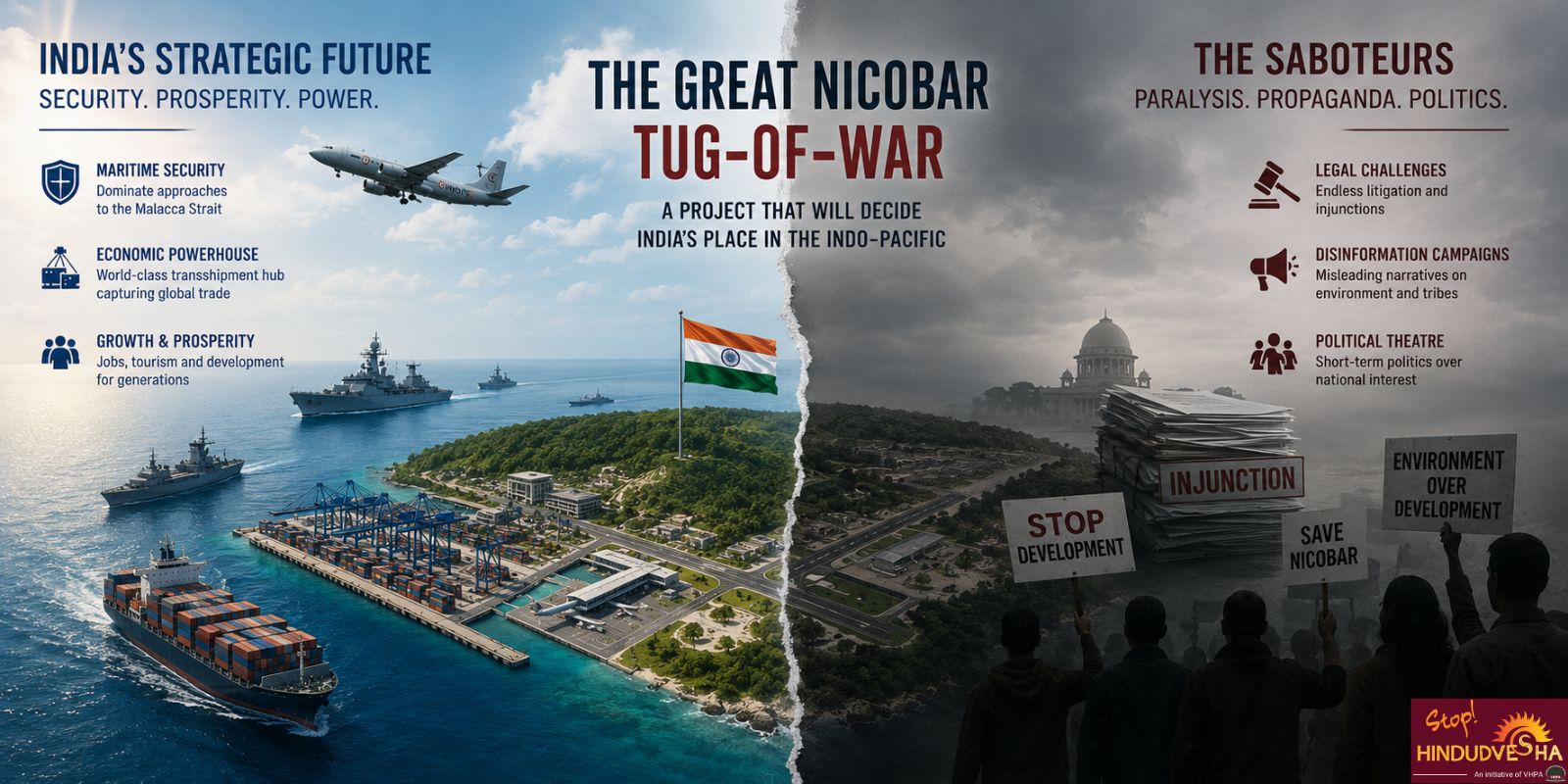
Summary
India is undertaking one of its most ambitious strategic projects: the ₹ 81,000-crore Great Nicobar Island Development Project. Centered on a massive 14.2 million TEU deep-water port at Galathea Bay, it aims to create a dual-use maritime hub that could serve as India’s “unsinkable aircraft carrier” near the Malacca Strait — directly challenging China’s critical vulnerability known as the “Malacca Dilemma.” The project promises huge economic returns by capturing transshipment trade currently lost to Singapore and Colombo, while boosting tourism and naval power projection. However, it faces intense organized opposition — legal challenges, international campaigns, and political attacks — following familiar patterns seen in Vizhinjam. Despite NGT approval and strong environmental safeguards, coordinated resistance risks delaying or derailing a project of immense national security and economic importance. The stakes are clear: India must choose between strategic ambition and manufactured paralysis.
“Whosoever commands the sea, commands the trade; whosoever commands the trade of the world, commands the riches of the world, and consequently the world itself.” – Walter Raleigh, English statesman and soldier, 1553-1618 [1]
The container ships never stop moving. Day and night, every twenty minutes or so, another vessel — laden with electronics, crude oil, auto parts, or fast-fashion polyester — threads through the Strait of Malacca, the narrow passage between Indonesia’s Sumatra and the Malay Peninsula. At its narrowest point, the strait is barely 2.8 kilometers wide. Yet through this constricted corridor flows approximately 30 percent of global seaborne trade and, more critically for Beijing’s strategic calculations, around 38 percent of China’s oil imports.[2] In dollar terms, that amounts to roughly $150 billion worth of energy — the lifeblood of the world’s second-largest economy — passing every year through a maritime chokepoint that Beijing neither controls nor could easily defend in a conflict.
Chinese strategists have a name for this vulnerability: the “Malacca Dilemma.” For over two decades, it has been the single greatest structural anxiety haunting the People’s Liberation Army Navy. [3]
Now, just 40 nautical miles from that chokepoint, India is building something that is giving Beijing nightmares.
India’s Dagger at China’s Throat
The Great Nicobar Island Development Project — a ₹81,000 crore (approximately $10 billion) initiative to transform India’s southernmost island into a strategic maritime and commercial hub — is arguably the most consequential infrastructure project in India’s post-independence history. Yet most people have barely heard of it.
The project centers on a deep-water International Container Transshipment Terminal (ICTT) at Galathea Bay, designed to handle 14.2 million TEUs annually — making it one of the largest in the region. It also includes a new greenfield international airport, a 450 MVA gas-and-solar power plant, and a sprawling township. The entire development will unfold in three phases between 2025 and 2047. [4]
The strategic arithmetic is straightforward. Great Nicobar lies nearly equidistant from Singapore, Port Klang, and Colombo. Its position near the Six Degree Channel and the northern approaches to the Malacca Strait means India does not merely sit near the world’s busiest shipping lane — it dominates its approaches. A fully developed naval and commercial presence there would give New Delhi the ability to monitor, and in a conflict, potentially interdict Chinese maritime supply lines — a prospect that concentrates minds in Beijing far more than any Indian Army deployment along the Himalayas. [5]
For Chinese strategic planners, the implications are sobering. The world’s second-largest economy and military has threaded its entire industrial civilization through a chokepoint narrower than many rivers. Despite decades of effort to mitigate this vulnerability — pipelines from Central Asia, Myanmar, and Russia, the China-Pakistan Economic Corridor (CPEC) at Gwadar, and even a proposed Kra Isthmus canal — none of these alternatives fully resolves the problem. If successfully executed, the Great Nicobar Project renders them largely irrelevant.
India’s Power Projection from Great Nicobar
The Andaman and Nicobar Islands stretch like a broken spine for 700 kilometers between the Bay of Bengal and the Andaman Sea.[6] Great Nicobar Island turns this geography into powerful strategic leverage. By developing a major port and dual-use airbase near the Malacca Strait, India gains the ability to monitor, influence, and — if necessary — disrupt movement through one of the world’s busiest maritime chokepoints. The island’s naval and aviation infrastructure would allow Indian forces to project power far beyond the eastern Indian Ocean. Warships could refuel and rearm without lengthy diversions, while surveillance aircraft and drones could maintain constant watch over critical sea lanes. In a conflict scenario, Great Nicobar would effectively function as an unsinkable aircraft carrier.
The Andamans serve as a potential kill-switch for the Malacca route, and geography explains why. Positioned near the western gateway of the strait, Great Nicobar lies within operational reach of nearly every vessel entering or exiting the corridor. India already maintains a military presence across the Andaman and Nicobar chain; this development strengthens and completes that strategic network. It also reduces India’s dependence on foreign transshipment hubs such as Singapore while improving logistics for the Indian Navy. Beyond its military value, the infrastructure could support humanitarian operations, disaster response, and commercial shipping. Yet its greatest significance lies in deterrence. A substantial share of China’s energy imports and trade flows through these waters, placing a vital economic artery within reach of Indian monitoring and rapid-response capabilities.
The strategic value of the islands has been recognized since the establishment of the Andaman and Nicobar Command (ANC) in 2001 — India’s first and only integrated tri-service theater command, combining the Army, Navy, and Air Force under unified leadership. [7]
In the years since, the ANC has steadily expanded its capabilities. Three naval communication network centers have been established. In 2024, a naval air station was equipped with a precision approach radar and the Integrated Underwater Harbour Defense and Surveillance System. Maritime patrol aircraft now routinely comb the waters around the strait. In military parlance, the islands have become India’s “unsinkable aircraft carrier” — a forward-operating platform that requires no tethering to a home port. [8]
But there is a critical limitation to the existing outposts. They represent only a military installation — not a full-spectrum strategic ecosystem. The Great Nicobar Project is intended to create an integrated civilian-military-maritime hub with far greater logistical depth and economic sustainability. In a prolonged Indo-Pacific confrontation, especially involving China’s expanding naval deployments, India would require much larger storage, fuel, repair, replenishment, and mobility infrastructure than the current lean outposts can provide. The proposed project fills that gap, transforming a surveillance post into a true power-projection platform.
Consider the dual-use airport alone. In peacetime, it would handle civilian passengers and cargo. In conflict, it would become a hub for strategic airlift, rapid force deployment, and deep maritime reconnaissance across the eastern Indian Ocean. The strategic implication for Chinese planners is clear: Chinese trade routes from the Middle East to China run close to the Indian coast for much of their journey. Without a substantial naval presence to counter India’s upgraded position, Chinese forces could find it difficult to protect shipping lanes in the vicinity of the Andaman and Nicobar Islands — potentially forcing convoys to reroute by thousands of miles and adding high costs to every energy shipment.
India’s Singapore Moment
The strategic case for the Great Nicobar Project is compelling. The economic case is, if anything, even more compelling.
India has, for decades, suffered a peculiar maritime humiliation. Despite sitting astride one of the world’s busiest sea lanes, it lacks the deep-water port infrastructure needed to service its own trade efficiently. Large cargo ships are often forced to route through foreign ports because India lacks adequate deep-draft facilities, resulting in substantial revenue loss. Much of this cargo is handled through Colombo and Singapore — meaning India pays foreign governments and foreign port operators to intermediate its own commerce. [9] Meanwhile, countries like Myanmar, China, and Sri Lanka are already building deep-water facilities designed to capture this lucrative trade.
The Great Nicobar port can change that equation fundamentally. [10] Unlike the shallow ports that constrain most of India’s coastline, Galathea Bay can accommodate the world’s largest containerships without any dredging. The ICTT’s planned capacity of 14.2 million TEUs annually would position it alongside Singapore, Dubai, and Hong Kong as one of the premier transshipment hubs on earth.
Then there is tourism. The project’s draft master plan identifies tourism as the primary economic driver of the island’s long-term growth. [11] Planners envision luxury resort development, cruise terminals, and improved aviation connectivity transforming the Andaman and Nicobar Islands into a destination rivaling Phuket or Bali. For years, India’s tourism authorities have bemoaned the irony of an archipelago comprising 836 islands — many of them extraordinarily beautiful — attracting only a tiny fraction of the visitors that Thailand’s beaches draw annually. The new airport, direct international connectivity, and modern urban infrastructure could finally end that anomaly, generating billions in tourism revenue while creating a robust local economy capable of sustaining the islands’ growing population.
With more than 90,000 merchant ships passing annually through the nearby Strait of Malacca, which carries about 30 percent of global trade, the Great Nicobar Project is ideally positioned to tap into this massive, perpetual flow of maritime commerce.[12] If even a fraction of regional transshipment business shifts to Galathea Bay, the economic returns — from port revenues, logistics services, tourism, and downstream employment — would dwarf the project’s construction cost within a generation.
China’s Invisible War on Indian Projects
The question is: If the Great Nicobar Project is this consequential, why is there so much organized opposition to it?
The ecological concerns are real and deserve serious engagement. Great Nicobar is genuinely extraordinary — a UNESCO-designated biosphere reserve harboring endemic species, pristine coral reefs, and leatherback turtle nesting grounds found nowhere else on Earth. [13] The Shompen, a hunter-gatherer tribe of a few hundred people who have lived in the island’s interior for millennia, are among the world’s most isolated communities. [14] Any honest assessment of the project’s environmental footprint must grapple with these realities.
But the pattern of resistance — the coordinated legal challenges, the international media campaigns, and the political amplification from opposition figures — has a texture that goes beyond organic environmental activism. It bears a striking resemblance to playbooks that India’s security establishment has seen before.
A 2014 Intelligence Bureau report, presented to Prime Minister Manmohan Singh, alleged that foreign-funded NGOs were systematically targeting India’s strategic infrastructure projects in mining, power, dams, and especially the nuclear sector — the key to energy independence. The report estimated that such activism may have reduced India’s GDP growth by up to 3 percent annually by delaying major industrial projects. [15] In today’s Indian economy, 3 percent of GDP represents approximately $120 billion per year in foregone output. Compounded over decades, the cumulative loss to Indian growth runs into the trillions of dollars — a stealth tax on national development imposed not through tariffs or sanctions, but through litigation, activism, and manufactured controversy.
The Intelligence Bureau report named organizations, including Greenpeace, and highlighted funding trails to European sources. Critics dismissed the report as an attempt to criminalize legitimate dissent. Supporters saw it as confirmation of what they had long suspected: that in modern geopolitical competition, infrastructure battlefields are as important as military ones.
The asymmetry is stark. While India has been litigating over environmental clearances for years, China has been constructing ports across three continents. While India’s strategic projects get bogged down in National Green Tribunal hearings, Beijing deploys infrastructure as statecraft — building the String of Pearls network of dual-use ports from Djibouti to Hambantota to Gwadar with the efficiency of a military campaign. [16]
China’s Belt-and-Road Initiative has focused heavily on securing maritime routes and port access across the Indian Ocean. India’s enhanced presence in the Strait of Malacca could serve as a significant counterweight to these efforts. [17] For Beijing, therefore, a delayed or diluted Great Nicobar Project is not merely a diplomatic win, but a strategic imperative. Every year the project is held up is another year in which China’s Indian Ocean network consolidates while India’s eastern flank remains exposed.
Does Beijing directly fund opposition to the Great Nicobar Project? No evidence in the public domain credibly establishes such a link. Modern influence operations rarely leave such clean fingerprints. The mechanism is more diffuse: European NGOs with ideological agendas provide funding; Indian civil society organizations with genuine (if sometimes weaponized) environmental concerns carry the message; legal activists and sympathetic academics amplify it internationally; and opposition politicians seize on the resulting controversy for domestic advantage. The ultimate beneficiary — the power whose strategic interests are served by Indian paralysis — need not issue any instructions whatsoever.
Lessons from Kerala’s Port War
India has a documented template for exactly this kind of organized infrastructure obstruction. It is called Vizhinjam.
The deep-water port at Vizhinjam, near Thiruvananthapuram in Kerala, was conceived as India’s answer to the transshipment dominance of Colombo and Singapore. It boasts a natural draft of 20–24 meters, minimal littoral drift, and was designed to handle Megamax containerships, with an eventual capacity exceeding 7 million TEUs. [18] The project’s strategic logic was identical to that of Great Nicobar: capture the transshipment trade that India had long been exporting to its neighbors and keep the economic benefits at home.
The project, operated by the Adani Group under a concession from the Kerala government, ran into sustained organized resistance led by the Latin Catholic Church and associated fishing community groups. The resistance culminated in a 138-day protest that brought construction to a complete halt. Protesters blocked road access, surrounded the construction site from the sea in boats, and, at one point, vandalized a police station. The church-led groups violated explicit assurances they had given to the Kerala High Court regarding peaceful conduct. [19] The protests cost the Adani Group an estimated ₹200 crore in direct losses from the construction halt alone.
The precedent matters enormously for the Great Nicobar debate. In Kerala, a port of purely economic significance — with no military dimension — was held hostage for over four months by organized religious and community resistance. The Vizhinjam project had been discussed and delayed for decades before construction finally accelerated in this century. Now multiply that pattern: apply it to a project ten times larger, with critical national security dimensions, located in a remote archipelago with limited administrative capacity, and you begin to understand the scale of the threat that opponents of the Great Nicobar Project could pose if they succeed in replicating Kerala’s template.
Partisan Politics vs National Security
On April 28, 2026, Great Nicobar entered the heart of India’s partisan politics following a visit by the leader of the country’s official opposition.
What followed was exactly the kind of political theatre India’s strategic establishment has come to dread. Opposition leaders met tribal representatives and local residents, portraying the Great Nicobar project as a grave threat to the island’s ecology and indigenous communities. [20]
The government’s response was swift. Within days, New Delhi issued a detailed defense of the project’s strategic, economic, and environmental logic. [21] The governing party dismissed the criticism as politically motivated and argued that some opposition messaging, intentionally or otherwise, risked amplifying narratives favorable to foreign interests. Opposition leaders accused the government of “damage control” and demanded greater parliamentary scrutiny, while some defense experts urged separating India’s security requirements from the project’s commercial aspects. [22]
This cycle of charges and counter-charges reveals a political dynamic that actively undermines India’s strategic interests. In theory, Parliament should be rigorously debating the merits of an ₹81,000 crore ($8.38 billion) project with profound national security implications. In practice, the discussion is degenerating into a sterile, predictable proxy war — one side waving the flag of national security, the other sounding alarms about environmental destruction and crony capitalism.
The larger concern is not intent but consequence. Strategic projects of national importance can become casualties of short-term political incentives. Political actors do not need to consciously weaken India’s strategic position to produce outcomes that complicate it. Amplifying uncertainty around critical infrastructure at sensitive moments can cast doubt on projects India’s security establishment regards as essential.
Intention and effect are not always the same. In geopolitics, an actor need not consciously advance a rival power’s interests to produce outcomes that ultimately align with them. Sometimes, amplification at a critical moment is enough.
Enough Reviews — Time to Build
Against this backdrop of manufactured controversy, it is worth noting what India’s own statutory bodies have actually concluded.
In February 2026, a special bench of the National Green Tribunal disposed of challenges to the Great Nicobar Project, stating that it found “no good ground to interfere” with the environmental clearance. The tribunal observed that “adequate safeguards” had been built into the project’s approval process. [23] The government has committed to 42 specific environmental compliance conditions covering biodiversity monitoring, coral relocation, marine ecology protection, and disaster management. The project requires diversion of just 1.82 percent of the island group’s forest cover, offset through compensatory afforestation.
The project is being implemented in three carefully phased stages between 2025 and 2047, with Phase I covering 72.12 sq km from 2025 to 2035. This phased approach allows for systematic monitoring and course correction before subsequent phases proceed. Wildlife corridors have been designed to facilitate the movement of arboreal animals, snakes, crabs, and crocodiles. No displacement of the Shompen community is planned; in fact, the tribal reserve area will actually expand under the project’s re-notification framework.
None of this satisfies the project’s most committed critics. But it establishes a critical point: India’s own judiciary, environmental regulators, and strategic policymakers — applying their own legal frameworks after extensive review — have concluded that this project should proceed.
When that determination is challenged not through domestic legal channels but through coordinated international media campaigns, foreign-funded NGO pressure, and high-profile political theater designed to generate damaging optics, the question of who exactly is being served by the opposition deserves serious scrutiny. Rahul and his friends have a lot to answer for.
The Price of Hesitation
India’s continental strategic culture — its historical obsession with Himalayan frontiers and land borders — has long blinded it to maritime realities. The country’s post-independence development model left its maritime flanks underdeveloped and its strategic posture fundamentally landlocked, even as it sat astride the world’s most critical sea lanes. The price of that hesitation has been paid in lost transshipment revenues, foreign-exchange hemorrhages to Colombo and Singapore, and strategic leverage surrendered by default to Beijing’s expanding Indian Ocean network. [24]
The 2014 IB report, whatever its limitations, pointed to a real and measurable cost: the compounded loss to national wealth from organized infrastructure obstruction runs into trillions of dollars. Beyond just numbers: schools not built, roads not laid, hospitals not staffed, and power not generated. It is the poverty that persists because India’s strategic infrastructure was held hostage by a combination of ideological activism, foreign funding incentives, and geopolitical manipulation.
The Andaman standoff is the latest chapter in this story. And the stakes are higher than they have ever been.
There are moments in geopolitics when a single infrastructure project changes the calculus of an entire region. The Great Nicobar Island Development Project is one such moment. A completed Galathea Bay port, a functioning dual-use airport, and an expanded Andaman and Nicobar Command would represent not just an economic asset but a fundamental shift in the regional balance of power — transforming India from a passive observer of Indo-Pacific competition into an active shaper of it.
For China, that transformation is unacceptable. For India, it is overdue.
The container ships, as always, continue moving through the Malacca Strait. The question is whether India will finally position itself to determine the terms under which they pass — or whether the familiar combination of NGO litigation, political obstruction, and manufactured environmental controversy will once again consign a generation-defining strategic opportunity to the graveyard of Indian hesitation.
Citations
[1] United Kingdom Parliament. “Navy Estimates, 1910–11.” Hansard, March 14, 1910. https://hansard.parliament.uk/%E2%80%8CCommons/1910-03-14/debates/2a7d9fe5-c716-41b1-a8fa-047b5d6660e1/NavyEstimates1910%E2%80%9311
[2] Visual Capitalist. “Charted: Oil Trade Through the Strait of Hormuz by Country.” https://www.visualcapitalist.com/charted-oil-trade-through-the-strait-of-hormuz-by-country/
[3] “Indian Ocean Chokepoints: Is China Still Vulnerable?” Observer Research Foundation. https://www.orfonline.org/expert-speak/indian-ocean-chokepoints-is-china-still-vulnerable
[4] Government of India, Press Information Bureau. “Government Clarifies Strategic, Economic, and Environmental Aspects of Great Nicobar Project.” https://www.pib.gov.in/PressReleasePage.aspx?PRID=2257174®=3&lang=2
[5] “The Malacca Kill Switch: How India Is Turning Great Nicobar into China’s Strategic Nightmare.” Sarkari Finance. https://sarkari.finance/blogs/the-malacca-kill-switch-how-india-is-turning-great-nicobar-into-chinas-strategic-nightmare/
[6] “India’s ‘Unsinkable Aircraft Carrier’: Great Nicobar as Strategic Weapon Against China in the Indian Ocean.” Defence Security Asia. https://defencesecurityasia.com/en/india-unsinkable-aircraft-carrier-great-nicobar-strategic-weapon-against-china-indian-ocean/
[7] Andaman and Nicobar Command Official X Account
[8] “The Role of Andaman and Nicobar Islands to Enhancing India’s Maritime Security Surveillance Architecture.” ResearchGate. https://www.researchgate.net/publication/401033740_The_Role_of_Andaman_and_Nicobar_Islands_to_Enhancing_India’s_Maritime_Security_Surveillance_Architecture
[9] Government of India, Press Information Bureau. “Government Clarifies Strategic, Economic, and Environmental Aspects of Great Nicobar Project.” https://www.pib.gov.in/PressReleasePage.aspx?PRID=2257174®=3&lang=2
[10] “Great Nicobar Project: Key Facts.” Asian Mirror, May 4, 2026. https://www.asianmirror.us/2026/05/04/great-nicobar-project-key-facts/
[11] “Great Nicobar Master Plan.” Next IAS, April 11, 2026. https://www.nextias.com/ca/current-affairs/11-04-2026/great-nicobar-master-plan
[12] “India’s Great Nicobar Project: A Strategic Hub for Trade, Maritime Security and Sustainable Growth in the Indo-Pacific.” Organiser, May 1, 2026. https://organiser.org/2026/05/01/351436/bharat/indias-great-nicobar-project-a-strategic-hub-for-trade-maritime-security-and-sustainable-growth-in-the-indo-pacific/
[13] Government of India, Press Information Bureau. “Government Response Following Criticism of Great Nicobar Project.” https://www.pib.gov.in/PressReleasePage.aspx?PRID=2257323®=3&lang=2
[14] Andaman and Nicobar Administration. “People of Nicobar District.” https://db.and.nic.in/nicobars/Profile/People.php
[15] “Foreign-Funded NGOs Stalling Development: IB Report.” The Times of India, June 12, 2014. https://timesofindia.indiatimes.com/india/Foreign-funded-NGOs-stalling-development-IB-report/articleshow/36411169.cms
[16] “China’s String of Pearls Policy: Implications for India.” Swadeshi Shodh Sansthan. https://swadeshishodh.org/chinas-string-of-pearls-policy-implications-for-india/
[17] “Great Nicobar Mega Project: How India Could Reshape Indo-Pacific Power and Challenge China’s Malacca Strategy.” TFI Global News, May 3, 2026. https://tfiglobalnews.com/2026/05/03/great-nicobar-mega-project-how-india-could-reshape-indo-pacific-power-and-challenge-chinas-malacca-strategy/
[18] “Vizhinjam Port: Church-Led Protestors Block Road to Port Site, Stop Construction Vehicles, Pelt Stones.” Swarajya. https://swarajyamag.com/amp/story/infrastructure/vizhinjam-port-church-led-protestors-block-road-to-port-site-stop-construction-vehicles-pelt-stones
[19] “Vizhinjam Port: Church Announces Temporary Halt to Protests After Talks with Kerala CM.” Swarajya. https://swarajyamag.com/infrastructure/vizhinjam-port-church-announces-temporary-halt-to-protests-after-talks-with-kerala-cm
[20] “Rahul Gandhi Opposes the Great Nicobar Project During Visit to Andaman and Nicobar Islands.” OpIndia. https://www.opindia.com/news-updates/congress-rahul-gandhi-opposes-the-great-nicobar-project-during-his-visit-to-the-andaman-and-nicobar-islands/
[21] BJP Tamil Nadu Facebook Post on Great Nicobar Project
[22] “Congress Accuses Centre of ‘Damage Control’ over Great Nicobar Project after Rahul Gandhi Visit.” ANI News, May 3, 2026. https://www.aninews.in/news/national/politics/congress-accuses-centre-of-damage-control-over-great-nicobar-project-after-rahul-gandhi-visit20260503125157/
[23] “India’s Great Nicobar Project: A Strategic Hub for Trade, Maritime Security and Sustainable Growth in the Indo-Pacific.” Organiser, May 1, 2026. https://organiser.org/2026/05/01/351436/bharat/indias-great-nicobar-project-a-strategic-hub-for-trade-maritime-security-and-sustainable-growth-in-the-indo-pacific/
[24] “India’s Dependence on Foreign Ports for Container Transhipment Has Ended with Opening of Vizhinjam Port, Says PM Modi.” The Economic Times, May 2026. https://infra.economictimes.indiatimes.com/news/ports-shipping/indias-dependence-on-foreign-ports-for-container-transhipment-has-ended-with-opening-of-vizhinjam-port-says-pm-modi/120824462

Donate to HINDUDVESHA
Our Mission is to explore and expose Hindudvesha through research analysis, education and response.
SUPPORT US