

The Economist’s Mughal Nostalgia: The Global Elite’s Obsession With India’s Invaders
 Rati Agnihotri · 06/07/2026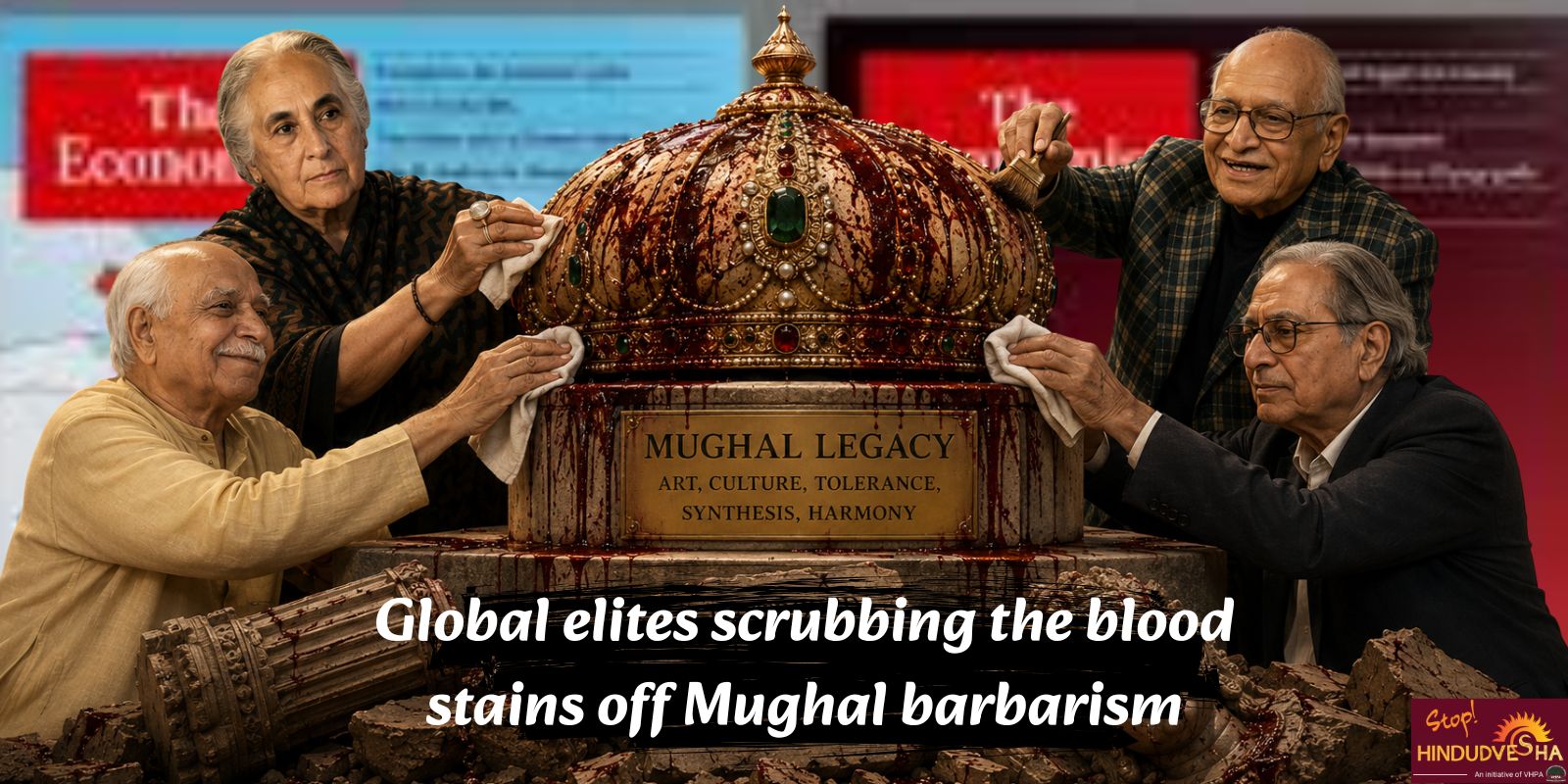
Summary
The Economist’s recent lament over India’s alleged neglect of the Mughal legacy reflects a deeper discomfort within sections of the global media and academic elite toward India’s ongoing civilizational reawakening. For decades, Mughal rule was romanticized through selective historiography, elite cultural narratives, and carefully curated depictions of “Ganga-Jamuni Tehzeeb,” while the large-scale destruction of temples, religious persecution, and imperial brutality associated with many Islamic invaders were minimized or ignored. As India increasingly re-centers its ancient Hindu civilizational identity and revisits long-suppressed historical realities, this ecosystem has reacted with visible hostility. The backlash is not really about preserving history. It is about preserving ideological control over how India understands its past, its civilizational identity, and the legacy of its invaders.
The Economist, long regarded as a leading voice on global business and geopolitics, recently published a piece chiding Indians for failing to honor the legacy of the “great” Mughal Empire. This is a curious stance. Mughal rule in India is historically associated with religious bigotry, widespread temple destruction, murderous campaigns, debauchery, and catastrophic mismanagement of the nation’s wealth. Far from a golden age, it left behind a trail of cultural vandalism and economic decline.
India’s ongoing civilizational and cultural resurgence has rightly consigned this chapter to the shadows of history—precisely where it belongs. Yet this natural shift has clearly unsettled a certain intellectual and cultural ecosystem that long profited from the over-the-top romanticization of Mughal rule. Turning invaders into aesthetic icons became an industry, complete with glossy coffee-table books, serialized dramas, and selective historiography. The Economist’s article, sadly, plays straight into this narrative.
Setting aside the odd spectacle of a premier global financial publication showing such zeal in whitewashing the crimes of a foreign conquest, the piece fits a familiar pattern. It reflects the broader discomfort—bordering on fury—within influential circles at the sight of India reclaiming and celebrating its own pre-Islamic civilizational heritage. What should be a straightforward exercise in historical perspective is instead treated as a dangerous regression. In reality, it is simply India choosing to remember its history on its own terms.
The Economist and the Mughal Whitewashing Industry
The history of Muslim invasions of India is soaked in the large-scale destruction and desecration of Hindu temples, often followed by the construction of mosques, madrasas, and other Islamic structures directly on the ruins, frequently using materials torn from the demolished mandirs themselves. Historical records and accounts describe the destruction of several thousand Hindu temples under successive Islamic invaders and dynasties, including the Mughals. Babur, the founder of the Mughal dynasty in India, himself recorded wanton acts of destruction and mass murder in his autobiography, the Baburnama. Mughal emperor Aurangzeb carried this legacy of intolerance and iconoclasm to even greater extremes, ordering the destruction of numerous temples, including some of Hinduism’s most sacred sites in Kashi, Ujjain, and Mathura, many of which were replaced with mosques as explicit symbols of conquest and domination.[1]
Yet The Economist cheerily published an article titled “What Have the Mughals Ever Done for Us?”[2], lightly chiding the Indian state for dishonoring their legacy and lamenting that “the quincentenary of the empire’s founding passed without note.” India, with its powerful ecosystem of Hinduphobes and colonial apologists, is perhaps the only country in the world where influential media outlets can comfortably publish articles that brazenly glorify aggressors and looters who killed the country’s indigenous people, inflicted torture on them, and destroyed their religious structures.
Interestingly, The Economist’s article does not come across as even mildly sarcastic when it casually acknowledges that the ruling party’s claims about the Mughals destroying temples are true. After conceding the point, the piece quickly dismisses it as inconsequential, revealing the Hinduphobia that runs through the text — one does not need to read between the lines to see it.
The Economist is not alone in its fascination with the Mughal era. Various other publications, including Indian ones, have joined in with over-the-top eulogies to mark the 500th anniversary of the invaders’ arrival. Many of these accounts gush with an almost teenage-like excitement at the supposed achievements of their favorite historical figures.
The Hindu laments the “forgotten” Mughal legacy in an article titled “Beyond the Taj: forgotten Mughal monuments to visit now”.[3] Hindustan Times offers a strongly rose-tinted portrayal, presenting the Mughals as largely misunderstood heroes and artistic geniuses who “were among history’s most passionate patrons of the arts, commissioning jewelry, manuscripts, paintings, architecture and decorative objects of breathtaking ambition”.[4] The South Asia Journal describes the Mughal empire as “one of the greatest empires to have ever existed”[5], conveniently downplaying the darker aspects of the Islamic invaders while positioning the Mughals as the most significant contributors to the “South Asia” brand.
India Owes Hindu Nationalism to the Mughals? Really?
One of the most preposterous claims in The Economist’s piece on the Mughals is that India owes Hindu nationalism to the Mughals themselves, and that the ruling party’s rise is premised on portraying the Mughals as villains. The writer takes a dig at the Ram Janmabhoomi movement, repeating the familiar one-sided narrative of the Babri Masjid’s destruction by Hindu nationalists, while conveniently ignoring the extensive archaeological evidence and historical records that led the Supreme Court to rule in favor of the Hindu side.
After dwelling at length on the Mughals’ contributions to Indian culture, language, music, cuisine and more, the writer declares emphatically in the final line that the Mughals “gave political Hinduism its eternal, indispensable villain”.[6]
This framing follows a well-worn pattern of “Hindutva” bashing common in sections of the media, academia and civil society. It casts Muslims as perpetual victims wronged and oppressed by Hindu nationalists. The inherent irony is striking: in its eagerness to demonize “Hindutva” and “Hindu nationalism” at all costs, the article recasts the elite Muslim rulers of medieval India — foreign invaders who conquered and ruled — as hapless victims of India’s “Hindu-majoritarian” politics in 2026. At that point, the line between vicious propaganda and outright comedy becomes almost impossible to distinguish.
Elite Anxiety Over Hindu Reawakening
The soft propaganda of Ganga-Jamuni Tehzeeb has long dominated India’s cultural narratives. What is often presented as the syncretic and composite culture of north India — especially in regions like Delhi and Awadh — is, in reality, little more than a covert whitewashing of the Mughal empire’s harsh realities. These narratives gloss over the large-scale destruction of temples, the oppression of Hindus, mass atrocities against the Hindu population, and the reality of forced conversions during Mughal rule. Instead, they enthusiastically praise the Urdu language, Sufi music, ghazals, Mughal cuisine, and architecture.
When a country has endured prolonged colonization and colonizers have become settlers, some degree of cultural exchange and hybrid forms is inevitable. However, defining an ancient civilization’s cultural, artistic, and literary identity almost entirely through the lens of its invaders’ legacy is far from benign. The same ecosystem that celebrates the so-called Mughal cultural legacy routinely denigrates and mocks India’s ancient civilizational and cultural ethos.
From leftist historians who have long served as brand ambassadors for the Mughals in modern India, to the Lutyens’ elite who endlessly celebrate Akbar’s supposed “religious tolerance” while sanitizing the record of a tyrant like Aurangzeb, an entire ecosystem has worked for decades to romanticize Islamic imperial rule. This pattern extends to Delhi’s heritage-walk industry and the ghazal-sher-shayari-sufism circuit, which glorify Mughal aesthetics while subtly casting India’s ancient Hindu civilizational identity as the awkward or unwelcome antagonist in their rose-tinted “Ganga-Jamuni Tehzeeb” saga.
Since India’s independence in 1947, this selective and heavily curated storytelling has remained a central pillar of India’s elite cultural establishment.
Now that the Mughals are being relegated to a mere footnote in India’s civilizational history and the focus has shifted to its Hindu heritage, this cabal is unleashing its predictable fury. The construction of the Ayodhya Ram Mandir, the reclamation of ancient Hindu heritage sites such as Sambhal, and growing public awareness of issues like Kashi-Gyanvapi and Mathura-Shahi Idgah have unsettled decades of carefully built narratives.[7] [8]
Such media narratives are essentially reactive — desperate attempts to keep the Mughals relevant in an era that is moving on. This explains the remarkable surge in such articles across mainstream publications and even obscure literary magazines over the past decade.
These pieces are typically published as “opinion” articles, a convenient format that allows outlets to push ideologically driven views while evading editorial accountability. A common trope is to frame India’s civilizational reawakening as a conspiracy against Islamic cultural legacy. As The Economist writer noted: “By early 2024, when Mr Modi consecrated the promised temple, his party held 56% of seats. It has spent the past decade renaming Mughal cities, rejecting Mughal cuisine, and writing Mughals out of history books.”[9]
A simple Google search for “Mughal Legacy in India” yields a flood of articles lamenting the supposed neglect of Mughal culture in favor of India’s ancient past. Headlines include “The Mughals and the making of India” in Frontline[10], while Engelsberg Ideas claims that “the profound legacies of the Mughal empire… are now under siege from a mythical vision of India’s past”.[11] The Conversation ran a piece titled “Tampering with history: how India’s ruling party is erasing the Muslim heritage of the nation’s cities”.[12]
What unites all these articles is clear: celebration of the Mughal legacy is almost always accompanied by the demonization of India’s ancient civilizational and cultural heritage.
Global Media’s Ideological Agenda
The Economist was founded in 1843 by a Scottish hat manufacturer to champion the cause of free trade. Yet the cognitive dissonance is hard to ignore. In the second decade of the 21st century, the same publication seems increasingly preoccupied with promoting ideological narratives centered on “Hindutva”, “caste”, and “Hindu nationalism”, while portraying medieval Islamic invaders as the primary architects of India’s civilizational heritage.
Looking at The Economist’s coverage on issues concerning India over the past couple of years, its relentless focus on denouncing “Hindutva” stands out. In March 2024, it published an article titled “What is Hindutva, the ideology of India’s ruling party?”.[13] Another piece followed suit in April 2023, advising readers on which books to read to understand the “dangerous ideology”.[14] The Economist published yet another hit piece in September 2024, claiming that India was witnessing a dangerous combination of technology and Hindu nationalism. [15]
The Economist’s preoccupation with Hindu Dharma and Hindutva appears unrelenting. As far back as 2015, it published a sharply critical article titled “The Hindutva rate of growth”. [16] Several of its headlines on the subject are so pointedly adversarial that they leave little room for nuance. One 2022 piece, for instance, carried the title: “Hindu bigots are openly urging Indians to murder Muslims”. [17]
When one reviews the publication’s coverage of these themes over the past decade, it is difficult not to wonder whether The Economist has, wittingly or otherwise, positioned itself as a prominent platform for voices deeply hostile to Hindu concerns.
The near-total absence of any alternative viewpoint makes The Economist’s editorial policy on India even more questionable. Rarely does one find an article that presents the perspective of Hindu groups and organizations or portrays Hindu concerns in a balanced or even mildly positive light. This consistent pattern inevitably raises the question of whether Hinduphobia has quietly become an entrenched part of the publication’s editorial stance.
The Academic Sanitization of Mughal Barbarity
Media narratives that unabashedly glorify the Mughal legacy form part of a broader academic Hinduphobia industry. Scholars like Audrey Truschke[18] have built entire careers on whitewashing the atrocities of India’s Islamic invaders while consistently bashing Hindus. In India, an established cabal of leftist historians turned the Mughals into an enduring object of “intellectual fantasy”, pushing Hindu rulers to the margins and systematically distorting the country’s ancient history.
With India’s ongoing civilizational reawakening, these deeply entrenched academic narratives are now being forcefully challenged. Armed with facts and logic, netizens are sharply critiquing the Hinduphobic academic elite of the Lutyens’ universe. The long-dominant hierarchy of leftist historians is fraying as more Indians turn to the works of non-left historians such as Meenakshi Jain. There is also a noticeable resurgence of interest in the writings of historians like RC Majumdar, Jadunath Sarkar, Radha Kumud Mukherjee, and Rakhaldas Banerji.[19] The works of Sita Ram Goel, who meticulously documented the destruction of Hindu temples by Islamic invaders, have entered mainstream public discourse and are further exposing the selective agenda of prominent leftist historians.
The recent changes in NCERT social science textbooks have rattled this ecosystem. The updated Class 8 history textbook describes Babur as “a brutal and ruthless conqueror, slaughtering entire populations of cities”. Akbar’s reign is now presented as “a blend of brutality and tolerance”, moving away from the earlier tendency to overemphasize his religious tolerance. The new text offers a factual account of temple destruction, brutality, and religious persecution under both the Delhi Sultanate and Mughal rule, and does not shy away from detailing Aurangzeb’s destruction of temples and gurudwaras. [20]
The NCERT has also reportedly removed chapters on the Delhi Sultanate and the Mughals from its Class 7 social science textbooks, replacing them with material on ancient Indian dynasties, sacred pilgrimage sites, and the MahaKumbh. While there is speculation that these topics may appear in the second part of the book, this has not been confirmed. [21]
For decades, Indian millennials grew up with history textbooks that portrayed the Mughals and Tipu Sultan as the only truly great rulers of India. These books relentlessly glorified Akbar’s policy of religious syncretism and his Din-i-Ilahi doctrine, while reducing Hindu rulers to little more than passing mentions. This created the impression among impressionable young minds that Hindu rulers were either insignificant or simply unimportant.
This shift in academic narratives — with its renewed focus on India’s ancient knowledge systems and the legacy of its Hindu rulers — has clearly unsettled the Ganga-Jamuni Tehzeeb ecosystem.
The media narratives being pushed by publications like The Economist should be seen as desperate attempts to keep the “Akbar-the-Great” narrative alive. With Bharat’s unprecedented civilizational reawakening, the ground has shifted beneath their feet. Yet, backed by significant media influence and academic hegemony, this cabal continues its campaign against India’s civilizational values, still hoping to shape the minds of the young.
Citations
[1] Payback for Plunder: India’s Case for War Reparations; https://stophindudvesha.org/payback-for-plunder-indias-case-for-war-reparations/#_ftn3
[2] What have the Mughals ever done for us? https://www.economist.com/asia/2026/04/19/what-have-the-mughals-ever-done-for-us
[3] Mughal empire legacy in India: forgotten monuments to visit now – The Hindu; https://www.thehindu.com/life-and-style/travel/500-years-mughals-forgotten-monuments-to-visit-india/article70863716.ece
[4] The Mughal Legacy 500 Years On; https://www.hindustantimes.com/specials/The-Mughal-Legacy-500-Years-On-101777553545934/index.html
[5] 2026: Celebrating 500 Years of the Mughal Empire | South Asia Journal; https://southasiajournal.net/post/india/60893/2026-celebrating-500-years-of-the-mughal-empire
[6] What have the Mughals ever done for us? https://www.economist.com/asia/2026/04/19/what-have-the-mughals-ever-done-for-us
[7] “Reclaiming India’s Heritage: Sambhal’s Key Discoveries”; https://stophindudvesha.org/reclaiming-indias-hindu-heritage-sambhal-discoveries-leading-the-way/
[8] “Temples spark India’s cultural reset.”; https://stophindudvesha.org/beyond-mausoleums-temples-tourism-drives-indias-cultural-reset/
[9] What have the Mughals ever done for us? https://www.economist.com/asia/2026/04/19/what-have-the-mughals-ever-done-for-us
[10] How the Mughals Shaped Modern India’s Identity – Frontline; https://frontline.thehindu.com/society/mughal-legacy-india-impact/article70915886.ece
[11] India’s war on the Mughal Empire – Engelsberg Ideas; https://engelsbergideas.com/essays/indias-war-on-the-mughal-empire/
[12] Tampering with history: how India’s ruling party is erasing the Muslim heritage of the nation’s cities; https://theconversation.com/tampering-with-history-how-indias-ruling-party-is-erasing-the-muslim-heritage-of-the-nations-cities-116160
[13] What is Hindutva, the ideology of India’s ruling party?: https://www.economist.com/the-economist-explains/2024/03/07/what-is-hindutva-the-ideology-of-indias-ruling-party
[14] What to read about Hindutva: https://www.economist.com/the-economist-reads/2024/04/05/what-to-read-about-hindutva
[15] Technology and Hindu nationalism have transformed India; https://www.economist.com/culture/2024/09/05/technology-and-hindu-nationalism-have-transformed-india
[16] The Hindutva rate of growth; https://www.economist.com/asia/2015/01/15/the-hindutva-rate-of-growth
[17] Hindu bigots are openly urging Indians to murder Muslims; https://www.economist.com/leaders/2022/01/15/hindu-bigots-are-openly-urging-indians-to-murder-muslims
[18] Tracing Anti-India Anti-Hindu Aurangzeb Lover Audrey Truschke’s Institutional Link And Campaigns Targeting India | Dailyhunt; https://m.dailyhunt.in/news/india/english/the+commune-epaper-thecom/tracing+antiindia+antihindu+aurangzeb+lover+audrey+truschkes+institutional+link+and+campaigns+targeting+india-newsid-n709883237
[19] Left historians have distorted Indian history. Young minds must bring back nationalist spirit; https://theprint.in/opinion/left-historians-have-distorted-indian-history-young-minds-must-bring-back-nationalist-spirit/1865191/
[20] NCERT New Class 8 Social Science Textbook Flags ‘Religious Intolerance’ In Mughal Era; https://www.ndtv.com/education/ncert-new-class-8-social-science-textbook-flags-religious-intolerance-in-mughal-era-8884792
[21] NCERT Class 7 books drop Mughals, Delhi Sultanate, introduce Maha Kumbh chapter – India Today; https://www.indiatoday.in/education-today/news/story/ncert-class-7-books-drop-mughals-delhi-sultanate-introduce-maha-kumbh-chapter-2716120-2025-04-28

Donate to HINDUDVESHA
Our Mission is to explore and expose Hindudvesha through research analysis, education and response.
SUPPORT US