

Accusation Without Proof: Media’s Smear Campaign Against BAPS Swaminarayan Sanstha
 Rati Agnihotri · 05/20/2026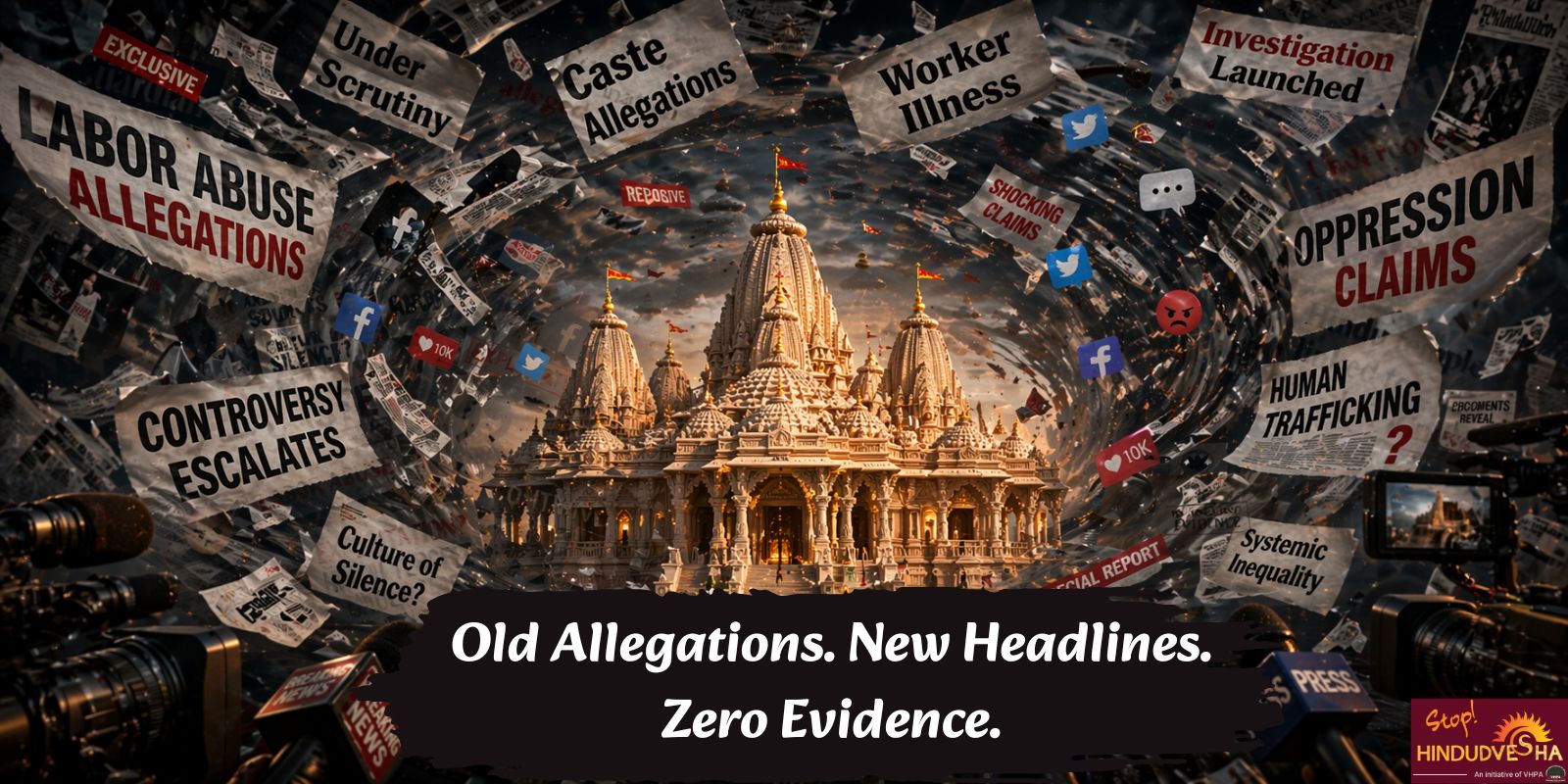
Summary
This article examines how recent media coverage targeting BAPS Swaminarayan Sanstha reflects a broader pattern of narrative-driven reporting surrounding Hindu institutions in the West. Focusing on a The Guardian article alleging worker illness and death linked to the construction of the BAPS temple in New Jersey, the piece argues that serious claims were advanced with heavy reliance on anonymous sourcing. It further explores how media amplification, caste-based framing, and ideological interpretation can transform localized disputes into symbolic indictments of Hindu identity. Drawing comparisons to earlier caste-related controversies, including the Cisco case, the article argues that selective scrutiny and simplified narratives risk distorting public understanding while reinforcing longstanding stereotypes about Hindu communities and institutions.
“If you are not careful, the newspapers will have you hating the people who are being oppressed, and loving the people who are doing the oppressing,” famously said Malcolm X. Though spoken in a very different socio-political context, the quote nevertheless mirrors the predicament of the Hindu community today.
Journalism in recent years has increasingly been reduced to the business of narrative-building. The traditional yardsticks of good journalism, such as facts, data, neutrality, and objectivity, have been conveniently sidelined in favor of screeching subjectivity, victim-driven storytelling, aggressive ideological posturing, and narrative manipulation. These trends are starkly visible in the global demonization of the Hindu community, which is increasingly cast as an oppressor based on perceived threats, while the very real threat of radical Islamist extremism targeting Hindus is often minimized or ignored.
Media ecosystems increasingly reward emotional persuasion over evidentiary restraint. The vicious smear campaign targeting the BAPS Swaminarayan Sanstha temple in New Jersey is a case in point. Even after the federal investigation concluded without findings of wrongdoing, the media campaign against BAPS continued unabated.
Recently, The Guardian published a highly incendiary piece alleging medical neglect and abuse of workers during the construction of the New Jersey temple. The modus operandi followed a familiar pattern: anonymous sources, emotionally charged victim narratives unsupported by concrete evidence, and sweeping allegations presented without substantiation.
The following sections will examine the dynamics of the malicious narrative-building surrounding BAPS and how a coordinated effort to malign an entire community emerged through the convergence of multiple stakeholders, including sections of the media, civil society, and the activist ecosystem.
The Guardian’s Silicosis Allegations and the Question of Evidence
The recently published piece by The Guardian titled “Workers carved the largest modern Hindu temple in the west. Now, some have incurable lung disease” levels a series of serious allegations against the BAPS Swaminarayan Sanstha [1]. What makes the claims particularly striking is not merely their severity, but the conspicuous absence of concrete supporting evidence.
The article alleges that during construction of the BAPS temple in New Jersey between 2015 and 2023, two workers died from silicosis caused by inhaling silica dust. It also describes allegedly harsh working conditions, inadequate safety measures, and poor medical protections. Yet nearly all testimony cited in support of these allegations comes from anonymous sources. Aside from the named son of a deceased worker, no quoted laborer is identified, making it difficult to independently verify either the claims or the circumstances surrounding them.
The report names two workers, Ramesh Meena and Devi Lal, as alleged victims of silicosis, but provides no publicly presented medical documentation, autopsy findings, or independent records directly substantiating the claim. As the article states:
“Workers believe that at least two laborers, Ramesh Meena and Devi Lal, died from a largely preventable, irreversible lung disease called silicosis, caused by inhaling fine silica dust while carving stone, according to court documents and labor advocates familiar with the case. Lal died while waiting for a lung transplant.”[2]
The article continues by linking conditions such as tuberculosis and chronic bronchitis to the construction project, while also alleging insufficient PPE (Personal Protective Equipment) and unsafe labor practices. These claims may be serious, but they are presented primarily through hearsay, anecdotal accounts, and unnamed sourcing rather than verifiable documentation.
As a result, the piece often reads less like a rigorously evidenced investigation and more like an emotionally framed narrative built around predetermined conclusions. Had the article included medical records, named witnesses, or independently corroborated findings, the allegations would invite more substantive engagement. As it stands, the article raises serious questions about evidentiary standards and narrative-driven reporting in prominent Western media outlets.
Media Smear Campaign Reviving the BAPS Case
The controversy surrounding the BAPS Swaminarayan Sanstha did not remain confined to a single article. Following the publication of The Guardian piece, similar narratives quickly appeared across ideologically aligned outlets, including The Wire[3] and The Siasat Daily [4]. The story also circulated widely across activist social media networks, where allegations surrounding caste oppression and labor exploitation were amplified with little distinction between accusation and established fact.
This pattern echoes the media cycle that began in 2021, when a civil lawsuit accused BAPS of trafficking laborers from India, forcing them into harsh working conditions, and confiscating passports. In May of that year, federal agents conducted a widely publicized operation at the BAPS Swaminarayan Akshardham construction site in Robbinsville, New Jersey. News coverage rapidly escalated beyond the legal claims themselves, framing the case through terms such as “human trafficking,” “forced labor,” and “slavery,” often extending the allegations into a broader critique of the Hindu diaspora in America.
That narrative lost institutional footing in September 2025, when the United States Department of Justice closed the case without finding evidence of trafficking, forced labor, or related criminal wrongdoing [5]. Yet the case’s closure did not bring the public narrative to an end. Instead, The Guardian article, published less than a year later, reads as a desperate attempt to revive allegations that had already failed to withstand federal scrutiny.
Major outlets, including The New York Times [6] and NBC News [7], have similarly framed coverage of the lawsuit through recurring themes of caste hierarchy and labor exploitation. The persistence of this framing suggests that the controversy has evolved beyond a legal dispute into a broader body of hostile narrative-building directed at Hindu institutions in the West.
Central to this framing is the repeated use of caste as an interpretive lens. Complex historical ideas rooted in the Vedic varna framework are frequently simplified into binaries of “upper caste” and “lower caste,” often filtered through the lens of European racial theories that sought to classify societies into rigid hierarchies of dominance and subordination. This produces a narrative structure in which Hindu institutions are viewed primarily through the prism of hierarchy and oppression. Such portrayals often position Dalit identity in permanent opposition to Hindu Dharma while reducing Hindu social realities to a single explanatory framework.
The Guardian article reinforces this pattern by depicting the temple project as a site of caste-based exploitation. It claims that nearly 200 Dalit workers traveled from Rajasthan to New Jersey to work on construction projects, while selectively incorporating commentary linking the case to alleged failures in enforcing India’s Bonded Labor System (Abolition) Act, 1976. In doing so, the article places a localized labor controversy within a much broader civilizational narrative centered on caste oppression [8].
Targeting Hindu Americans Through the Atrocity-Literature Frame
The controversy surrounding BAPS Swaminarayan Sanstha fits within a broader pattern through which Hindu identity in the West is increasingly interpreted. Rather than treating allegations as individual claims requiring verification, certain activist and media ecosystems place Hindu institutions within a pre-existing atrocity framework, where caste hierarchy, oppression, and victimhood become the dominant lens of interpretation. Once that framework takes hold, individual facts often become secondary to maintaining the narrative.
Caste discourse in the United States is often framed as though caste discrimination and social oppression in Indian society are settled and indisputable realities, requiring little room for debate or competing interpretation. Within this framework, Dalit identity is frequently presented as politically uniform and inherently aligned against Hindu institutions or Hindu social structures. Yet the diversity of voices within Dalit and Bahujan communities is rarely given comparable visibility in mainstream coverage.
As documented in our 2023 reporting for The Sunday Guardian, opposition to California’s anti-caste legislation emerged not only from Hindu advocacy organizations but also from Dalit and Bahujan voices themselves. Groups such as the Ambedkar Phule Network of American Dalits and Bahujans publicly opposed the legislation, arguing that it relied on broad assumptions about Hindu identity and caste discrimination. Among its most visible critics was Milind Makwana, a Dalit activist based in the United States who campaigned against the bill before his death in July 2023. A professional working in Silicon Valley, Makwana also volunteered extensively within Hindu educational and community initiatives.
Examples such as these complicate the simplified narratives often presented in activist and media discourse. They show that Dalit and Bahujan communities in the United States are neither politically monolithic nor uniformly aligned behind a single interpretation of caste or Hindu identity. Many Bahujan Hindus maintain strong religious identities while participating fully in professional, civic, and cultural life, yet such experiences rarely fit the dominant framing of Hinduism as a system defined primarily by oppression. As a result, visibility is often granted selectively, favoring narratives that reinforce conflict, grievance, and ideological certainty over complexity and lived diversity.
This selective framing creates a process of “othering,” in which Hindu Americans are not merely criticized but cast as permanent symbols of hierarchy and exclusion. The repeated use of caste language places Hindu identity within a moral binary where one side is cast as victim and the other as oppressor. Much like Marxist frameworks that reduce society to competing categories of domination and grievance, this lens compresses complex realities into fixed ideological roles.
A similar pattern emerged in the widely publicized case involving Cisco. The California Civil Rights Department lawsuit against Cisco employees Sundar Iyer and Ramana Kompella was frequently described as a landmark caste discrimination case in American corporate life. Yet key elements of the case ultimately crumbled under the weight of contrary evidence, including questions surrounding the complainant’s employment claims and judicial skepticism toward caste-discrimination evidence presented by advocacy groups [9].
The significance of the Cisco matter lies less in its legal outcome than in the narrative template it established. Allegations of caste discrimination were rapidly elevated into proof of a broader civilizational pattern, linking individual workplace disputes to sweeping conclusions about Hindu society and diaspora identity.
The BAPS controversy appears to follow a similar trajectory, but on a larger symbolic scale. Whereas the Cisco case centered on caste in elite technology spaces, the temple narrative extends the framework into religion, labor, and public morality. Because the workers came from India, preexisting assumptions about caste hierarchy became embedded into the interpretive frame, allowing a Hindu temple project to be recast not merely as a construction site, but as a symbol of systemic oppression itself.
BAPS as a Symbolic Institution Within the Hindu Diaspora
The BAPS New Jersey temple is not an isolated undertaking, but part of a much broader institutional footprint. BAPS mandirs are present across major North American cities, including Houston, Chicago, Atlanta, Los Angeles, San Jose, Cleveland, Austin, and Miami. Despite decades of temple construction and community activity, comparable allegations of worker abuse have not surfaced in connection with other BAPS projects.
At a time when attacks on Hindu temples in several Western countries, including the United States, have become an increasing concern for the community, BAPS Swaminarayan Sanstha has remained one of the most visible and organized Hindu institutions in the diaspora. Since establishing its first U.S. mandir in New York City in 1971, the organization has expanded to more than one hundred mandirs across 35 states and roughly 100 congressional districts [10]. Over that period, BAPS has rarely been associated with any significant controversy. Viewed against this broader institutional history, the 2021 lawsuit appears less indicative of a systemic problem within BAPS and more reflective of an opportunistic attempt to attach an agenda-driven narrative to a highly visible Hindu institution.
The attention directed toward BAPS Swaminarayan Sanstha also intersects with broader debates surrounding Hindu visibility and India’s evolving civilizational identity. The growing prominence of Hindu themes within India’s political and cultural life, including developments such as the construction of the Ram Mandir in Ayodhya and renewed engagement with India’s ancient Hindu ethos, has generated strong reactions across ideological, media, and academic spaces. Discussions surrounding “Hindutva,” caste, and nationalism have increasingly shaped how Hindu organizations abroad are interpreted, often extending scrutiny beyond their direct activities and into what they are perceived to symbolize.
Within this larger context, diaspora institutions have increasingly become stand-ins for wider political and cultural battles. Hindu organizations operating in the West are often judged not solely by their civic or religious work but by broader narratives shaped by identity politics, power struggles, and historical grievances. BAPS’s prominence makes it especially vulnerable to agenda-driven attacks. Its temples are not merely places of worship; they stand as visible symbols of permanence, institutional success, and an unmistakable Hindu presence in American society.
BAPS has also emerged as an important center for transmitting Hindu values to younger generations. Through an extensive volunteer network, the organization engages youth in religious education, cultural participation, and community service. BAPS mandirs regularly combine traditional observances with broader civic initiatives, including celebrations tied to events such as International Women’s Day and Earth Day, expanding Hindu Dharma’s visibility within contemporary public life. The organization also participates in interfaith dialogue, engages in discussions on religious freedom, and partners with diverse civic groups. For supporters, this institutional reach helps explain why BAPS has become an increasingly prominent focus of criticism. A large, peaceful, and highly organized Hindu charity that advances cultural continuity may be viewed by some ideological networks not simply as a religious organization, but as a visible symbol of Hindu confidence and permanence in the West.
Endnote – Media Bias Against the Hindu Community Must Be Called Out
The Guardian article alleging that worker deaths were linked to the construction of the BAPS Swaminarayan Sanstha temple in New Jersey appears to be a clumsy attempt to revive a controversy that had largely faded following the conclusion of federal scrutiny. In doing so, it raises questions that extend far beyond a single publication or institution. At stake is not merely the accuracy of one article, but a broader pattern in which Hindu organizations are viewed through ideological lenses that place narrative certainty above evidence and accusation above proof.
While opinionated writing falls within the protection of free expression, journalism is expected to operate under a higher standard. Because it claims authority through truth-seeking, verification, and objectivity, it carries a responsibility to distinguish allegation from proof, advocacy from investigation, and framing from fact.
When coverage of a particular community consistently relies on selective sourcing, emotionally charged storytelling, and familiar civilizational tropes, the result is not simply criticism. The issue is not whether Hindu organizations should face scrutiny. The question is whether that scrutiny is applied fairly, proportionately, and in accordance with the same evidentiary standards expected elsewhere.
The repeated portrayal of Hindu institutions through a narrow lens of caste oppression, extremism, or inherited guilt reflects an unsavory habit of moralizing that carries echoes of the colonial past, when non-Western societies were routinely judged through civilizational hierarchies and claims of moral superiority. Such framing reduces complex cultures to simplified moral categories, where communities are assigned fixed roles of oppressor or victim. Once these assumptions harden, nuance becomes difficult to recover, and institutions are judged less by facts than by the symbolic meanings imposed upon them.
But the world no longer operates under an old colonial monopoly over narrative. Hindu communities today possess a public voice, institutional presence, and growing confidence to challenge portrayals they view as unfair, selective, or rooted in outdated assumptions about their culture and traditions. They are no longer passive subjects of others’ interpretation. Increasingly, they are prepared to push back against the denigration of their values and institutions, and to use that voice unapologetically against narratives they believe distort, caricature, or unjustly malign their civilizational identity.
Citations
[1] Workers carved the largest modern Hindu temple in the west. Now, some have incurable lung disease | New Jersey | The Guardian; https://www.theguardian.com/us-news/2026/apr/02/new-jersey-hindu-temple-lung-disease
[2] Ibid.
[3] Conditions at BAPS’s New Jersey Temple Contributed to His Suicide’: What Family of Worker Told Media – The Wire; https://thewire.in/rights/baps-new-jersey-worker-suicide-family-allegations
[4] Lung diseases among workers who built major US Hindu temple : Report; https://www.siasat.com/lung-diseases-among-workers-who-built-major-us-hindu-temple-report-3446208/
[5] Tried by Media Now Cleared by DOJVerdict; https://stophindudvesha.org/tried-by-the-media-vindicated-by-doj-the-baps-forced-labor-case-and-a-failure-of-fairness/#_ftn1
[6] A $96 Million Hindu Temple Opens Amid Accusations of Forced Labor – The New York Times; https://www.nytimes.com/2023/10/21/nyregion/nj-hindu-temple.html
[7] Hindu temple in New Jersey accused of ‘shocking violations’ in forced-labor lawsuit; https://www.nbcnews.com/news/us-news/hindu-temple-new-jersey-accused-shocking-violations-forced-labor-lawsuit-n1267041
[8] Workers carved the largest modern Hindu temple in the west. Now, some have incurable lung disease | New Jersey | The Guardian; https://www.theguardian.com/us-news/2026/apr/02/new-jersey-hindu-temple-lung-disease
[9] Cisco’s Engineering Role: Caste Discrimination Claim; https://stophindudvesha.org/head-of-engineering-position-at-cisco-john-doe-claims-caste-discrimination-for-was-first-offered-to-another-dalit-candidate/
[10] BAPS in the United States – BAPS Public Affairs; https://www.bapspublicaffairs.org/about-us/baps-in-the-united-states/

Donate to HINDUDVESHA
Our Mission is to explore and expose Hindudvesha through research analysis, education and response.
SUPPORT US