

When Victory Invites Contempt: Why Liberals Are Intolerant of India’s Cricketing Success
 Som Misha · 05/01/2026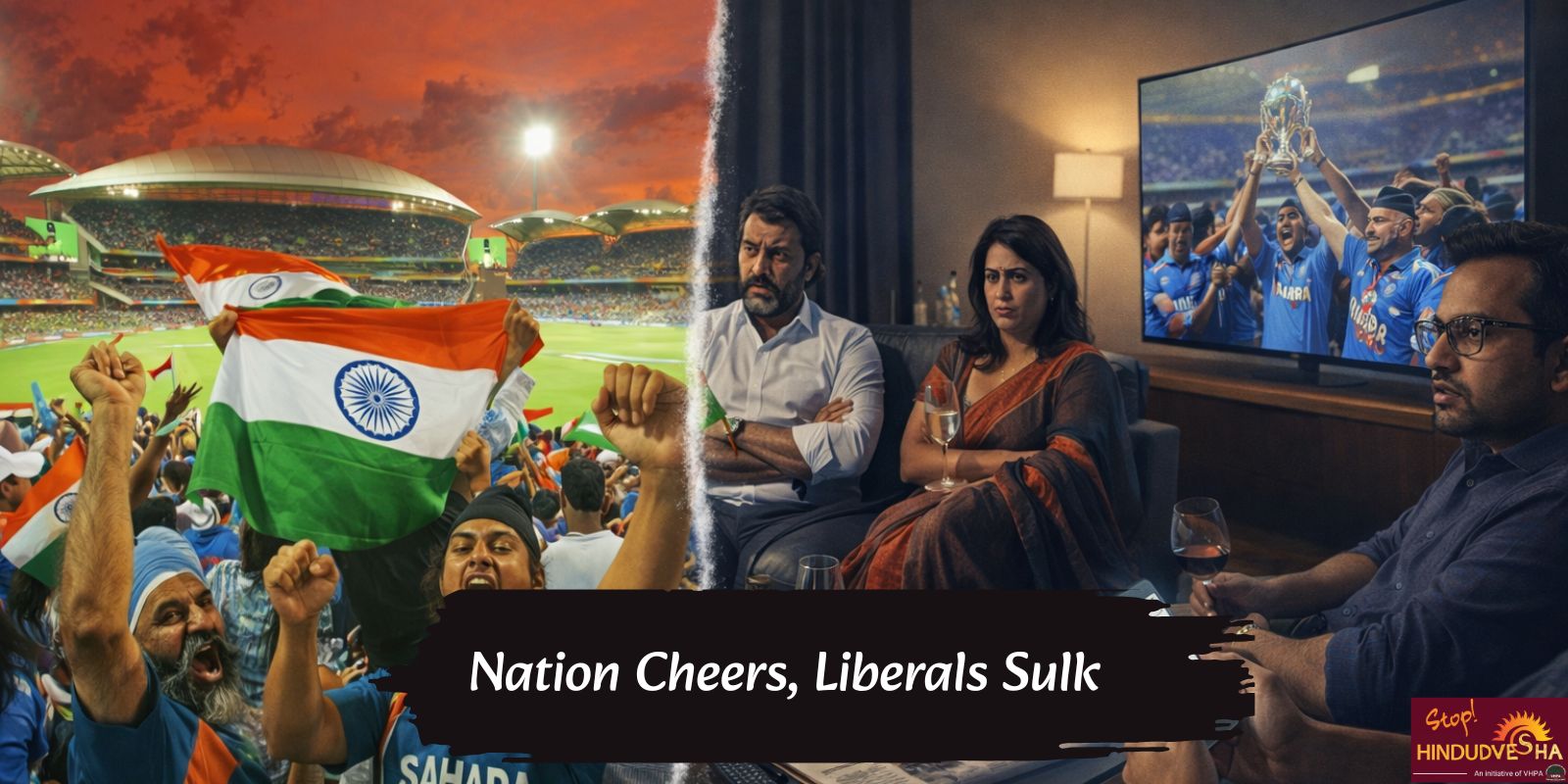
Summary
India’s cricketing victories, once moments of shared national pride, now reveal a growing cultural divide. While the broader public celebrates triumphs with unrestrained enthusiasm, a segment of India’s liberal elite often responds with skepticism, critique, and discomfort. This reaction reflects more than sporting disagreement; it signals a deeper ideological unease with the symbolism attached to India’s rise, particularly in the post-2014 era. Cricket, shaped by history and transformed into a global powerhouse by India’s economic and institutional strength, has become a site of contestation rather than unity. The result is a fractured sporting culture in which success is no longer simply celebrated but interrogated, qualified, and, at times, diminished.
At the 1980 Winter Olympics in Lake Placid, as the United States men’s ice hockey team skated onto the rink against the mighty Soviet Union, the entire country held its breath in a way that felt almost sacramental. The “Miracle on Ice,” as it came to be called, was not merely a sporting upset; it was a civic communion.[1] Democrats and Republicans, liberals in Cambridge and conservatives in Orange County, found themselves chanting the same refrain: “U-S-A! U-S-A!” President Jimmy Carter, beleaguered by inflation and the hostage crisis in Iran, praised the players as symbols of American resilience. Four years later, at the Los Angeles Olympics, the medal count rolled in like a tide, and even those who had marched against the Vietnam War or decried Ronald Reagan’s defense buildup could not suppress a flicker of pride.
Liberal Disdain for Indian Victories
Contrast this with the complicated choreography of Indian cricket, particularly in the fevered weeks leading up to an International Cricket Council tournament final. In March 2026, on a balmy evening in Ahmedabad, India dismantled New Zealand by 96 runs to claim its third T20 World Cup title. Fireworks lit the Stadium. Streets from Chandigarh to Chennai erupted in honking processions and impromptu celebrations. Yet in certain quarters—urban drawing rooms in South Delhi, English-medium newsrooms in Mumbai, the timelines of academics and columnists who style themselves as guardians of the old secular order—a different mood prevailed.[2] There were sighs rather than cheers, memes laced with irony rather than jubilation, and editorials that framed the triumph less as a national achievement than as a symptom of something askew: an overweening dominance they cannot handle. And when Indian skipper Suryakumar Yadav took the World Cup trophy to the Hanuman Temple, liberals reacted sharply, with Trinamool Congress politician Kirti Azad posting “Shame on Team India” on X.[3]
Shoaib Akhtar, the former Pakistani fast bowler known for his thunderous deliveries and, more controversially, for remarks about Pakistani and Central Asian Muslims one day entering India and fulfilling the Islamic prophecy of Ghazwa-e-Hind[4], captured the liberal sentiment with characteristic bluntness: “It’s like when there’s one rich kid in a neighborhoods who calls all the poor kids and says, ‘Come, let’s play cricket.’ Out of eight teams, they keep four, and out of those four, they call three again and move forward, and then they say, ‘See, I’ve won.’ They have ruined cricket entirely.”[5]
The remark ricocheted across Indian social media, amplified by those who saw in it not mere sour grapes but a mirror to their own unease. For a vocal segment of the commentariat—the left-liberals and Lutyens elites—India’s victories had begun to carry an ideological surcharge. The team’s success was no longer simply cricket; it was entangled with the muscular nationalism of “Naya Bharat,” or the New India.
What in America might register as uncomplicated patriotism here provoked reflexive skepticism: laments about flat pitches engineered for Indian batters, murmurs about the Board of Control for Cricket in India’s (BCCI) financial stranglehold, and a quiet discomfort with the nationalistic fervor that now seemed to accompany every boundary. As one commentator at the left-leaning Frontline magazine wrote, “BCCI has weaponized India’s beloved sport to further the ruling party’s divisive agenda and, in that process, fractured regional relations and stripped the game of its soul.”[6]
This pattern is not new, but it has sharpened in the past decade. When India reached the final of major tournaments—the T20 or ODI World Cups—the ritual of celebration among the masses coexisted uneasily with critique from the salons. Pitches were blamed, home advantage decried, and the BCCI’s scheduling power portrayed as a form of sporting imperialism.
At the same time, historical dominance by other teams, such as Australia’s golden era under Ricky Ponting in the early 2000s—three straight ODI World Cups and a 34-match unbeaten streak in the tournament—elicited no comparable domestic handwringing. Back then, Indian commentators marveled at Ponting’s ruthlessness without invoking the ruin of the game’s soul. Today, the same language of equity and balance is deployed selectively, often when Indian success aligns with the political symbolism of the ruling dispensation. The result is a perceived hypocrisy—one that reveals less about cricket than about the fractures in post-2014 India, where sport has become another arena in which elite anxieties about majoritarianism play out.
How Cricket Developed in India
To understand this, one must trace cricket’s long metamorphosis in the subcontinent. The game arrived with the British Raj, a colonial import played on maidan greens by anglicized elites. Yet it was swiftly appropriated. The 1983 World Cup triumph under Kapil Dev—India’s first, achieved against the odds in England—felt like a decolonizing rite. It was celebrated not as a Hindu assertion but as a collective thumbing of the nose at the former rulers. Left-leaning intellectuals, who had little patience for jingoism elsewhere, joined the street parties. The victory belonged to India, not to any ideological faction.
The 1990s and early 2000s brought commercialization. The BCCI, once a sleepy gentlemen’s club, transformed into a corporate behemoth, fueled by television rights and the Indian Premier League. Economic liberalization enriched the board; India’s vast market made it the financial engine of global cricket. Yet nationalism remained relatively subdued. The 2011 World Cup win, sealed under Mahendra Singh Dhoni’s cool captaincy with a six over the ropes in Mumbai, elicited near-universal euphoria. Even outlets skeptical of market excesses hailed it as a meritocratic triumph. Dhoni, who rose through grit rather than pedigree, embodied a softer, more inclusive narrative. There was little talk of pitches being “doctored” or of the BCCI’s dominance “ruining” the game for Bangladesh or Zimbabwe. Success was framed as earned, not engineered.
Post-2014 Inflection Point
The inflection came after 2014, when Modi’s government took office with an emphasis on cultural assertiveness and “cultural renaissance.”[7] It was this transition that provoked the backlash. Author Ramachandra Guha, a controversial figure who has drawn criticism for provocative public statements[8], expressed the Left’s unease with India’s rise in a 2025 essay. India, he argued, had become cricket’s “Vishwa-Bully”—the global hegemon whose financial clout had captured the International Cricket Council, much as past English and Australian empires had shaped the game on their terms.[9]
The Wire, often criticized by its detractors for inaccuracies[10], accused the BCCI of converting cricket into a proxy for war against Pakistan. “The matches (usually played in the Narendra Modi Stadium at Ahmedabad) have not been marketed as a celebration of shared heritage or even as an intense sporting contest. On the contrary, they have been sold as one imagines a fun day at the Colosseum would have been advertised in Ancient Rome. With no Pakistani fans in the stadium, the implication is that the Pakistan team exists simply to be thrown to the metaphorical lions for our entertainment, and wealthy Indians from cities like Mumbai and Ahmedabad in particular have been willing to pay large sums to view this spectacle.”[11]
Tensions in India-Pakistan Rivalry
Nowhere does this tension peak more sharply than in India-Pakistan encounters. Burdened by history, the wounds of Partition, and the enduring tensions over Kashmir, this rivalry has never been just about sport. Yet in recent years, segments of the Indian elite have championed “Aman ki Asha”—hope for peace—framing matches as opportunities for people-to-people diplomacy, even as Pakistani commentary often veers into conspiracy (match-fixing allegations, claims of ICC ownership).
The liberal cabal in India tends to sanitize Pakistani hostility to preserve a narrative of moral equivalence. When Indian crowds or players display raw emotion—refusals to shake hands with overtly jihadi Pakistani players[12] and chants of “Victory to Mother India”—it is decried as hyper-nationalism; when Pakistani fans burn effigies or cheer against India, it is sometimes contextualized as understandable resentment. The double standard is not lost on the broader public. As one Substack analysis noted, some liberals appear to require a “normal” Pakistan to sustain their critique of domestic majoritarianism, downplaying the anti-India rhetoric that still permeates segments of Pakistani discourse.[13]
Sociological and Psychological Roots
The sociological roots run deep. India’s urban, English-speaking liberals—many products of elite institutions and inheritors of a postcolonial contempt for the ordinary Indian—view the nationalism of the cricket-watching masses as jingoistic excess. It echoes older anxieties about subaltern energies overwhelming the secular state. Social media offers a microcosm: viral videos of street celebrations juxtaposed with temple visits by cricketers, including a Muslim, Zaheer Khan, and their wives.[14]
For some, the team’s triumphs threaten a cherished self-image as custodians of the idea of India. As the Substack author notes: “Indian left-liberal elites have, since Independence, positioned themselves as the enlightened vanguard dragging a benighted Hindu society into ‘modernity.’ Their self-image depends on a sharp vertical hierarchy: on top, the cosmopolitan, secular, English-speaking minority; below, the traditional, vernacular Hindu majority that must be lectured, reformed, and disciplined. To sustain this pyramid, it is essential that the majority never feels morally secure or civilizationally confident.”[15]
The pattern is well documented. Reddit threads and X discussions in left-leaning spaces after recent victories reveal a minority current of schadenfreude at India’s losses, often rationalized as resistance to Hindutva optics. A 2023 Indian Express op-ed captured the mood bluntly: “I am not sad that India lost the World Cup. Hyper-nationalism has ruined cricket for me.” Its author framed defeat as a rebuke to those who reduced the game to “surgical strikes” and masculine ego.[16]
Essentially, the left-liberal stance is this: if India wins, label it as majoritarianism; if India loses, celebrate. To paraphrase Satan in The Devil’s Advocate, they want to set the rules in opposition; it’s the goof of all time.[17]
Cricket’s Democratizing Force
Yet this elite skepticism sits uneasily beside cricket’s democratizing force. The IPL has professionalized the sport, creating talent pipelines that benefit players from small towns and, indirectly, associate members worldwide.[18] India’s investments in infrastructure have elevated global standards. Smaller nations complain of marginalization, but many also acknowledge the revenue that flows from Indian viewership. The BCCI’s power is real, but so is the talent that produces players like Jasprit Bumrah, Ishan Kishan, and Suryakumar Yadav, whose skills transcend any boardroom machination.
Compare this again to the United States. American identity politics, for all its intensity, rarely weaponizes Olympic golds or Super Bowl wins against domestic foes. Team USA’s dominance in basketball or swimming is celebrated across the aisle; critics focus on funding or doping, not on the medals themselves as affronts to equity. In India, by contrast, the masses love cricket as a sport, but liberals often view it as a site of ideological contestation.
The Costs of Liberals’ Calumny
The costs are tangible and far-reaching. Internationally, persistent narratives portraying India and the BCCI as a bullying hegemon—relentlessly amplified by sections of the leftist media—steadily erode goodwill and diplomatic capital in the cricketing world. Accusations of a financial stranglehold, schedule manipulation, and turning the sport into a “one-team pageant” have gained traction among smaller boards and commentators, despite India’s massive revenue contribution to sustaining global cricket.
Domestically, this manufactured divide risks alienating minorities and liberals from what should be a shared national symbol. Instead of fostering unity, the reflexive skepticism and selective outrage deepen the very polarization these critics claim to decry. Street celebrations after triumphs like the 2026 T20 World Cup are dismissed as “performative patriotism” or “majoritarian excess,” while genuine mass euphoria is painted as jingoistic. The result is a fractured sporting culture where elite discomfort with “Naya Bharat” symbolism overrides collective pride, weakening cricket’s potential as a unifying force in a diverse and chaotic democracy. Such calumny ultimately harms the game and the nation more than any on-field dominance ever could.
Conclusion: Liberals Become the Laughing Stock
In the 2021 T20 World Cup, India lost a rare match to Pakistan. The schadenfreude from some secular commentators was swift. Radhika Khera, then the national media coordinator of the Congress party, posted in Hindi, which roughly translates to: “What, Hindu nationalists? How’s the taste? You have managed to humiliate yourselves?”
Pointing out the hypocrisy, veteran journalist Sandipan Deb described the rants as “vacuous intellectualization to establish some sort of liberal credentials.”[19]
“Where is the cricket in all of this?” he wondered. “The one constant claim for social media ‘liberals’ has been that they are intellectually superior to the ‘IT cell trolls.’ But they have just revealed how petty and vicious they are. It is shameful that they wantonly celebrate a defeat, are more cruel to the Indian team than the ‘illiterate’ fans they scoff at daily, and make it out to be a defeat for India as a nation. Indians who celebrate their team’s sporting defeat as some sort of Waterloo for a democratically elected government must have a really strange and self-hating ‘idea of India.’ What they have performed is a tasteless comedy act where the world laughs at you, not with you.”
Still, depoliticized patriotism is possible and inevitable. India’s rise is rooted in genuine excellence—training regimens, scouting networks, and a deep talent pool—not in administrative fiat or match-fixing (which, incidentally, is an art that the liberals’ favored country excels at).[20] Celebrating that need not require caveats about “ruining the game.”
Citations
[1] “U.S. Hockey Team Makes ‘Miracle on Ice.’” History.com. https://www.history.com/this-day-in-history/February-22/u-s-hockey-team-makes-miracle-on-ice
[2] “Miracle on Ice (Video).” YouTube. https://www.youtube.com/watch?v=aHsSPGUODfU
[3] “Ours Is a Democratic Country: Kirti Azad Claps Back at Gautam Gambhir over Temple Controversy.” Mint. https://www.livemint.com/sports/cricket-news/ours-is-a-democratic-country-kirti-azad-claps-back-at-gautam-gambhir-over-temple-controversy-t20-world-cup-11773214822667.html
[4] “India Have Ruined Cricket: Shoaib Akhtar Slams India after Historic T20 World Cup Win.” The Times of India. https://timesofindia.indiatimes.com/sports/cricket/icc-mens-t20-world-cup/india-have-ruined-cricket-shoaib-akhtar-slams-india-after-historic-t20-world-cup-win/articleshow/129315213.cms
[5] “Shoaib Akhtar and ‘Ghazwa-e-Hind’ Viral Video.” OpIndia. https://www.opindia.com/2020/12/shoaib-akhtar-ghazwa-e-hindi-viral-video/
[6] “BCCI, Hindutva Politics and Indian Cricket Crisis.” Frontline. https://frontline.thehindu.com/social-issues/bcci-hindutva-politics-indian-cricket-crisis/article70599637.ece
[7] “India’s Cultural Renaissance: A Journey of Heritage, Unity and Global Influence.” DD News. https://ddnews.gov.in/en/indias-cultural-renaissance-a-journey-of-heritage-unity-and-global-influence/
[8] “Eminent Historian Ramachandra Guha Removes Beef Tweet after Facing Flak, Threats.” Hindustan Times. https://www.hindustantimes.com/india-news/eminent-historian-ramchandra-guha-removes-beef-tweet-after-facing-flak-threats/story-TpCyVSOkonDqlWCHsiBUKI.html
[9] “The Vishwa Bully: India as International Cricket’s Hegemon.” The Telegraph India. https://www.telegraphindia.com/opinion/the-vishwa-bully-india-as-international-crickets-hegemon-prnt/cid/2119292
[10] “Meta to Shut Down ‘Reliable Sources’ Newsletter.” CNN. https://edition.cnn.com/2022/10/11/media/meta-news-outlet-reliable-sources
[11] “India-Pakistan Cricket Diplomacy and the Politics of Shaking Hands.” The Wire. https://thewire.in/south-asia/india-pakistan-cricket-bcci-diplomacy-shaking-hands
[12] “Cricket as Jihad: Time to Ostracise Pakistan.” Swarajya. https://swarajyamag.com/politics/cricket-as-jihad-time-to-ostracise-pakistan
[13] “Why India’s Left-Liberal Gatekeepers…” Reverse the Gaze (Substack). https://reversethegaze.substack.com/p/why-indias-left-liberal-gatekeepers
[14] “Instagram Reel.” Instagram. https://www.instagram.com/reel/DUUyJrgDFey/
[15] “Why India’s Left-Liberal Gatekeepers…” Reverse the Gaze (Substack). https://reversethegaze.substack.com/p/why-indias-left-liberal-gatekeepers
[16] “Cricket Outsider Writes: It’s Not a Game, It’s a Business That Promotes Narrow Nationalism.” The Indian Express. https://indianexpress.com/article/opinion/columns/cricket-outsider-writes-its-not-a-game-its-a-business-that-promotes-narrow-nationalism-9035864/
[17] “Cricket Video (YouTube).” YouTube. https://www.youtube.com/watch?v=jARp24AJWLk
[18] “How IPL Led India’s Billion-Dollar Sports Revolution.” IISM World. https://iismworld.com/blog/how-ipl-led-indias-billion-dollar-sports-revolution/
[19] “How India’s T20 Loss to Pakistan Lets Our Social Media Liberals Take off Their Masks.” Firstpost. https://www.firstpost.com/india/how-indias-t20-loss-to-pakistan-lets-our-social-media-liberals-take-off-their-masks-10087431.html
[20] “Betrayal at Lord’s: When World Cricket Was Rocked by Spot-Fixing Scandal in 2010.” The Times of India. https://timesofindia.indiatimes.com/sports/cricket/news/betrayal-at-lords-when-world-cricket-was-rocked-by-spot-fixing-scandal-in-2010/articleshow/113881783.cms

Donate to HINDUDVESHA
Our Mission is to explore and expose Hindudvesha through research analysis, education and response.
SUPPORT US