

$25 Million Betrayal: How Mittal Cash Powers Harvard’s Anti-Hindu Narrative Machine
 Rakesh Krishnan Simha · 04/02/2026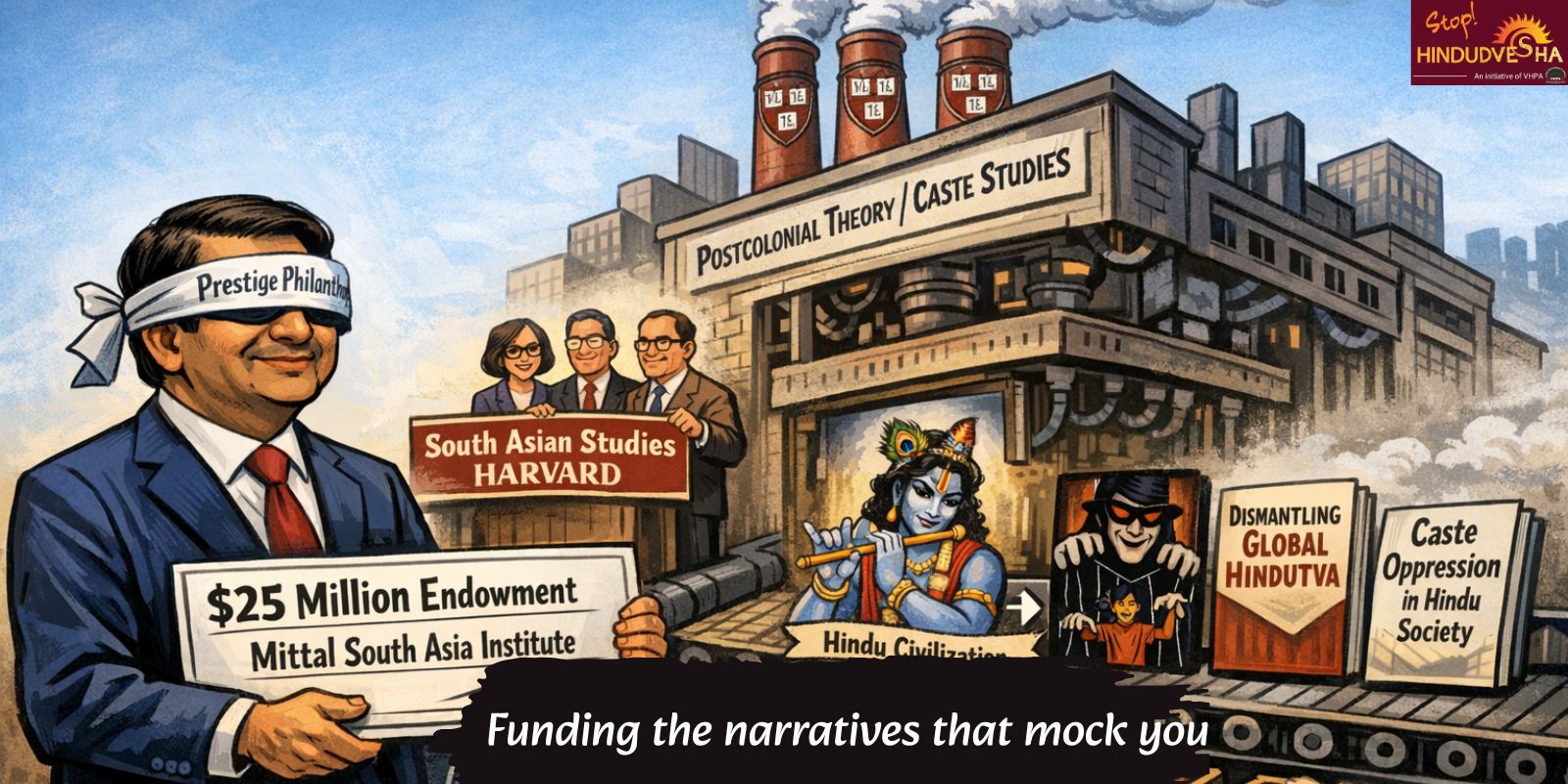
Summary
The article examines a growing paradox in global philanthropy: wealthy Indian donors funding Western academic institutions whose scholarship often portrays Hinduism and India negatively. Triggered by Harvard’s controversial Sanskrit course image depicting Krishna as a manipulative puppet master, the controversy exposed deeper structural issues in South Asian studies. Donations such as the Mittal family’s $25 million endowment to Harvard’s South Asia Institute have helped sustain academic ecosystems that frequently frame Hindu traditions through narrow ideological lenses. Unlike Chinese philanthropic models that attach strategic conditions, Indian donors often give without oversight. The article argues that diaspora philanthropy must evolve toward accountable, strategic giving that protects civilizational interests while supporting genuine scholarship.
In the dim glow of a promotional image for Harvard’s Elementary Sanskrit course, a shadowy figure looms, its forehead marked with a tilak — a sacred Hindu symbol — while ghostly puppets dangle from its hands. [1] The scene, evoking a puppet master’s sinister control, was meant to entice students into the ancient language of the Vedas. Instead, it ignited a firestorm. Released in early 2026 by the Department of South Asian Studies, part of the Lakshmi Mittal and Family South Asia Institute, the artwork drew accusations of blatant Hinduphobia. Critics, including the Coalition of Hindus of North America (CoHNA), likened it to Nazi-era caricatures of Jewish bankers as manipulative overlords, a visual trope of dehumanization that has haunted history’s darkest chapters. [2] The resemblance was uncanny: a blue-tinted silhouette manipulating figures reminiscent of the Pandavas from the Mahabharata, implying Krishna — Hinduism’s beloved deity of wisdom and divine play — as a malevolent schemer.
Unusually, Harvard issued an apology within days. “We deeply regret the posting of an insensitive image in relation to our Sanskrit program,” the department stated, attributing the artwork to Indian artist Anirudh Sainath and noting its inspiration from Hindu epics like Krishna’s Ras Leelah. [3] But for many in the Hindu diaspora, the damage was done. This wasn’t an isolated gaffe; it was a symptom of a deeper malaise at elite American institutions, where generous donations from Indian billionaires like the Mittals have inadvertently — or perhaps negligently — bankrolled narratives that vilify Hinduism and India. In a follow-up post, CoHNA referenced a 2020 incident in which Harvard University Press featured another Hinduphobic cartoon to promote a book by university professor Ajantha Subramanian on caste, saying Hinduphobia had a “long shelf life” at the university. [4]
As one wag commented, “Our gods are turned into villains in the very halls funded by our own.”
Mittals: Serial Offenders
This isn’t the first time the Mittal-backed South Asia Institute has acted against India’s interests. In 2025, it bankrolled a “Pakistan Conference 2025” in the aftermath of the Pahalgam terrorist attack carried out by Pakistan-backed terrorists. The one-day academic event was organized by Pakistani students along with faculty advisers, with the institute providing logistical support. [5]
Delegates included notorious Hindu-haters such as Muhammad Aurangzeb, Pakistan’s finance minister; Rizwan Saeed Sheikh, Pakistan’s ambassador to the United States; and journalist Hamid Mir, who kept carping about the “Indian clout in US academia,” prompting the Pakistani envoy to pledge that Islamabad would revive its own academic chairs. The institute’s executive director, Hitesh Hathi, also took part in a discussion with Pakistani historian Ayesha Jalal on “The Enlightened Muslim.” [6]
Facing backlash from Indian students and activists, who argued that it risked complicity with a nation harboring terrorists, the Mittal family issued a statement saying the event had been scheduled without consulting them. A spokesperson for the family drew attention to a statement from the institute noting that it “did not consult any benefactor of the Institute about this conference” and that Pakistani students at Harvard, along with their faculty adviser, “independently determined the topics and speakers presenting.”
Donations Without Oversight
The Mittal family’s generous $25 million gift in 2017 renamed Harvard’s South Asia Institute after Lakshmi Mittal, whose ArcelorMittal steel empire spans the globe. Announced with fanfare, the endowment aimed to foster engagement with South Asia across disciplines, from the sciences to the humanities. [7] “International centers like this serve as a vital conduit between the University and the world we study,” Harvard President Drew Faust said at the time. [8] Mittal himself framed it as a bridge to help ensure India’s prosperity. Yet, nearly a decade later, the institute has become a flashpoint for controversy, accused of amplifying anti-Hindu biases under the guise of scholarship.
Here’s the deal. While the Mittal Institute did not commission or host the controversial image, its gargantuan endowment contributes to Harvard’s South Asia infrastructure. The institute and the Department of South Asian Studies share faculty overlaps, events, and a common institutional umbrella. Unrestricted funding sustains an academic culture in South Asian Studies long criticized for postcolonial, Marxist, and caste-obsessed frameworks that prioritize the deconstruction of Hindu traditions over affirmative scholarship. Scholars like Wendy Doniger, Sheldon Pollock, and Audrey Truschke have faced accusations of reductive or hostile interpretations of Hindu texts; the 2021 “Dismantling Global Hindutva” conference (co-sponsored by over 50 U.S. departments, including Harvard’s) exemplified this trend, drawing protests for equating Hindu cultural assertion with supremacism.
Funding Baseless Research
Another egregious case is a 2017 ‘research’ paper by Ranjani Srinivasan, a shadowy figure known for promoting radical ideologues. Her paper, titled “Gold & Cyanide: Family, Caste, and the Post-extractive Landscape at Kolar Gold Fields,” is a textbook example of Mickey Mouse academics — university work that lacks depth or real-world relevance. [9] The paper, funded by the Mittal Institute, explores the socio-economic aftermath of mining in India. If banality has an address, it is found in these pages. The paper is laughable in its contrived premise and lack of purpose, serving only as a vehicle for self-promotion or for pushing an anti-Hindu narrative. Her central argument is that the gold mines’ high-caste owners exploited lower-caste laborers.
The issue here is that Srinivasan is being economical with the truth — the Kolar Gold Fields were owned by the British before India’s independence, and it was the colonial government that ran the mine. The British, not Indians, exploited poor laborers by dumping cyanide waste near their homes. Srinivasan reframed colonial abuse as caste oppression.
The Mittal family’s lack of strings attached meant that no donor review board or cultural advisory panel existed to flag such portrayals. Indian-American activists argue that this enables Hinduphobia backed by the Mittal family’s mega donation.
Here’s some advice for the Mittal family: when you fall into a hole, stop digging. The argument that the Mittals weren’t consulted doesn’t wash. If you bankroll an organization, you are at the very least morally responsible for its acts of omission and commission. Worse, allowing Pakistani students to independently determine the topics for discussion at an Indian-funded institute is the equivalent of giving your adversary the means to attack you. What were the Mittals thinking? That the Pakistanis would organize a Festival of India?
This paradox raises uncomfortable questions: Why do Indian philanthropists, unlike their Chinese counterparts, donate without strings attached? And how has this laissez-faire approach allowed Hinduphobia to flourish, harming Hindus and India in ways that echo colonial-era distortions?
To understand this, one must delve into the ecosystem of American academia, where foreign donations pour in like monsoon rains — $57.97 billion since 1986, with a surge of $29 billion between 2021 and 2024 alone. [10] Indian billionaires have been generous players. The Tatas gave $50 million to Harvard Business School in 2010, the largest international donation in its history, funding Tata Hall. [11] Anand Mahindra donated $10 million to the Humanities Center in 2010, renaming it after his family. [12] Ajay Piramal and Nandan Nilekani followed suit with millions to Harvard and Yale, respectively. [13] The Godrejs, too, have supported various initiatives. These gifts, often born of alumni loyalty or national pride, come with no explicit demands for pro-India content. As Ratan Tata reflected on his Harvard donation, it was a privilege and a pleasure to “give back to Harvard a little bit of what it gave to me.” [14] Basically, it was a payback to his alma mater, nothing more.
The Chinese Way of Donations — Our Way or the Highway
Contrast this with Chinese billionaires, whose philanthropy is often strategic and aligned with Beijing’s interests. Ma Huateng of Tencent donated millions to Princeton and MIT, funding projects like the China Impact Project, which examines U.S. media perceptions of China — potentially softening critical narratives. [15] Duan Yongping gave $30.9 million to Beijing Normal University, but his U.S. ties underscore a pattern: Chinese donors frequently impose conditions, ensuring that research bolsters pro-China views or facilitates access to U.S. technology. [16] A 2024 Wall Street Journal investigation revealed that nearly 200 U.S. universities held $2.32 billion in contracts with Chinese businesses from 2012 to 2024, often for research in AI and semiconductors — fields vital to China’s military ambitions. [17] The U.S. government has scrutinized these ties, uncovering undisclosed funds funneled to advance CCP goals, including censorship and espionage.
Indian donors, by contrast, eschew such oversight. Unlike Chinese billionaires, who make it incumbent upon recipients to produce studies that benefit China one way or another, Indian billionaires often do not hold recipients accountable. This hands-off approach stems from a mix of gratitude — many are alumni — and a Hindu cultural emphasis on selfless giving, or “daana.” [18] But it leaves the door open for misuse, as has repeatedly happened at Harvard.
Harvard — Home of Hinduphobia
Hinduphobia at Harvard manifests in subtler ways as well. Admissions data has revealed systemic bias against Asian-American applicants, including Indians (predominantly Hindu), who receive lower “personality” scores despite stellar academic records. [19] Harvard’s Asian enrollment has historically hovered below 13 percent, compared with 45 percent at merit-based Caltech. Author Malcolm Gladwell has called this exclusionary, echoing colonial strategies to destabilize Indian unity. In classrooms, Hinduism is often portrayed through a narrow lens of caste oppression and violence, ignoring its philosophical depth. A Houston University student in 2025 accused a Hinduism course of misrepresentation, citing syllabus language that denigrated “Hindutva” as nationalist bigotry. [20]
The 2021 “Dismantling Global Hindutva” conference, co-sponsored by more than 40 universities, including Harvard affiliates, exemplified this trend. Organizers faced criticism from Hindu groups, who argued that it equated Hinduism with extremism and fostered hostility. [21] Speakers amplified narratives portraying Hindutva — a term associated with Hindu cultural identity — as akin to fascism, while denying the existence of Hinduphobia. Such events, funded indirectly through endowments like Mittal’s, create an endogenous cycle of bias: distorted scholarship begets further distortion, perpetuating stereotypes.
Mechanisms of Harm: Stereotypes, Admissions Bias, and Geopolitical Fallout
The fallout extends beyond campuses. Unaccountable funding perpetuates harm in multiple ways.
First, cultural stereotyping. Portrayals such as the puppet-master Krishna normalize viewing Hindu deities and epics through a lens of manipulation, echoing colonial “divide and rule” tactics or Dravidianist critiques. This shapes future policymakers, journalists, and business leaders exposed to Harvard curricula. For Hindus in the United States, numbering around 2.5 million, these narratives can fuel microaggressions and hostility. FBI data shows that anti-Hindu hate crimes, though underreported, trail anti-Jewish incidents but exceed anti-Muslim incidents in some years. [22] Hindu students report feeling attacked for defending their faith, as seen in California textbook battles where Hinduism was stereotyped as oppressive. [23]
Second, admissions and representation. Harvard has historically rated Asian applicants — including high-achieving Indians, many of them Hindu — lower on subjective traits such as “personality” and “likability,” a practice documented in the 2018 Students for Fair Admissions lawsuit. [24] Before the 2023 Supreme Court ruling on affirmative action, Asian enrollment hovered lower relative to merit-based expectations; by contrast, Caltech’s merit-based model showed more than 40 percent Asian enrollment. After the ruling, Harvard’s Class of 2029 saw Asian American freshmen rise to 41 percent. [25] Yet legacy preferences, athletic admissions, and donor-related considerations persist, potentially disadvantaging Indian applicants. Institutes that focus heavily on critiquing “Hindu nationalism” may also signal that applicants critical of India are more academically acceptable, subtly discouraging expressions of cultural pride.
Third, geopolitical and soft-power damage. Narratives emerging from Mittal-funded or adjacent programs can influence U.S. policy discourse about India, framing it primarily as majoritarian or caste-oppressive rather than as a complex and vibrant democracy. The “Dismantling Global Hindutva” conference and similar events have fueled divisions within the diaspora and shaped international commentary. India’s image can suffer, while Hindu temples and communities abroad sometimes face heightened scrutiny or vandalism linked to such narratives. Biased academic frameworks can travel outward as graduates enter think tanks, media organizations, and government institutions.
Finally, there is the question of self-inflicted cultural erosion. By directing large donations to Western universities rather than domestic institutions, Indian billionaires divert resources that could otherwise strengthen Indian universities, support independent research centers, or preserve historical heritage. In effect, wealthy Hindu families risk subsidizing academic frameworks that often deconstruct their own civilizational traditions.
Stepping Back from Civilizational Suicide
Yet the Mittals and their peers are not villains; they are philanthropists caught in a web of unintended consequences. Lakshmi Mittal, born in Rajasthan and knighted in Britain, embodies the global Indian success story. His donation was widely praised as a milestone. But without accountability, such gifts can become double-edged swords. As Rajiv Malhotra, a critic of academic Hinduphobia, argues, Indian donors must shift from passive giving to strategic oversight. [26]
Solutions abound. Indian billionaires and the diaspora must evolve beyond prestige philanthropy. Here are some practical recommendations:
- Conditional Giving with Oversight: Insert clauses requiring donor advisory boards with Hindu scholars and Indian representatives to review content involving religious depictions. Fund chairs in “Hindu Studies” or “Dharmic Civilizations” that emphasize primary sources and balanced scholarship.
- Build Alliances: Partner with groups like CoHNA and HinduPACT for training and policy review. Advocate for legislation recognizing Hinduphobia, as seen in resolutions passed in Georgia and Ohio. U.S. Rep. Shri Thanedar’s 2024 House Resolution 1131 is a starting point.
- Accountability Mechanisms: Establish foundations that audit grants for bias. Support lawsuits or congressional scrutiny of foreign funding transparency, building on U.S. Section 117 disclosures. Engage Harvard directly to encourage more balanced programming.
- Alternative Ecosystems: Beyond reforming Western institutions, Indian donors should prioritize building alternative intellectual ecosystems, including think tanks, digital platforms, and K–12 educational curricula presenting balanced accounts of Indian history and philosophy. Organizations such as CoHNA and other global Hindu advocacy groups can help monitor and engage with universities.
- Cultural Confidence: Indian industrialists should study successful models such as Jewish philanthropists who fund Holocaust education and Israel studies with built-in safeguards. They should also demand reciprocity: if Harvard hosts Pakistan-focused events during periods of tension, it should support robust India-focused programming equally.
- Policy Advocacy: Lobby for U.S. legislation mandating cultural-sensitivity audits for foreign-funded regional studies, similar to foreign-agent registration frameworks. In India, encourage domestic philanthropy through tax reforms that reward strategic giving.
- Promote Counter-Narratives: Fund scholars and research initiatives that challenge distortions through conferences, books, and academic publications.
- Educate Donors: Forums such as Indiaspora could host discussions on strategic philanthropy, helping donors understand how academic ecosystems function and how their contributions shape narratives.
- Domestic Prioritization: Redirect some philanthropic resources toward rebuilding ancient Indian monuments through trusts restoring sites such as Kashi or Mathura, endowing Indian universities such as the IITs and central universities, or creating domestic research centers on the Indian Subcontinent — often labeled “South Asia” in the West — free from ideological capture. One model is the €300 million gift by French tycoons François Pinault and Bernard Arnault to rebuild the Notre-Dame Cathedral in 2019.
Endgame: Reform or Perish
The Mittal family, like many Indian donors, acted with generosity, though often motivated by a sense of prestige. Their endowment advanced knowledge exchange. Yet without accountability, such gifts risk subsidizing narratives that alienate the very civilization they represent. Harvard’s apology in the Sanskrit case shows that institutions do respond to pressure; sustained engagement can reshape the ecosystem.
Hindus and India deserve philanthropy that protects rather than undermines their heritage. By attaching reasonable cultural safeguards — not censorship — Indian billionaires can transform themselves from unwitting enablers into strategic guardians. The alternative is continued erosion: Harvard-trained elites shaping a world where Krishna is portrayed as a manipulator, India as a problem, and Hindus as perpetual outsiders. The choice, and the responsibility, rests with the donors.
Citations
[1] Coalition of Hindus of North America (CoHNA). “Post on X.” https://x.com/CoHNAOfficial/status/2027182386245444052/photo/1
[2] Campaign Against Antisemitism. Antisemitic Imagery May 2020. https://antisemitism.org.uk/wp-content/uploads/2020/07/Antisemitic-imagery-May-2020.pdf
[3] NDTV. “Harvard University Apologises Over ‘Insensitive’ Social Media Post on Sanskrit Program.” https://www.ndtv.com/world-news/harvard-university-apologises-over-insensitive-social-media-post-on-sanskrit-program-11148288
[4] Coalition of Hindus of North America (CoHNA). “Post on X.” https://x.com/CoHNAOfficial/status/2027182388875239867?s=20
[5] Times of India. “Harvard Under Fire for Hosting Pakistan Conference After Pahalgam Terror Attack.” https://timesofindia.indiatimes.com/world/us/harvard-under-fire-for-hosting-pakistan-conference-after-pahalgam-terror-attack/articleshow/120737863.cms
[6] Times of India. “Mittal Family Says It Was Not Consulted on Harvard’s Pakistan Conference by Institute They Funded.” https://timesofindia.indiatimes.com/world/us/mittal-family-says-it-was-not-consulted-on-harvards-pakistan-conference-by-institute-they-funded/articleshow/120769833.cms
[7] Harvard University. Mittal South Asia Institute. “Mittal Family Donates $25M to SAI.” https://mittalsouthasiainstitute.harvard.edu/2017/10/mittal-family-donates-25m-to-sai/
[8] Harvard Gazette. “Mittal Family Gift Expands Opportunities for South Asia Engagement.” https://news.harvard.edu/gazette/story/2017/10/mittal-family-gift-expands-opportunities-for-south-asia-engagement/
[9] StopHinduDvesha. “Brown Money, Red Agendas: How Indian Billionaires Are Funding the Ivy League’s War on India.” https://stophindudvesha.org/brown-money-red-agendas-how-indian-billionaires-are-funding-the-ivy-leagues-war-on-india/
[10] The Free Press. “Explosion in Foreign Funding for American Universities.” https://www.thefp.com/p/explosion-in-foreign-funding-for-american-universities
[11] StopHinduDvesha. “Brown Money, Red Agendas: How Indian Billionaires Are Funding the Ivy League’s War on India.” https://stophindudvesha.org/brown-money-red-agendas-how-indian-billionaires-are-funding-the-ivy-leagues-war-on-india/
[12] Times of India. “Global Indians Who Have Donated Millions of Dollars to US Universities.” https://timesofindia.indiatimes.com/india/global-indians-who-have-donated-millions-of-dollars-to-us-universities/articleshow/101487950.cms
[13] Rajiv Malhotra. “Harvard and the Indian Billionaires.” https://rajivmalhotra.com/harvard-and-the-indian-billionaires/
[14] Governance Now. “Giving Back to Alma Mater: Ratan Tata Gifts $50M to Harvard.” https://www.governancenow.com/news/regular-story/giving-back-alma-mater-ratan-tata-gifts-50mn-harvard
[15] Washington Free Beacon. “Controversial Chinese Tech Billionaire Gives Millions to Elite American Universities.” https://freebeacon.com/national-security/controversial-chinese-tech-billionaire-gives-millions-to-elite-american-universities/
[16] Facebook. “Shared Post.” https://www.facebook.com/share/p/1BJZETceb9/
[17] National Association of Independent Colleges and Universities (NAICU). “Research for Sale: How Chinese Money Flows to American Universities.” https://www.naicu.edu/news-events/headline-news/2024/04/research-for-sale-how-chinese-money-flows-to-american-universities/
[18] Exotic India Art. “Dana (The Concept of Giving in Hinduism).” https://www.exoticindiaart.com/article/dana/?srsltid=AfmBOorxOY5fijDThJLmkatOZ9PsRwYYiKbzNw3FaCp0HbqZmtRyx3sS
[19] StopHinduDvesha. “Harvard’s Hinduphobia: Why It’s Getting Harder for Hindus to Enter the Ivy League.” https://stophindudvesha.org/audio/harvards-hinduphobia-why-its-getting-harder-for-hindus-to-enter-the-ivy-league/
[20] Times of India. “Misrepresented, Portrayed Negatively: Indian-American Student on Hinduism Course by Houston University.” https://timesofindia.indiatimes.com/nri/us-canada-news/misrepresented-portrayed-negatively-indian-american-student-on-hinduism-course-by-houston-university/articleshow/119696274.cms
[21] Hindu American Foundation. “Dismantling Global Hindutva Is Hinduphobic.” https://www.hinduamerican.org/blog/dismantling-global-hindutva-is-hinduphobic
[22] Voice of Hindus. “Hinduphobic Assaults by Anti-Hindu Hate Organizations: Who Are They?” https://voiceofhindus.org/hinduphobic-assaults-by-anti-hindu-hate-organizations-who-are-they/
[23] Coalition of Hindus of North America (CoHNA). “Hinduphobia.” https://cohna.org/hinduphobia
[24] The Guardian. “Harvard Sued for Discrimination Against Asian Americans.” https://www.theguardian.com/education/2018/jun/15/harvard-sued-discrimination-against-asian-americans
[25] WBUR. “Harvard Freshman Enrollment Data by Race.” https://www.wbur.org/news/2025/10/23/harvard-freshman-enrollment-data-race
[26] Rajiv Malhotra. “Dismantling Global Hindutva and the American Nexus of Hinduphobia.” https://rajivmalhotra.com/dismantling-global-hindutva-and-the-american-nexus-of-hinduphobia/

Donate to HINDUDVESHA
Our Mission is to explore and expose Hindudvesha through research analysis, education and response.
SUPPORT US