

From Snake Charmers to Superpower: Norway’s Uneasy Gaze at a Rising India
 Rakesh Krishnan Simha · 03/18/2026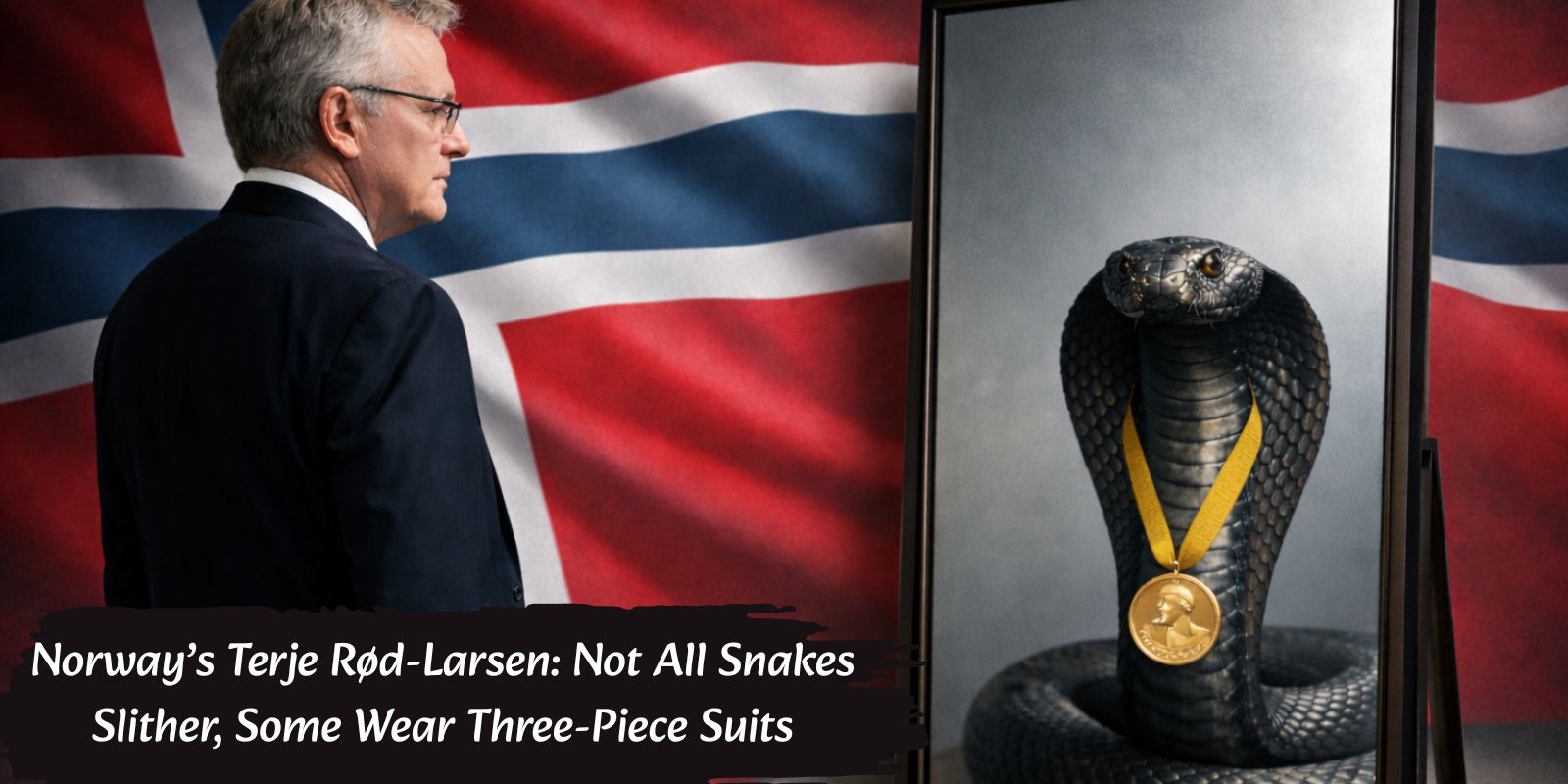
Abstract
This article examines how a resurfaced 2015 email from Norwegian diplomat Terje Rød-Larsen, containing a racist slur about Indians, has undermined Norway’s carefully cultivated image as a neutral moral authority. It situates the episode within Norway’s broader “peace brand,” shaped by the Nobel Peace Prize, NATO alignment, and decades of liberal internationalism. The piece argues that Rød-Larsen’s remarks, alongside his later ties to Jeffrey Epstein, expose deeper contradictions between public virtue and private conduct.
Against this backdrop, the article explores India’s rise as a confident, civilizational state that resists Western ideological templates. India’s strategic autonomy, electoral mandates, climate positions, and Global South leadership challenge long-standing Western assumptions. The analysis suggests that Norway’s discomfort reflects a wider liberal disorientation in a multipolar world. Ultimately, the article contends that sustaining moral relevance today requires humility, self-reflection, and genuine engagement with non-Western perspectives rather than inherited hierarchies.
On Christmas Day, 2015, as families across Europe and America unwrapped gifts beneath spruce trees stitched with electric stars, Terje Rød-Larsen—the silver-haired Norwegian diplomat who had once helped midwife the Oslo Accords—sat down to compose an email to Jeffrey Epstein. The message, unearthed years later among court-released materials, contained a line that seemed to have drifted in from some moth-eaten colonial club: “Have you heard the saying: when you meet an Indian and a snake, kill the Indian first![1]” The remark was not delivered in public debate or in a diplomatic cable, but in private correspondence to a man already notorious for his predatory appetites and his 2008 plea deal in Florida [2].
The sentence landed like an anachronism—part Empire, part locker room—yet it also illuminated something more unsettling: a fissure in Norway’s cultivated self-image as a neutral, peace-brokering nation above the fray. Rød-Larsen, born in 1947, the year India won independence, had built a career navigating the salons of Oslo, Davos, and Turtle Bay. He served as Norway’s deputy foreign minister in the nineteen-nineties and later as a U.N. envoy, and he helped orchestrate the secret talks that produced the Oslo Accords between Israel and the PLO in 1993 [3]. If anyone embodied Norway’s “peace industry” — its blend of moral seriousness and geopolitical calculation — it was he.
It’s worth mentioning here that in 2020, Rød-Larsen was forced to resign as the president and CEO of the International Peace Institute (IPI), a prominent think tank located across from the United Nations in New York, after revelations emerged about his personal financial ties to the late financier and convicted sex offender Jeffrey Epstein. The IPI board accepted his resignation on October 29, 2020, describing Epstein’s crimes as “hideous” and emphasizing that any association with him was repugnant to the institute’s values [4].
The diplomat apologized to the IPI board for his “failed judgment.” This included accepting a personal loan from Epstein in 2013 (reportedly $130,000, which he stated was fully repaid from his own funds) and securing approximately $650,000 in donations to IPI from foundations connected to Epstein.
The Prize and the Peripheral Power
To understand the dissonance between Norway’s reputation and this private sneer, one must begin not in 2015 but in 1895, in Alfred Nobel’s will.
Alfred Nobel, the Swedish chemist who made a fortune from dynamite, decreed that his prizes in physics, chemistry, medicine, literature, and (later) economics be awarded by Swedish institutions, but that the Peace Prize be entrusted to a five-member committee appointed by Norway’s parliament, the Storting [5]. At the time, Sweden and Norway were bound in a union; Nobel regarded Norway as a less militaristic, more deliberative partner. The arrangement endured even after the union dissolved in 1905.
The Peace Prize became Norway’s most potent instrument of soft power. With a population of roughly 5.5 million today, the country wields an outsized cultural megaphone each December at Oslo City Hall. The laureate’s speech, broadcast globally, transforms a sedate Scandinavian capital into a moral amphitheater.
But the prize has never floated above geopolitics. Norway joined NATO in 1949 [6], anchoring itself firmly in the Western alliance. Its Arctic geography made it strategically vital in monitoring Soviet — and later Russian — naval activity. Norwegian diplomacy has often fused idealism with Atlanticism: mediating conflicts abroad while securing alliances at home.
Few omissions haunt the Nobel Peace Prize like that of Mohandas Karamchand Gandhi. The Indian politician and proponent of absolute non-violence was nominated multiple times — in 1937, 1938, 1939, 1947, and 1948 [7]. Yet he never received the award. In 1948, after his assassination, the committee declined to award the prize at all, explaining that “there was no suitable living candidate [8].” Later committee members acknowledged that failing to honor Gandhi was among the prize’s most notable oversights [9].
The omission reflected a tension that persists: the prize celebrates moral audacity but is administered by a political body. When the committee honored Henry Kissinger in 1973 for the Paris Peace Accords [10], it did so amid controversy so intense that two committee members resigned. Vietnamese diplomat Le Duc Tho declined the award, citing ongoing conflict[11]. The episode revealed that “peace,” as interpreted in Oslo, could align with Western strategic priorities.
India’s Rise and the Liberal Disquiet
If Gandhi once represented a moral challenge to empire, contemporary India represents a geopolitical and civilizational one to a different establishment — an establishment that includes, but is not limited to, liberal elites in Western Europe.
India is now the world’s most populous nation and among its largest economies by purchasing power parity [12]. In 2023, it hosted the G20 summit in New Delhi, where it successfully championed the inclusion of the African Union as a permanent member [13]. The gesture was widely interpreted as an assertion of leadership on behalf of the Global South.
For many in Norway’s policy circles — educated in the catechism of liberal internationalism — India’s ascent presents a paradox. Here is a democracy of staggering scale, conducting elections for nearly a billion voters, yet governed by a party whose ideology is rooted in Hindu nationalism. Under Prime Minister Narendra Modi, India has combined muscular nationalism with economic modernization, digital governance, and infrastructural expansion [14].
The Secular Ideal and the Civilizational State
Norway’s liberal elite tends to view politics through a secular, social-democratic lens shaped by Lutheran heritage and postwar consensus. The country consistently ranks high on human development and gender equality indices [15]. Its political culture prizes consensus and incremental reform.
India’s trajectory unsettles that template. The rise of the Bharatiya Janata Party (BJP), which advocates a vision of India as a civilizational state rooted in Hindu identity, challenges Western assumptions that modernization inevitably secularizes politics. The inauguration of the Ram Temple in Ayodhya in 2024 — on a site long contested between Hindu and Muslim claimants — was hailed by supporters as a historic rectification and criticized by detractors as a blow to pluralism [16].
To Norway’s liberal establishment, which reflexively aligns moral authority with secular universalism, such developments can appear regressive. This is simply because they weren’t paying attention and got blindsided.
For decades, many Western observers — journalists, academics, policymakers, and think-tank analysts — formed their understanding of India largely through the lens of the country’s English-language left-leaning and anti-Hindu media outlets. These Indian sources often emphasized a Nehruvian legacy of one-sided secularism, portraying any rise of Hindu nationalism as fringe, regressive, or temporary aberrations rather than a broad-based sentiment.
This narrative aligned comfortably with Western liberal expectations: India as a counter-model to religious majoritarianism elsewhere. However, the BJP’s repeated electoral success under Narendra Modi shattered this picture. The Indian electorate demonstrated strong, sustained support for a political vision rooted in cultural nationalism. India’s voters, including many from historically marginalized communities, endorsed a synthesis of welfare populism and cultural assertiveness. Many Western commentators have associated this redefinition of Indian identity with intolerance or erosion of secular values.
The result has been visible dismay and disorientation in parts of the Western commentariat. The mandate complicates the narrative of democratic backsliding.
Strategic Autonomy in a Polarized World
India’s foreign policy further confounds Western expectations. While Norway, as a NATO member, has supported sanctions against Russia following the invasion of Ukraine, India has maintained trade ties with Moscow, purchasing discounted Russian oil [17]. Indian officials describe this as a pragmatic decision driven by energy security and national interest.
Simultaneously, India deepens its engagement with the United States and its allies through forums like the Quad [18]. It participates in joint military exercises with Western powers while retaining defense procurement relationships with Russia. To many European policymakers, this hedging appears inconsistent. To India, it is continuity with a long tradition of nonalignment — updated for a multipolar era.
For liberal elites accustomed to moral binaries — democracy versus autocracy, rules-based order versus revisionism — India’s refusal to slot neatly into a camp can feel like heresy. Norway’s foreign-policy establishment, steeped in Atlantic solidarity, may interpret India’s posture less as independence than as equivocation.
Climate, Energy, and Moral Hierarchies
Another axis of discomfort lies in climate politics. Norway is a champion of environmental diplomacy and climate finance. Yet it remains a major exporter of oil and gas [19]. India, meanwhile, argues that developed countries bear historical responsibility for emissions and must allow developing nations space to grow [20].
India has set ambitious renewable-energy targets and expanded solar capacity dramatically [21], yet it also continues to rely on coal to power development. Western critics often frame this as climate irresponsibility; Indian policymakers counter that per capita emissions remain far below those of many Western nations [22].
The tension is not merely technical but moral. Norway’s self-conception as a green pioneer coexists uneasily with its hydrocarbon wealth. India’s insistence on equity in climate negotiations exposes that contradiction.
The Postcolonial Shadow
Rød-Larsen’s email, however flippant, evokes an older vocabulary — one shaped by colonial hierarchies. Norway did not possess a vast overseas empire like Britain or France, but it was culturally and economically embedded in European imperial networks. Its shipping magnates transported goods across colonial trade routes; its elites were educated in European capitals.
Gandhi’s omission from the Nobel rolls can be read, in retrospect, as a failure to recognize a non-Western moral vocabulary on its own terms. The Nobel Committee’s archives reveal debates about Gandhi’s political methods and the violence surrounding Partition [23]. Yet the committee ultimately proved more comfortable honoring figures embedded in Western institutional frameworks.
India’s contemporary assertion of civilizational confidence — its space missions [24], its digital public infrastructure [25], its advocacy for the Global South — can be read as a belated reclamation of agency. For some in Western Europe, including Norway, this assertiveness disrupts an ingrained hierarchy in which moral validation flows northward.
The Peace Brand in a Multipolar Age
Norway’s peace diplomacy remains active. It has mediated conflicts from Colombia to the Philippines [26]. The country’s diplomats are adept at convening adversaries in discreet Nordic settings.
Yet in a world increasingly defined by great-power rivalry and civilizational narratives, the efficacy of such mediation depends on perceived impartiality. When a prominent Norwegian diplomat’s private correspondence contains a slur about Indians, it risks reinforcing suspicions that Western arbiters carry unexamined biases.
India’s rise is not merely economic or military; it is epistemic. It challenges who gets to define “peace,” “development,” and “progress.” During its G20 presidency, India emphasized the motto “Vasudhaiva Kutumbakam” — the world is one family [27]. The phrase, drawn from ancient Sanskrit, signaled a bid to root global governance in non-Western philosophical traditions.
For liberal elites in small European states, this shift can feel disorienting. Norway’s influence has long rested on moral suasion amplified by the Nobel platform. If the moral center of gravity drifts toward Asia, Oslo must either adapt or risk marginality.
Norway’s Moment of Reckoning
The Nobel Peace Prize was born to honor those who chase the dream of “fraternity between nations [28]” — a lofty aspiration, never a finished product. True peace demands that the prize-givers turn the mirror on themselves, questioning their own biases and blind spots.
Rød-Larsen’s resurfaced 2015 email — casually tossing out the vile quip, “when you meet an Indian and a snake, kill the Indian first!” — might fade as just another ugly footnote in a diplomat’s private inbox. Yet it lands like a sharp parable in today’s world.
As India surges forward — fusing millennia-old civilizational roots with cutting-edge digital prowess, fierce strategic autonomy with bold global outreach — Western liberal elites stand at a crossroads. They can keep viewing India’s path as a regrettable “deviation” from their preferred secular, progressive script. Or they can wake up to the bigger truth: this is pluralism on a planetary scale, a vibrant, majority-driven democracy rewriting the rules in its own voice.
Norway, that quiet little powerhouse nestled between dramatic fjords and Arctic vastness, has long wielded outsized moral clout through the language of peace. But in a multipolar era where moral authority is no longer a Western exclusive, Oslo’s continued relevance won’t hinge on grand ceremonies in City Hall. It will depend on something far harder: the humility to listen, to unlearn old stereotypes, and to see the world as it actually is — diverse, defiant, and determined — beyond the fjords.
Citations
[1] Wall Street Journal. “Epstein Files Reveal Norwegian Diplomat’s Email.” https://www.wsj.com/world/europe/epstein-files-norway-diplomat-email
[2] U.S. Department of Justice. “Jeffrey Epstein Charged with Sex Trafficking of Minors.” https://www.justice.gov/usao-sdny/pr/jeffrey-epstein-charged-sex-trafficking-minors
[3] Nobel Peace Prize. “The Oslo Accords.” https://www.nobelpeaceprize.org/history/oslo-accords
[4] CNN. “Epstein Donations Linked to International Peace Institute Resignations.” https://edition.cnn.com/2020/10/30/world/epstein-donations-international-peace-institute-resign
[5] Nobel Prize. “Alfred Nobel’s Will.” https://www.nobelprize.org/alfred-nobel/alfred-nobels-will/
[6] NATO. “What Is NATO?” https://www.nato.int/cps/en/natohq/topics_52044.htm
[7] Nobel Prize. “Nomination Archive: Mahatma Gandhi.” https://www.nobelprize.org/nomination/archive/show_people.php?id=1203
[8] Nobel Prize. “1948 Nobel Peace Prize Press Release.” https://www.nobelprize.org/prizes/peace/1948/press-release/
[9] Nobel Prize. “Nobel Peace Prize FAQ.” https://www.nobelprize.org/prizes/peace/faq/
[10] Nobel Prize. “1973 Nobel Peace Prize Summary.” https://www.nobelprize.org/prizes/peace/1973/summary/
[11] CNBC-TV18. “Le Duc Tho: The Man Who Refused the Nobel Peace Prize.” https://www.cnbctv18.com/world/le-duc-tho-meet-the-man-who-refused-nobel-peace-prize-19717805.htm
[12] World Bank. “GDP, PPP (Current International $).” https://data.worldbank.org/indicator/NY.GDP.MKTP.PP.CD
[13] G20 India. “New Delhi Leaders’ Declaration, 2023.” https://www.g20.org/en/g20-india-2023/new-delhi-leaders-declaration/
[14] Government of India. “Digital India.” https://www.digitalindia.gov.in/
[15] United Nations Development Programme. “Human Development Index Rankings.” https://hdr.undp.org/data-center/country-insights#/ranks
[16] Swarajya. “Ram Mandir: A Civilisational Triumph.” https://swarajyamag.com/commentary/ram-mandir-a-civilisational-triumph
[17] International Energy Agency. “Russian Oil Exports and Sanctions.” https://www.iea.org/reports/russian-oil-exports-and-sanctions
[18] U.S. Department of State. “The Quad.” https://www.state.gov/the-quad/
[19] Norwegian Petroleum Directorate. “Production and Exports.” https://www.norskpetroleum.no/en/production-and-exports/
[20] United Nations Framework Convention on Climate Change. “Process and Meetings.” https://unfccc.int/process-and-meetings
[21] International Renewable Energy Agency. “Renewable Energy Data.” https://www.irena.org/Data
[22] World Bank. “CO₂ Emissions (Metric Tons per Capita).” https://data.worldbank.org/indicator/EN.ATM.CO2E.PC
[23] Nobel Prize. “Nomination Archive.” https://www.nobelprize.org/nomination/archive/
[24] Indian Space Research Organisation. “Chandrayaan-3 Mission.” https://www.isro.gov.in/Chandrayaan3.html
[25] Government of India. “Digital India Programme.” https://www.digitalindia.gov.in/
[26] Government of Norway. “Peace and Reconciliation Efforts.” https://www.regjeringen.no/en/topics/foreign-affairs/peace-and-reconciliation-efforts/id2009523/
[27] Arun Kumar Kar. “Vasudhaiva Kutumbakam: Concept and Meaning.” https://sanskritarticle.com/wp-content/uploads/13-49-Arun.Kumar_.Kar_.pdf
[28] Nobel Prize. “Alfred Nobel’s Will.” https://www.nobelprize.org/alfred-nobel/alfred-nobels-will/

Donate to HINDUDVESHA
Our Mission is to explore and expose Hindudvesha through research analysis, education and response.
SUPPORT US