

Battle of Natham Kanavai (1755): Defending the Sacred and Reclaiming Forgotten Warriors
 K. Sindhu · 02/18/2026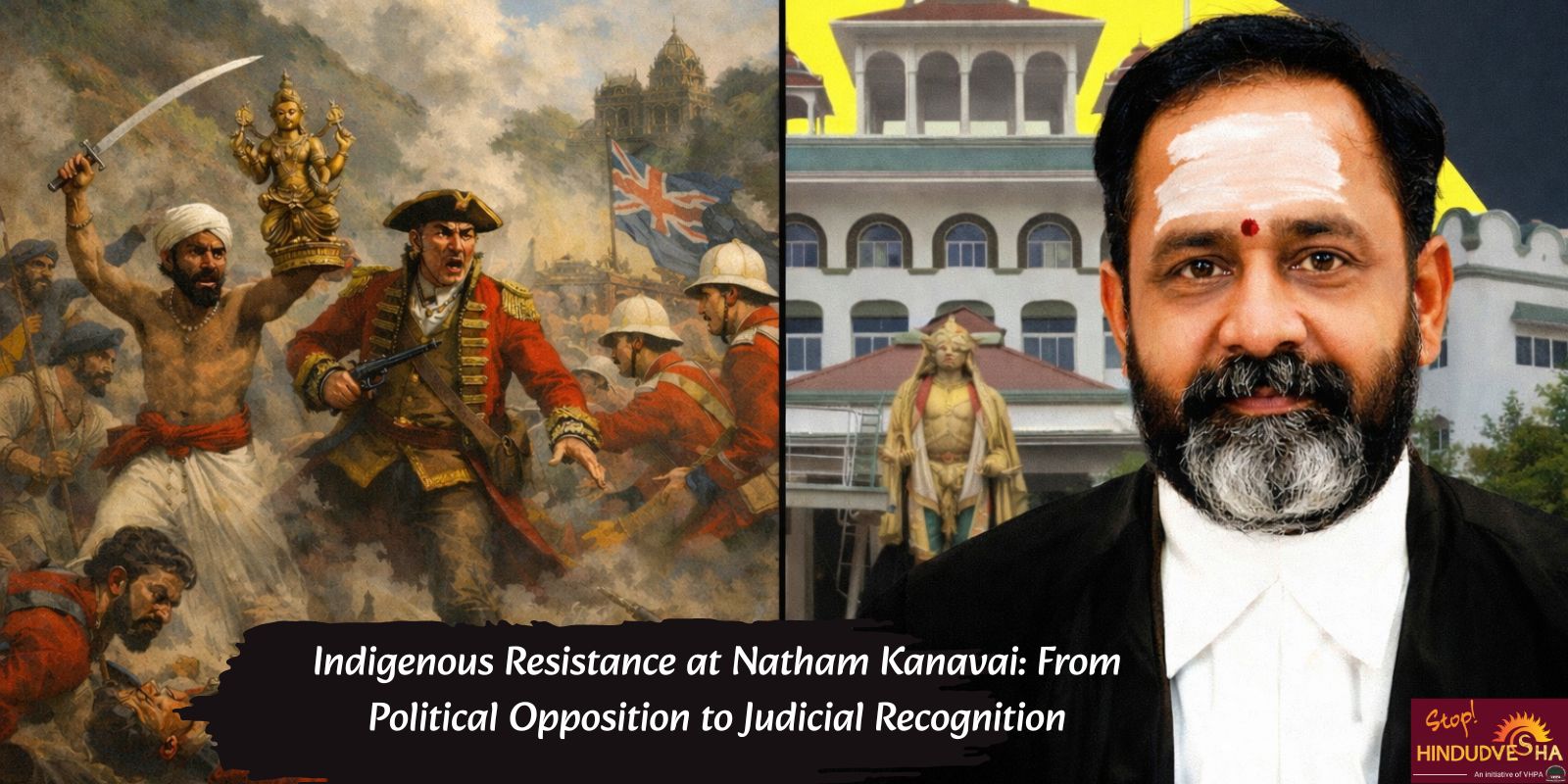
- The Natham Kanavai battle of 1755 was an organized act of indigenous resistance in which the Melur Kallar warriors reclaimed looted temple murtis and defended sacred institutions against colonial plunder.
- Their actions were rooted in dharmic duty and the protection of temples, community honor, and civilizational continuity, not in personal ambition or political gain.
- The historical significance of this resistance has been formally acknowledged by the Madras High Court, which recognized the legitimacy of commemorating such acts of indigenous valor.
- The Court affirmed that memorialization on private patta land does not require state permission, underscoring the judiciary’s role in restoring historical memory.
- The episode nevertheless highlights ongoing inconsistencies in public commemoration and the need for principled, fact-based recognition of indigenous resistance.
How a civilization remembers its past shapes how it understands its present and imagines its future. In Bharat, the memory of resistance to foreign domination has often been narrowed to selective episodes, dominant personalities, or mass nationalist movements, sidelining many local and community-based acts of courage that never entered formal historical narratives. The battle of Natham Kanavai in 1755, recently brought back into public attention through a judgment of the Madras High Court, stands as one such forgotten episode of indigenous resistance. Its rediscovery invites a broader examination of how such struggles are remembered, neglected, or selectively marginalized in independent India.
Fought at Natham Pass in present-day Tamil Nadu, the confrontation saw the Melur Kallar community rise against British forces to recover sacred murtis looted from the Thirumogur (Koilkudi) Temple. The struggle involved heavy loss of life, yet the Kallars succeeded in reclaiming the stolen idols, marking a decisive moment of organized indigenous resistance that remained largely absent from mainstream historical accounts. By revisiting the events of the 1755 battle, examining the recent Madras High Court ruling, and situating the episode within a larger civilizational framework, this article argues for restoring the memory of Bharat’s forgotten warriors and integrating their sacrifices into the nation’s collective historical consciousness.
The Immediate Controversy: A Memorial Denied, a Memory Questioned
The immediate trigger for renewed attention to the Natham Kanavai battle of 1755 was the refusal by local authorities to permit the construction of a memorial stupa commemorating the warriors who fought in the battle. As noted in proceedings before the Madras High Court, the proposed memorial was to be erected on private patta land rather than on public or government property. Despite this, permission was denied, compelling the petitioner and advocate Siva Kalaimani Ambalam to approach the Court[1].
That such a request became contentious in independent India is revealing. Memorials to historical figures, freedom fighters, and social reformers are familiar features of the public landscape. Yet when the memory sought to be commemorated involves armed resistance to colonial forces in defense of a Hindu temple, administrative hesitation becomes pronounced. The controversy was therefore not merely about land use or regulatory compliance; it raised deeper questions about which histories are considered worthy of public remembrance.
The Court was thus called upon to address not only a dispute over a memorial but also the broader question of how Bharat engages with its history of resistance to foreign domination. Justice G.R. Swaminathan emphasized that memorialization preserves historical memory, inspires future generations, and fosters collective pride. By recognizing the bravery of the Kallars, the Court reaffirmed that private efforts to honor past resistance should not be obstructed in the absence of clear statutory restriction[2].
The episode illustrates how attempts to commemorate regional or forgotten heroes often encounter bureaucratic resistance. More importantly, it underscores a critical truth: acknowledging history is not merely symbolic. It shapes collective consciousness and strengthens cultural resilience. In this sense, the struggle to erect a memorial is as much about restoring historical dignity as it is about building a physical structure.
Sacred Duty and Armed Resistance: The Battle of Natham Kanavai
The Natham Kanavai battle of 1755 stands as a testament to the defense of temples, dharma, and local honor against colonial aggression. At the center of the conflict were the Melur Kallar warriors, whose martial skill and unwavering commitment to sacred duty enabled them to challenge British forces led by Colonel Alexander Heron. The confrontation arose when the British, having looted sacred murtis from the Thirumogur (Koilkudi) Temple, attempted to transport the idols through the Natham Pass in Tamil Nadu.
Upon learning of the plunder, the Kallars mobilized swiftly and intercepted the British contingent at the pass. What followed was a fierce confrontation marked by heavy casualties, yet the Kallar warriors succeeded in recovering the looted idols, leaving only a handful of survivors from Heron’s troops[3]. This outcome was more than a tactical victory. It was a symbolic triumph of dharmic obligation over foreign domination, demonstrating that attacks on sacred institutions would not go unchallenged.
The recovery of the temple murtis was not merely a material act but a reaffirmation of civilizational continuity. In Hinduism, temples are living institutions that embody spiritual, cultural, and social life. Attacks on these spaces were understood as assaults on community identity, collective honor, and dharma itself. The courage of the Kallar warriors thus reflected a moral imperative to defend the sacred, transcending individual or localized interests.
By resisting colonial plunder, the Kallars preserved the spiritual and symbolic essence of the temple and ensured continuity of practice and faith. The Natham Kanavai battle must therefore be understood not merely as a military engagement but as an act of civilizational defense, where courage, devotion, and collective resolve converged to assert autonomy over sacred heritage. It is this intertwining of dharma and resistance that gives the episode its enduring relevance.
Judicial Recognition of a Forgotten Resistance
The recent Madras High Court judgment brought the Natham Kanavai battle into contemporary focus, reaffirming the importance of recognizing historical acts of indigenous resistance. Justice G.R. Swaminathan examined the case through both historical material and broader context, observing that the commemoration of past achievements, whether in warfare or other fields, serves as a powerful source of collective motivation. Just as India marks Vijay Diwas to commemorate the 1971 victory, he emphasized that remembering local triumphs against colonial powers is essential for cultivating historical awareness and civic pride.
The Court clarified that erecting memorials on private property, particularly to honor acts of historical and national significance, does not require governmental authorization unless expressly prohibited by law. Justice Swaminathan noted that memorialization is a historical and civic responsibility that strengthens shared memory and national identity. The judgment also affirmed India’s plural and civilizational unity, recognizing that the heroic acts of distinct communities collectively enrich the nation’s historical consciousness[4] [5].
By permitting the installation of the stupa on patta land, the Court reaffirmed that commemorating indigenous resistance falls within the legitimate exercise of a landowner’s private rights[6]. The ruling thus transforms the Natham Kanavai battle from a neglected episode into a living symbol of dharmic valor, linking past heroism with present recognition and reverence.
Colonial Expansion and the Assault on Hindu Sacred Institutions
The Natham Kanavai battle did not occur in isolation. It was part of the East India Company’s early expansion, a phase marked by systematic encroachment on Hindu institutions and sacred spaces. The events of 1755 fit within a broader colonial pattern in which temples were repeatedly targeted. Across successive periods of foreign rule, Hindu sacred institutions functioned not only as places of worship but also as repositories of wealth, authority, and cultural continuity. Colonial forces viewed them as strategic sites for material extraction and for undermining indigenous legitimacy.
Sacred artefacts removed from these institutions frequently found their way into foreign coffers and museums[7], severed from their ritual and civilizational context. The invocation of colonial legality to normalize such appropriation compounded the injury, converting acts of civilizational erasure into routine administrative practice.
When Defending the Sacred Became a Collective Duty
The confrontation at Natham Kanavai was more than an armed clash; it was dharma in action. Within the Hindu civilizational framework, temples are living institutions, and an attack on a temple or its idols is understood not as property damage but as an assault on dharma itself. This understanding provides the lens through which resistance at Natham Kanavai becomes intelligible. Intercepting the colonial convoy and reclaiming the idols affirmed that spiritual and cultural continuity could not be subordinated to foreign domination.
The battle also reveals how resistance was grounded in collective responsibility. Communities coordinated their efforts to confront a formidable adversary, guided by shared values. The response of the Kallar community demonstrates that defending sacred institutions was considered non-negotiable and central to sustaining civilizational continuity.
This episode challenges the notion that Hindus passively accepted foreign rule. Resistance arose repeatedly whenever the foundations of civilizational life were threatened, cutting across regions, castes, and communities. Even where such resistance did not develop into large-scale movements, it manifested in localized, intense, and meaningful confrontations that expressed civilizational self-respect. Natham Kanavai thus offers insight into many such resistances that remain outside mainstream historical narratives.
From Warriors to “Criminal Tribes”: Colonial Retaliation Against Resistance
The Kallar community, which inflicted a significant setback on British forces, soon faced a deliberate campaign of stigmatization. To prevent future resistance, the British administration branded the community as “criminals by birth” under the Criminal Tribes Act. This designation carried lasting consequences. Surveillance became routine, movement was restricted, and social stigma was imposed across generations, reducing a proud martial community to marginal status[8].
This experience reflected a broader colonial strategy across Bharat. Communities that demonstrated effective indigenous resistance, whether by protecting temples, repelling looters, or asserting autonomy, were systematically criminalized and undermined. Such measures aimed to dismantle social cohesion, suppress martial traditions, and weaken the civilizational capacity for organized opposition.
By portraying resistant communities as inherently criminal, colonial authorities erased the legitimacy of indigenous valor while promoting narratives of colonial inevitability. The memory of resistance was deliberately suppressed, shaping later histories in which conquest appeared uncontested. The aftermath of Natham Kanavai reveals a stark truth: victories against foreign domination were often punished long after the battlefield fell silent.
Selective Commemoration and the Question of Moral Consistency
The discussion surrounding Natham Kanavai is not confined to the past; it speaks directly to contemporary practices of recognition and public memory in Bharat. The refusal to permit a memorial honoring the warriors of the 1755 Natham Kanavai battle stands in sharp contrast to other instances where memorialization has been allowed. In recent years, public memorials have been permitted for figures such as Stanislaus Lourduswamy, popularly known as Stan Swamy, despite his having faced serious charges under the Unlawful Activities (Prevention) Act[9] and his association with the Bhima Koregaon case, a controversy that distorted historical events and deepened social and ideological fault lines. By contrast, recognition for the Melur Kallar warriors, who organized armed resistance to recover looted temple murtis and defend sacred institutions from colonial plunder, has encountered hesitation and obstruction.
This contrast raises a fundamental question of moral consistency in public commemoration. When figures linked to controversy, division, or unresolved legal questions are accorded public memorials, while warriors who sacrificed their lives defending temples, dharma, and community honor are denied recognition, the imbalance is difficult to justify. The Natham Kanavai warriors did not act out of political ambition or personal gain. Their resistance was rooted in the defense of sacred institutions and civilizational continuity, values that lie at the core of Hindu society. Yet their sacrifices continue to face bureaucratic resistance and selective forgetfulness.
Such selectivity is not merely symbolic. Public commemoration plays a powerful role in shaping collective consciousness, influencing how present and future generations understand history, sacrifice, and moral legitimacy. When memorials are extended to contested figures while genuine freedom fighters are sidelined, respect for dharmic resistance is weakened, and the moral framework that sustains national and cultural cohesion is gradually eroded.
At a broader level, this episode underscores the need for principled and fact-based remembrance. Honoring the warriors of Natham Kanavai is not an endorsement of violence; it is a correction of historical neglect and an affirmation of cultural memory. Recognition must be guided by historical truth, ethical consistency, and civilizational integrity, rather than political convenience or ideological preference, if Bharat is to preserve the coherence and dignity of its historical narrative.
Distorted Histories and the Cost of Civilizational Amnesia
The episode reflects a broader pattern of civilizational amnesia that has shaped Bharat’s historical consciousness over centuries. When events are selectively remembered, reframed, or suppressed, the collective understanding of resistance, sacrifice, and dharmic duty becomes distorted. Colonial-era confrontations are often portrayed as internal disputes, obscuring the reality that many were struggles between indigenous communities defending temples, dharma, and social continuity, and foreign powers seeking domination.
Such amnesia carries serious consequences. It weakens social cohesion, erodes confidence in India’s historical resilience[10], and reinforces narratives that portray Hindus as passive or complicit in their own subjugation. When battles like Natham Kanavai are reduced to minor skirmishes or localized conflicts, the courage and sacrifice of those who confronted overwhelming odds to defend their land and faith are diminished[11].
Recovering and commemorating these episodes enables a more honest engagement with history. It reminds present and future generations that resistance was neither rare nor accidental, but a recurring response when the foundations of civilizational life were threatened. Fact-based remembrance is not merely academic; it is essential for restoring cultural confidence, reinforcing moral continuity, and nurturing unity in the face of contemporary challenges.
The cost of forgetting is therefore not merely historical, but civilizational. By neglecting episodes of indigenous resistance, Bharat risks losing touch with the values that allowed it to endure centuries of invasion and domination. Recognizing and memorializing these struggles corrects historical imbalance and ensures that the memory of sacrifice remains alive, meaningful, and instructive for generations to come.
Freedom as Accumulated Sacrifice, not a Singular Movement
The Natham Kanavai battle illustrates that Bharat’s freedom was not the product of a single leader or movement but the cumulative outcome of countless acts of resistance by communities across the subcontinent[12]. The Melur Kallar resistance formed part of a long continuum of dharmic defense aimed at protecting temples, idols, and local institutions from colonial plunder.
Justice G.R. Swaminathan’s recognition of the battle’s significance reinforces the constitutional and moral weight of remembrance[13]. Article 51A of the Indian Constitution places a duty on citizens to cherish the ideals that inspired the struggle for freedom[14]. Remembering battles such as Natham Kanavai reconnects contemporary Bharat with its lineage of courage and resistance.
Seen in this light, memorializing forgotten warriors is not an exercise in nostalgia but an act of historical justice. Every act of dharmic resistance, however localized, contributed to the eventual liberation of the land.
Wrapping Up
The Natham Kanavai battle is far more than a historical footnote. It stands as a testament to Bharat’s enduring civilizational spirit and to the commitment of its communities to protect dharma, temples, and sacred continuity. The resistance of the Melur Kallar community exemplifies the courage, strategy, and sacrifice that have shaped Hindu civilization across centuries.
Memorializing such warriors restores dignity to forgotten sacrifices, strengthens national unity, and reaffirms civilizational confidence. It corrects selective amnesia and reconnects modern Bharat with deeper currents of courage and dharmic duty.
Remembrance in this context is not about glorifying conflict. It is about truth, continuity, and moral responsibility. The Natham Kanavai episode reminds us that the struggle for dharma and independence has always been collective and intergenerational, and that preserving these memories is essential for honoring both the past and the responsibilities of the future.
Citations
[1] No Permission Required For Installation Of Statue Of Freedom Fighter In Patta Land: Madras High Court Allows Lawyer To Erect Natham Kanawai War Memorial Stupa; https://www.verdictum.in/court-updates/high-courts/madras-high-court/sivakalaimani-ambalam-v-the-district-collector-permission-statue-patta-land-lawyer-natham-kanawai-war-memorial-stupa-1600475
[2] Ibid
[3] No permission required to erect Natham Kanavai War Memorial Stupa on private land: Madras High Court; https://www.scconline.com/blog/post/2025/12/15/madras-hc-communitys-right-to-erect-natham-kanavai-war-memorial-stupa-on-private-land-scc-times/
[4] Siva. Kalaimani Ambalam v. The District Collector (Case No.: W.P.(MD)NO.34220 OF 2025); https://www.verdictum.in/pdf_upload/downloaded-28madras-1758602.pdf
[5] No Permission Required For Installation Of Statue Of Freedom Fighter In Patta Land: Madras High Court Allows Lawyer To Erect Natham Kanawai War Memorial Stupa; https://www.verdictum.in/court-updates/high-courts/madras-high-court/sivakalaimani-ambalam-v-the-district-collector-permission-statue-patta-land-lawyer-natham-kanawai-war-memorial-stupa-1600475
[6] Ibid
[7] Natham Kanavai Battle 1755: How Hindus defeated a temple-looting British officer and retrieved sacred Murtis; https://organiser.org/2026/01/05/333678/bharat/natham-kanavai-battle-1755-how-hindus-defeated-a-temple-looting-british-officer-and-retrieved-sacred-murtis/
[8] Natham Kanavai Battle 1755: How Hindus defeated a temple-looting British officer and retrieved sacred Murtis; https://organiser.org/2026/01/05/333678/bharat/natham-kanavai-battle-1755-how-hindus-defeated-a-temple-looting-british-officer-and-retrieved-sacred-murtis/
[9] Justice Swaminathan का एक और धमाकेदार फैसला; https://www.youtube.com/watch?v=6wbFenPvEbg
[10] Illogical to assume that freedom struggle was led by a single leader or organisation: How Madras HC opened a can of worms in one judgement allowing erection of Stupa; https://www.opindia.com/2026/01/madras-hc-allows-stupa-to-honour-1755-natham-kanavai-war-against-british/
[11] Ibid
[12] Madras High Court Quashes Tahsildar Order, Allows Memorial for 1755 Anti-British Battle; https://lawbeat.in/news-updates/madras-high-court-quashes-tahsildar-order-allows-memorial-for-1755-anti-british-battle-1552884
[13] Siva. Kalaimani Ambalam v. The District Collector (Case No.: W.P.(MD)NO.34220 OF 2025); https://www.verdictum.in/pdf_upload/downloaded-28madras-1758602.pdf
[14] Article 51A in Constitution of India; https://indiankanoon.org/doc/867010/

Donate to HINDUDVESHA
Our Mission is to explore and expose Hindudvesha through research analysis, education and response.
SUPPORT US