

A.R. Rahman’s Fall from Grace: A Symptom of Bollywood’s Unease with India’s Civilizational Reawakening
 Rati Agnihotri · 01/30/2026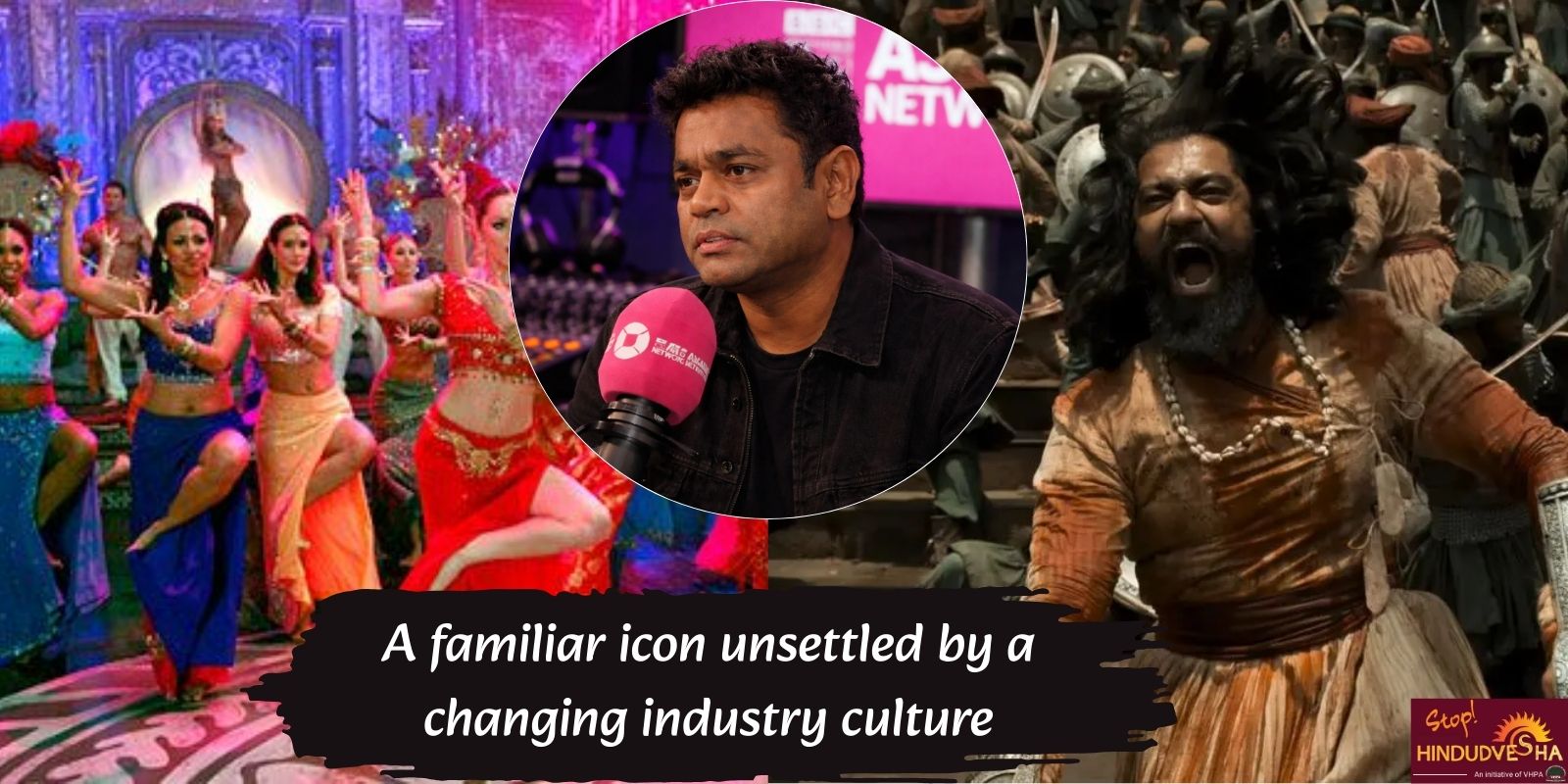
- In a recent interview, A. R. Rahman invoked a familiar minority-victim framing, suggesting he may have faced “communal” discrimination in Bollywood over the past eight years due to an alleged “power shift.”
- Rahman’s remarks reflect a broader unease with India’s ongoing civilizational and cultural reassertion.
- Mainstream Bollywood has long advanced pro-Pakistan and anti-India narratives, at times soft-pedaling Pakistan-sponsored terrorism.
- As independent and non-mainstream filmmakers challenge this dominance through films such as The Kashmir Files, The Kerala Story, Chhaava, Swatantraya Veer Savarkar, The Sabarmati Report, and Dhurandhar, entrenched industry interests have grown increasingly uncomfortable.
- Bollywood’s Hinduphobic tendencies and anti-India bias are now being more visibly challenged and exposed through social media.
From the timeless melodies of Roja, Bombay, Taal, and Lagaan to the eclectic compositions of Saathiya, Swades, Rang De Basanti, and Guru, music maestro A. R. Rahman has traversed a formidable career trajectory, capturing the imagination and adulation of an entire nation. Despite the problematic political contexts of some of the films he composed for, Rahman’s music has continued to draw overwhelming, largely unconditional appreciation from Indian audiences—an achievement few of his peers can claim. Yet, in what appears to be either a stroke of propaganda or a miscalculated rhetorical flourish, Rahman managed to undo a decades-old legacy in a single moment.
In a recent interview with the BBC Asian Network, Rahman casually claimed he had faced instances of “communal” discrimination in Bollywood over the last eight years, allegedly due to a “power shift.” He remarked that “people who are not creative have the power to decide things,” adding that “this might have been a communal thing also, but not in my face.” He further stated that he would hear “Chinese whispers” suggesting such discrimination had occurred.
Rahman, who was interviewed by BBC Asian Network’s Haroon Rashid, also described Chhaava as a “divisive” film, despite having composed its music. His passive-aggressive jibes at Bollywood’s changing narrative landscape and the growing wave of films on the other side of the discursive divide did not go unnoticed. Intense social media debates followed, reflecting a certain ecosystem’s rising discomfort with India’s ongoing civilizational resurgence.
Rahman thus adopted a familiar ‘minority victim’ posture, notably in front of a Pakistani-origin BBC journalist. The irony was difficult to ignore. However, his remarks are not an isolated anomaly. They reflect a deeper unease within Bollywood’s dominant ideological ecosystem—one that has long shaped narratives around history, culture, and national identity. Over time, a convergence between the left-liberal intelligentsia and Islamist networks has shaped Bollywood’s ideological ecosystem.
Discomfiture With India’s Changing Cultural Narrative
In the same BBC interview, Rahman subtly advances a particular narrative—one in which the interviewer and the interviewee appear to operate within a tacit understanding. Over the course of an hour-and-a-half-long conversation, the controversial segments may occupy only a small portion of the total runtime, but they stand out for their thinly veiled critiques of the changing sensibilities of the Indian film audience.
In the segment, where the interviewer repeatedly frames the current cultural ethos as increasingly divisive, Rahman readily agrees with the host’s assertions and makes little effort to interrogate those assumptions or to offer an alternative perspective. The interviewer presents a highly dramatized, overly simplistic picture of the Indian film industry, suggesting that creative freedom was at its peak 10–15 years ago, when Bollywood was supposedly free of propaganda. By contrast, he implies that the “landscape” has grown more divisive in recent years, with cinema becoming progressively politicized.
Rahman endorses this thesis wholeheartedly, adding, “Some movies are made with a bad intention. I try to avoid those movies.” The interviewer then presses further, asking whether Rahman considers Chhaava to be a divisive film. Rahman responds in the affirmative, though his answer appears somewhat tentative and internally conflicted: “It is divisive. I think it cashed on divisiveness, but I think the core of it is to show the bravery.” [1]
Interestingly, Rahman was the music director for Chhaava, a historical film that delves into the life and legacy of Chhatrapati Sambhaji Maharaj, the son of Chhatrapati Shivaji Maharaj, who sacrificed his life resisting the Mughal Empire. The blockbuster film has been denounced by the left-liberal ecosystem. Its stark, unsparing portrayal of the Mughal emperor Aurangzeb as ruthless and menacing has predictably invited accusations of “Hindu right-wing propaganda[2]” and “Islamophobia.”
By labeling Chhaava as divisive and offering a series of cryptic remarks about the sensibilities of the Indian audience—suggesting that they are “smart” and cannot be misled by certain narratives—Rahman appears to play conveniently into the hands of the anti-Hindu and anti-India ecosystem. His passive-aggressive commentary on the changing narrative landscape of Indian cinema reveals a palpable discomfort with the ongoing civilizational and cultural resurgence.
Bollywood has long tended to foreground films that conveniently distort historical facts while perpetuating the cinematic myths promoted by leftist historiography. The industry has a consistent record of glorifying Mughal invaders while remaining conspicuously silent on Bharat’s indigenous civilizational and cultural heritage. From classics such as Taj Mahal and Mughal-e-Azam to more contemporary productions like Jodhaa Akbar and Padmaavat, Bollywood has repeatedly resorted to exaggerated, romanticized portrayals of Islamic invaders, most notably the Mughals.
Mainstream Bollywood cinema has also played a significant role in advancing pro-Pakistan and anti-India narratives. Several films have ventured into the subtle glorification of Pakistan-sponsored terror. Movies such as Main Hoon Na, Mission Kashmir, Bajrangi Bhaijaan, Raazi, PK, and Pathaan have pushed overtly pro-Pakistan narratives, either through idealized depictions of Pakistani society or by deliberately softening the reality of Pakistan-sponsored radical extremism and terrorism affecting India, often framed through sentimental cross-border love stories. Such films frequently rely on formulaic cinematic clichés—“love conquers politics”—paired with contrived human-interest angles and misleading romantic arcs, complete with obligatory song-and-dance sequences.
An article published by Swarajya aptly examines this wave of pro-Pakistan Bollywood films in the 21st century, with particular focus on Shah Rukh Khan and Deepika Padukone’s Pathaan (2023), in which Khan portrays a RAW agent while Padukone plays an ISI operative[3].
With winds of change sweeping through Bollywood, and small, independent, or previously non-mainstream filmmakers increasingly taking on projects outside the traditional Bollywood narrative—The Kashmir Files, The Kerala Story, Chhaava, Swatantraya Veer Savarkar, The Sabarmati Report, and Dhurandhar—a certain ecosystem has begun to show visible discomfort. The unprecedented box-office success of Dhurandhar, in particular, has ruffled many feathers.
A spy-action thriller, Dhurandhar depicts an anti-terror covert operation in which an Indian undercover agent infiltrates Karachi’s political and criminal underworld in Pakistan. By portraying Pakistan unambiguously as a nerve center of terrorism, the film decisively overturned the long-standing “Pakistan-love” narrative. Despite receiving overwhelmingly negative reviews from the left-liberal press, Dhurandhar went on to shatter box-office records.
The film’s runaway success also laid bare the deep unease within the elite reviewers’ lobby. Prominent critic Anupama Chopra faced intense backlash on social media for her sharply negative review of the film. As netizens subjected her to widespread trolling, Chopra adopted the familiar posture of victimhood, invoking the argument of creative freedom. The Film Critics Guild, a self-appointed private body, subsequently issued a strongly worded statement condemning what it described as “targeted attacks, harassment, and hate” directed at film critics over their reviews of Dhurandhar.
Many netizens, however, viewed this response with evident skepticism, noting the irony that two of the critics facing public criticism—Anupama Chopra and Sucharita Tyagi—were also the principal office bearers of the very body that issued the condemnation[4].
The Rahman controversy led to several other uncomfortable revelations. In the aftermath of the debate surrounding Rahman’s BBC interview, actor and politician Kangana Ranaut claimed on X that fashion designer Masaba Gupta had, on one occasion, explicitly asked a stylist not to dress Kangana after learning that she intended to wear the outfit for her Ram Janmabhoomi Darshan.
Kangana Ranaut further stated that the stylist, acting in good faith, explained that she had personally paid for the saree to avoid any potential conflict and had also requested Kangana not to tag Masaba or her brand. As social media users began trolling Masaba Gupta over what they perceived as hostility toward Hindu Dharma, the designer chose not to issue any clarification. She subsequently disabled the comments section on her recent posts[5].
Dawood Gang Stranglehold and the Hounding of Hindus
There was a time when Hinduphobia was virtually the norm in Bollywood films—dacoits, bandits, and criminals were routinely shown sporting tilaks; temples were depicted as sites of dubious or illicit activity; Hindus, particularly Thakurs, were portrayed as violent and anti-women; Pandits were cast as cunning and manipulative; and the minority community was often portrayed in an excessively positive light, in contrast to the subtle yet persistent demonization of Hindus.
For a prolonged period, most notably during the 1980s and 1990s, Bollywood remained under the influence of a radical Islamist ecosystem, with several films and studios allegedly financed by the D-Company (Dawood Ibrahim and his associates). Actor Anu Aggarwal, who rose to prominence in the 1990s after starring in the romantic film Aashiqui, has spoken candidly about Bollywood’s links with the underworld. In a media interview, she described the film industry of that era as “dirty,” stating that most financing arrangements were conducted “off the record,” with “figures like Dawood Ibrahim reportedly pulling the strings behind the scenes[6].”
If media reports are to be believed, there was a time when several top Bollywood stars openly took pride in their association with underworld don Dawood Ibrahim. Using the film industry as a conduit to convert black money into white, Dawood reportedly obliged actors with expensive gifts and extended generous “loans” for film projects. Actors such as Rishi Kapoor and Dilip Kumar spoke publicly about having met him[7].
Even after Dawood Ibrahim fled Mumbai following his involvement in the 1993 Mumbai blasts and went into hiding, a certain ecosystem’s grip over Bollywood appeared to persist. While Rahman chose to play the victim card and indirectly accuse an entire country of becoming “communal,” it may be worth recalling that during the period of D-Company’s influence, it was Hindus who often emerged as the real victims.
Gulshan Kumar, the owner of T-Series and widely known for his devotional music albums, was shot dead in broad daylight after stepping out of a temple where he had offered his morning prayers. According to a report by HinduPost, eyewitnesses claimed that before shooting him, the assailants taunted Gulshan Kumar, saying, “You have done enough pooja. Now go up and do your pooja.” In January 2001, Abdul Rauf, alias Daud Merchant, was arrested in Kolkata. The trial, which began the same year, concluded in 2021, with the Bombay High Court upholding Abdul Rauf’s conviction and sentencing him to life imprisonment[8] [9].
Although Gulshan Kumar’s murder has largely been attributed to alleged professional rivalry with the underworld, critics have pointed out the inherent Hinduphobic undertones in the sequence of events—particularly the targeting of a prominent Hindu film and music producer whose brand actively promoted Hindu devotional music. This dimension warrants closer scrutiny and further investigation[10].
Bollywood-Pakistan Nexus
The steady influx of Pakistani actors and singers into Bollywood—Atif Aslam, Rahat Fateh Ali Khan, Ali Zafar, Fawad Khan, Mahira Khan, among others—has also raised legitimate questions about the industry’s role in whitewashing and, at times, tacitly endorsing the radical terror ecosystem fostered by the Pakistani establishment. Several Pakistani artists who have worked in Bollywood have repeatedly made anti-India remarks, a pattern that exposes the uncomfortable reality of Bollywood functioning as a convenient platform for the circulation of anti-India narratives.
In May 2025, the All India Cine Workers Association (AICWA) issued a strongly worded statement criticizing Pakistani actors Fawad Khan and Mahira Khan for making anti-India comments. Mahira Khan reportedly described Operation Sindoor as “seriously cowardly,” while Fawad Khan was accused of “supporting divisive narratives” rather than unequivocally condemning terrorism. In response to these statements, the association reiterated its long-standing demand for a blanket ban on Pakistani artists working in India[11].
When Bollywood producers and filmmakers continue to cast Pakistani actors in their projects while turning a deaf ear to India’s national security concerns, the stance appears to reflect a calculated anti-India and anti-Hindu bias. At a time when millions of Indian artists struggle to secure even peripheral roles in Bollywood films, the industry’s willingness to import Pakistani actors and elevate them to stardom almost overnight seems far more than a mere coincidence.
Noted Bollywood singer Abhijit Bhattacharya has been quite vocal on the issue of systematic infiltration of Pakistani artists in Bollywood. In October 2015, amidst a controversy surrounding Shiv Sena’s ban on Pakistani artists performing in Mumbai, Abhijit Bhattacharya supported the proposed ban, calling Pakistani artists “dengue artists”. Bhattacharya also accused a section of the Indian media of bending over backwards to promote Pakistani artists. He said that while Pakistan continued its proxy war against India, how could Indian people be entertained by Pakistani singers and artists?[12]
Abhijit Bhattacharya, the voice behind popular Bollywood songs such as “Main Koi Aisa Geet Gaon” (Yes Boss) and “Suno Na Suno Na” (Chalte Chalte), rose to prominence during the 1990s and early 2000s before gradually fading from the mainstream music scene. He remains one of the few Bollywood figures who has spoken openly and unapologetically about his pro-Hindu views. Bhattacharya has stated that he identifies with Hindu, Hindutva, and Hindustan, and that he places patriotism above professional considerations in music[13].
Subtle Islamization of Bollywood – The Sufi Music Narrative
In the BBC Asian Network interview, AR Rahman spoke at length about Sufi music and its integral role in his spirituality. Rahman also shared that he felt some Bollywood songs used “Sufi” music as a mere prop, thereby diluting its essence. [14]
Just as Rahman accused Bollywood of becoming increasingly “divisive” over the past couple of years under the influence of a certain narrative, one could hypothetically argue that A. R. Rahman himself soft-peddled a Sufi narrative through his music, often inserting Islamic compositions even when they appeared incongruous with the storylines. As Hindus have historically remained open and receptive to a wide range of cultural influences and traditions—driven by a deep-rooted magnanimity and affinity for syncretism—it may be worthwhile to play the devil’s advocate and examine the steady stream of soft propaganda advanced by a particular ecosystem under the guise of creative freedom and cultural expression.
The near-disappearance of Hindi words of Sanskrit origin from Bollywood song lyrics is a development that merits serious scholarly attention. Urdu words with pronounced Islamic overtones—such as “Ishq,” “Fanaa,” “Fidaa,” “Butparastee,” “Pardanashee,” “Ibadat,” “Sajda,” and “Jannat”—have become commonplace, while lyrics drawing on Sanskritized poetry and vocabulary have all but vanished.
This gradual shift in Bollywood’s cultural narrative, which subtly establishes Urdu’s hegemony while pushing Sanskritized Hindi to the margins, appears to be part of a broader, systematic effort to elevate Urdu’s literary dominance. This is often done under the banner of promoting “Hindustani” or colloquial Hindi, while portraying Hindi rooted in Sanskrit as outdated or irrelevant.
Rahman’s Communal Cauldron
Following Rahman’s BBC interview, a post went viral on social media, drawing attention to a 2020 incident in which Rahman’s mother had allegedly asked a Tamil lyricist to remove the tilak from his forehead before entering her home. This disturbing episode, described by critics as an instance of anti-Hindu bigotry, was reported by HinduPost in 2020.
According to the HinduPost report, lyricist and poet Piraisoodan had once visited A. R. Rahman’s residence with vibhuti and kumkum applied on his forehead—symbols that are commonly worn by many practicing Hindus. Rahman’s mother, Kareema Begam, allegedly asked him not to apply kumkum and vibhuti when he visited their house. Rahman was reportedly present at the time but did not intervene, remaining silent. The HinduPost article also includes a brief video clip of the lyricist himself, in which he appears to recount the incident in Tamil[15] [16].
Before the BBC interview, Rahman largely steered clear of explicitly “communal” themes. However, on several occasions, he did not shy away from subtly presenting his conversion from Hindu Dharma to Islam. In a 2000 interview, Rahman reportedly stated that he was uncomfortable with his birth name, Dileep, as it “did not resonate with his self-image.” His biography, AR Rahman: The Spirit of Music, notes that his mother added “Allah Rakha” to his name, a change she reportedly described as a revelation in a dream.
In 2020, images of Rahman’s daughter wearing a burqa went viral on social media. Author Taslima Nasrin commented on X that while she admired Rahman’s music, she felt “suffocated” upon seeing his daughter in the burqa[17].
Closing Remarks: Bollywood’s Anti-Hindu Bias Exposed
With the underworld ecosystem’s stranglehold over Bollywood gradually loosening, and with the rise of independent filmmakers and production houses operating outside the traditional mainstream, the anti-Hindu lobby within Bollywood appears increasingly unmoored. As a result, it now clings desperately to the remnants of a misplaced version of secularism long promoted by this ecosystem.
Dhurandhar’s phenomenal mainstream success has delivered a significant blow to Bollywood’s entrenched anti-India and anti-Hindu narrative. With the growing influence of social media and the broader civilizational reawakening of Indian audiences—who are increasingly rejecting Hinduphobic storytelling—the industry’s propaganda machinery appears to be under visible strain.
When propaganda can no longer be pushed effortlessly or without scrutiny, playing the familiar “communal victim” card increasingly seems to be the fallback strategy.
Citations
[1] (62) A.R. Rahman Interview | Roja to Ramayana | International Success | Oscars | AI | – YouTube; https://www.youtube.com/watch?v=GvRPrjPyC8c&t=3417s
[2] The Wire: The Wire News India, Latest News, News from India, Politics, External Affairs, Science, Economics, Gender and Culture; https://thewire.in/history/aurangzeb-chhaava-indian-history
[3] One-Sided Pakistan Love In Bollywood; https://swarajyamag.com/culture/one-sided-pakistan-love-in-bollywood
[4] Film Critics Guild, headed by critics Anupama Chopra and Sucharita Tyagi, condemns criticism of their Dhurandhar reviews; https://www.opindia.com/news-updates/film-critics-guild-headed-by-critics-anupama-chopra-and-sucharita-tyagi-condemns-criticism-of-their-dhurandhar-reviews/
[5] Masaba Gupta disables Instagram comments after Kangana Ranaut’s saree allegation. – The Times of India; https://timesofindia.indiatimes.com/life-style/fashion/buzz/masaba-gupta-disables-instagram-comments-after-kangana-ranauts-saree-allegation/articleshow/126789760.cms
[6] Anu Aggarwal exposes Bollywood’s 90s underworld ties: ‘Ruled by Dawood Ibrahim…It was a dirty business’ | – The Times of India; https://timesofindia.indiatimes.com/entertainment/hindi/bollywood/news/anu-aggarwal-exposes-bollywoods-90s-underworld-ties-ruled-by-dawood-ibrahim-it-was-a-dirty-business/articleshow/121252376.cms
[7] Rishi Kapoor, Dilip Kumar openly spoke about meeting Dawood Ibrahim: ‘It was a thing to be proud of, he gave expensive gifts’ | Hindi Movie News – The Times of India; https://timesofindia.indiatimes.com/entertainment/hindi/bollywood/news/rishi-kapoor-dilip-kumar-openly-spoke-about-meeting-dawood-ibrahim-it-was-a-thing-to-be-proud-of-he-gave-expensive-gifts/articleshow/119105110.cms
[8] The Gulshan Kumar Murder Case: A Recap – India Today; https://www.indiatoday.in/movies/celebrities/story/gulshan-kumar-murder-case-a-recap-1821531-2021-07-01
[9] Gulshan Kumar’s murder was an attack on the pillar of Hindu Dharma in Bollywood by Muslim gangsters; https://hindupost.in/crime/gulshan-kumars-murder-was-an-attack-on-the-pillar-of-hinduism-in-bollywood-by-muslim-gangsters/
[10] Ibid.
[11] AICWA Condemns Mahira Khan and Fahad Khan Over “Anti-India” Remarks, Reiterates Ban On Pakistani Artists; https://www.ndtv.com/entertainment/aicwa-condemns-mahira-khan-and-fawad-khan-over-anti-india-remarks-reiterates-ban-on-pakistani-artists-8361794
[12] Expose anti-Hindu media and intellectuals in India, says star singer Abhijeet Bhattacharya. | Struggle for Hindu Existence; https://hinduexistence.org/2015/10/21/expose-anti-hindu-media-and-intellectuals-in-india-says-star-singer-abhijeet-bhattacharya/
[13] I am associated with Hindu, Hindutva, and Hindustan: Abhijeet Bhattacharya | Hindustan Times; https://www.hindustantimes.com/music/i-am-associated-with-hindu-hindutva-and-hindustan-abhijeet-bhattacharya/story-2jKsZECLgzZcTYnBUgRMNM.html
[14] (62) A.R. Rahman Interview | Roja to Ramayana | International Success | Oscars | AI | – YouTube; https://www.youtube.com/watch?v=GvRPrjPyC8c&t=3417s
[15] A.R. Rehman’s mother asked Hindu lyricist to remove tilak if he was to enter the house!; https://hindupost.in/news/a-r-rehman-mother-refused-tilak-sporting-hindu-entry-in-house/
[16] A.R. Rahman’s mother had asked Tamil poet Piraisoodan to remove Tilak; https://www.opindia.com/2020/07/piraisoodan-a-r-rahman-mother-remove-vibhuti-kumkum-tilak/
[17] A.R. Rahman Removes His Façade: The Real Picture is Hideous; https://www.dharmadispatch.in/commentary/ar-rahman-removes-his-facade-the-real-picture-is-hideous

Donate to HINDUDVESHA
Our Mission is to explore and expose Hindudvesha through research analysis, education and response.
SUPPORT US