

From Oxford to Academia at Large: Free Inquiry or Scripted Discourse Against Hindus
 Rati Agnihotri · 12/24/2025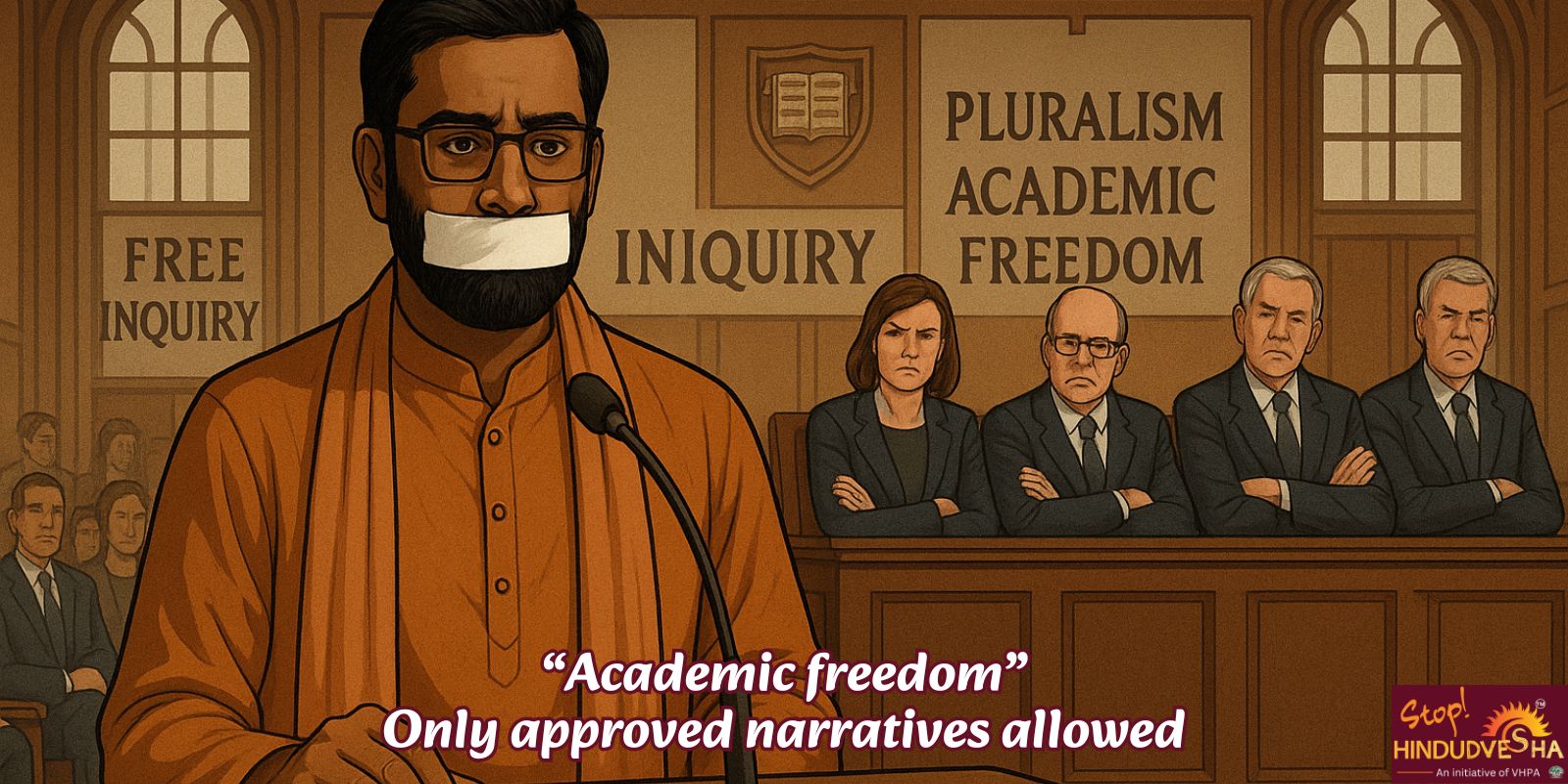
- Elite Western academic platforms increasingly frame India and Hindu identity through prescriptive, ideologically loaded narratives.
- The Oxford Union episode illustrates how debates are structured to control outcomes rather than enable genuine dialogue.
- Hindu voices and perspectives are routinely excluded, turning scholarly forums into one-sided indictments.
- Academic authority is used to legitimize suspicion, hostility, and delegitimization of a minority community.
- These trends reflect a deeper structural bias within Western academia, eroding both intellectual integrity and public trust.
For much of the past decade, a discernible pattern has emerged within elite Western academic spaces, where debates, conferences, and research initiatives increasingly converge on a narrow set of narratives about India and Hindu society. What is often presented as rigorous scholarship or free academic inquiry, upon closer examination, reveals a troubling tendency to frame Hindu civilizational identity through ideologically loaded assumptions. These interventions have a profoundly damaging impact, shaping public perception, influencing policy debates, and normalizing suspicion and hostility toward a minority community in the West.
The recent controversy surrounding the Oxford Union debate on India’s policy toward Pakistan is best seen as a textbook example of how every available tactic can be deployed to undermine genuine dialogue. It was not a minor procedural lapse or an error of student judgment, but a deliberate exercise in narrative management. From the prescriptive framing of the motion to the exclusion of essential stakeholders, and from last-minute alterations to studied institutional silence in the face of credible allegations, the episode reveals a systematic effort to control outcomes rather than facilitate discussion. When such methods become routine, academic forums cease to function as spaces for honest exchange and instead slide into instruments of persuasion, where the distinction between debate and propaganda is effectively erased.
This article examines how prestigious academic forums, from student debating societies to major universities, are increasingly used to advance selective narratives on India and Hindu identity. It situates the Oxford Union episode alongside broader developments, including ideologically driven conferences and reports, to explore how academic speech is being weaponized, not to illuminate complexity, but to delegitimize a community and normalize hostility under the cover of scholarship.
Oxford Union: The Politics Behind a “Student” Debate
A deeply troubling episode recently unfolded at the Oxford Union, an institution long associated with rigorous debate and intellectual credibility. What transpired, however, bore less resemblance to a serious academic exercise and more to a carefully staged political drama. The student-run debating society organized a motion titled, “This House Believes That India’s Policy Towards Pakistan Is a Populist Strategy Sold as Security Policy.” The event was reportedly convened under the presidency of Moosa Harraj, a Pakistan-origin student leader and the son of Muhammad Raza Hayat Harraj, Pakistan’s federal minister for defense production.
The Indian side was represented by Dharmic scholar and author Pt Satish K. Sharma, Jammu and Kashmir activist Manu Khajuria, and senior lawyer and author J Sai Deepak. According to speakers from the Indian side, they were tricked by the Oxford Union management into skipping the debate. As shared widely by J Sai Deepak, he received a personal call from the Union, informing him that the Pakistani delegation had not arrived. The Indian speakers were then given an option to participate in a debate against students, which they refused, and chose not to go to Oxford. Soon after, the Pakistan High Commission in London publicly declared a “victory” on social media, asserting that the Indian delegation had withdrawn from the debate. [1]
The Indian delegation subsequently shared detailed accounts of the episode through posts on X and in various media interviews, describing how they had been drawn into what they viewed as an embarrassing sham. According to them, the episode bore all the hallmarks of a contrived exercise designed to generate a publicity narrative favorable to Pakistan rather than facilitate a substantive exchange. The speakers noted, with a mix of disbelief and irony, that Pakistan’s official claims of “victory” were entirely fictitious and bore little resemblance to what had actually transpired.[2]
What further deepened the controversy was the Oxford Union’s complete silence throughout the episode. The institution did not issue a clarification, offer a public explanation, or present any credible evidence to challenge the Indian delegation’s account. This absence of transparency has been widely interpreted as more than mere administrative negligence. Given that the Union’s president is directly related to a senior minister in the Pakistani government, the choice of the motion and the sequence of events that followed are difficult to dismiss as coincidental. Even by the most generous standards, the episode raises serious questions about conflict of interest and institutional neutrality.
However, what comes across as most disturbing is the choice of the debate topic itself. The moment a country’s security policy toward a state known for exporting terrorism was turned into a debate, the forum ceased to be academic and became an instrument of propaganda. While the Union does not publicly archive all its past debates, making systematic comparison difficult, it is hard to imagine a similar motion scrutinizing the national security policies of major Western powers in such a reductive and accusatory manner. This is especially true when those policies concern counterterrorism and national security.
An opinion piece published in The Sunday Guardian aptly contextualizes the inherent bias of the motion – “By framing India’s defensive measures, including surgical strikes and diplomatic isolation of state sponsors of terrorism, as mere ‘populist strategy sold as security policy’, the proposition presupposed guilt on India’s part while absolving Pakistan of its well-documented role in cross-border terrorism. Such phrasing is not neutral as it clearly mirrors the standard narrative pushed by Islamabad and its sympathisers abroad, inverting victim and aggressor”, says the writer.[3]
University debates are typically organized on topics where there is ample scope for speaking both “for” and “against”, topics that are somewhat ambivalent, nebulous, and where it’s hard to take a side. This is precisely why abstract moral dilemmas or contested social questions lend themselves to debate. However, a country’s security policy position specifically aimed at countering terrorism and protecting the lives of its citizens doesn’t qualify as a debate topic, especially when a plethora of evidence exists regarding the casual “export” of cross-border terrorism by a neighbouring country. Holding such a “debate” essentially amounts to narrative building and whitewashing of terrorism.
Author and activist Rashmi Samant, a previously elected President of the Oxford University Student Union, who was coerced into resigning following a vicious smear campaign targeting her Hindu identity, also shares her perspective on the Oxford Union Indian security policy debate fiasco. In a panel discussion on CNN News 18, she argues that there is a discernible link between the Pakistan establishment and the Oxford Union. She also alleges that there have been similar controversies in the past, whenever the Union has been headed by a Pakistani President. In essence, Samant argues that the Oxford Union is being rapidly reduced to being a mouthpiece of the Pakistani state, considering the kind of influence wielded by Pakistan-origin political leaders in UK politics. [4]
Honest Inquiry or Narrative Setting?
It isn’t the first time that a debate targeting India’s state policy on contentious issues has been organized at Oxford University. Over the years, the Oxford Union has developed a pattern of conducting debates on India that are provocative in tone and prescriptive in framing, ranging from the Kashmir issue to assessments of the Modi government.
In November 2024, the Oxford Union organized a debate titled “This House Believes in the Independent State of Kashmir.” The motion immediately triggered strong reactions from Indian students on campus, many of whom staged protests against the event. Their objections were not limited to political disagreement with the proposition. A group of students formally wrote to the university administration expressing serious concern over the participation of speakers such as Muzzammil Ayub Thakur and Zafar Khan, whom they alleged had ties to organizations associated with violent extremism and terrorism. [5]
Earlier, the Kashmir Files director Vivek Agnihotri had declined an invitation to participate in the debate. Announcing his decision publicly on X, he described the theme as “anti-India” and “offensive,” and shared images of the invitation card he had received from the Oxford Union. [6]
In June 2023, the Oxford Union organized a debate titled “This House Believes Modi’s India is on the right path”. The list of speakers included personalities from media and politics, including well-known Indian journalist Palki Sharma, who spoke in favour of the motion. According to the Oxford Union, the majority of voters rejected the debate motion. [7] As Palki Sharma’s debate speech went viral after a year, she shared her experiences at the Oxford Union debate in a podcast hosted by BeerBiceps. She mentioned that the atmosphere at the debate was “borderline hostile”, with the audience members harbouring rigid pre-conceived notions against India. More troublingly, she recalled how some speakers opposing the motion, who were themselves Indian, resorted to sensational and unsubstantiated claims. These included assertions that they feared returning to India because they might be harassed or arrested, without any evidence to support their allegations. [8]
Sharma’s account reflects the familiar “atrocity literature” framework through which discussions about India or Hindus are often presented on Western academic platforms. In such spaces, the measure of effective debating is less about facts, logic, or careful argumentation, and more about adopting exaggerated, ideologically charged, activist-style positions that openly indulge in anti-India rhetoric.
Notably, BJP leader Varun Gandhi was also invited to participate in the 2023 debate, which he chose to decline, arguing that he didn’t believe the chosen topic offered much scope for a genuine debate. [9]
Despite repeated objections from members of the Indian diaspora in the United Kingdom and from Indian students, the Oxford Union has continued to host debates that intrude into India’s internal political and security matters. While controversy itself is not uncommon in student forums, the transformation of such platforms into staging grounds for geopolitical narratives is far more concerning. Even more troubling is the recurring presence, whether overt or indirect, of figures sympathetic to extremist causes.
Academic Delegitimization of Hindu Voices
The targeting of India by sections of the Western academia is invariably accompanied by a broader assault on Hindu Dharma, its practitioners, and cultural issues affecting the community. The academia has manufactured an entire cottage industry around gaslighting Hindu concerns, fabricating biased theories using jargon like “Hindu majoritarianism”, “Hindutva fascism”, “Hindutva terror”, “Brahmanical patriarchy.”
This phenomenon is not entirely new. What distinguishes the present moment is the manner in which colonial-era atrocity literature, once used to morally justify imperial intervention, has been repackaged in contemporary academic language. The result is a selective moral framework in which Hindu Dharma, rebranded as the largely benign and apolitical category of “Hinduism,” is contrasted with a constructed adversary called “Hindutva” or “Hinduness,” portrayed as inherently violent, exclusionary, and authoritarian. This artificial bifurcation allows scholars to claim neutrality while systematically discrediting the political and public articulation of Hindu identity.
A section of the Western academia has taken a rather unusual degree of interest in hosting conferences lamenting the rise of “Hindutva” over the past decade. In 2021, the Dismantling Global Hindutva conference was organized with the support of many reputed US universities. The event featured speakers drawn largely from far-left ideological circles, including individuals sympathetic to extremist movements, commentators hostile to India’s civilizational resurgence, and scholars with a documented record of Hinduphobic rhetoric.
The irony of the event was difficult to miss. While accusing the so-called “Hindutva ecosystem” of fascism and totalitarian impulses, the conference openly employed visual symbolism reminiscent of the very ideologies it claimed to oppose. Its promotional material depicted an inverted hammer violently uprooting a human figure that strongly resembled a saffron-clad RSS volunteer. [10] The conference agenda and the speeches aside, the poster itself dehumanized a community that only has one land where it constitutes a majority, and that forms a minuscule minority in countries across the world, including prominent Western nations.
It is worth considering whether Western academia would tolerate a similarly framed conference dedicated to “uprooting” radical Islamic extremism. Such an event would almost certainly provoke immediate accusations of Islamophobia from media outlets, civil society groups, and political actors. In all likelihood, it would either be cancelled or never approved in the first place. The contrast is revealing. When it comes to Hindu communities, the criminalization of public Hindu identity and political expression is treated as acceptable, even virtuous, thereby laying the discursive groundwork for normalizing hostility toward Hindus.
This pattern was again evident on October 27, 2025, when Rutgers University hosted a panel discussion centered on a report titled “Hindutva in America: An Ethnonationalist Threat to Equality and Religious Pluralism.” Presented as scholarly analysis, the report advanced sweeping allegations that Hindu American organizations function as proxies for the RSS and systematically promote Islamophobia, caste discrimination, and anti-minority politics. These claims were made without substantive empirical evidence, relying instead on ideological inference and guilt by association. [11] [12]
Despite strong opposition from Hindu American organizations, community members, and several U.S. Congressmen, including Indian-origin lawmakers, the university proceeded with the event. [13]
What came across as most shocking was that the event, while making sweeping and uninformed rants on Hindu Dharma and the public and political representation of Hindu issues, did not feature even a single practicing Hindu on its panel. Moreover, according to Hindu American organizations that attended the event, dissenting voices were silenced during the discussion.
Academic Freedom as Cover for Anti-Hindu Narratives
The report “Hindutva in America,” released by Rutgers Law School’s Center for Security, Race and Rights (CSRR), represents a troubling development in the use of academic authority to target a religious minority in Western societies. Framed as scholarship, the report sets a dangerous precedent by portraying a small and vulnerable community through a lens of suspicion and ideological hostility.
It’s a classic case of weaponizing academia for “manufacturing a villain to Justify Civilizational Erasure”.[14] By labelling Hindu advocacy organizations as fascist or extremist and urging heightened scrutiny or action against them, it directly undermines the rights of Hindu Americans to organize, speak publicly, and participate in civic life. This is especially concerning given the documented rise in Hinduphobia across the West, including vandalism and attacks on temples, increasing hate speech, and incidents of racially motivated violence against Indians. In such a climate, scholarship that depicts Hindu organizations as threats to pluralism and social harmony does not remain confined to academic debate. It contributes to an atmosphere of suspicion that places an already small minority at greater risk.
The report relies heavily on familiar rhetorical constructions, most notably the claim that Hinduism is a benign religion while “Hindutva” is a distinct and inherently dangerous political ideology. It further alleges that Hindutva draws ideological inspiration from early twentieth-century European fascism, portraying it as exclusionary, authoritarian, and fundamentally incompatible with democratic values. On this basis, the report asserts that Hindutva represents a grave threat to pluralism, religious freedom, and civil rights, both in India and in the United States. Central to this argument is the depiction of the Rashtriya Swayamsevak Sangh (RSS) as the ideological nerve center of Hindutva, presented as a militaristic and authoritarian organization. The report then extends this characterization to a range of Hindu American organizations, including the VHPA, HSS, Ekal Vidyalaya, Infinity Foundation, and Sewa International, describing them as components of a broader “Hindutva ecosystem.” [15]
Equally problematic is the manner in which these claims are advanced. Academic conferences and panels based on the report have proceeded without the participation of Hindu scholars, practitioners, or representatives of the organizations being criticized. The complete exclusion of Hindu viewpoints transforms what is presented as scholarly dialogue into something closer to a one-sided indictment. Without space for rebuttal or engagement, such forums resemble curated exercises in narrative reinforcement rather than genuine inquiry. In effect, they function as legitimized platforms for anti-Hindu rhetoric under the protection of academic respectability.
A detailed rebuttal published by StopHindudvesha highlights the deeper implications of this approach. The critique argues that the report follows a recognizable pattern associated with historical processes of dehumanization. These include the demonization of a collective identity, the delegitimization of its institutions, the deconstruction of its culture, and the denial of its right to self-definition. When such tropes are embedded in academic discourse, they acquire a veneer of moral authority, making exclusionary outcomes appear justified rather than discriminatory. [16]
An “Events Industry” Built on Atrocity Narratives
This phenomenon does not exist in isolation. Western academia has, over time, developed what can be described as an “events industry” centered on circulating anti-Hindu atrocity literature. Conferences, workshops, and seminars on caste, Hindu nationalism, Hindutva, and so-called Brahmanical patriarchy have become increasingly common. [17] [18] [19]
While critical examination of any culture or belief system is a legitimate part of academic work, the persistent and disproportionate targeting of a single religious community raises serious questions about intent and balance. The asymmetry is striking. Comparable levels of sustained, hostile scrutiny are rarely applied to other religious traditions or to the belief systems of their practitioners. Instead, Hindus are repeatedly cast, often through the euphemism of “Hindutva-vadis,” as the archetypal oppressor within global moral narratives. This framing does not merely distort reality; it also sets a dangerous precedent for the safety and social standing of Hindu minorities in Western countries by normalizing suspicion toward their civic and religious life.
Wrapping Up
Taken together, these episodes point to a deeper crisis within sections of Western academia, where the language of inquiry is increasingly used to advance predetermined ideological outcomes. When debates are framed prescriptively, voices from the affected community are excluded, and dissent is managed rather than engaged, academic freedom becomes a shield for narrative enforcement rather than a safeguard for truth-seeking. The cumulative effect is not merely intellectual distortion but real-world harm, as suspicion toward Hindu identity and institutions is normalized under the authority of scholarship.
If academic spaces are to retain credibility, they must recommit to basic principles of balance, transparency, and inclusion. This requires resisting the temptation to treat complex civilizational questions as moral indictments and acknowledging the difference between critique and caricature. Without such course correction, elite institutions risk eroding public trust and deepening social divisions, turning forums meant for dialogue into arenas of ideological exclusion. The Oxford Union episode, and others like it, should serve as a warning of what is lost when fairness and rigor are subordinated to influence and agenda.
Citations
[1] India-Pakistan Oxford Union debate: Pak claims false victory after shambolic Oxford Union debate gets cancelled | World News – The Times of India; https://timesofindia.indiatimes.com/world/uk/pak-claims-false-victory-after-shambolic-oxford-union-debate-gets-cancelled/articleshow/125644588.cms
[2] Manu Khajuria & Satish Sharma Slam Pakistan’s Claim of India’s ‘Walkout’ From Oxford Union debate – YouTube; https://www.youtube.com/watch?v=fav3Bpv6mdE
[3] Fall of the Oxford Union: Bastion of free speech to pawn of the Pakistani deep state; https://sundayguardianlive.com/editors-choice/fall-of-the-oxford-union-bastion-of-free-speech-to-pawn-of-the-pakistani-deep-state-161893/
[4] Oxford Union Debate: Pakistan Delegation No-Show Sparks Tension | India’s Policy or Populism? – YouTube; https://www.youtube.com/watch?v=oCZ9hWcE4y8
[5] UK: Indian Students Hold Protest Outside Oxford Union Against Kashmir Debate featuring Speakers With Terror Links; https://swarajyamag.com/news-brief/uk-indian-students-hold-protest-outside-oxford-union-against-kashmir-debate-featuring-speakers-with-terror-links
[6] Vivek Agnihotri declines Oxford Union debate on Kashmir, labels the theme as ‘offensive, anti-Indian’ | Hindi Movie News – Times of India; https://timesofindia.indiatimes.com/entertainment/hindi/bollywood/news/vivek-agnihotri-declines-oxford-union-debate-on-kashmir-labels-the-theme-as-offensive-anti-indian/articleshow/113102620.cms
[7] Oxford Union doesn’t believe Modi’s India is on the right path – Cherwell; https://cherwell.org/2023/06/09/oxford-union-doesnt-believe-modis-india-is-on-right-path/
[8] Defending India In England – Palki’s BOLD Oxford Union Debate Experience – YouTube; https://www.youtube.com/watch?v=feVXB_OElVk
[9] Varun says no to Oxford debate, amid Rahul Cambridge Row; https://www.thestatesman.com/india/varun-says-no-to-oxford-debate-on-this-house-believes-modis-india-is-on-the-right-path-1503163415.html
[10] Dismantling Global Hindutva Event: Hate to justify genocide of Hindus; https://www.opindia.com/2021/08/dismantling-global-hindutva-event-nazi-propaganda-justify-genocide-hindus/
[11] Hit Job: Rutgers Fuels Anti-Hindu Hate with Dubious Report; https://stophindudvesha.org/hit-job-rutgers-fuels-anti-hindu-hate-with-dubious-report/
[12] Rebuttal to Rutgers’ Hindutva Report; https://stophindudvesha.org/a-hindu-american-rebuttal-to-the-genocidal-subtext-of-rutgers-hindutva-in-america-report/
[13] US varsity holds Hindutva debate, faces backlash for excluding Hindus from it – India Today; https://www.indiatoday.in/world/us-news/story/rutgers-universtiy-hindutva-event-sparks-student-protests-draws-criticism-from-us-lawmakers-america-new-jersey-2810351-2025-10-29
[14] A Hindu American Rebuttal to the Genocidal Subtext of Rutgers Law School’s Center for Security, Race and Rights (RCSRR)’s report; https://stophindudvesha.org/wp-content/uploads/2025/06/Rebuttal-to-RCSRR-Report-on-Hindutva.pdf
[15] A Hindu American Rebuttal to the Genocidal Subtext of Rutgers Law School’s Center for Security, Race and Rights (RCSRR)’s report; https://stophindudvesha.org/wp-content/uploads/2025/06/Rebuttal-to-RCSRR-Report-on-Hindutva.pdf
[16] Ibid.
[17] The Sixth International Caste Conference – Center for Global Development and Sustainability | The Heller School; https://heller.brandeis.edu/gds/conferences/caste-conference/index.html
[18] The Global Research Conference on Caste, Business and Society; https://www.bath.ac.uk/case-studies/the-global-research-conference-on-caste-business-and-society/
[19] ‘Caste Beyond South Asia: Diaspora and the Internet’ Conference | indox; https://www.india.ox.ac.uk/event/caste-beyond-south-asia-diaspora-and-internet-conference

Donate to HINDUDVESHA
Our Mission is to explore and expose Hindudvesha through research analysis, education and response.
SUPPORT US