

Salman Rushdie: “Hindus Are Intolerant Because They Are Giving a Bad Name to the Muslims Trying to Kill Me”
 Rakesh Krishnan Simha · 01/06/2026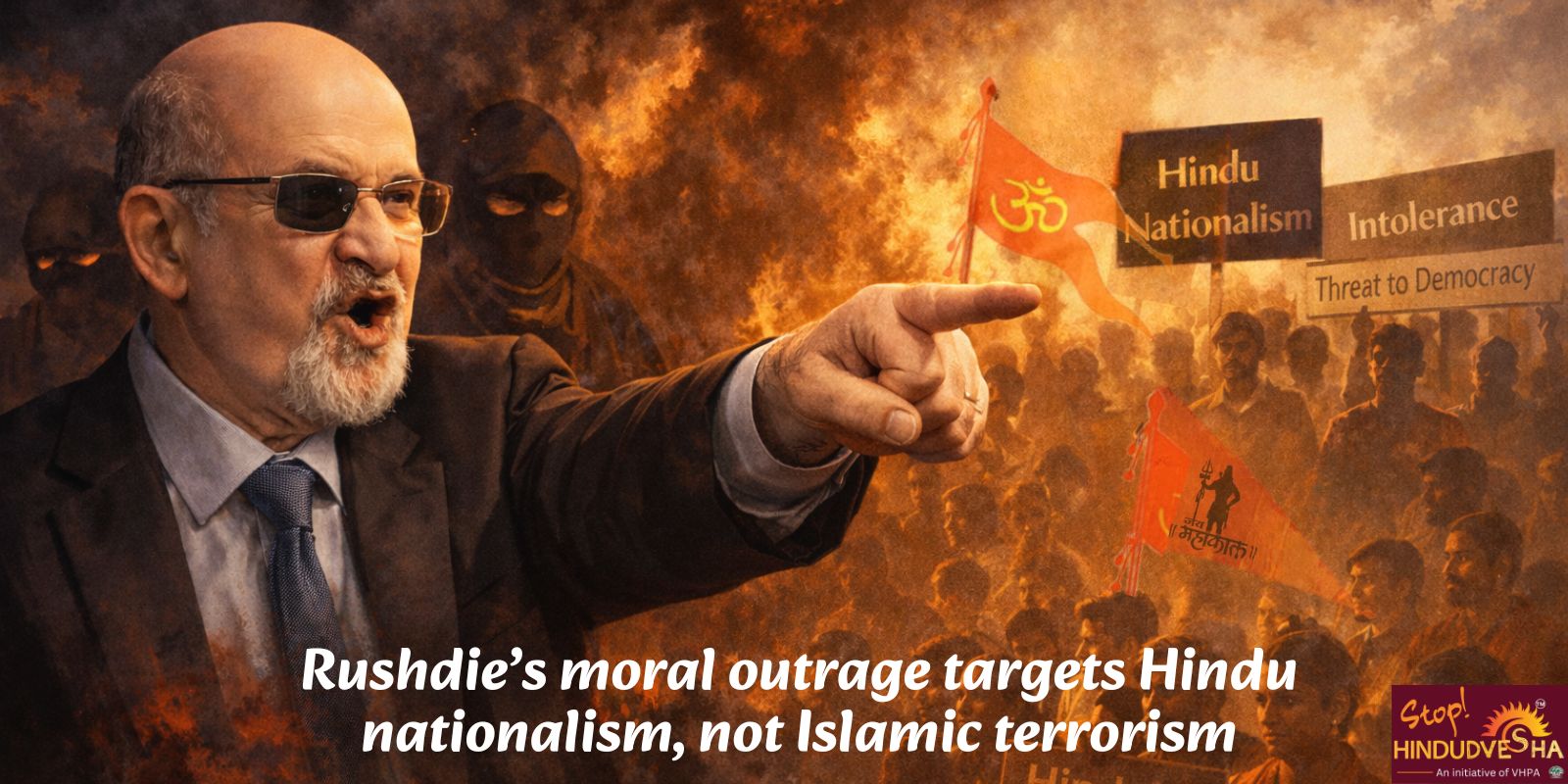
- Hunted by Islamist fanatics for 36 years, Rushdie now trains his moral fire on Hindu nationalism, sparing the ideology that issued fatwas, enforced global censorship, and nearly killed him.
- He condemns India’s Hindu revival despite Modi’s government quietly lifting the ban on The Satanic Verses, exposing a striking gap between lived facts and ideological talking points.
- Islamist violence cost Rushdie his freedom, marriages, and an eye; Hindu nationalism cost him nothing yet remains his preferred target.
- His criticism reflects elite echo chambers and self-preservation, not courage: attacking Hindus is safe, confronting Islamist extremism still carries blood-soaked consequences.
- In choosing the safer adversary, Rushdie undermines his own legacy, trading principled free speech for selective outrage shaped by fear rather than truth.
For thirty-six years, Salman Rushdie has lived like a fugitive, perpetually on the run. The 1989 Iranian fatwa, which placed a million-dollar bounty on his head, forced the author into hiding for nearly a decade, living under constant British police protection at secret addresses.[1] Four of his marriages collapsed under the strain. Professionally, booking tours became impossible. Translations of The Satanic Verses, which Muslims claimed insulted Muhammad, were banned or burned in dozens of countries; publishers faced boycotts and murderous attacks. Rushdie wrote under pseudonyms and lived with death threats that resurfaced repeatedly.[2] In August 2022, at a bucolic retreat for thinkers in upstate New York, the author was stabbed 27 times by a radicalized Muslim, an attack that left him blind in one eye.[3]
And yet, despite a life shaped by the extremes of religious intolerance, Rushdie now directs much of his criticism toward Hindus in India.[4] Despite not having visited India in years and drawing solely from conversations with his left-leaning friends, he claimed in a December 2025 Bloomberg interview: “There seems to be a desire to rewrite the history of the country; essentially to say Hindus are good, Muslims bad.”[5] Imagine that — Rushdie lost his freedom, family, an eye, and nearly his life to Muslim fanatics, and yet his primary concern is not freedom of speech but the image of Indian Muslims. That’s a textbook case of spineless inversion of priorities.
The outburst raises a difficult question: How can he rise to defend the Muslim community, which has not absolved him of his alleged guilt, and imply that Hindus, who have empathized with Rushdie during the entirety of his four-decade ordeal, are intolerant? The tension between those positions is as paradoxical as Rushdie’s own life story.
To view Rushdie’s remarks purely as hypocrisy is tempting. Indeed, many critics have seized on the irony: a man blinded by a Muslim attacker dedicating his renewed moral outrage to Hindu nationalism. But such a reading risks reducing Rushdie to a caricature — the “victim turned hypocrite.” Real life, as always, is messier.
Satanic Verses: From Literary Stardom to Enduring Peril
Born in Mumbai in 1947, amid India’s partition, Salman Rushdie emerged as a masterful chronicler of postcolonial identity. His early works, including the sci-fi Grimus (1975) and the Booker Prize-winning Midnight’s Children (1981), blended magic realism with the complexities of migration, exile, and hybrid cultures. Fluent in English and Urdu, and a blend of atheism and inherited Islam, Rushdie positioned himself as a cosmopolitan voice challenging boundaries.
The publication of The Satanic Verses in 1988 marked a turning point. This dreamlike novel, exploring migration, identity, and blasphemy through a fictionalized portrayal of Muhammad (as “Mahound”), was seen by many Muslims as a profound insult to Islam. Protests erupted worldwide, from Bradford to Islamabad, involving book burnings, effigies, and riots that claimed many lives. India, under Rajiv Gandhi’s Congress government, ever sensitive to its Muslim vote bank, swiftly banned the book to maintain “public tranquility,” a decision that deeply wounded Rushdie, who still viewed India as home.[6]
The crisis escalated on February 14, 1989, when Iran’s Ayatollah Ruhollah Khomeini issued a fatwa: “I inform the proud Muslim people of the world that the author of The Satanic Verses book, which is against Islam, the Prophet and the Koran, and all involved in its publication who were aware of its content, are sentenced to death.”[7] A bounty, eventually reaching $3.3 million, was offered.[8] At 41, Rushdie entered nearly a decade of hiding under the pseudonym “Joseph Anton” (inspired by Conrad and Chekhov), protected by British security in secret safe houses.
By the time Rushdie emerged from hiding in 1998 — after Iran’s President Mohammad Khatami distanced the state from active enforcement — the fatwa had metastasized into a cultural phenomenon. It birthed “Rushdie Rules,” the term coined by scholar Daniel Pipes for the self-censorship that grips discourse on Islam: criticize Hinduism or Christianity freely, but tread lightly on the prophet.[9]
Decades later, on August 12, 2022, at New York’s Chautauqua Institution, 24-year-old Hadi Matar — a Lebanese American Muslim radicalized online — stabbed Rushdie multiple times during a lecture on writerly threats. The 27-second attack blinded Rushdie in one eye, damaged his liver, and severed nerves. The author recovered after prolonged sepsis and paralysis, but the incident reopened old fissures. For, it was the same scourge — Matar or Khomeini, Islamist zeal meant eternal vendetta.
Targeting Hindu Nationalism
Two years on, as of December 2025, Rushdie’s life is a mosaic of guarded normalcy. He winters in New York, summers in London; his sight in the surviving eye sharpens with corrective lenses. He mentors young writers, spars on the social media platform X, and is more prolific than ever. Matar, the fanatic Muslim assassin, is serving a prison term of 25 years — plenty of time for Rushdie’s frayed nerves to heal and not worry about recidivism at least in the author’s lifetime. The fatwa, though dormant, persists: Islamist hardliners in Iran still tout it as a badge of piety.
Enter India, the prodigal homeland, where Rushdie’s latest salvo has ignited a transatlantic blaze. In the Bloomberg interview, aired amid global chatter on free speech, Rushdie turned his unblinking eye eastward. “I feel very worried about it,” he said of India under Prime Minister Narendra Modi. “I have lots of friends in India. Everybody is extremely concerned with the attack on the freedoms of journalists, writers, intellectuals, professors, et cetera.” He decried a “desire to rewrite the history of the country; essentially to say Hindus good, Muslims bad — the thing VS Naipaul once called a ‘wounded civilisation,’ the idea that India is a Hindu civilisation wounded by the arrival of Muslims. That project has a lot of energy behind it.”[10]
Naipaul’s 1977 polemic, An Area of Darkness[11], had lambasted India’s wounded psyche under the yoke of Muslim and British rules — a view Rushdie now repurposes as a critique of Modi’s Bharatiya Janata Party (BJP), which swept to power in 2014 on a platform blending economic reform with Hindu revivalism. Modi, a former tea seller from Gujarat’s hinterlands, has presided over India’s ascent as the world’s fifth-largest economy, yet his tenure draws fire from the so-called intellectuals.
The author’s alarm comes from spending too much time in India’s leftist echo chamber. For Rushdie, raised in Bombay’s elitist milieu and surrounded by Bollywood glamour, this evokes the Emergency of Indira Gandhi (1975-77), when press freedoms were throttled, and opposition leaders were thrown into jail.
Who Stabbed You? Not Hindus
Yet herein lies the paradox that has propelled Rushdie’s words into a maelstrom. Just last year, in November 2024, the Modi government allowed the lifting of the 37-year import ban on The Satanic Verses. This cleared the path for booksellers in India to stock the novel, a quiet vindication for the author who had called the ban a betrayal. Congress, the party of Gandhi and Nehru, had imposed it to appease Islamist MPs like Syed Shahabuddin, who threatened unrest; Modi’s administration, for all its Hindu majoritarianism, let it lapse without fanfare[12].
This irony detonated on X, where Rushdie’s interview clip unleashed a torrent of rebuke. Anand Ranganathan, professor and vocal Hindu nationalist, posted a video rebuttal: “He was handed a death sentence by Muslims; he went into hiding for a decade; his books were banned; he was cancelled by his own; he lost his eye and nearly his life to a jehadi attack — and who does he blame? Modi and Hindus.”
Many echoed the sentiment: “Sitting with an eye lost to Islamists, Salman Rushdie is worried about Hindu nationalists. He knows who to target to keep the other eye safe.“[13]
Firstpost editor Utpal Kumar framed Rushdie’s stance as duplicity: “To watch Rushdie reprimand Hindu nationalism after surviving a near-fatal Islamist attack is, therefore, to witness a tragic spectacle: a man shaped by fear into criticizing the safest opponent available. It is not courage; it is self-preservation masquerading as principle. And it underscores a deeper truth about our intellectual climate — the willingness of cultural elites to condemn, even cut, the tree that never struck them while tiptoeing around the jungle that nearly swallowed one of their own. Rushdie’s warning about Hindu nationalism may win him applause in ‘Left-Liberal’ salons, but it is a misdirection that obscures the true, documented, bloodstained threat that has shadowed him for the past 36 years.”[14]
No argument there. In contrast to the 45 Satanic Verses-linked murders, Rushdie’s encounters with Hindu nationalism have been almost banal. In 2015, he went on Twitter to mock Hindus who supported Narendra Modi: “Here come the Modi Toadies. FYI, Toadies: I support no Indian political party & oppose all attacks on free speech. Liberty is my only party.”[15] In response, social media users simply pointed out his hypocrisy — targeting the Hindu community that had supported him throughout his career while pussyfooting around the real threat to free speech posed by Muslim fundamentalists.
Rushdie’s tweet came after Shiv Sena party workers blackened the face of politician Sudheendra Kulkarni in Mumbai for organizing an event to launch a book by former Pakistan foreign minister Khurshid Kasuri. Read that again — Hindu nationalists used harmless dye to blacken the face of a rogue politician who was in cahoots with an Islamist minister from Pakistan. That’s right — no stabbing, no eye gouging, no blood, no Allahu Akbar, just words.
Rushdie’s Modi Obsession
But oblivious to the irony of his stance, Rushdie doubled down and claimed Modi was curbing freedom in India. “There are attacks on ordinary liberties, the ordinary right of assembly, the ordinary right to organise an event in which people can talk about books and ideas freely and without hostility. That seems to be in real grave danger in India today,” he said from London.[16]
Earlier in 2014, during India’s general elections, he said at the 10th annual PEN World Voices Festival in New York, “I am pretty concerned about a Modi-run government. The indications that it would be a fairly bullying government are already there. We have already seen journalists and writers being bullied, and the BJP has not taken power yet.”[17]
Rushdie then joined a cabal of leftists, liberals, Muslims, and useful idiots from the West to jointly write an article that demonized Modi. Its moot point was: “Were he to be elected prime minister, it would bode ill for India’s future as a country that cherishes the ideals of inclusion and protection for all its peoples and communities.”[18]
When Salman Rushdie mocked Shiv Sena leader Bal Thackeray and caricatured Hindu figures in The Moor’s Last Sigh (1995), Hindu nationalists largely ignored the provocation. Thackeray himself brushed Rushdie aside as irrelevant, remarking that the book did not merit his attention and could be read, if at all, by his secretary.
Utpal Kumar’s op-ed dissected the easy targeting of Hindu nationalism: “What makes Rushdie’s commentary on India more revealing than the opinions he expresses is not merely what he chooses to say, but what he conspicuously avoids. Notably, he offers no sustained criticism of Islamic radicalism — the very force that has repeatedly sought to silence him through threats of violence and attempts on his life and that of his associates.”[19]
Conditioned by his ideological echo chamber, Rushdie misreads contemporary India. Modi’s India is not a theocracy. Its Constitution explicitly enshrines secularism; its courts continue to check executive overreach, as seen in the decision to overturn the ban on The Satanic Verses; and the vast majority of Hindus regard religious tolerance as essential, as documented by the Pew Research Center[20]. Rushdie fails to register this reality because the India he invokes is the one he left behind, where Hindu society lacked an effective public voice, minorityism was entrenched, and political appeasement was routine. For those long accustomed to appeasement, the restoration of equal standards can easily be mistaken for intolerance. What is often described as Modi’s “Hindu majoritarianism” is more accurately understood as a correction to decades, and in some respects, centuries of structural appeasement.
The Man is No Hero
Rushdie claims he is an atheist like his father. And yet as soon as the fatwa storm arrived, in February 1989, Rushdie expressed remorse with great alacrity, saying: “I profoundly regret the distress that publication has occasioned to sincere followers of Islam.” In 1990, Rushdie again expressed remorse, saying he had embraced the Islamic faith. That’s right — the atheist author offered to convert to Islam to save his skin.[21] He also declared that he did not agree with the views expressed by characters in the novel, and opposed the book’s publication in paperback.
These lame attempts to suck up to the unyielding Islamists predictably did not work, with the Ayatollah declaring: “Even if he repents and becomes the most pious Muslim on Earth, there will be no change in this divine decree.” In 2016, 40 state-run media organizations in Iran pooled together to raise $600,000 to top up the bounty on the writer’s head to $3.5 million. The fatwa is eternal, and who knows, maybe generational.
Wrapping Up
As a survivor, Rushdie commands sympathy. As a public intellectual, he commands attention. But as a truth-teller, he invites scrutiny. In the end, his selective outrage — rooted in living in a leftist echo chamber rather than direct confrontation with the ideology that has repeatedly sought his erasure — reveals not just inconsistency, but a form of intellectual dishonesty. While Hindu nationalism may polarize and provoke debate, it has never issued a fatwa, never stabbed him on stage, and, in a quiet irony Rushdie refuses to acknowledge, presided over the effective lifting of the ban on his most defining work.
Rushdie’s silences on the persistent dangers of radical Islamism speak louder than his words on India, underscoring a deeper malaise in elite discourse: the readiness to assail the safer adversary while tiptoeing around the one that draws real blood. In this inversion of threats and priorities, Rushdie diminishes his own legacy as a defender of unfettered expression, becoming instead a cautionary figure of fear disguised as principle.
Citations
[1] CNN. “Salman Rushdie and Iran: A Long, Violent History.” CNN, August 15, 2022. https://edition.cnn.com/2022/08/15/middleeast/salman-rushdie-iran-mime-intl
[2] CBC News. “Salman Rushdie’s New Memoir Revisits a Life in Hiding.” CBC News. https://www.cbc.ca/news/entertainment/salman-rushdie-s-new-memoir-revisits-a-life-in-hiding-1.1203614
[3] News on Air. “American-Lebanese Man Hadi Matar Sentenced to 25 Years in Prison for 2022 Knife Attack on Author Salman Rushdie.” News on Air. https://www.newsonair.gov.in/american-lebanese-man-hadi-matar-sentenced-to-25-years-in-prison-for-2022-knife-attack-on-author-salman-rushdie/
[4] YouTube. “Salman Rushdie.” YouTube Shorts. https://www.youtube.com/shorts/kJur-1jEogk
[5] The Telegraph India. “Rushdie Flags Desire to Rewrite India’s History to Say Hindus Are Good, Muslims Bad.” The Telegraph India. https://www.telegraphindia.com/world/rushdie-flags-desire-to-rewrite-indias-history-to-say-hindus-are-good-muslims-bad/cid/2136773
[6] News18. “Why Rajiv Gandhi Banned Salman Rushdie’s The Satanic Verses: Row over the Book Explained.” News18. https://www.news18.com/explainers/why-rajiv-gandhi-banned-salman-rushdies-the-satanic-verses-row-over-the-book-explained-9168496.html
[7] Pulitzer Prizes. “We Shall Not Be Silenced.” The Pulitzer Prizes. https://www.pulitzer.org/article/we-shall-not-be-silenced
[8] Flood, Alison. “A Tsunami of Outrage: Salman Rushdie and The Satanic Verses.” The Guardian, August 12, 2022. https://www.theguardian.com/books/2022/aug/12/tsunami-outrage-salman-rushdie-satanic-verses
[9] Pipes, Daniel. “The Rushdie Rules.” Middle East Quarterly. https://www.meforum.org/middle-east-quarterly/the-rushdie-rules
[10] The Telegraph India. “Rushdie Flags Desire to Rewrite India’s History to Say Hindus Are Good, Muslims Bad.” The Telegraph India. https://www.telegraphindia.com/world/rushdie-flags-desire-to-rewrite-indias-history-to-say-hindus-are-good-muslims-bad/cid/2136773
[11] [Untitled Book]. Digital Library of India. Archive.org. https://archive.org/details/dli.ernet.236455
[12] Business Standard. “Salman Rushdie’s The Satanic Verses Ban in India Lifted after 37 Years.” Business Standard. https://www.business-standard.com/india-news/salman-rushdie-satanic-verses-india-ban-lifted-37years-124122500394_1.html
[13] TFI Post. “Salman Rushdie Targets Hindu Nationalism; Internet Reminds Him of His Own Violent Attack.” TFI Post. https://tfipost.com/2025/12/salman-rushdie-targets-hindu-nationalism-internet-reminds-him-of-his-own-violent-attack/
[14] Firstpost. “Salman Rushdie’s Comments on Hindu Nationalism and Islamist Attacks.” Firstpost. https://www.firstpost.com/opinion/salman-rushdie-comments-hindu-nationalism-islamist-attacks-13958065.html
[15] The Commune. “Salman Rushdie, Target of Islamist Violence for The Satanic Verses, Now Says He’s Worried about Hindu Nationalism.” The Commune. https://thecommunemag.com/salman-rushdie-target-of-islamist-violence-for-satanic-verses-now-says-hes-worried-about-hindu-nationalism/
[16] Hindustan Times. “Modi Toadies: Salman Rushdie Hits Back at Social Media Detractors.” Hindustan Times. https://www.hindustantimes.com/india/modi-toadies-salman-rushdie-hits-back-at-social-media-detractors/story-9UUyAV8UYfvJ1wfSVKWqKL.html
[17] The Times of India. “Narendra Modi-Run Government Would Be a Bullying One, Salman Rushdie Says.” Times of India. https://timesofindia.indiatimes.com/news/narendra-modi-run-government-would-be-a-bullying-one-salman-rushdie-says/articleshow/34726866.cms
[18] Rushdie, Salman. “If Modi Is Elected, India’s Future Will Look Like Gujarat.” The Guardian, April 10, 2014. https://www.theguardian.com/commentisfree/2014/apr/10/if-modi-elected-india-future-gujarat
[19] Firstpost. “Salman Rushdie’s Comments on Hindu Nationalism and Islamist Attacks.” Firstpost. https://www.firstpost.com/opinion/salman-rushdie-comments-hindu-nationalism-islamist-attacks-13958065.html
[20] Pew Research Center. “Religion in India: Tolerance and Segregation.” Pew Research Center, June 29, 2021. https://www.pewresearch.org/religion/2021/06/29/religion-in-india-tolerance-and-segregation/
[21] Flood, Alison. “A Tsunami of Outrage: Salman Rushdie and The Satanic Verses.” The Guardian, August 12, 2022. https://www.theguardian.com/books/2022/aug/12/tsunami-outrage-salman-rushdie-satanic-verses

Donate to HINDUDVESHA
Our Mission is to explore and expose Hindudvesha through research analysis, education and response.
SUPPORT US