

Why Hindus Must Build Their Own Universities in the West
 Rati Agnihotri · 10/18/2025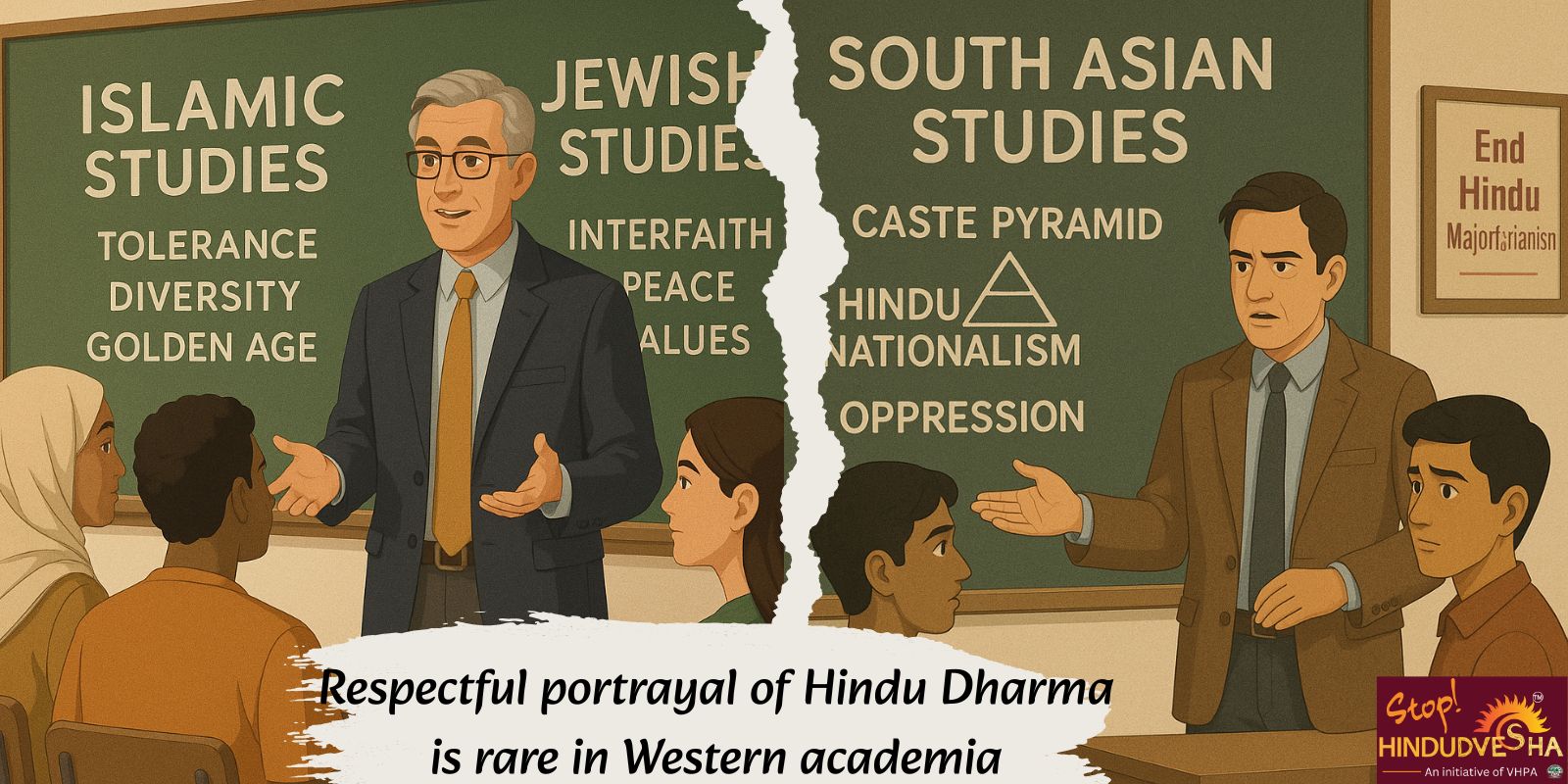
- Hindu youth in the West face growing deracination due to biased curricula, caste-focused narratives, campus activism, and woke ideologies that distance them from their cultural and civilizational roots.
- Hinduphobia in Western academia is entrenched, with “caste” disproportionately emphasized across unrelated disciplines, creating guilt and stigma for Hindu students while framing the community as inherently oppressive.
- Woke activism on campuses, often aligned with left-liberal and Islamist forces, draws Hindu youth into movements that vilify their own heritage and perpetuate anti-Hindu narratives.
- Unlike Christians, Hindus have not invested significantly in world-class higher education institutions in the West that combine modern scientific learning with civilizational ethos.
- Building such institutions would provide balance in academic research, integrate practitioner perspectives, and create a supportive intellectual environment for Hindu youth to remain confident in their identity.
In June, the US Supreme Court issued a rare ruling in favor of parental choice. Parents from multiple faiths had sought the right to exempt their elementary-age children from reading books with LGBTQ+ themes.[1] The court agreed, granting an “opt-out” option. This decision comes amid a broader trend across Western nations, where LGBTQ+ and gender identity content is being introduced into school curricula under the guise of sensitization and inclusivity. For young children, such exposure often encourages premature questioning of gender identity, reflecting how deeply woke ideology has seeped into education.
While all communities feel this impact, Hindu youth face distinctive challenges. Woke discourse creates alliances among groups claiming victimhood, with left-liberal and Islamist networks leveraging this framework to portray Hindus as oppressors. Academic theories such as Critical Race Theory and Intersectionality Studies routinely place women, LGBTQ+ individuals, and Muslims under one marginalized umbrella while amplifying caste narratives to depict Hinduism as uniquely oppressive.
This has enabled Hinduphobia to spread through schools and universities. Caste-sensitization workshops, biased research, and negative framing in social sciences have created an environment where Hindu identity is stigmatized. Instead of fostering cultural confidence, Hindu students are pressured to internalize stereotypes and align with struggles unrelated to their experiences.
The result is alienation and cultural uprooting. Hindu youth in the West are increasingly separated from their civilizational roots, subjected to bullying and activism that vilifies their traditions. Worse, some are being groomed into reproducing anti-Hindu narratives themselves.
The combination of biased curricula, peer pressure, and ideological indoctrination poses a long-term threat: a generation of Hindus in the diaspora at risk of losing both cultural pride and authentic connection to their heritage, while being co-opted into movements that undermine it further.
Campus Radicalism and the Deracination of Hindu Youth
Our platform has done extensive coverage of the dubious funding trail of Harvard and other elite universities in the US. Our analysis reveals a direct connection between the major funding sources of many of these universities and the alarming rise in antisemitism on campuses, along with the concerning rise in pro-Hamas activism, especially in rallies organized by the “Students for Justice in Palestine” (SJP). Following the October 7 Hamas terrorist attack on Israel, many such rallies organized across US university campuses glorified Hamas terrorists as “martyrs” and even called for a “globalization” of terror violence, openly demanding the annihilation of the Jewish state of Israel. [2]
Campus activism, fueled by the alliance of woke, left-liberal, and radical Islamist forces, has left no community untouched. Hindu American youth are increasingly being drawn into this dangerously misleading activism, which is brainwashing them into becoming terror apologists while systematically severing their ties to their own cultural and civilizational roots.
There have been many instances of Indian-origin students in the US being arrested or detained for pro-Gaza activism on campus over the past 2-3 years, with Hindu American youth found to be involved in some of these cases. Achinthya Sivaligan, a student at Princeton University, was reportedly arrested in April 2024 after she, along with the other protestors, set up tents for an encampment in the university courtyard. Born in Coimbatore, Tamil Nadu, Achinthya was raised in Columbus, Ohio, according to media reports. [3] [4]
In another case, Indian American student Megha Vemuri, President of the Massachusetts Institute of Technology Class 2025, was barred from attending her own graduation ceremony[5] after delivering a pro-Palestine speech at an official event in June 2025.
Such cases raise an urgent question: why are Hindu American youth so vulnerable to woke activism on campus? The reasons are complex, involving peer pressure, academic indoctrination, lack of grounding in Dharmic and cultural values, and relentless social media influence. Young Hindus in the West live in a toxic environment where they are surrounded by anti-Hindu narratives at all times. The woke ecosystem also relies heavily on trolling and public shaming to silence dissent. Without an alternate ecosystem of support, Hindu students often succumb to these pressures.
The tragic case of Riddhi Patel illustrates this vulnerability. A 28-year-old Indian American, Patel was arrested in Bakersfield, California, in April 2024 for threatening to murder members of the local city council and the mayor during a pro-Palestine speech. Patel’s supposedly pro-Palestine speech was laced with Hinduphobia, calling Navratri a “festival of oppressors”. She also invoked Mahatma Gandhi and Jesus Christ right before she threatened to murder the city council members.[6] While the Hindu American community quickly distanced itself from her rhetoric, condemning her Hinduphobia, Patel’s story is a stark warning. Though she is not representative of the average Hindu American youth, her case shows how easily young Hindus can be groomed into anti-Hindu narratives and radical ideologies, even at the cost of their futures and their families’ well-being.
Many Hindu parents in the West make sincere efforts to impart knowledge of Hindu values, culture, and traditions to their children. Yet many still fall prey to brainwashing in the woke-dominated academic environment. College and university campuses are especially hostile, and the overwhelming emphasis on “personal space” in Western culture prevents parents from guiding or advising their adult children too closely. This creates further distance between youth and their cultural roots.
The story of Shobha Swamy, General Secretary of the Coalition of Hindus of North America (CoHNA), poignantly highlights this dilemma. In an interview with Infinity Foundation, Shobha shared her personal experiences to explain how and why Hindu American families are being targeted by wokeism. Despite her and her husband’s best efforts to inculcate Hindu values in their daughters and immerse them in Hindu culture, both drifted towards wokeism and Hinduphobia once they entered college. They stopped participating in Hindu festivities and family pujas, and after graduation, refused to accompany their mother to temples. One of Shobha’s most painful discoveries was learning that one of her daughters was being trained by the virulently Hinduphobic organization Equality Labs.[7] [8]
Academic Hinduphobia and Caste Narratives
Our platform has extensively covered how Hinduphobia in Western academia serves as the root source of anti-Hindu narrative that later permeates media, creative industries, social media, and the think tank ecosystem.[9]
In Breaking India: Western Interventions in Dravidian and Dalit Faultlines, Rajiv Malhotra and Aravindan Neelakandan trace the early history of anti-Hindu scholarship, beginning with colonial Indologists who sowed the seeds of hostile discourse. Later, in Snakes in the Ganga: Breaking India 2.0, Rajiv Malhotra and Vijaya Viswanathan analyze the motivated funding nexus of elite Western universities, particularly Harvard, and how these institutions perpetuate Hinduphobia through social sciences and humanities curricula.
Another significant book is Ten Heads of Ravana: A Critique of Hinduphobic Scholars, edited by Rajiv Malhotra and Divya Reddy. This volume exposes the inherent biases and hostility towards Hindu traditions in the writings of well-known Western scholars on Indology, including Audrey Truschke, Wendy Doniger, Sheldon Pollock, and Michael Witzel.
This phenomenon is not confined to Hindu studies but pervades the broader social sciences and humanities. Hinduphobic scholarship is subtly promoted, leaving Hindu youth more exposed to hostile narratives. The most striking example is the disproportionate focus on “caste.” Elite Western universities frequently insert caste into areas where it is irrelevant, producing theories that distort unrelated disciplines. Consequently, Hindu youth in the West face constant pressure to feel ashamed of their identity. Persistent repetition of caste narratives frames them as inherently oppressive. This pressure is institutionalized through caste sensitization workshops [10] [11] that are imposed on schools and universities. These sessions single out Hindu students, branding their community as universal oppressors, thereby undermining cultural confidence and weakening ties to their civilizational identity.
Caste narratives have entrenched themselves so deeply in the West that they now appear in unrelated fields like international affairs. White House Trade Adviser Peter Navarro’s outburst against “Brahmins,” linking them to profiteering from India’s Russian oil trade, reflects this disturbing pattern. Such remarks reveal how anti-Hindu sentiment has become fashionable not only in academia and media but also in politics and geopolitics. Fueled by wokeism, these inflammatory claims worsen hostility toward Hindus in the West, turning the diaspora into an easy scapegoat in global controversies.
Why Hindus Must Invest in Their Own Universities
While the Hindu community in the West has made some efforts towards creating adequate infrastructure for imparting Dharmic education to its kids and youth, it hasn’t quite invested in the creation of higher educational institutions that impart modern education, while being rooted in a Hindu ethos.
A few pioneering institutions have laid the groundwork for this. The Hindu University of America, Hindu International University, Vivekananda Yoga University, and Vedic Hindu University have sought to contextualize Hindu studies for a Western audience. They have brought practitioner perspectives into pedagogy, offering authentic courses in Sanatan Dharma and related fields. Similarly, organizations like the American Institute of Vedic Studies have played a crucial role in introducing Hindu American youth to Dharmic thought and enabling Western society to access Hindu traditions from an authentic perspective.
However, as important as these contributions are, they remain limited in scope. Dharmic education alone is insufficient. The overwhelming influence of woke-left liberal-radical Islamist narratives on Western campuses has created a toxic intellectual environment where Hindu youth often dismiss Dharmic perspectives with suspicion or ridicule. Immersed in Hinduphobic discourse, they come to see their own heritage through distorted lenses.
There is a striking imbalance between the study of Hinduism in Western universities and the treatment of disciplines such as Islamic Studies. While dozens of American universities offer graduate-level programs—MA and PhD—in Islamic Studies, hardly any institutions provide comparable programs in Hindu Studies. Similarly, Jewish Studies enjoys dedicated programs across many universities, but Hindu Studies remains largely absent.
Leading universities such as Columbia, Harvard, New York, Stanford, Georgetown, Chicago, Berkeley, Pennsylvania, and Yale all feature Islamic Studies in their curricula. In many of these, exclusive centers and departments focus on Islamic culture, civilization, and religion. By contrast, Hinduism is often relegated to broad and imprecise categories, such as South Asian Studies. Moreover, in Islamic Studies, the practitioner’s voice and perspective are welcomed, and the aim is often to cultivate a nuanced understanding beyond stereotypes and prejudice. Ironically, in the case of Hinduism, it is precisely the prejudiced and dogmatic lens that dominates much of the scholarship, rather than a genuine attempt at deeper understanding.
For instance, the Prince Alwaleed Bin Talal Islamic Studies Program at Harvard University “seeks to bridge gaps in understanding between the Muslim and non-Muslim worlds and to ensure that Islamic studies at Harvard reflect the depth and breadth of Islam’s historically rich and geographically diverse cultures.” Similarly, New York University hosts a whole department devoted to Middle Eastern and Islamic Studies, where one of the stated priorities is to address Islamophobia and present a balanced view of Islam and the Muslim world. [12] In sharp contrast, the study of Hinduism in Western universities rarely incorporates the practitioner’s perspective and is most often framed through rigid themes of caste and hierarchy. [13] [14] [15]
This makes it critical for the Hindu diaspora to invest in mainstream higher educational institutions in the West that combine modern academics with an Indic ethos. Such universities must offer standard programs in STEM, management, social sciences, humanities, and the arts, while also integrating Hindu cultural values, ethics, and civilizational knowledge. The aim should not be isolation but integration—educating students in a way that allows them to excel in modern professions while remaining grounded in Hindu identity.
It is essential to bear in mind that funding the existing institutions to promote Hindu studies will only end up further reinforcing Hinduphobia in Western academia by enabling the production of more and more anti-Hindu works. Thus, the only choice is to raise fully Hindu-owned institutions – perhaps starting with liberal arts programs but eventually expanding to all disciplines.
The Hindu community does not need to reinvent the wheel. Numerous Christian models already exist in the West. For instance, the University of San Diego proudly identifies itself as a “contemporary Catholic university,” [16] with a vision strengthened by the Catholic intellectual tradition. The University of Notre Dame, one of America’s most prestigious institutions, defines itself as rooted in faith, describing its mission as a “bold act of faith” where “faith and inquiry are never at odds.” [17]
Even the prestigious Ivy League carries this imprint. Harvard, Yale, Princeton, University of Pennsylvania, Brown, Columbia, Dartmouth, and Cornell all trace their origins to Christianity. They began as “distinctively Christian training grounds for America’s leaders – first for clergy and then for leaders of all types.” [18]
Similarly, many prestigious UK universities, including Oxford and Cambridge, proudly display their Christian heritage, even though they may not explicitly identify themselves as Christian universities.
Hindus should take inspiration from the Christian model and invest in establishing world-class higher educational institutions in the West that uphold and promote Hindu values and ideals, while remaining firmly committed to delivering modern scientific education.
Countering Distortions Through Hindu Universities
The social sciences and humanities research in Western universities is steeped in Hinduphobia. Any research involving India invariably drifts into the domain of “Hindutva”, “Hindu majoritarian”, and “caste.”
Caste has become such a conspicuous recurrence in social sciences and humanities research that it now appears even in the most unrelated of disciplines, such as environmental studies and science & technology. [19]
If the Hindu community begins to fund and develop modern and progressive higher educational institutions in the West, rooted in a Hindu ethos, they can also gradually influence the trends in humanities and social sciences research for good. Even the creation of a handful of such institutions could help counter the entrenched Hinduphobia found in Hindu studies courses and within the wider curriculum of social sciences and humanities departments. Such intervention would allow balanced research on Hindu Dharma and civilization, including practitioner perspectives usually excluded.
Progressive Packaging of Hindu Traditions and Issues
Hindu youth get easily drawn into anti-Hindu woke ideologies in the West because these are presented mainly as “progressive” credentials. On the other hand, when the youth are taught Hindu Dharma from a purely religious and spiritual perspective, they perceive it as restrictive, outdated, or even bigoted.
Thus, the community must make efforts to package Hindu issues and traditions in a manner that resonates with modern and progressive discourse. The irony is that Hindu Dharma is, in essence, the most modern and progressive of all the world’s major religious systems. It encompasses an entire way of life, ancient knowledge systems, intellectual traditions, art, and cultural forms, as well as a rich repository of oral traditions and ancient scientific and mathematical knowledge. Yet, the impressionable mind bound by Abrahamic dogmas and the filters of wokeism prevents them from seeing this dimension.
In the book What is Hinduism, David Frawley calls Hinduism a scientific religion, arguing that it is a system of inquiry that encourages introspection and allows individuals to seek their own paths to truth, without binding them to fixed dogmas. For the Hindu community in the West, the task is to frame these aspects in the language of modernity, so that young people recognize the progressive nature of their own tradition.
Saving Hindu Youth in the West
The Hindu community in the West is at a tipping point. Outwardly, it appears to enjoy prosperity, influence, and political clout. Yet, beneath this veneer lies a troubling reality.
Hindu youth are increasingly being drawn into the vortex of wokeism and Hinduphobia. They are being indoctrinated into narratives of hate politics that turn them against their own religion, culture, and people. The urgency of the situation cannot be overstated. Without meaningful intervention, young Hindus risk losing their cultural grounding and becoming active participants in movements that vilify their heritage.
Citations
[1] US Supreme Court allows parents to opt out of lessons with LGBT books; https://www.bbc.com/news/articles/c8xgdegv2x5o
[2] HarvardGate – The Varsity Funding Trail from Hell; https://stophindudvesha.org/harvardgate-the-varsity-funding-trail-from-hell/
[3] Indian-Origin Princeton Student Arrested For Joining Anti-Israel Protests; https://www.ndtv.com/india-news/indian-origin-student-arrested-for-taking-part-in-anti-israel-protests-in-us-5526018
[4] Who is Achinthya Sivalingam? Indian-origin student held in US, banned from Princeton University over anti-Israel protest | Hindustan Times; https://www.hindustantimes.com/world-news/us-news/who-is-achinthya-sivalingam-indian-origin-student-held-in-us-banned-from-princeton-university-over-anti-israel-protest-101714130706230.html
[5] Who is Meghna Vemuri, Indian-origin student banned from graduation ceremony by one of the biggest technology universities in America: She deliberately… – The Times of India; https://timesofindia.indiatimes.com/technology/tech-news/who-is-megha-vemuri-indian-origin-student-banned-from-graduation-ceremony-by-one-of-the-biggest-technology-universities-in-america-she-deliberately-/articleshow/121547193.cms
[6] Who is Riddhi Patel? Indian-American protestor arrested for threatening to ‘murder’ Bakersfield City council members | Hindustan Times; https://www.hindustantimes.com/world-news/us-news/who-is-riddhi-patel-indian-american-protestor-threatened-to-murder-bakersfield-city-council-101712985715861.html
[7] How wokeism is targeting families explains CoHNA’s Shobha Swamy; https://hindupost.in/society-culture/wokeism-target-families-cohna-swamy/
[8] (67) Is family the latest frontier for wokeism? Shobha Swamy Gen Sec. CoHna – YouTube; https://www.youtube.com/watch?v=f8K3EbEH-18
[9] Hindudvesha and UN’s Double Standard; https://stophindudvesha.org/hindudvesha-and-uns-double-standard/
[10] Raising Awareness to End Caste Discrimination – College of Arts & Sciences at Syracuse University; https://artsandsciences.syracuse.edu/news-all/news-2023/raising-awareness-to-end-caste-discrimination/
[11] Workshop on Caste, Religion, Education and Occupational Mobility in Contemporary South Asia – Decolonising Lancaster University; https://wp.lancs.ac.uk/decolonising/2024/03/29/workshop-on-caste-religion-education-and-occupational-mobility-in-contemporary-south-asia/
[12] About Us; https://as.nyu.edu/departments/meis/about.html
[13] Caste, Culture, and Aesthetics | Stanford Humanities Center; https://shc.stanford.edu/stanford-humanities-center/workshops/caste-culture-and-aesthetics
[14] Understanding the persistence of caste | Harvard Kennedy School; https://www.hks.harvard.edu/more/student-life/student-stories/understanding-persistence-caste
[15] GENED 1126 – Race and Caste | Harvard Anthropology; https://anthropology.fas.harvard.edu/class/gened-1126-race-and-caste
[16] Mission, Vision, and Values – University of San Diego; https://www.sandiego.edu/about/mission-vision-values.php
[17] About | University of Notre Dame; https://www.nd.edu/about/
[18] Fruits of the ivy vine | Christian History Magazine; https://christianhistoryinstitute.org/magazine/article/139-fruits-of-the-ivy-vine
[19] “Brown Billions, Ivy Hate: India’s Elite Fund War”; https://stophindudvesha.org/brown-money-red-agendas-how-indian-billionaires-are-funding-the-ivy-leagues-war-on-india/

Donate to HINDUDVESHA
Our Mission is to explore and expose Hindudvesha through research analysis, education and response.
SUPPORT US