

State-Sanctioned Civilizational Suicide: India’s War on Its Own Heritage – and can it Reverse Course?
 Rakesh Krishnan Simha · 09/22/2025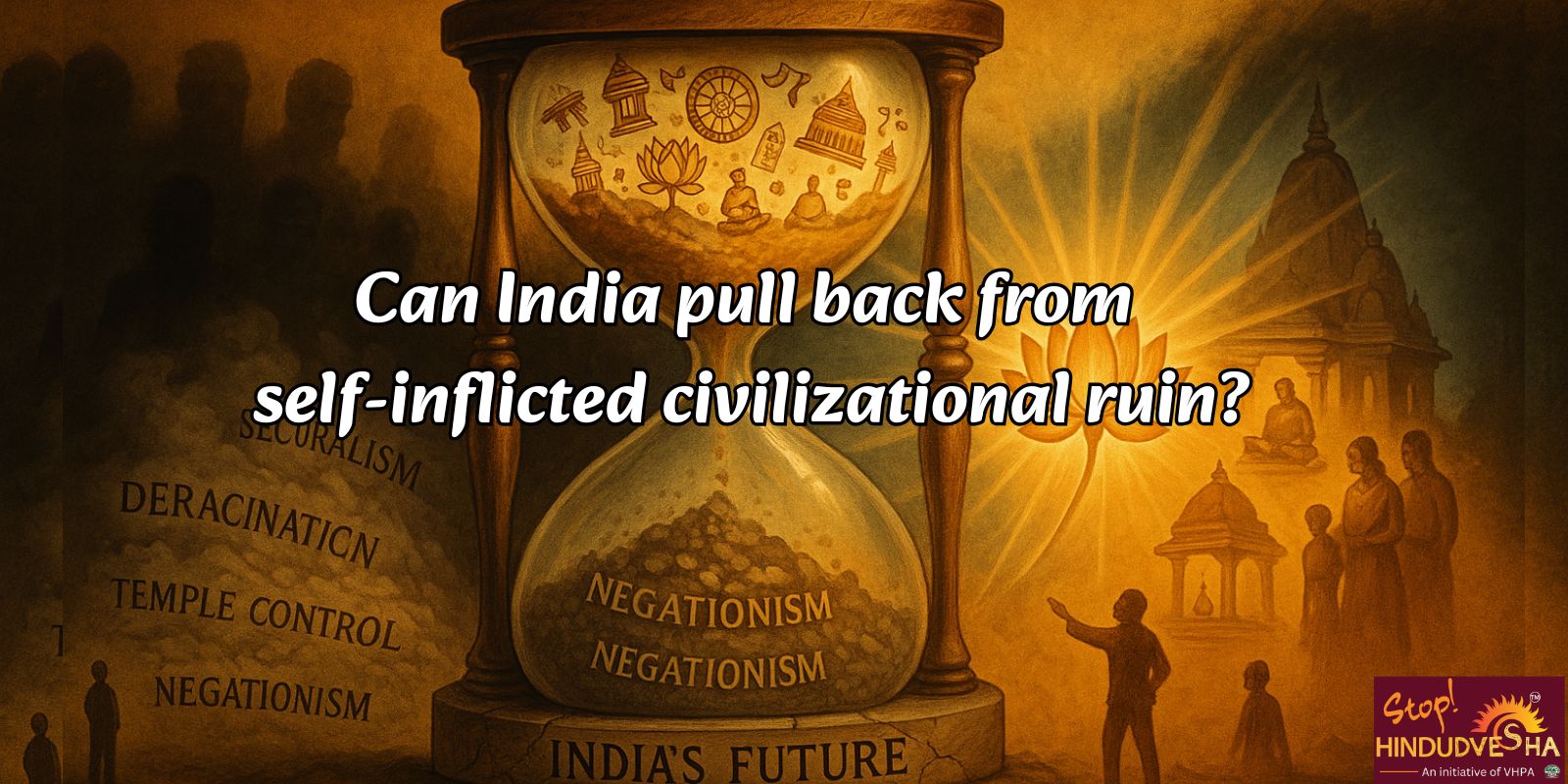
- India, the world’s oldest continuous civilization, survived invasions and colonialism but now faces erosion in the post-independence era through state policies, distorted education, and cultural deracination — a form of “civilizational suicide.”
- Though Islamic invasions and British rule inflicted great damage, Hindu civilization adapted and revived. Ironically, independence ushered decline under Western secularism, which marginalized Hindu identity.
- Education ministers from Maulana Azad onward whitewashed Islamic atrocities, downplayed Hindu resistance, and promoted Eurocentric/Marxist narratives, severing generations from their roots.
- State control of temples, demographic decline in key regions, and deracinated elites further weakened Hindu continuity, while minority institutions retained autonomy.
- Revival demands dharmic education, inner sadhana, temple renaissance, narrative sovereignty, language revival, legal reform, and community mobilization — aligning politics, culture, and spirituality.
In his 12-volume work ‘A Study of History,’ historian Arnold Toynbee argued that “Civilizations die from suicide, not by murder.“[1] This adage suggests that a civilization’s decline is not merely the result of external forces but often stems from internal choices, failures to adapt, complacency, erosion of foundational ethos, or self-destructive tendencies. India, the world’s oldest continuous civilization spanning over five millennia, offers a compelling case study for this perspective.
Applying this lens to India reveals a paradox: the civilization that survived the Indus-Saraswati Valley’s environmental collapse, the iconoclastic fury of Islamic rule, and rapacious British colonialism is now showing signs of decay in the post-colonial framework — an era supposedly shaped by self-rule and freedom. Under the banner of secularism, Hindu society has steadily ceded ground, manifesting a form of cultural suicide through state policies, intellectual deracination, and societal fragmentation. India’s current civilizational decline is less a product of exogenous shocks than endogenous betrayals.
Endurance Through Conquest: A Civilization That Refused to Die
The Islamic invasions of India (8th–18th centuries) began in earnest with the Arab incursions into Sindh, but it was the Ghaznavid, Ghurid, Delhi Sultanate, and Mughal invasions that posed significant existential threats to Hindu civilization. These attacks targeted temples, centers of learning, and royal institutions — epicenters of cultural and religious life. [2]
Yet, the civilizational core of Hindu society endured. Villages, temple rituals, caste networks, and sacred texts were preserved, often moving deeper into the hinterlands or adapting through vernacular and regional expressions. The Bhakti movement that arose during this period revitalized spiritual life, offering a decentralized, emotional, and inward response to violence and imperialism. Far from civilizational collapse, this period saw an inward strengthening of cultural forms.
British rule (1757–1947) introduced a new form of imperial domination that was economic, administrative, and epistemic, though somewhat less overtly violent. The colonial state dismantled traditional patronage networks, disrupted indigenous education, and imposed an Anglicized worldview. Yet even this did not fundamentally erode Hindu civilization. [3]
Ironically, colonialism sparked a Hindu renaissance. Thinkers like Swami Vivekananda, Dayananda Saraswati, Bankim Chandra Chattopadhyay, and Sri Aurobindo revived the philosophical and ethical foundations of Hindu civilization. Movements like the Arya Samaj attempted to purify, reform, and modernize Hindu practices, indicating a strong civilizational reflexivity rather than decline.
Post-Independence Paradox: Decline in the Age of Freedom
India’s independence in 1947 was seen as the culmination of Hindu resilience. Yet, paradoxically, the period of civilizational self-rule inaugurated a steady cultural erosion. The newly adopted framework of secularism, modeled not on Indian civilizational experience but on a Western liberal template, attempted to artificially separate religion and public life in a society where the two had always been integrated.
Instead of recognizing Hinduism as a civilizational framework rather than a mere religion, secularism in practice became anti-Hindu in tone and policy. It created a political culture in which expressions of Hindu identity were seen as regressive, communal, or majoritarian — even when those expressions were cultural, not theocratic.
Distortion of Education and Brainwashing Generations
Arguably, the most devious way in which the anti-Hindu agenda was played out was by introducing negationism in Indian education. This was achieved by placing a Muslim at the helm of the critical Education Ministry. With over 90 percent of Muslims declaring that they did not want to co-exist with Hindus, after which they broke India and created the independent nation of Pakistan in 1947, it was clear as daylight that the Muslims of India had no loyalty to the country of their birth.
And yet India’s post-independence education system was shaped by its first Education Minister, Maulana Abul Kalam Azad (1947–1958) and subsequent Muslim ministers — Humayun Kabir (1958–1963), Mohammadali Currim Chagla (1963–1966), Fakhruddin Ali Ahmed (1966–1967), and Saiyid Nurul Hasan (1971–1977). These leaders distorted history to suppress Hindu identity, whitewash Islamic invasions, marginalize Hindu contributions, and glorify foreign invaders, ultimately aiming to deracinate Hindus from their cultural and historical roots. [4]
Maulana Azad, born in Mecca in 1888, was an Islamic scholar from the fanatic Deobandi school. During the freedom movement, he had opposed India’s partition, viewing undivided India as historically Dar-ul-Islam, believing it would eventually become Islamic. As Education Minister, he laid the groundwork for a secular system that masked an agenda to erase Hindu narratives. [5]
Curricula under Azad omitted or sanitized atrocities from medieval sources like Tarikh-i-Firishta and Chachnama, including temple destructions, forced conversions, and massacres by figures such as Mahmud of Ghazni, Muhammad bin Qasim, and Alauddin Khalji. Events like the 1025 sack of Somnath Temple or the 1193 burning of Nalanda University by Bakhtiyar Khalji were downplayed, portraying Muslim rulers as benevolent patrons and Islamic rule as a golden era, while ignoring Hindu suffering and resistance.
Azad promoted Urdu over Sanskrit, supported Islamic institutions like Jamia Millia Islamia while neglecting Hindu gurukuls, and vilified Sanatana Dharma as superstitious. Cultural bodies like the Sahitya Akademi and Sangeet Natak Akademi prioritized Urdu and Persian-influenced arts over Hindu epics like the Ramayana and Mahabharata, fostering Hindu cultural inferiority and sidelining Hindu symbols in public institutions.
Nurul Hasan is singled out as the most culpable after Azad. As a historian and minister from 1971–1977, he empowered Marxist historians like Romila Thapar and Irfan Habib to rewrite school textbooks, inserting class struggles into ancient/medieval history, emphasizing Mughal achievements, and minimizing Hindu resistance (such as the Rajput wars against Babur or Ahom defiance of Aurangzeb). The Maratha Empire’s role in weakening the Mughals and reconquering two-thirds of India from the Muslims was understated or vilified, while Babur’s conquests were highlighted. Hasan’s policies promoted Urdu and minority institutions, shaming Hindu identity and using education to Abrahamize India by erasing indigenous Hindu culture.
Over the approximately seven decades of secular rule, India’s educational curricula expunged the civilizational depth of Hindu history, presenting it either through colonial categories or Marxist lenses. Sacred geography, rituals, epics, and philosophies were trivialized or pathologized. The result: a progressive detachment of the elite classes from their civilizational inheritance.
State Control of Hindu Institutions
Another blatant form of discrimination being practiced in India is in the domain of religion. Unlike minority religious institutions, Hindu temples and religious trusts were taken over by the state in many Indian states under the pretext of reform and accountability. Temple revenues were diverted to secular uses or to fund religious minorities, creating an uneven playing field. At the same time, Hindu religious education, priestly training, and traditional knowledge systems were systematically neglected. [6]
Rather than empowering reform from within, the state imposed control from without. In contrast, Christian and Islamic institutions retained autonomy, foreign funding, and the freedom to propagate. Hinduism, the majority religion, became the only one subject to state interference — a unique and ironic feature of Indian secularism.
Demographic and Cultural Retreat
Between 1950 and 2015, India’s demographic landscape underwent a marked shift. The share of Hindus in the population declined by 7.82 percent, falling from 85 percent in 1950 to 78 percent in 2015. In contrast, the Muslim share rose sharply by 43.15 percent, increasing from 10 percent to 14 percent over the same period. At the same time, the share of the Christian population rose from 2.24 percent to 2.36 percent – an increase of 5.38 percent between 1950 and 2015.[7] Demographically, strategic regions such as Kashmir, parts of the Northeast, Kerala, and the border areas of West Bengal have seen a retreat of Hindu presence. This is not solely due to fertility rates or migration, but also due to a lack of political will to protect civilizational continuity.
Culturally, many urban Hindus have become deracinated, disconnected from classical languages (such as Sanskrit and Tamil), temple traditions, and ethical-philosophical frameworks like dharma, karma, and moksha. A globalized, consumerist elite emerged with little allegiance to the civilizational ethos that sustained their ancestors through centuries of adversity.
Decline of a Civilization: Symptoms and Causes
Every civilization carries within it both the seeds of renewal and the risks of decline. When the latter takes hold, the symptoms reveal themselves not suddenly, but gradually, in the erosion of confidence, cohesion, and authenticity. Hindu civilization today is not immune to these dangers, and several troubling patterns can be clearly discerned.
The most evident is the loss of civilizational confidence. A society that ceases to believe in the worth of its own values edges toward self-destruction. Hindu intellectual life, in particular, often suffers from an inferiority complex — either mimicking Western liberalism uncritically or resorting to aggressive political posturing that lacks philosophical depth. The profound pluralism, subtle metaphysics, and ethical sophistication of Hindu thought risk being reduced to little more than slogans, spectacles, or superficial identity politics.
Fragmentation and sectarianism add to the malaise. Caste identities, once part of a nuanced and dynamic social order, have been repurposed by politics into rigid vote banks. Pan-Hindu consciousness has weakened under the weight of internal fractures, and initiatives for reform are too often derailed by short-term political interests rather than guided by dharmic concerns.
Equally concerning is the dilution of spirituality. What was once a rigorous path of self-inquiry, meditation, and inner transformation is now frequently commodified into commercial yoga, internet gurus, or the “festivalization” of rituals. This performative religiosity overshadows the deeper currents of Hindu practice, leaving the civilizational soul vulnerable to erosion.
Can a Civilization Be Reawakened?
Civilizational suicide is not inevitable — but it requires self-awareness to arrest. In contrast to the German polymath Oswald Spengler, who thought that the rise and fall of civilizations was inevitable [8], Toynbee maintained that the fate of civilizations is determined by their response to the challenges facing them. In fact, the unifying theme throughout the book is challenge and response.
“We are not doomed to make history repeat itself; it is open to us, through our own efforts, to give history, in our case, some new and unprecedented turn. As human beings, we are endowed with this freedom of choice, and we cannot shuffle off our responsibility upon the shoulders of God or nature. We must shoulder it ourselves. It is up to us, it is up to us to respond creatively to the challenges of our time.” [9]
Toynbee’s view is that when a civilization successfully responds to challenges, it grows. When it fails to respond to a challenge, it enters its period of decline. For Toynbee, civilizations were not intangible or unalterable machines but a network of social relationships within their borders and therefore subject to both wise and unwise decisions made.
Reviving a Civilization: Pathways to Renewal
The decline of Hindu civilization is not irreversible. The same traditions that have withstood invasions, colonialism, and internal schisms can be reanimated — but only through intentional, coherent, and dharmically grounded efforts. Hindu civilization, in its long arc, has shown resilience, adaptability, and philosophical depth unmatched in many traditions.
The revival of Hindu civilization must avoid superficial symbolism[10] and cultural hubris, in particular the constant reference to India being a unique and superior country, and instead focus on substantive civilizational reconstruction across multiple domains: intellectual, educational, spiritual, cultural, and political. Rather than clinging to the overused claim of being a Vishwaguru (teacher to the world), India should aspire to become a Vishwamitra (friend to the world). This shift — from a didactic posture to one of collaboration — marks a crucial rethinking of India’s global identity and the role it seeks to play. [11]
Reclaiming Civilizational Self-Knowledge
At the heart of civilizational renewal lies svadharma — the rediscovery and practice of one’s essential nature and duties. For Hindu civilization, this requires reclaiming its philosophical depth and historical self-understanding and ensuring that these traditions are transmitted to future generations with both integrity and confidence.
A crucial step in this process is the reform of education. Schools and universities must develop robust curricula that present India’s intellectual traditions — from Nyaya, Vedanta, and Sankhya to Buddhism, Jainism, classical literature, and temple architecture. These should be taught not as sectarian religion but as cultural heritage and civilizational knowledge systems, offering young minds both critical tools and a sense of rooted identity.
Equally important is the task of translation and commentary. High-quality, accessible works on Sanskrit, Tamil, and other regional texts must be produced by scholars grounded in the tradition itself. Such efforts can challenge the dominance of Eurocentric and Marxist readings, ensuring that Hindu thought is articulated and interpreted by indigenous voices rather than through alien frameworks.
Finally, civilizational revival demands the preservation of institutional memory. This requires investment in archives, digital libraries, and academic institutions dedicated to dharmic knowledge systems. Without such continuity, the accumulated wisdom of centuries risks vanishing within a single generation. Only by institutionalizing memory can Hindu civilization safeguard its past and draw strength for the future.
Decentralized Dharma-Based Education
Modern Indian education has been largely shaped by colonial and secular ideals. Hindu civilization must create parallel educational ecosystems that preserve and transmit dharmic knowledge:
A meaningful reform of education must begin with reconnecting to India’s own intellectual traditions. Gurukulas and Pathshalas, once the backbone of learning, can be revitalized with modern tools, where Sanskrit, philosophy, arts, and sciences are presented in ways that engage today’s youth.
In parallel, private and community-led schools and universities should be encouraged to blend contemporary disciplines with classical Indian knowledge systems, ethics, and civilizational pride.
Supporting this effort requires a strong emphasis on teacher training, cultivating a new generation of acharyas, educators, and scholars who are firmly rooted in tradition while equipped to participate in modern discourse.
Spiritual Depth, Not Just Ritualism
A civilization cannot endure on external display alone. Hindu civilization, in particular, cannot be carried forward by festivals and rituals in isolation; its true foundation lies in adhyatma vidya — spiritual knowledge. Any genuine revival must therefore seek depth rather than mere spectacle.
Central to this renewal is the promotion of inner sadhana. Practices such as meditation, yoga, self-inquiry (atma-vichara), and ethical living grounded in the yamas (social restraints) and niyamas (personal observances) form the very spine of Hindu civilization. [12] These disciplines not only sustain the individual’s spiritual journey but also offer a universal message of balance and inner freedom to the world.
Equally vital is a temple renaissance. Temples should be restored not simply as ritual spaces but as vibrant centers of art, community, and learning. As living institutions, they must be freed from bureaucratic control and entrusted once again to capable and dharmic stewardship, enabling them to serve as focal points of cultural continuity and civilizational vitality. [13]
Finally, no revival is possible without inter-generational transmission. Families and communities must consciously pass down stories, values, and practices, ensuring that rituals and festivals are not empty performances but shared pathways of learning and identity. In this way, the wisdom of the past can be woven into the fabric of the present, securing the future of Hindu civilization. [14]
Rebuilding Cultural Confidence
A civilization cannot endure without self-respect and self-belief. For Hindu civilization, reclaiming this confidence means ensuring that its worldview, spaces, and languages are nurtured as living forces rather than relics of the past.
One essential step is narrative sovereignty. Literature, cinema, and media must be encouraged to present the Hindu civilizational perspective in nuanced and unapologetic ways. Such storytelling should move beyond shallow mythologizing or romantic nationalism and instead draw confidently on itihaasa and the puranas to offer grounded, meaningful narratives that speak to both past and present. [15]
Equally important is the restoration of public spaces and sacred geography. Pilgrimage routes, historic temples, and ancient centers of learning must be protected not merely as tourist sites but as active, living symbols of civilizational continuity. These spaces embody collective memory and serve as anchors of identity for generations to come.
Language revival also lies at the heart of cultural renewal. Classical languages such as Sanskrit and Tamil are not just instruments of communication; they are carriers of metaphysics and vehicles of subtle thought. Encouraging their study and use ensures that civilizational wisdom can be engaged in its original idiom, preserving both precision and depth. [16]
Political and Legal Reforms
Civilizational revival cannot be secured through culture and spirituality alone; it also requires political and legal structures aligned with civilizational ethos. Without this integration, renewal remains partial and vulnerable.
The first priority is equal treatment under the law. India’s present “secular” framework disproportionately regulates Hindu institutions while granting autonomy to others. Such asymmetry undermines genuine pluralism. True secularism must rest on parity, ensuring that all communities are treated alike rather than singling out one for state control.
Alongside legal reform, there must be a return to civilizational statecraft. Political thought should draw inspiration from Rajadharma, the Arthashastra, and other indigenous models of governance that combine ethical responsibility, spiritual wisdom, and administrative rigor. These traditions offer a vision of leadership that balances power with restraint and authority with duty.
Finally, Hindu society’s traditional decentralization needs renewal through modern forms of organization. Sabhas, sanghas, and think tanks can provide forums for collective mobilization, bringing together scholars, practitioners, and leaders in common cause. Such institutions are essential for fostering unity, articulating vision, and sustaining civilizational confidence in a rapidly changing world. [17]
Toward Civilizational Ascent, Not Just Survival
Revival is not a return to a static past — it is a dynamic rediscovery of essence. Hindu civilization must transcend the twin dangers of cultural amnesia and political tokenism.[18] It must rediscover dharma not as dogma, but as the animating principle of personal, social, and cosmic order.
India’s future — and that of the broader Indic civilization — will depend on whether it can balance modernity with continuity, liberty with rootedness, and plurality with unity. The opportunity is immense: to offer the world a civilizational model that is not predatory, but compassionate; not homogenizing, but integrative; not expansionist, but expansive.
The suicide of a civilization is a choice. So is its renaissance.
Citations
[1] Christopher Quigley: Civilizations die by suicide, not by murder (The Transnational, 2023); https://transnational.live/2023/04/28/christopher-quigley-civilizations-die-by-suicide-not-by-murder/
[2] Plunder of Civilization: How Islamic Rulers Wrecked India’s Economy (StopHinduDvesha.Org, 2023); https://stophindudvesha.org/plunder-of-civilization-how-islamic-rulers-wrecked-indias-economy/
[3] Is India’s Billionaire Boom Worse Than British Rule? Debunking West’s Inequality Narrative (StopHindiDvesha.Org, 2025); https://stophindudvesha.org/is-indias-billionaire-boom-worse-than-british-rule-debunking-wests-inequality-narrative/
[4] Erasing Hindu History: Maulana Azad’s Educational Legacy (Swarajya, 2025); https://swarajyamag.com/blogs/erasing-hindu-history-maulana-azads-educational-legacy
[5] Identity Crisis: Why Muslims in India Seek Foreign Islamic Connections (StopHinduDvesha.Org, 2024); https://stophindudvesha.org/identity-crisis-why-muslims-in-india-seek-foreign-islamic-connections/
[6] The sacred and the secular (Hindupost, 2020); https://hindupost.in/law-policy/the-sacred-and-the-secular/#
[7] Religious Demographics in India: From 1950-2015, the Hindu population dipped from 85% to 78%, and Muslims rose to 14% from 10% (First Report, 2024); https://firstreport.news/india/religious-demographics-india/
[8] Oswald Spengler: Why Civilizations Die Like Organisms | The Decline of the West Explained (Philosopheasy, 2025); https://www.philosopheasy.com/p/oswald-spengler-why-civilizations
[9] Christopher Quigley: Civilizations die by suicide, not by murder (The Transnational, 2023); https://transnational.live/2023/04/28/christopher-quigley-civilizations-die-by-suicide-not-by-murder/
[10] Significance of Superficial understanding (Wisdom Library); https://www.wisdomlib.org/concept/superficial-understanding
[11] Why has India reimagined its role from Vishwaguru to Vishwamitra? (The Interpreter, 2025); https://www.lowyinstitute.org/the-interpreter/why-has-india-reimagined-its-role-vishwaguru-vishwamitra
[12] How to Live in Harmony with Yourself and the World Around You (The Art of Living); https://artoflivingretreatcenter.org/blog/how-to-live-in-harmony-with-yourself-and-the-world-around-you/
[13] Considered as one of the three ‘Great Living Chola Temples’, the Brihadeeswara Temple in Thanjavur dates back to around 1010 CE (Facebook); https://www.facebook.com/watch/?v=1597525957516301
[14] Kantara is a REAL Story – Rajarshi Nandy Reveals (YouTube); https://www.youtube.com/watch?v=-w3qP5KlDVs
[15] The Puranas (The Divine Life Society); https://www.dlshq.org/religions/the-puranas/#:~:text=The%20Puranas%20were%20written%20to,the%20stories%20from%20their%20grandmothers.
[16] Lost & Revived: Endangered Languages in India Making a Comeback (Transperfect, 2025); https://www.transperfect.com/blog/lost-revived-endangered-languages-india-making-comeback
[17] Sangh and Hindutva: The expanding footprint (The Deccan Herald, 2021); https://www.deccanherald.com/india/sangh-and-hindutva-the-expanding-footprint-1045865.html
[18] What Is Tokenism? (Culture Ally); https://www.cultureally.com/blog/what-is-tokenism

Donate to HINDUDVESHA
Our Mission is to explore and expose Hindudvesha through research analysis, education and response.
SUPPORT US