

Mistranslation of Dharma as “Religion”: A Colonial Legacy with Enduring Consequences
 Aditi Joshi · 08/26/2025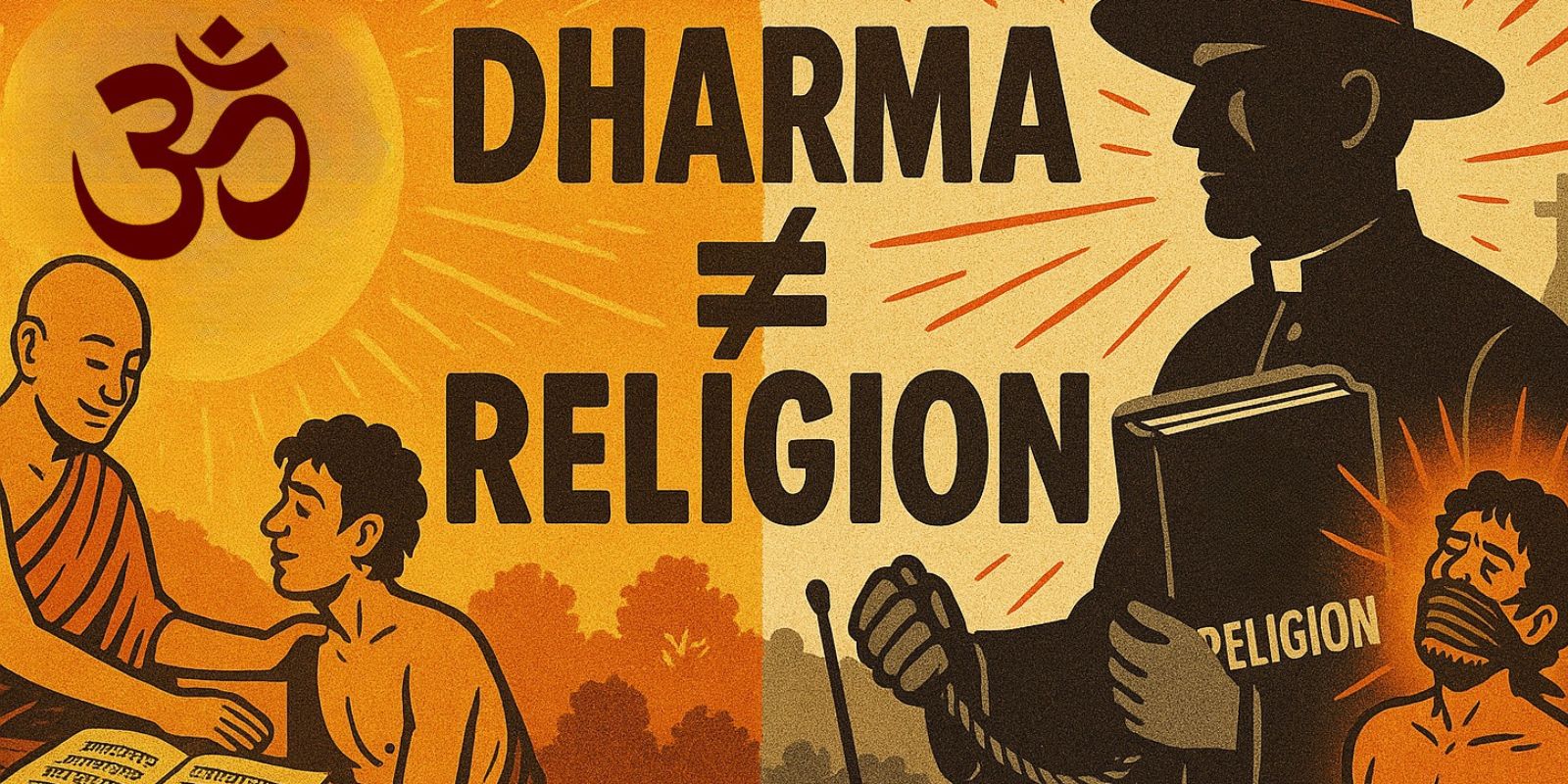
- Dharma, a foundational Indic concept meaning “to uphold” or “to sustain,” has been wrongly compressed into the Western category of “religion.”
- Dharma is pluralistic, non-founder-centric, action-oriented, and aimed at moksha (liberation) and harmony, whereas Abrahamic “religion” is exclusivist, founder-centric, belief-oriented, and aimed at salvation.
- European missionaries, Orientalists, and administrators mapped the Indic civilizational framework onto their own theological template, labeling Dharma as “Hindu religion.”
- The misreading shapes India’s legal frameworks, undermines interfaith dialogue, erodes civilizational self-understanding among Hindus, and limits the global recognition of Dharma’s universal ecological and ethical relevance.
- Restoring accuracy begins with language, using precise Sanskritic terms like Dharma, Sampradāya, and Paramparā.
The words we use do more than communicate; they frame our perception of reality itself. Across centuries, a subtle yet deeply consequential mistranslation has quietly shaped and often warped the global and domestic understanding of India’s civilizational ethos. The Sanskrit term Dharma, a concept vast, layered, and integral to the Indic worldview, has been persistently compressed into the narrow, foreign category of “religion,” as though the two were interchangeable. They are not. The conflation is not a mere semantic oversight; it constitutes a fundamental epistemic error.
This distortion has far-reaching implications. It influences legislative interpretations and constitutional provisions, informs judicial reasoning and public policy frameworks, shapes the discourse of interfaith engagement, and perhaps most insidiously, reshapes the self-understanding of Hindus themselves. When Dharma is viewed through the prism of a Western-derived notion of “religion,” its philosophical expanse, its ethical grounding, and its civilizational role are diminished, misunderstood, or entirely erased.
Correcting this misinterpretation is therefore not merely an exercise in linguistic precision; it is an urgent intellectual and civilizational imperative. The present study aims to set the record straight, excavate Dharma from beneath the conceptual debris of colonial translations, and restore it to its rightful semantic and philosophical context. In doing so, it aims to reframe not only the academic discourse but also the very terms through which India’s heritage, identity, and social order are understood.
What is Dharma?
The Sanskrit term “Dharma” derives from the verbal root “dhṛ,” meaning “to uphold,” “to bear,” or “to sustain.”[1] In the Indic worldview, it signifies far more than a mere code of conduct; it refers to the foundational principles that uphold the cosmos, sustain social order, and guide the individual towards alignment with the universal rhythm. Dharma is not a static compilation of dogmas or articles of faith. Rather, it is a dynamic synthesis of natural law, moral order, and ethical duty, a framework that integrates metaphysical truth with practical living.[2]
Operating simultaneously at multiple and interrelated levels, Dharma encompasses:
- Sanātana Dharma, the eternal and universal principles that underlie and govern the fabric of existence, transcending historical periods, cultures, and individual identities.
- Svadharma, the personal duty or ethical responsibility specific to one’s nature (svabhāva), role, and stage of life (āśrama), as articulated in classical texts such as the Bhagavad Gītā.
- Samāja Dharma, the collective responsibilities and norms that sustain societal harmony, ensuring the well-being of the community as a whole.
Classical Indian literature vividly illustrates the multifaceted nature of Dharma. Arjuna’s moral and existential crisis in the Mahābhārata reflects the tension between personal duty and broader ethical considerations,[3] while the Vedic conception of Ṛta describes the cosmic order into which human conduct must be integrated. In this sense, Dharma is a living, adaptive principle, responsive to context and circumstance, rather than a rigid or exclusionary creed. Its resilience lies in this very adaptability, allowing it to serve as both a metaphysical constant and a practical guide for human action across time.[4]
What is Religion?
The term “religion” originates from the Latin religāre, meaning “to bind” or “to fasten.”[5] In its classical sense, it refers to the act of binding oneself to a system of beliefs, obligations, or rituals.[6] However, in the context of the Abrahamic traditions, Judaism, Christianity, and Islam,[7] the term has evolved to signify a belief-centered and doctrine-driven framework.[8] Such systems are characterized by an exclusive claim to ultimate truth, an authoritative institutional structure, and codified prescriptions governing both faith and conduct.
Within this paradigm, religion typically revolves around several defining features:
- A singular prophet or founding figure who is regarded as the final or supreme conduit of divine will, such as Moses, Jesus Christ, or the Prophet Muhammad, for example.
- A fixed, canonical scripture that serves as the ultimate and unalterable authority, whether the Torah, the Bible, or the Qur’an.
- A soteriological framework in which the central aim is salvation or redemption, often conditional upon specific beliefs, ritual observance, and obedience to divine commandments.
- A binary division between adherents and outsiders, commonly framed as believers versus non-believers, the saved versus the damned, establishing a rigid boundary of spiritual belonging.
In this worldview, salvation is the supreme objective, typically conceived as liberation from sin, eternal reward in an afterlife, or divine favor, and is generally contingent upon adherence to revealed commandments. This adherence is not merely personal but collective, forming the basis of religious identity and communal boundaries. Consequently, “religion” in its Abrahamic construction functions as a closed system, anchored in revelation, safeguarded by institutional authority, and resistant to theological plurality.
Why Dharma is Not Religion
The distinctions between Dharma and “religion” are not superficial; they are structural and foundational, arising from entirely different metaphysical premises and cultural trajectories.
- Truth Claims: Dharma is inherently pluralistic, expressed in the Vedic maxim Ekam Sat Viprā Bahudhā Vadanti—“Truth is One; the wise describe it in various ways.” This is not mere tolerance but a recognition of multiple equally valid paths to ultimate reality. Most religious frameworks, whether monotheistic, polytheistic, or otherwise, tend to establish a bounded set of truth claims, prioritising their own path as uniquely authoritative and often treating other paths as incomplete or mistaken.[9]
- Authority: Dharma recognizes no single founder, no final prophet, and no exclusive text. Its authority is dispersed across an extensive corpus, Vedas, Upanishads, Itihāsa, Purāṇas, Dharmaśāstras, and mediated through diverse lineages and interpretive traditions. Religions, by contrast, are anchored to a founding figure or event, preserved in a fixed canon, and often regulated by centralized institutions.
- Practice: In Dharma, practice takes precedence over mere belief. Its essence is realized through karma (righteous action), yoga(spiritual discipline), and seva (selfless service), with belief functioning as a guide rather than a boundary of inclusion. Bhakti yoga, devotional engagement with a chosen form of the Divine, may resemble religion in that it often centers around a specific deity and can be transmitted through lineages founded by particular saints or teachers. However, these features do not create exclusivity: the chosen deity (iṣṭa-devatā) is understood as one manifestation of the same ultimate reality, and the founder of a sampradāya is revered as a guide rather than an infallible prophet or sole authority. One may honor a preferred form while still accepting the validity of other forms and paths, an inclusivity rarely found in creedal religions. Membership in the dharmic fold is not determined by a formal profession of faith but by alignment with principles and conduct. By contrast, many religions prioritize doctrinal assent as the primary marker of belonging, with ritual practice serving to reinforce that belief framework.
- Purpose: The telos of Dharma is mokṣa, liberation from the cycle of birth and death, and the cultivation of harmony and balance within oneself, society, and the cosmos. Many religions aim for different objectives, such as salvation from sin, securing divine favor, or attaining a promised afterlife in heaven or paradise. These goals are typically framed within a linear conception of life and cosmic history, where a single earthly life is followed by an eternal, unchanging state of reward or punishment, often mediated by divine judgment. The moral or theological framework is shaped accordingly: the emphasis falls on obedience to divine commandments, conformity to prescribed beliefs, and maintaining the right relationship with a personal deity as defined by that tradition. By contrast, Dharma’s orientation toward mokṣa arises from a cyclical view of existence (saṃsāra), in which liberation entails transcending not only moral failings but also the very limitations of conditioned reality, realizing one’s unity with the ultimate truth beyond birth and death.
To subsume Dharma within the conceptual category of “religion” is to commit a categorical error of the highest order. It is akin to describing mathematics as a branch of music, while both may share surface elements of structure and pattern, distinct logics, aims, and internal grammars govern them. Such conflation obscures the philosophical originality of Dharma and distorts both academic discourse and public understanding.
How the Confusion Took Root
This conceptual conflation bears unmistakable colonial fingerprints. When Europeans, Orientalist scholars, and administrative officials first sought to comprehend the social and spiritual fabric of the Indian subcontinent, they approached it through the epistemic lens of their own cultural and theological categories. Unfamiliar with a civilizational framework that did not revolve around a single founder, fixed scripture, or exclusive truth claim, they resorted to mapping what they encountered onto the familiar template of “religion.” In this process, Dharma, a term encompassing metaphysics, ethics, social order, and cosmic law, was reductively translated as “Hindu religion.”
This was not a neutral act of linguistic substitution; it was a profound act of epistemic reframing. By reinterpreting Dharma as a “religion” in the Abrahamic mold, the colonial discourse compressed a civilizational ethos into a narrow faith category, stripping it of its philosophical expanse and societal depth. Over time, this mistranslation was institutionalized, embedded in colonial legal codes, later echoed in the constitutional language of independent India, and perpetuated in academic discourse both in India and abroad.
The adoption of the “world religions” model in modern scholarship further cemented this distortion. Under this schema, Dharma-based traditions —Hinduism, Buddhism, Jainism, and Sikhism —were placed alongside Christianity and Islam as discrete, comparable “religions,” despite their fundamentally different ontological assumptions and civilizational orientations. The result was a double erasure: first, the loss of the distinctive philosophical categories of the Indic tradition, and second, the loss of the ability to understand these categories on their own terms, without relying on foreign conceptual frameworks.
Why the Difference Matters
This is not a mere matter of philosophical semantics; the ramifications of equating Dharma with “religion” are tangible, structural, and far-reaching.
- Legal Frameworks: The misclassification of Dharma as “religion” has directly influenced the constitutional and legal architecture of India. Articles 25–30 of the Indian Constitution, while purporting to guarantee freedom of religion, operationalize the term in an Abrahamic sense, prioritizing belief and institutional autonomy as the defining markers.[10] As a result, Hindu institutions, particularly temples, have been subjected to extensive state control, while comparable institutions of other faiths remain largely autonomous.[11] This asymmetry arises from judicial misinterpretation, specifically, the tendency of Indian courts to evaluate Dharma using legal categories and precedents designed for Semitic religious models. In The Commissioner, Hindu Religious Endowments, Madras v. Sri Lakshmindra Thirtha Swamiar of Shirur Mutt,[12] the Supreme Court attempted to define what constitutes the “essential practices” of a religion. While the “essential practices doctrine” was intended to safeguard religious freedoms under Articles 25 and 26 of the Constitution, it forced Dharma, a decentralized, practice-based tradition, into the mold of creed-based religion, reducing its diversity to a set of court-approved rites (see Marc Galanter, Hinduism, Secularism, and the Indian Judiciary, 1971).[13]
Similarly, in Sri Adi Visheshwara of Kashi Vishwanath Temple v. State of U.P., (1997),[14] and earlier in Sri Venkataramana Devaru v. State of Mysore,[15] the judiciary upheld significant state control over Hindu temples. This contrasts with the relative autonomy preserved for mosques (e.g., Masjid Shahid Ganj v. Shiromani Gurdwara Parbandhak Committee)[16] and churches, which are generally managed by their own denominational bodies without equivalent state interference.
By translating dhārmic categories, such as ācāra (custom), śāstra (scriptural authority), and sampradāya (lineage), into rigid legal constructs like “religion,” “sect,” or “denomination,” the courts impose an alien framework that distorts their meaning and function. The result is a structural mismatch: Dharma is legally defined in terms alien to itself, leading to the inconsistent application of rights, protections, and restrictions — for example, state-appointed management of Hindu institutions under various Hindu Religious and Charitable Endowments Acts, versus the legal immunity afforded to analogous institutions of other faiths.
- Interfaith Dialogue: When Dharma is forced into a religion-shaped mold, its philosophical pluralism is often misinterpreted as relativism, an “anything goes” stance, rather than as a structured pluralism grounded in metaphysical unity. Such framing flattens its ethos, making it seem like just another contender in a competitive marketplace of faiths, thereby obscuring its distinctive contribution to global conversations on coexistence.
- Civilizational Self-Understanding: The pedagogical and cultural implications are equally profound. Generations of Hindus educated within this framework come to view Dharma merely as “Hindu religion,” stripped of its metaphysical, ethical, and civilizational scope. This internalization weakens the continuity of Indic knowledge systems and erodes the civilizational confidence necessary for their preservation and renewal.
- Global Ethics: Perhaps most critically, confining Dharma within the boundaries of “religion” diminishes its universal relevance. Its ecological vision, rooted in the understanding of all life as interconnected (Vasudhaiva Kutumbakam), and its ethical framework, which integrates personal duty with cosmic order, offer insights urgently needed in addressing planetary crises. Yet these dimensions are often overlooked when Dharma is framed narrowly as a religion, rather than as a comprehensive way of life and thought.
Reclaiming Dharma
Reclaiming Dharma begins with language. Words are not neutral vessels; they carry with them entire frameworks of thought. The continued mistranslation of Dharma as “religion” perpetuates conceptual distortions with legal, political, and cultural consequences. The first step in correcting this error is to refuse the substitution altogether and to use instead the precise Sanskritic vocabulary that captures the diversity and depth of the Indic civilizational matrix, terms such as Dharma, Sampradāya (spiritual tradition), and Paramparā (lineage or transmission).
Education is central to this reclamation. From primary school textbooks to higher academic curricula, from legal interpretation to media discourse, the distinction between Dharma and “religion” must be clearly articulated. This is not a matter of cultural nostalgia but of intellectual precision and historical accuracy. Without such clarity, India risks continuing to frame its own heritage through alien categories, thereby undermining its ability to engage with itself and the world on its own terms.
On the global stage, India must present Dharma not as a sectarian creed competing in the “world religions” arena, but as a philosophical and ethical offering with universal relevance. In an era marked by environmental crises, social fragmentation, and intercultural conflict, the dhārmic vision, rooted in balance, harmony, and the recognition of interdependence, offers pathways for rethinking global ethics.
Dharma is not a “religion” in the conventional sense. It is a civilizational framework that sustains life, order, and harmony at multiple levels: individual, societal, and cosmic. Understanding this distinction is essential, not only for Hindus reclaiming their philosophical heritage, but for policymakers, jurists, educators, and anyone engaging in intercultural dialogue. Reclaiming Dharma is not an exercise in semantics; it is an act of civilizational clarity. In a world fractured by exclusivist ideologies and competing truth claims, the inclusive and timeless wisdom of Dharma may well be one of humanity’s most vital resources for fostering coexistence and resilience.
Citations
[1] Dharma in Hinduism, Buddhism & Jainism – A Complete Guide; https://theyogainstitute.org/the-concept-of-dharma#
[2] Meaning of the name Dharma; https://www.wisdomlib.org/names/dharma#:~:text=Background%2C%20origin%20and%20meaning%20of,and%20preserving%20its%20traditional%20teachings.
[3] Mahābhārata Explained: The Truth Behind India’s Greatest Epic | Ami Ganatra; https://www.youtube.com/watch?v=yPRufctxAO0
[4] Defending Dharma: Lessons from Our Shastras on Confronting Adharma; https://stophindudvesha.org/defending-dharma-lessons-from-our-shastras-on-confronting-adharma/
[5] Thomas Allen; 2004; The Pagan Christ: Recovering the Lost Light; Toronto.
[6] Brent Nongbri; 2013; Before Religion: A History of a Modern Concept; Yale University Press.
[7] Daniel Dubuisson; 2007; The Western Construction of Religion: Myths, Knowledge, and Ideology.
[8] John Morreall; Tamara Sonn; 2013; 50 Great Myths about Religions; Wiley-Blackwell.
[9] Ekam Sad Vipra Bahudha Vadanti: A Vedic Consciousness of God; https://www.sieallahabad.org/hrt-admin/book/book_file/fd756770f9122be1b484f12c5ffbe828.pdf
[10] Weaponized Secularism: The Legal Assault on Hindus in the Name of Minority Rights (Part 1); https://stophindudvesha.org/the-legal-assault-on-hindus-in-the-name-of-minority-rights-part-1/
[11] The Constitutional Blind Spot: The Article 26 Injustice Against Hindus – Hindu Dvesha; https://stophindudvesha.org/the-constitutional-blind-spot-the-article-26-injustice-against-hindus/
[12] The Commissioner, Hindu Religious … vs Sri Lakshmindra Thirtha Swamiar Of Sri … on 16 April, 1954; https://indiankanoon.org/doc/1430396/
[13] Ruling on Rituals: Courts of Law and Religious Practices in Contemporary Hinduism; https://journals.openedition.org/samaj/4451#:~:text=About%20the%20author-,Abstract,manageable%20within%20a%20legal%20context.
[14] Sri Adi Visheshwara Of Kashi Vishwanath … vs State Of U.P. And Ors on 14 March, 1997; https://indiankanoon.org/doc/923604/
[15] Sri Venkataramana Devaruand Others vs The State Of Mysore And Others(With … on 8 November, 1957; https://indiankanoon.org/doc/1896039/
[16] Masjid Shahid Ganj Mosque vs Shiromani Gurdwara Parbandhak … on 2 May, 1940; https://indiankanoon.org/doc/1035515/?type=print

Donate to HINDUDVESHA
Our Mission is to explore and expose Hindudvesha through research analysis, education and response.
SUPPORT US