

India’s Forgotten Pogrom: Revisiting the 1948 Chitpavan Brahmin Massacre
 Rakesh Krishnan Simha · 08/14/2025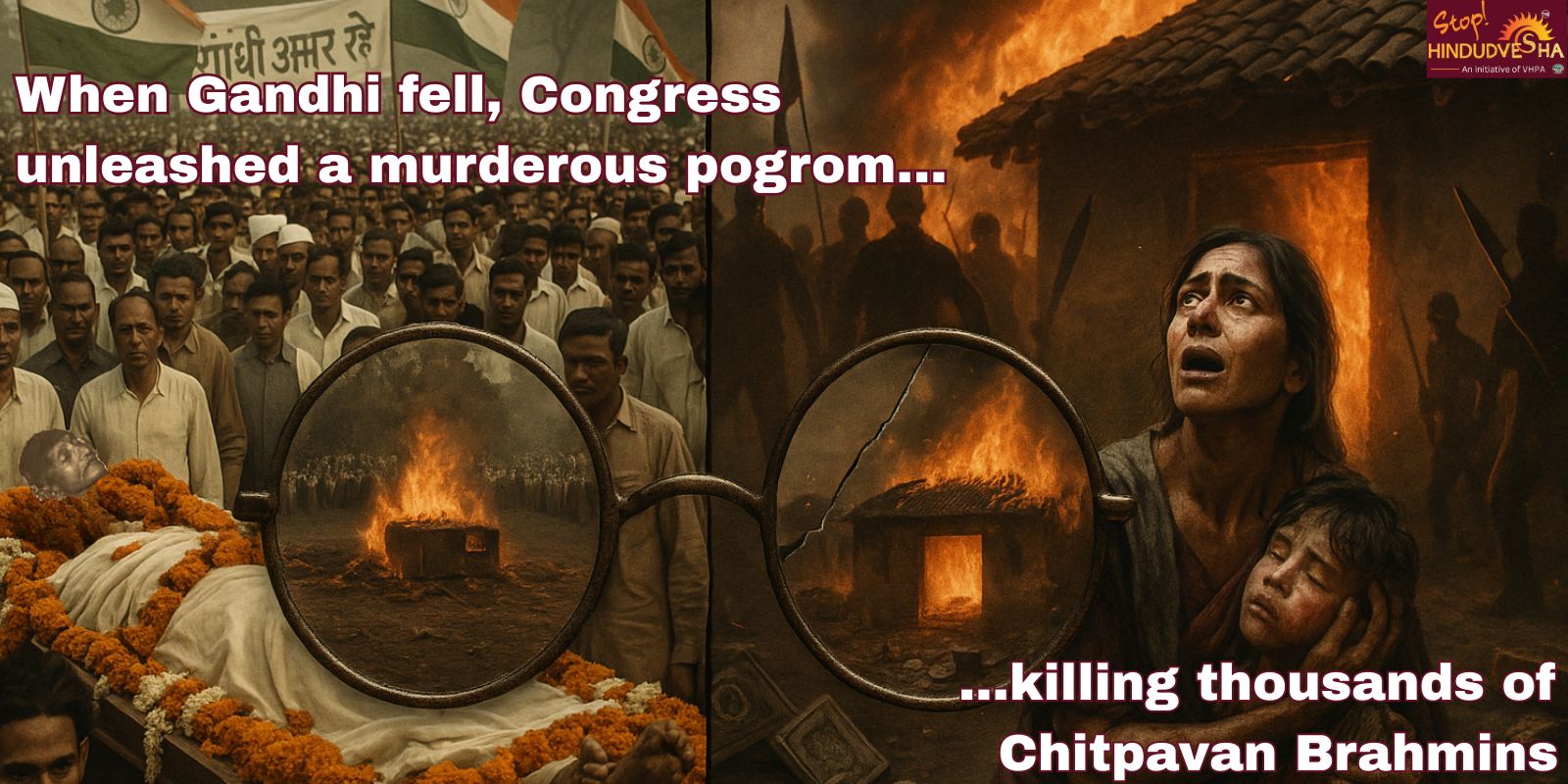
- Following Gandhi’s assassination by Nathuram Godse, mobs across Maharashtra brutally targeted Chitpavan Brahmins, resulting in thousands of deaths, rapes, and destruction of property.
- The violence was not spontaneous; Congress members actively led or enabled attacks, framing them as retaliation.
- Well-known figures like Veer Savarkar and his family were directly attacked, and many Brahmin families were displaced or impoverished.
- Despite the scale, police files remain sealed, media coverage was minimal, and no prosecutions occurred, indicating political suppression.
- To this day, the 1948 Chitpavan massacre remains one of independent India’s most silenced and unacknowledged atrocities.
In the aftermath of Mohandas Gandhi’s assassination on January 30, 1948, a sinister shadow fell across the state of Maharashtra. Nathuram Godse — a Chitpavan Brahmin — had pulled the trigger, but what followed was a macabre vengeance inflicted upon thousands of innocent civilians who shared nothing with the assassin but his caste identity. As the news of Gandhi’s death rippled across the nation, a chilling sequence unfolded. By nightfall, the streets of Pune, Mumbai, Nagpur, and the rural heartlands of Satara, Kolhapur, and Belgaum seethed with mobs — not spontaneous, not frenzied, but deliberate.[1] Armed with machetes, iron rods, and jerrycans of kerosene, they hunted with precision. Their target: the defenceless Chitpavan Brahmins.
The irony was as dark as the flames that swallowed homes — Gandhi’s disciples, sworn to “absolute non-violence,”[2] now orchestrating one of post-independence India’s earliest and bloodiest community-driven purges. Congress workers, according to many accounts, led the mobs, using Gandhi’s death as both a smokescreen and a justification for carnage. In Pune alone, 50 Brahmins were marked and murdered within hours of the assassination. On January 31, even the notoriously anti-Hindu New York Times documented 15 deaths in Bombay.
But this was no isolated incident. This was a calculated week-long pogrom. As many as 300 districts saw coordinated assaults, burnings, lynchings, and rapes. Some historians, like Koenraad Elst, offer cautious estimates of several hundred dead. Vikram Sampath, drawing from survivor testimonies, raises the toll to 2,000–5,000. Arti Agarwal, who leads the research on Hindu genocide, estimates the death toll at about 8,000.[3] Yet no figure can be confirmed. The truth is buried beneath scorched records, government silence, and ideological apathy. What remains is a massacre cloaked in denial and long overdue for reckoning.
Historical Context
The Chitpavan Brahmins, who were historically influential as the Peshwas (prime ministers) of the Maratha Empire, held significant administrative, cultural, and economic power in Maharashtra during the 18th and 19th centuries. They led the pan-Indian fight against Islamic imperialism, with the Maratha Empire liberating around 70 percent of the Indian subcontinent from centuries of Islamic rule. During British colonial rule, the community produced legendary freedom fighters, including Veer Savarkar, Mahadev Rande, Gopal Krishna Gokhale, Lokmanya Tilak, and the Chapekar brothers, Damodar, Balkrishna, and Vasudev. Comprising approximately 4-5 percent of Maharashtra’s population, their prominence in the state’s socio-economic life made them a target for groups with pre-existing anti-Brahmin sentiments. Gandhi’s assassination provided a pretext for these groups, supported by the then-ruling party, the Indian National Congress, to unleash violence against them, framing it as retribution for Godse’s actions.[4]
The violence began almost immediately after Gandhi’s death, suggesting a level of premeditation. Sources describe mobs armed with kerosene, iron rods, and machetes targeting Brahmin homes, shops, and factories across Maharashtra. The attacks involved killings, rapes, arson, and looting. Properties belonging to well-known individuals, such as Savarkar, were also targeted and destroyed. The fact that the violence fanned rapidly across 300 districts alone indicates a coordinated effort, challenging the label of “riots” and suggesting a planned pogrom.[5]
Author Vikram Sampath quotes Advocate PL Inamdar in his book, Savarkar, Vol. II: “Some of my close relatives living in the southern districts of Maharashtra were being made victims of this manhunt only because they were Maharashtrian Brahmins. They escaped being lynched only by the sheer chance of not being found in their houses at the time of the raids.”[6]
In Kolhapur, renowned filmmaker Bhalji Pendharkar’s studio was burnt down. In another incident, the entire factory of Hindu leader GH Joshi was burnt and destroyed. A cloth mill and a hospital, both owned by Brahmins, were set on fire in Sangli. In Panchgani, a school was burnt down because it was headed by a Brahmin. A woman and her grandson from a remote Udatre village, and an entire family from a remote Kapare village, were burnt alive just because they were Brahmins.[7]
Anand Khatvakar’s family was reduced to penury. “My family stands as proof. My grandfather was among the richest merchants in Pune and had three cloth stores then, which were gutted in a selective killing and property burning incident. The family was instantly reduced to poverty, and we had to sell off all the properties to reduce the trading credits. The family recovered from the losses only by the late 70s.”[8]
Lynching a Patriot
The mob, under the influence of the ruling party, had been fed with so much poison of hate that they went to attack Veer Savarkar’s residence. The sequence of events suggests a larger plot against the renowned freedom fighter. On the very day of Gandhi’s assassination, Savarkar’s two bodyguards were conveniently arrested, stripping him of protection. Soon after, the mob descended on Savarkar Sadan in Dadar. They ransacked the house, torched his library, and destroyed valuable documents. Yet, due to his loyal followers, Savarkar narrowly escaped harm.[9]
Enraged by their failure to lynch him, the mob turned its fury toward Narayanrao Savarkar — Veer Savarkar’s brother, a doctor and freedom fighter known for serving the poor. He was brutally attacked with stones and later died from his injuries. No arrests were ever made.
Veer Savarkar wrote about this personal tragedy: “He who relentlessly served the nation, he who relentlessly worked for the people, he who stood firm against the British, he who fought for liberating Maa Bharati, today was stoned to death by his own brothers for whom he fought.”
The family, which fought for the independence of Indians, was destroyed by Indians. Some Brahmins who were wealthy migrated to the US and other countries, whereas those who couldn’t afford to escape moved to different parts of India to save their coming generations.
Role of the Ruling Congress Party
Dwarka Prasad Mishra, a senior Congress leader and later Chief Minister of Madhya Pradesh, admitted in his memoir ‘Living In An Era: India’s March to Freedom’ that Congress party members were involved in the violence in Nagpur and Berar. There were over 100 arrests but no prosecutions.[10]
According to Mishra, “After the assassination of Gandhiji, mobs of rioters attacked houses and shops of Brahmins and tried to torch them. Even educational institutions run by the Brahmins were not spared. The Joshi High School in Nagpur was set on fire; when the fire brigade arrived, the mob forced it to return. In the horrific and heartbreaking cases of violence against the Brahmins, most of the non-Brahmin rioters were Congressmen. Some of them were also officials of Congress committees.”[11]
Sampath says Congress workers, including office-bearers, orchestrated or participated in the violence. The lack of prosecutions, despite arrests, suggests political protection.[12]
British journalist Maureen Patterson and historian Arti Agarwal note that police records were withheld, and the Indian media underreported the violence, possibly to protect the ruling party’s image or to avoid escalating tensions.[13] Says Elst: “On mass murders, estimates are often overdramatized, but here we must count with a countervailing factor: The government’s active suppression of these data, as they would throw a negative light on Gandhism.”[14]
Prime Minister Jawaharlal Nehru apparently had full knowledge of the brutal atrocities inflicted upon innocent Brahmins. Without a shred of proof, he blamed the Rashtriya Swayamsevak Sangh — which Godse had quit long back — for Gandhi’s killing. On March 14, 1948, in Maharashtra’s Vardha district, Nehru stated that he was ready to resign from his office to fight the Sangh by taking to the battlefield.[15] Did Nehru mean he would also start torching the residences of Hindu activists and killing them? Clearly, he and his successive governments had the incentive to wipe out every trace of Brahmin genocide from the records.
Estimating the Toll
The Chitpavan Brahmin massacre remains one of India’s most under-reported and poorly documented instances of post-Independence communal violence. While estimates of the death toll range from a few dozen to as many as 12,000, arriving at an accurate figure has proven exceptionally challenging. A closer look reveals why the truth remains elusive.
Suppression of Records and Media Silence: One of the primary reasons the massacre’s toll remains so unclear is the apparent suppression of official records. Eeven after all these years, the police files remain inaccessible to the public. This lack of transparency has fueled suspicions that the government deliberately buried evidence.
Unlike the 1984 anti-Sikh riots, where widespread killings were eventually documented through inquiries, media investigations, and human rights reports, the 1948 violence occurred in a time of limited press freedom and weak institutional oversight. Indian newspapers offered little coverage, and radio broadcasts were tightly controlled by the state. Without the accountability mechanisms we take for granted today, the 1948 attacks passed largely unrecorded in official memory.
Absence of Comprehensive Studies: Unlike the 1984 riots, which have been analyzed by commissions and independent researchers, the Chitpavan massacre lacks a comprehensive scholarly investigation. As noted by Elst, no systematic academic study has ever been conducted. This vacuum has left historians reliant on a patchwork of sources, including survivor accounts, foreign media coverage, and scattered mentions in political memoirs.
This absence of rigorous inquiry makes it challenging to cross-verify claims or build a coherent dataset. Sampath’s mid-range estimate of 2,000-5,000 deaths — based on interviews and anecdotal evidence — remains the most credible so far, but the lack of primary records still constrains it.
Geographic Spread and Duration: Another challenge is the sheer breadth of the violence. The attacks were not limited to one city or district — they spanned over 300 districts across the state of Maharashtra. Rural areas, such as Satara, Kolhapur, and Belgaum, were especially hard-hit; yet, these regions lacked consistent communication infrastructure, further complicating documentation efforts. The violence lasted just 4-5 days, but its intensity — marked by killings, rapes, arson, and looting — was devastating.
In such conditions, centralized reporting was nearly impossible. Local law enforcement, often aligned with political groups, failed to register cases or collect data, and no follow-up census or forensic examination was conducted to assess casualties or damage.
1984 Parallels: Some historians suggest comparing the Chitpavan violence to the 1984 anti-Sikh riots to approximate the likely toll. The riots, which erupted after the assassination of Indira Gandhi, resulted in more than 3,000 deaths, mainly in Delhi and a few northern cities. Those attacks were similarly targeted, politically charged, and marked by Congress’s complicity, with Prime Minister Rajiv Gandhi protecting the rioters.[16] Given that the 1948 violence had comparable geographical spread and a pattern of systematic targeting, a toll in the thousands seems plausible — even likely.
Toward a Reasoned Estimate: Considering all the above factors — geographic spread, intensity, survivor narratives, and suppressed records — a conservative but reasonable estimate places the death toll between 3,000 and 6,000. This range aligns with Sampath’s findings and reflects a middle ground between ideologically inflated figures and outright denial.
Importantly, this estimate isn’t just about numbers. It reflects the targeted nature of the violence, the long-term displacement and economic ruin of victims, and the systemic silence that followed.
Way Forward: What Needs to Be Done
To better understand the true scale of the Chitpavan massacre, several steps are essential:
- Declassification of Government Records: If any police or administrative documents from the 1948 period exist, they must be made public.
- Access to Local Archives: District archives in Satara, Kolhapur, and Pune may hold vital data, including land records, FIRs, or correspondence, that can offer valuable clues.
- Oral Histories: As with Holocaust and Partition research, gathering testimonies from survivors and their descendants can help reconstruct events.
- Foreign Media Reviews: Newspapers such as The Times (UK), The Guardian, The New York Times, Time magazine, or The Chicago Tribune may have archived reports, given their extensive coverage of Gandhi’s assassination.
- Comparative Research: Studying the event alongside better-documented massacres, such as the 1984 riots, could help contextualize and refine estimates.
Conclusion
The Chitpavan Brahmin massacre of 1948 remains shrouded in silence, not due to a lack of tragedy, but because of the political sensitivities, media apathy, and institutional neglect that followed. As India continues to reckon with its past, shedding light on this dark episode is not just about historical accuracy — it is about justice, memory, and the right to truth. Only then can we ensure such targeted violence never disappears into the shadows again.
Importantly, it is worth noting that the non-violence of Gandhi and his Congress followers was reserved for political posturing against colonial authorities. The British, who were illegally and tyrannically occupying India for nearly 200 years, were not to be attacked. Similarly, Muslims were not to be touched. Gandhi’s theory of absolute non-violence gaslighted Hindus so they were unable to defend themselves against Muslim mobs across India.[17]
But against Brahmins, the Congress party abandoned non-violence, orchestrating targeted violence against a defenceless Hindu community. Again, in 1984, the followers of Gandhi strategically deployed violence against Sikhs to consolidate power. Clearly, Gandhi’s non-violence died with him.[18]
Citations
[1] It is about time we talk about the 1948 genocide of Maharashtrian Brahmins that followed M K Gandhi’s assassination (OpIndia, 2022); https://www.opindia.com/2022/01/maharashtra-brahmin-massacre-nathuram-godse-gandhi-assassination/
[2] Hindu Rashtra Darshan (Veer Savarkar); https://library.bjp.org/jspui/bitstream/123456789/286/1/Hindu%20Rashtra%20Darshan.pdf
[3] How Nehruvian Congress manipulated Mahatma Gandhi’s assassination to emasculate Hindu nationalism (Firstpost, 2022); https://www.firstpost.com/opinion/how-nehruvian-congress-manipulated-mahatma-gandhis-assassination-to-emasculate-hindu-nationalism-10961811.html
[4] “The First Political Massacre of Chitpavan Brahmins in Independent India” (Adhiyajna Sharma in Medium, 2020); https://medium.com/%40AdhiyajnaSharma/after-hundreds-of-years-of-freedom-struggle-india-got-her-independence-from-foreigners-in-563aeb7db7f7
[5] Congress officials orchestrated anti-Brahmin pogrom after Gandhi’s death, no cases were filed: Vikram Sampath (TimesNowNews.Com, 2021); https://www.timesnownews.com/india/article/congress-officials-orchestrated-anti-brahmin-pogrom-after-gandhi-s-death-no-cases-were-filed-vikram-sampath/789834
[6] It is about time we talk about the 1948 genocide of Maharashtrian Brahmins that followed M K Gandhi’s assassination (OpINdia, 2022); https://www.opindia.com/2022/01/maharashtra-brahmin-massacre-nathuram-godse-gandhi-assassination/
[7] The Brahmin Files: Independent India’s First Political Genocide (IgauravMahajan); https://igauravmahajan.in/the-brahmin-files-independent-indias-first-political-genocide/
[8] Maharashtran Brahmin Genocide – 8000 Killed (Arti Agarwal in Hindu Genocide, 2019);
https://hindugenocide.com/political-crimes/1948-maharashtrian-brahmin-genocide-8000-killed/
[9] The Brahmin Files: Independent India’s First Political Genocide (IgauravMahajan); https://igauravmahajan.in/the-brahmin-files-independent-indias-first-political-genocide/
[10] It is about time we talk about the 1948 genocide of Maharashtrian Brahmins that followed M K Gandhi’s assassination (OpINdia, 2022); https://www.opindia.com/2022/01/maharashtra-brahmin-massacre-nathuram-godse-gandhi-assassination/#google_vignette
[11] The untold story of Maharashtrian Brahmin genocide committed by Congress after Gandhi’s death – No cases were filed (Satyagrah.Com); https://satyaagrah.com/history/hindu-genocide/563-the-untold-story-of-maharashtrian-brahmin-genocide-committed-by-congress-after-gandhi%25E2%2580%2599s-assassination-in-1948
[12] Congress officials orchestrated anti-Brahmin pogrom after Gandhi’s death, no cases were filed: Vikram Sampath (TimesNowNews.Com, 2021); https://www.timesnownews.com/india/article/congress-officials-orchestrated-anti-brahmin-pogrom-after-gandhi-s-death-no-cases-were-filed-vikram-sampath/789834
[13] The untold story of Maharashtrian Brahmin genocide committed by Congress after Gandhi’s death – No cases were filed (Satyagrah.Com); https://satyaagrah.com/history/hindu-genocide/563-the-untold-story-of-maharashtrian-brahmin-genocide-committed-by-congress-after-gandhi%25E2%2580%2599s-assassination-in-1948
[14] How Nehruvian Congress manipulated Mahatma Gandhi’s assassination to emasculate Hindu nationalism (Firstpost, 2022); https://www.firstpost.com/opinion/how-nehruvian-congress-manipulated-mahatma-gandhis-assassination-to-emasculate-hindu-nationalism-10961811.html
[15] The untold story of Maharashtrian Brahmin genocide committed by Congress after Gandhi’s death – No cases were filed (Satyagrah.Com); https://satyaagrah.com/history/hindu-genocide/563-the-untold-story-of-maharashtrian-brahmin-genocide-committed-by-congress-after-gandhi%25E2%2580%2599s-assassination-in-1948
[16] Rajiv Gandhi responsible for anti-Sikh riots – Satpal Singh Satti (The Times of India, 2019); https://timesofindia.indiatimes.com/city/shimla/take-back-bharat-ratna-conferred-on-rajiv-gandhi-satti/articleshow/69287607.cms
[17] Learning from Mahatma Gandhi’s Mistakes – 2 (Konraad Elst in Center for Indic Studies); https://cisindus.org/indic-varta-internal.php?vartaid=105
[18] “Gandhi’s philosophy of ‘ahimsa’ died with him.” Arti Agarwal on Chitpavan Brahmins (YouTube); https://www.youtube.com/watch?v=89NNPeDFZE8

Donate to HINDUDVESHA
Our Mission is to explore and expose Hindudvesha through research analysis, education and response.
SUPPORT US