

Payback for Plunder: India’s Case for War Reparations
 Rakesh Krishnan Simha · 06/28/2025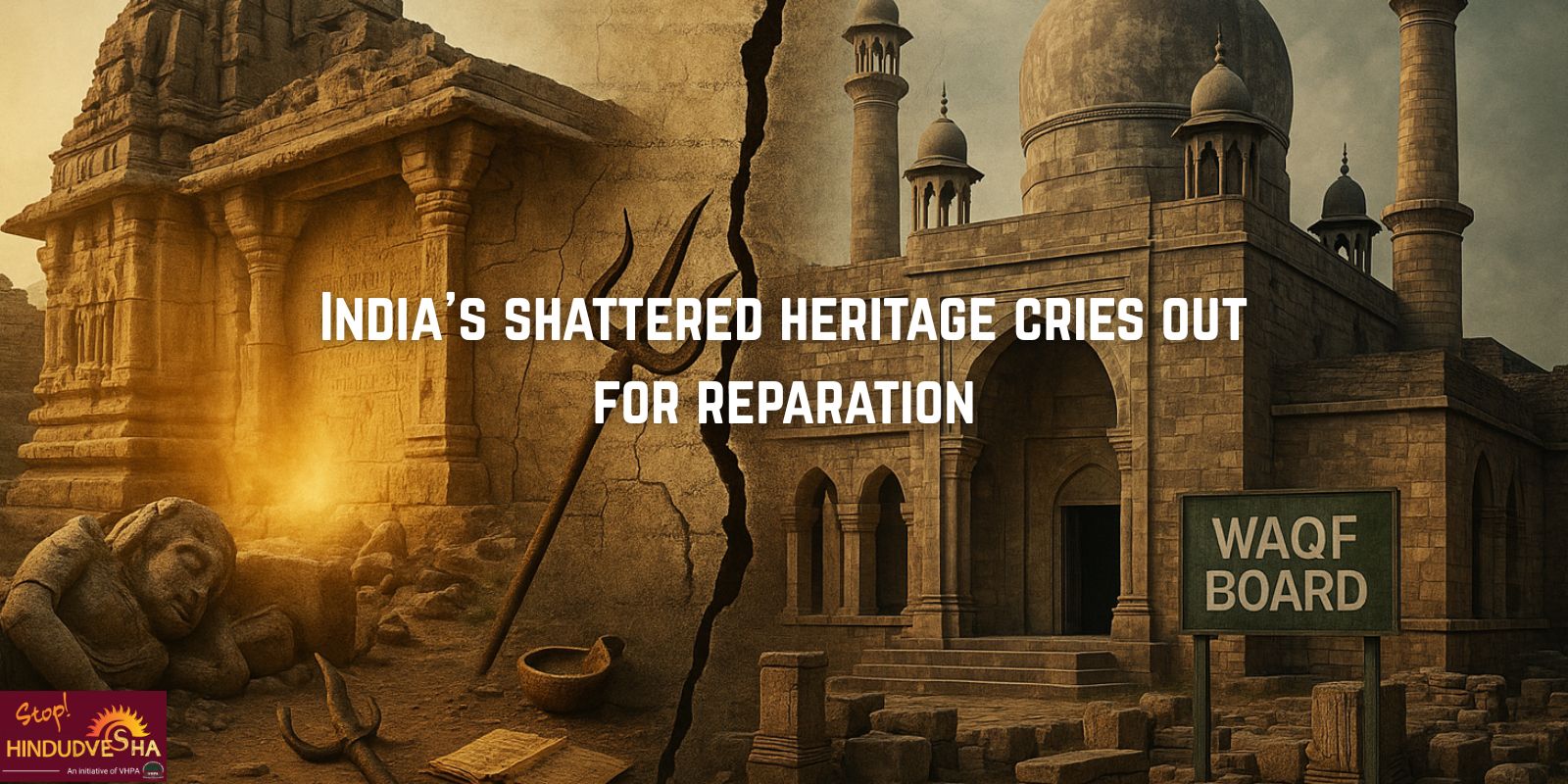
- For over a millennium, India faced invasions and colonial rule that destroyed thousands of temples, plundered wealth, erased culture, and seized community lands — impacts still visible today.
- A lawful framework for war reparations and cultural restitution is proposed, focusing on reclaiming desecrated sites and auditing land trusts formed through conquest, rather than seeking money from modern states.
- Global precedents, such as Holocaust reparations and South Africa’s transitional justice, support India’s case, aligning with UN principles on reparations and civilizational justice.
- Waqf and Church trusts, conquest-era shrines, and foreign museums holding stolen artifacts are key targets for restitution and accountability.
- The proposed Act would build legal, diplomatic, and institutional pathways to redress, restoring history without revenge and positioning India as a global leader in postcolonial justice.
For over a millennium, India has endured a succession of foreign invasions and colonial occupation that systematically dismantled its economic systems, destroyed its religious and cultural heritage, impoverished its people, and drastically altered its territorial landscape. From the early Islamic conquests beginning in 638 CE to the widespread plunder by Timur, Mahmud of Ghazni, and Mohammad Ghori, and later, the colonial domination by the British and other European powers, India suffered trauma that still affects the national psyche.
This article argues for a lawful, historically grounded, and institutionally driven framework for war reparations and cultural restitution. Given that monetary reparations from the modern successors of invading powers are largely impractical, India can — and must — seek justice through institutional and property-based war reparations. This includes reclaiming structures built upon desecrated Hindu, Jain, and Buddhist sites, reforming religious land trusts formed under foreign patronage, and holding institutions that still benefit from looted or alienated lands accountable.
While modern states like Iraq, Syria, Uzbekistan, Turkey, Iran, and Tatarstan are not direct successors of historical conquerors, the institutions and properties created during those eras still exist—and continue to benefit from the consequences of conquest. That legacy can — and should — be subject to accountability.
A War Reparations and Cultural Restitution Act could serve as a formal mechanism to seek redress for these historical aggressions, not as an act of vengeance but as a step toward historical justice. It can also serve as a global model for postcolonial justice.
The Long Shadow of Conquest
India’s civilizational narrative has been shaped not only by its indigenous developments but also by centuries of external disruption. While historical change is natural, what occurred in India between the 7th and 20th centuries was not mere political evolution. It was often systematic cultural suppression, economic plunder, and spiritual vandalism — an erasure of memory intended to replace one civilizational identity with another.
We do not aim to revive ancient grievances or stir intercommunal hostilities. Instead, we advocate for a principled, legal, and evidence-based approach to historical justice, anchored in international law, archaeological records, and cultural rights.
Brief History of Invasions and Looting
India’s tryst with violent external incursions began with Arab invasions that started in 638 CE. They were soundly defeated, but with Muhammad bin Qasim’s conquest of Sindh in 712 CE, the Islamic hordes got a foothold in India. The real devastation began in the 11th century with Mahmud of Ghazni, who conducted 17 raids deep into the Indian heartland. His infamous plunder of the Somnath Temple is only one of many such acts.[1]
Mahmud’s campaigns targeted economically significant temple towns, such as Mathura and Kannauj. He robbed and burnt down 1,000 temples at Mathura and 10,000 in and around Kanauj. One of his successors, Ibrahim, demolished 1,000 temples each in the Ganga-Yamuna Doab and Malwa.
Muhammad Ghori destroyed another 1,000 at Varanasi. Qutb-ud-Din Aibak employed elephants to pull down 1,000 temples in Delhi. Ali Adil Shah of Bijapur destroyed 200 to 300 temples in Karnataka. A Sufi, Qayim Shah, destroyed 12 temples at Tiruchirapalli.
Adding up the temples destroyed by just six Muslim rulers gives you the stupendous figure of 15,212. However, such exact or approximate counts are available only in a few cases.
The Mughals, the darlings of the liberals, weren’t much different. While some Mughal emperors like Akbar pursued policies of relative tolerance, others — especially Aurangzeb — intensified temple destruction. His firmans ordered the demolition of temples at Kashi, Mathura, and Ujjain, and these were often replaced with mosques such as the Gyanvapi Mosque in Varanasi and the Shahi Idgah in Mathura. Additionally, land grants (jagirs and waqfs) were issued on confiscated temple lands, thereby legitimizing the replacement of religious institutions.[2]
If one begins to calculate the total number of Hindu (plus Jain, Buddhist, and Sikh) temples destroyed by Muslims in India, the final figure would be staggering. It would likely still be a low estimate because not all invaders and rulers systematically recorded every instance of temple destruction.
Historians Sita Ram Goel, Arun Shourie, Harsh Narain, Jay Dubashi, and Ram Swarup created what is acknowledged as the most exhaustive work on temple destruction and desecration in India and its near abroad. “Our citations mention 61 kings, 63 military commanders, and 14 sufis who destroyed Hindu temples in 154 localities, big and small, spread from Khurasan in the west to Tripura in the east, and from Transoxiana in the north to Tamil Nadu in the south, over a period of 1,100 years. In most cases, the destruction of temples was followed by the erection of mosques, madrasas, and khanqahs, etc., on the temple sites and, frequently, with temple materials.”[3]
European Colonialism (1600–1947)
Colonialism ushered in a new phase of structured plunder. British exploitation led to the deindustrialization of India’s thriving economy, draining over $45 trillion, according to economist Utsa Patnaik.[4] Land alienation continued under new guises. Christian missions were granted lands, often previously temple-owned or community-held.[5] Missionaries were given endowments by the colonial rulers.[6] Colonial laws — such as the Waqf Act of 1923 and the Church Endowments Acts — codified foreign religious dominance over alienated lands.
Why Reparations Are Justified
There is ample historical precedent affirming the legitimacy of war reparations as a form of justice for historical wrongs. After World War II, Germany paid billions in reparations to Holocaust survivors and the state of Israel, acknowledging the scale of atrocity and displacement. Similarly, Japan compensated victims of its wartime aggression in Korea and China, particularly those subjected to forced labor and exploitation. In South Africa, the Truth and Reconciliation Commission enabled institutional and symbolic compensation for victims of apartheid, recognizing the systemic nature of historical injustice.
Plus, the United Nations’ Basic Principles on Reparations (2005) explicitly affirm the right of nations and individuals to compensation and guarantees of non-recurrence in cases of gross violations of human rights or humanitarian law.[7]
In this global context, India’s claim for reparations and cultural restoration is based on firm legal and moral grounds, aligning with established norms of transitional justice and civilizational redress.
Focus on Institutional Reparations
Mosques, dargahs: There are hundreds of examples of such structures. For instance, in Bahraich, Uttar Pradesh, the dargah of Salar Masud, a Turkic invader and nephew of Mahmud of Ghazni, attracts many Hindus despite his role in early Islamic invasions of India. Its earnings run into the millions.[8] The Ajmer Dargah, which attracts millions of pilgrims who donate vast sums of money, was likely constructed after razing a Hindu temple. But more to the point, it was built to honor Khwaja Moinuddin Chishti, who was instrumental in the destruction of the Hindu kingdom of Ajmer by goading Mohammed Ghori to attack it.[9] Down south in Kerala, the Sabarimala pilgrimage route has a shrine dedicated to Vavar, a Muslim pirate. It also collects millions in donations from Hindus.[10] Delhi’s Jama Masjid is allegedly built using the remains of demolished temples in Rajasthan.[11] There is also literary evidence that the Mughal tyrant Aurangzeb ordered cartloads of Hindu murtis brought from demolished temples to be cast under its steps on 25 May 1679.[12] All these structures are fit cases for reparations.
Waqf Boards: The Waqf Board controls and manages 940,000 acres of land across 870,000 properties, with an estimated value of ₹1.2 lakh crore (approximately US$15 billion). This makes the Waqf Board the third largest landowner in India, after the Indian Railways and the armed forces.[13] Some of these lands originated from temple sites appropriated during Islamic rule. While not all Waqf land is controversial, many sites — such as those in Varanasi, Mathura, and Jaunpur — sit on historically contested terrain.
Church Trusts and Missionary Institutions: Numerous church properties, particularly in South India and the Northeast, were granted land during the colonial era. Some of this land was appropriated from communities or was historically part of temple complexes or common lands.[14] During the construction of the Bengaluru Metro, it was discovered that land under the control of All Saints Church was leased to the church authorities by the army during 1865, 1884, and 1898.[15] A national audit could determine which properties were unjustly acquired under colonial privilege and should now be subject to restitution.
Foreign Museums and Institutions: Thousands of Indian artifacts — including idols, manuscripts, and jewels — were stolen and now reside in institutions such as the British Museum, the Victoria and Albert Museum, and the collections of Oxford and Cambridge universities. India has a strong case under UNESCO conventions and bilateral agreements to demand the return of these cultural treasures.[16]
Proposed Framework for Reparations
A comprehensive law should be introduced to address the long-standing legacy of civilizational and cultural damage. This legislation would begin by establishing a National Commission identifying key categories of historical injustice. These include destroyed temple sites, lands alienated during foreign rule and converted into religious or educational use, and institutions — both domestic and foreign — that directly benefited from imperial or colonial patronage.
The Act would also create a legal framework for restitution, enabling the return of properties where appropriate or establishing shared administrative models for historically contested religious sites. In cases where physical return is not feasible, the law could mandate financial compensation or symbolic reparations, ensuring justice without disrupting current community structures.
Crucially, the Act must amend or sunset outdated colonial-era laws that continue to protect landholdings and endowments rooted in conquest. This includes reforming the Waqf Act and the Church Endowments Acts and reviewing land grants made during the British Raj or earlier Islamic rule. To ensure transparency, the Act would require public audits of religious and institutional landholdings, especially those suspected to have originated from temple or community land seizures.
Finally, the Act should establish a Repatriation Office under the Ministry of External Affairs. This office would actively pursue the return of stolen artifacts and cultural property from museums and private collections abroad. It would also engage in diplomatic negotiations to secure symbolic reparations, public acknowledgments, and formal apologies from institutions and nations that hold India’s looted heritage.
Funding and Implementation
To support the implementation of these measures, the Act should also mandate the allocation of a special corpus under the Ministry of Culture. This fund would be dedicated to rebuilding demolished temples, preserving historically significant sites, and digitizing lost or damaged manuscripts and other cultural records. Such a corpus would serve not only as a financial engine for compensation but also as a symbol of India’s commitment to reviving its civilizational heritage. The initiative should collaborate closely with institutions such as the Archaeological Survey of India, the Indian Council of Historical Research, and relevant state archaeological bodies to ensure historical accuracy, legal soundness, and cultural sensitivity in the restoration process.
Can India Really Do This?
Every bold idea meets its share of challenges, and pushing for reparations is no exception. However, each challenge has a path forward if handled with clarity, care, and conviction.
- Legal Hurdles Are Not Roadblocks: While India’s current laws don’t allow for property reassignment based on centuries-old history, this doesn’t mean justice is out of reach. The answer lies in transitional justice — a global standard in post-conflict societies, such as South Africa and Rwanda.[17] By learning from these models, India can develop a forward-looking legal framework that respects the Constitution while addressing the country’s deep historical wounds.
- Avoiding Communal Flashpoints: This initiative isn’t about blaming communities or reopening old wounds — it’s about institutions, land ownership, and historical accountability. To maintain a sharp focus and a civil conversation, India should establish interfaith panels comprising legal experts, historians, and faith leaders to review sensitive claims. The goal isn’t “us vs. them” — it’s shared custodianship, respect for history, and restorative balance, not revenge.
- Diplomatic Delicacy: Simply asking today’s nations or global museums to pay for what their predecessors did centuries ago won’t always go smoothly. That’s why India must play it smart — using symbolic reparations, international cultural laws, and diplomatic finesse. Framing these efforts as part of a global movement for postcolonial justice — similar to Holocaust reparations or the return of African artifacts — lends India’s case credibility and moral weight on the world stage.
Global Implications and India’s Leadership Role
If implemented properly, India’s reparations initiative would set a global precedent for other postcolonial nations in Africa, Asia, and Latin America. It would necessitate a reevaluation of colonial-era property laws that were still in effect across the Commonwealth. Plus, it would solidify India’s moral standing as a civilizational leader in global heritage justice.
Conclusion: Restoration, Not Revenge
In the words of VS Naipaul, India is a wounded civilization. But despite the deep wounds it has suffered at the hands of Islamic and Christian colonizers, it isn’t seeking revenge. It’s not asking for apologies drenched in guilt or for the descendants of the invaders to atone for the past. What it’s asking for is something far more powerful: recognition and restoration. You can’t rewind centuries of loot, desecration, and cultural erasure — but you can restore what was lost, repair what was broken, and reclaim what was taken.
A War Reparations and Cultural Restitution Act wouldn’t be about reopening old wounds. It would demonstrate to the world that India, one of the world’s oldest civilizations, is ready to lead not with anger but with wisdom. Let justice — not time — heal the wounds of history.
Citations
[1] Rakesh Krishnan Simha (Stop Hindudvesha), One Thousand Years of Iconoclasm: The Beast that Demolished Somnath Continues to Haunt India; https://stophindudvesha.org/one-thousand-years-of-iconoclasm-the-beast-that-demolished-somnath-continues-to-haunt-india/
[2] Rakesh Krishnan Simha (Stop Hindudvesha), Plunder of Civilization: How Islamic Rulers Wrecked India’s Economy; https://stophindudvesha.org/plunder-of-civilization-how-islamic-rulers-wrecked-indias-economy/
[3] Rakesh Krishnan Simha (Stop Hindudvesha), Resurrecting the Ram Mandir: A Cathartic Moment for Hindus After Centuries of Iconoclastic Fury; https://stophindudvesha.org/resurrecting-the-ram-mandir-a-cathartic-moment-for-hindus-after-centuries-of-iconoclastic-fury/
[4] NDTV (2024), Explained: How The British Empire Robbed India Of $45 Trillion; https://www.ndtv.com/india-news/explained-how-the-british-empire-robbed-india-of-45-trillion-7087633
[5] Swarajya (2019), Bengaluru: Defence Ministry Stakes Claim On Disputed Church Land Set To Be Part Of Metro Project; https://swarajyamag.com/insta/bengaluru-defence-ministry-stakes-claim-on-disputed-church-land-set-to-be-part-of-metro-project
[6] Nairra Nisar Shah, British Government as a Proselytising Auxiliary of Christian, International Journal for Multidisciplinary Research (2023); https://www.ijfmr.com/papers/2023/4/4402.pdf
[7] United Nations Human Rights, Basic Principles and Guidelines on the Right to a Remedy and Reparation for Victims of Gross Violations of International Human Rights Law and Serious Violations of International Humanitarian Law (2005); https://www.ohchr.org/en/instruments-mechanisms/instruments/basic-principles-and-guidelines-right-remedy-and-reparation
[8] Agrah Pandit, Saiyyad Salar Masud (“Ghazi Miyan”): The fanatic who was defeated and killed by Maharaja Suheldev (Organiser, 2025); https://organiser.org/2025/03/19/82416/bharat/saiyyad-salar-masud-ghazi-miyan-the-fanatic-who-was-defeated-and-killed-by-maharaja-suheldev-2/
[9] The Economic Times (2024), Shiva Temple under Ajmer Sharif Dargah? Here is all about the latest controversy: https://economictimes.indiatimes.com/news/india/shiva-temple-under-ajmer-sharif-dargah-here-is-all-about-the-latest-controversy-about-another-shrine/articleshow/115792733.cms?from=mdr
[10] Rakesh Krishnan Simha (Stop Hindudvesha), Muslim Shrines, Hindu Pilgrims: The Misguided Syncretism of Sabarimala and Vavar’s Myth; https://stophindudvesha.org/muslim-shrines-hindu-pilgrims-the-misguided-syncretism-of-sabarimala-and-vavars-myth/
[11] Daily Jagran (2024), ‘Delhi Jama Masjid Built On Temple Ruins To Humiliate Hindus’: Hindutva Leader Writes To ASI, Seeks Survey; https://www.thedailyjagran.com/india/delhi-jama-masjid-built-on-temple-ruins-to-humiliate-hindus-hindutva-leader-writes-to-asi-seeks-survey-10204860
[12] Quora, How true are the claims that Delhi’s Jama Masjid was rebuilt by Hindu Baniyas and Jains over a period of 40 years starting 1868? https://www.quora.com/How-true-are-the-claims-that-Delhis-Jama-Masjid-was-rebuilt-by-Hindu-Baniyas-and-Jains-over-a-period-of-40-years-starting-1868
[13] Hindustan Times (2025), Waqf Board explainer: How much land it owns, its powers, what the govt wants to change and other questions answered; https://www.hindustantimes.com/india-news/waqf-board-explainer-how-much-land-it-owns-its-powers-what-the-govt-wants-to-change-and-other-questions-answered-101732365947161.html
[14] Manu Pillai, The colonial state and India’s gods (2018); https://manuspillai.com/2018/11/09/the-colonial-state-and-indias-gods-10-november-2018/
[15] Swarajya (2019), Bengaluru: Defence Ministry Stakes Claim On Disputed Church Land Set To Be Part Of Metro Project; https://swarajyamag.com/insta/bengaluru-defence-ministry-stakes-claim-on-disputed-church-land-set-to-be-part-of-metro-project
[16] UNESCO, “Return & Restitution” Intergovernmental Committee; https://www.unesco.org/en/fight-illicit-trafficking/return-and-restitution
[17] International Center for Transitional Justice, What is Transitional Justice (2008); https://legal.un.org/avl/pdf/ls/Van-Zyl_RecReading1_.pdf

Donate to HINDUDVESHA
Our Mission is to explore and expose Hindudvesha through research analysis, education and response.
SUPPORT US