

Hashtag Jihad: Pakistan’s Hilarious Attempt at Digital Warfare Against India
 Rakesh Krishnan Simha · 06/16/2025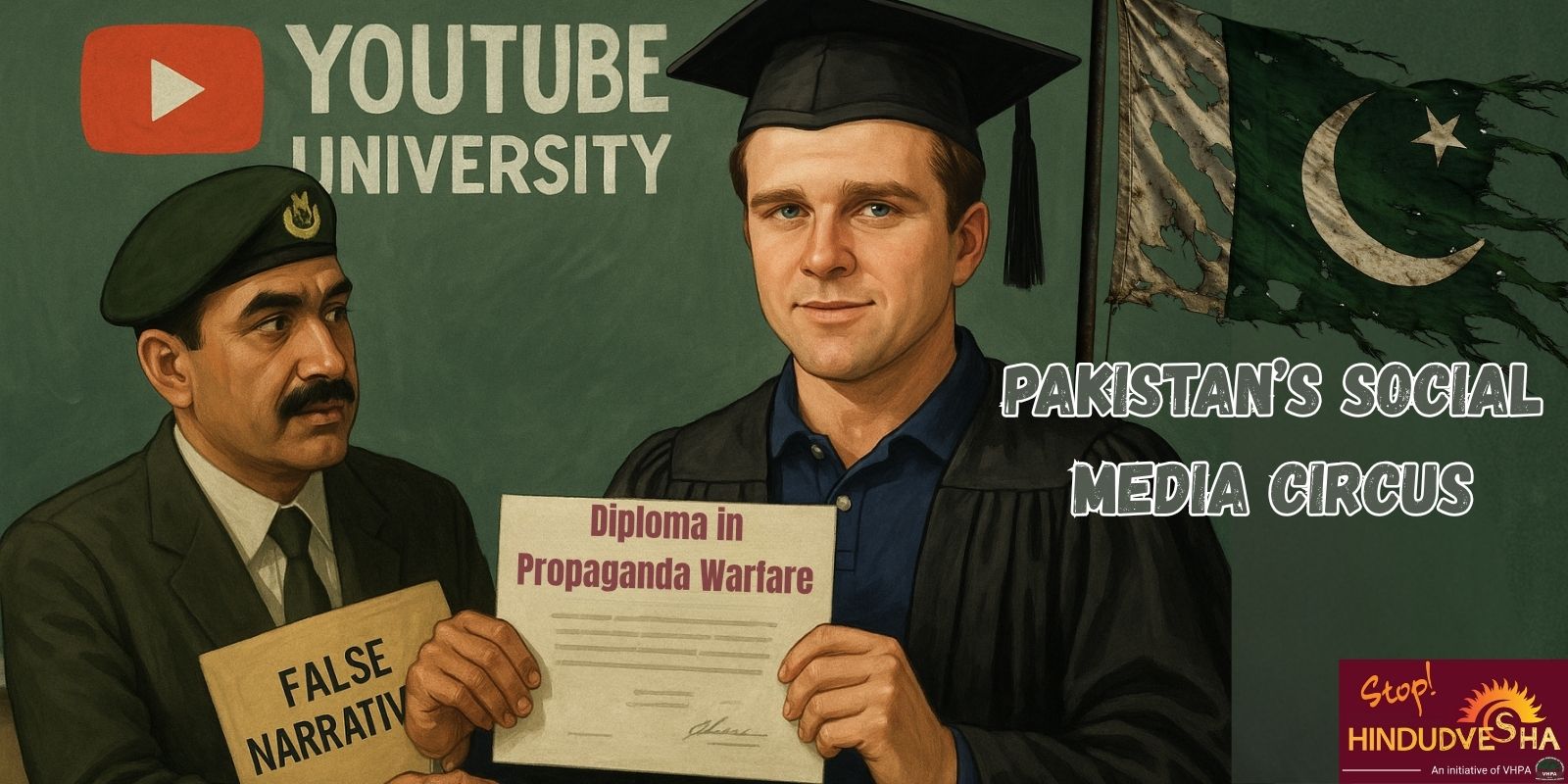
- Unable to counter India militarily, Pakistan has turned to AI bots, recycled propaganda, and dubious influencers to flood social media with conspiracy theories, most notably pushing false flag narratives after terror attacks like Pahalgam.
- From generating fake hashtags before casualties are even counted to using Western influencers for amplification, Pakistan’s disinfo campaigns aim not at Indians, but at manipulating Western opinion to build diplomatic pressure.
- Figures like Jackson Hinkle — banned from multiple platforms — are used as frontline artillery in this digital war, spreading anti-India propaganda with bizarre claims and questionable credibility.
- This isn’t Pakistan’s first misinformation rodeo. From Pulwama to Leicester riots, radical influencers like Mohammed Hijab and Zeeshan Ali have long been used to incite anti-Hindu hate under the pretense of activism.
- Pakistan’s meme-driven campaign is now an extension of its military strategy. Despite losing every real war, it hopes to win the narrative battle, though ironically, it has mostly succeeded in turning itself into an international laughingstock.
In the golden age of misinformation, where truth is negotiable and internet fame is an acceptable currency for global influence, Pakistan has boldly entered the chat. With its tanks rusting in Rawalpindi and fighter jets parked more for selfies than sorties, the Pakistani establishment has redirected its battlefield ambitions to where they matter most today—the internet.
But don’t expect anything as dull as diplomatic debates or intelligence dossiers. Oh no. Pakistan’s 21st-century arsenal includes generative AI bots, deep-fried memes, and influencers with political science degrees from YouTube University. And they have one mission: to convince the Western world that every terror attack in India is secretly orchestrated by Indian intelligence for some mysterious, diabolical purpose. It’s James Bond meets Infowars — produced on a shoestring budget and starring Pakistani spooks as the misunderstood geniuses of global affairs.
The Disinformation Playbook
Let’s start with the gruesome Pahalgam terror attack, where Islamic terrorists from Pakistan singled out 25 Hindu male tourists and executed them in front of their families.[1] India was barely beginning to identify the bodies when — surprise! — Pakistan’s digital warriors had already cranked out a fully-formed narrative: India did it to itself.
That’s right, folks. According to the AI-powered geniuses of Islamabad, the Indian government orchestrated the killing of its own citizens just to score PR points. Makes total sense, right? Who needs evidence when you’ve got hashtags like #BJPBehindPahalgam and #StopModiFascism zooming across timelines faster than you can say “international embarrassment?” Below is the outline of Pakistan’s three-step process for manufacturing outrage:
- Pakistan-linked state actors begin pushing the “India bombed itself” narrative before Indian authorities have even finished counting casualties.
- Thousands of AI-generated memes are blasted across the internet, each more laughably inaccurate than the last.
- Enter the influencers — Western, loud, and always ready to blame democracy for everything. They magnify the message for Western audiences, who are more likely to listen to a podcast than, say, the Indian Ministry of External Affairs.
Let’s be clear — the goal is not to convince Indians. It’s to create pressure on Western governments by shaping public opinion. Because if you can get a bored grad student in Brooklyn to believe India is committing false flags, maybe, just maybe, you can get a think tank intern in DC to write a memo about it. Global influence via vibes.
When Bots Become Soldiers
The Network Contagion Research Institute (NCRI), a US-based disinformation watchdog, has done what Pakistan clearly didn’t anticipate — analyzed the data. Its open-source monitoring did a deep dive to quantify the spread of false flag conspiracy theories. And what they found was a cringe-worthy mix of recycled propaganda, AI-generated garbage, and the worst use of Photoshop since your uncle tried to become an Instagram model.
Its report, titled “From State Actors to Western Influencers: The Transnational Surge of False Flag Disinformation After Terror Attack in India,” NCRI explains how Pakistani officials began seeding the false flag narrative within hours of the Pahalgam attack on April 22, 2025, with former Pakistani High Commissioner Abdul Basit playing a key role. Basit, a longtime diplomatic surrogate for Pakistani state messaging, was among the first to frame the attack as an Indian false flag operation, posting on X within hours of the attack that “Kashmiri mujahideen never target civilians.”[2]
According to the NCRI report, over 20,000 posts pushing the “false flag” theory flooded X (aka Twitter) within hours of the Pahalgam attack. Of these, nearly 40 percent came from bots — artificial intelligence tools trained not to help humanity but to regurgitate the same five talking points in broken English and aggressive fonts.
They even used generative AI to cook up terrorist-themed memes. Nothing says “truth-teller,” like a pixelated image of Narendra Modi photoshopped next to a mushroom cloud with captions like “Modi Bombs Own Country?” And “INDIAN FALSE FLAG EXPOSED.”
It’s unclear whether the bots know they’re lying or are just passionate about geopolitical cosplay. But one thing is certain — they’re more consistent than Pakistan’s GDP growth.
Influencers for Hire
The AI bots may be the infantry, but the artillery comes in the form of influencers. Yes, the same people who once did makeup tutorials and mukbangs now think they’re Clausewitz reincarnated.
Leading the charge is none other than Jackson Hinkle, a 25-year-old American TikTok-to-Terror-Takes pipeline graduate. He’s become the darling of anti-Western circles, pro-Russia propaganda machines, and — naturally — Pakistani intelligence.
Hinkle, who now styles himself a “MAGA communist” (because those two words totally make sense together), has been banned from YouTube, Twitch, and Instagram, presumably for violating the sacred rule of making sense. But don’t worry — he still has X, where three million followers hang on to his every Kremlin-adjacent word. You’d think with that many followers, he’d go legit, but sadly, he wears the unfortunate title of “Twitter’s most viral misinformation spreader.”[3]
He’s also attended a conference by the Houthi rebels, spoken fondly of Hezbollah, and even popped by the funeral of a Hezbollah leader. If frequent flyer miles could be converted into credibility in disinformation campaigns, Hinkle would be Chairman of the Troll Travel Alliance.[4]
His podcast “Legitimate Targets” sounds like a threat but is just a safe space for conspiracy theories, especially those blaming India for every explosion this side of Syria.
In a high-visibility interview days after the Pahalgam attack, Pakistan’s Basit repeated his false lag claim during a live stream hosted by Hinkle, whose engagement has previously been exposed for exhibiting over 40 percent bot-like or automated behavior, reinforcing the narrative to a global audience.
Here is a small sample of Hinckle’s handiwork on social media:
- “Maybe India would have better air defenses if all their engineers weren’t in the US…” https://x.com/jacksonhinklle/status/1921245595425001550
- “Trump DID NOT force INDIA to agree to peace. Chinese air defenses FORCED INDIA into SUBMISSION.” https://x.com/jacksonhinklle/status/1921183732355997726
- “India was so shocked by Pakistan’s military capabilities, they begged Trump for a ceasefire last night. Don’t start a war you can’t win…” https://x.com/jacksonhinklle/status/1921259934034882774
- “Instead of pursuing de-dollarization with BRICS, India started a war with Pakistan. Good slaves of Western finance capital.” https://x.com/jacksonhinklle/status/1921251840164798754
This Isn’t Pakistan’s First Meme Rodeo
This isn’t Pakistan’s first foray into the meme-and-slander industrial complex. Remember Pulwama?[5] Or the disinformation campaigns during the Israel-Hamas conflict? Or the infamous social media incitement during the Leicester riots in the UK?[6]
According to NCRI, radicalized influencers like Mohammed Hijab and Zeeshan Ali have long been on the front lines of narrative warfare. Their work includes spreading anti-Hindu conspiracies and stirring communal hatred, all under the ever-charming guise of activism.
Hijab and Ali were key figures behind the 2022 Leicester unrest, where the UK’s multiculturalism was temporarily replaced with Molotov cocktails and YouTube live streams. Their reward? A starring role in Pakistan’s current anti-India narrative offensive.
Operation Sindoor vs Operation Keyboard Warrior
When India responded to the Pahalgam attack with precision airstrikes under Operation Sindoor, the usual suspects fired up their Wi-Fi routers. The volume of “false flag” chatter on social media surged dramatically, peaking on May 6 — coincidentally just a few hours before India’s retaliatory action.
Apparently, airstrikes don’t just rattle buildings; they rattle botnets and content calendars, too. The influencers were quick to jump on the wave, pushing hashtags as if their monetization depended on it. (Spoiler: it probably does.)
India’s own Chief of Defence Staff, General Anil Chauhan, said that 15 percent of the Indian military’s time during the operation was spent not on logistics or strategy — but on countering disinformation. “Combating fake news was a constant effort. Our communication strategy was deliberate; we chose to be measured, not reactive, because misinformation can quickly distort public perception during high-stakes operations.” [7]
You know things are bad when national defense includes fact-checking memes created by anonymous accounts with profile pictures of Che Guevara or anime characters.
Pakistan on a Dangerous Slippery Slope
During the early days of social media, when people often judged each other’s importance by their number of followers, there was a newspaper cartoon about a man’s funeral, which was attended by just three or four. One of the visitors comments: “He had over 2,000 Facebook friends. I was expecting a bigger turnout.”[8]
You get the picture – online numbers count for little against real power on the ground. Likewise, despite all its experience in disinformation, Pakistan is destined to lose real wars. It had no answer to India’s airstrikes against nine terror camps, 10 military bases, and its Chinese-built air defense systems. In a bold and calculated move, India pushed the boundaries, nearly taking out Pakistan’s prized nuclear arsenal — the very shield it had long used to ward off tough Indian retaliation for terror attacks. With its defenses crumbling and losses piling up, a desperate Pakistan had no choice but to call for a ceasefire, turning first to Washington, then to New Delhi. [9]
In fact, each time India has conducted retaliatory strikes, it has pushed deeper into Pakistan. In 2016, India did a surgical strike in Uri in PoK; in 2019, the Indian Air Force hit Balakot in Khyber-Pakhtunkhwa; and in 2025, India attacked the length and breadth of Pakistan. This is a worrying trend for Pakistan because it has very little depth to hide. The next attack could cripple its military if not its economy.
Impact of Disinformation on India
India cannot afford to take this infowar lightly. In a world where trust in traditional media is plummeting and social media has become the go-to place for news for many people, this propaganda can sometimes work. This isn’t just about bad memes and cringe podcasts. Disinformation campaigns can impact in a myriad of ways. When someone in Brussels reads a meme from a bot in Lahore and decides to delay a trade deal with India, or someone in France cancels a big-ticket investment in Mumbai, that’s soft sabotage.
According to the NCRI report, “This convergence of foreign influence, sectarian messaging, and online disinformation poses an acute threat to domestic cohesion. Leicester (2022) shows that diaspora-targeted false flag narratives can catalyze real-world unrest, stoke retaliatory violence, and fracture intercommunal trust in Western democracies.”
Pakistani propaganda amplified by Western influencers is no longer just a fringe issue of online trolling; it’s an emerging threat to international peace. And with AI tools becoming more sophisticated, the line between real and fake blurs further, leaving societies vulnerable to chaos engineered by distant regimes operating with a digital mask and a loud keyboard.
Also, let’s call this what it is: narrative warfare, with Pakistan’s military-industrial complex now extending to influencers and AI programmers. The Pakistani military has been decimated in every conflict with India[10], and it doesn’t seem like they will win any real wars, but they sure are trying to sway minds — with hashtags and hallucinated infographics.
It’s almost poetic: the very country that has harbored terrorists for decades now points fingers at India and cries “false flag” every time a bomb goes off. If irony could be weaponized, Pakistan would finally have a WMD.
Conclusion: Digital Jihad Meets Internet Clown Show
Pakistan’s military — now in partnership with AI bots, internet preachers, and MAGA Marxists — has taken its battle against India from the LoC to the TL (Twitter Timeline). Their weapons? Fake memes, distorted facts, and a battalion of activists whose primary qualification is knowing how to go viral.
But perhaps the greatest irony is this: In trying so hard to tarnish India’s image, Pakistan has made itself into a caricature — a nation so obsessed with propaganda that it outsourced its dignity to a podcast hosted by a guy banned from YouTube, Instagram, and Twitch.
In the end, Pakistan’s grand information offensive didn’t shatter India’s image — it just proved that even a nuclear state can be reduced to a glorified meme factory.
Citations
[1] Rakesh Krishnan Simha, From Paris to Pahalgam: Why the World Must Unite to Defeat Radical Islam; https://stophindudvesha.org/from-paris-to-pahalgam-why-the-world-must-unite-to-defeat-radical-islam/
[2] NCRI, From State Actors to Western Influencers: The Transnational Surge of “False Flag” Disinformation After Terror Attack in India; https://networkcontagion.us/wp-content/uploads/Inside-a-Pakistani-network-promoting-false-flag-conspiracies-about-Pahalgam-terrorist-attack.pdf
[3] The Jewish Chronicle, Who is Jackson Hinkle? Twitter’s most viral misinformation spreader and anti-Israel activist; https://www.thejc.com/news/world/who-is-jackson-hinkle-twitters-most-viral-misinformation-spreader-and-anti-israel-activist-m9kzki7y
[4] New York Post, Russia, Pakistan and Houthi rebels all using the same US influencer — Jackson Hinkle — to spread misinformation to his 3 million followers; https://nypost.com/2025/05/19/world-news/us-social-media-influencer-spreads-anti-western-propaganda/
[5] Jai G Bansal, Pakistan Joins UN Counter-Terrorism Committee: A Diplomatic Farce Drenched in Blood; https://stophindudvesha.org/pakistan-joins-un-counter-terrorism-committee-a-diplomatic-farce-drenched-in-blood/
[6] The Sunday Guardian, Anti-Hindu hate flies under the radar in the UK; https://sundayguardianlive.com/news/anti-hindu-hate-flies-under-the-radar-in-the-uk
[7] ‘First Post, Countering fake narratives took Army’s 15% of time during Op Sindoor’: CDS Anil Chauhan; https://www.firstpost.com/india/operation-sindoor-disinformation-campaign-cds-anil-chauhan-13893317.html
[8] X Tweet, He had over 2000 Facebook friends, I was expecting a bigger turnout; https://ifunny.co/picture/he-had-over-2000-facebook-friends-i-was-expecting-a-bEl9AoXgA
[9] YouTube, Pak Caught Red-handed: ‘Their DGMO Called Us Fearing Retaliation’ | Indian Army’s Big Reveal; https://www.youtube.com/watch?v=h3uyWba6wsw
[10] YouTube, Pakistan lost ALL 4 wars against India : Mr. Najam Sethi; https://www.youtube.com/watch?v=ybioqLp7EVo

Donate to HINDUDVESHA
Our Mission is to explore and expose Hindudvesha through research analysis, education and response.
SUPPORT US