

The Case for Bharat’s Claim to Hindu-Sikh Properties in Pakistan
 K. Sindhu · 06/05/2025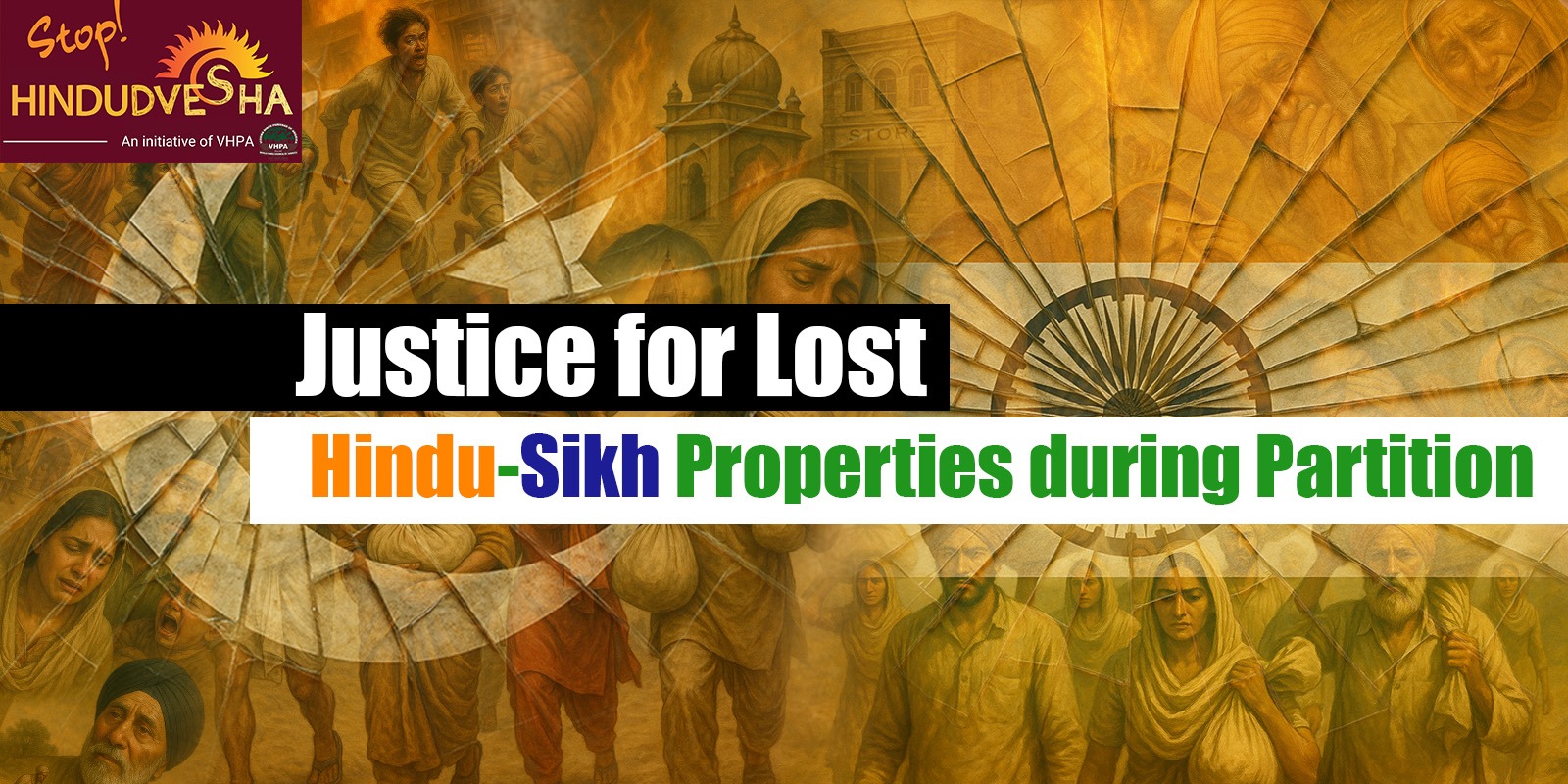
- Millions of Hindus and Sikhs were violently uprooted from Pakistan during Partition, leaving behind vast ancestral properties.
- The abandoned assets were confiscated by the Pakistani state and never returned or compensated, despite promises of equal treatment.
- Bharat provided refuge, citizenship, and limited resettlement support to displaced communities, while properties left behind by emigrating Muslims were handed over to the Waqf Board rather than used to compensate Hindu and Sikh refugees.
- The issue of evacuee property remains unresolved, placing strain on Bharat’s resources while Pakistan evades responsibility.
- With renewed geopolitical focus, Bharat must raise this issue globally and assert its rightful claim to the properties left behind.
As calls to reclaim Pakistan-occupied Kashmir (PoK) gain political and public momentum[1][2][3][4], Bharat must also reckon with another long-festering wound from 1947: the unresolved question of compensation for property abandoned by Hindu and Sikh refugees during Partition, many of whom fled with little more than the clothes on their backs.
The Partition of Bharat was not merely a redrawing of borders; it unleashed one of the most brutal mass migrations in human history, overwhelmingly targeting Hindus and Sikhs stranded in the newly formed Islamic state of Pakistan. Over 10 million people were uprooted, but the migration was far from symmetrical. In Pakistan, Hindus and Sikhs weren’t just pressured to leave—they were systematically driven out through organized pogroms, sexual violence, looting, and targeted massacres, particularly in regions like West Punjab and Sindh. These were not spontaneous outbursts but part of a deliberate campaign of ethnic cleansing. Landowners, traders, priests, and teachers—entire communities—were wiped out or forced into exile. At the time of Partition, roughly 25 million non-Muslims lived in Pakistan. Today, only a small, marginalized, and often terrorized fraction remains.
These refugees left behind vast tracts of ancestral property—homes, shops, farms, and estates. Despite the grand promises of equal rights and protection made by Pakistan’s ‘esteemed’ founder at the time of Partition, these properties were swiftly seized by the Pakistani government[5] and its officials[6], with no restitution or compensation ever offered. Much of the land was appropriated by the state or handed over to Islamist organizations and influential elites, including those complicit in the anti-Hindu violence.
In the following sections, this article will delve into the long and painful journey of addressing the evacuee property issue—from the early legal frameworks and compensation schemes in India to the enduring challenges displaced families face. We will examine how this unresolved legacy continues to impact national memory, justice, and the call for historical redress.
A Historical Betrayal
At the time of Bharat’s Partition in 1947, leaders on both sides gave solemn assurances that non-Muslim minorities would be protected and treated as equal citizens. India’s first Prime Minister, Jawaharlal Nehru, along with senior Congress leaders, emphasized the importance of safeguarding minorities in both nations. Pakistan’s founder, Mohammad Ali Jinnah, echoed similar sentiments, declaring that Pakistan would be a secular state where religious identity would hold no bearing on citizenship or rights. In his landmark speech of August 1947, Jinnah stated:
“You are free; you are free to go to your temples; you are free to go to your mosques or any other place of worship in the state of Pakistan. You may belong to any religion, caste, or creed – that has nothing to do with the business of the state[7].”
Lulled into a false sense of security by these assurances, millions of Hindus and Sikhs who found themselves on the wrong side of the newly drawn border chose not to migrate to Bharat. But what awaited them was a nightmare. Contrary to the promises of protection, the creation of Pakistan unleashed widespread violence, mass displacement, and a systemic campaign of persecution targeting religious minorities. Despite continued declarations of religious freedom—such as the 1949 Objective Resolution—non-Muslims were increasingly scapegoated, marginalized, and treated with deep suspicion, often as a means of diverting attention from internal failures of the Pakistani state. [8]
The rise of Islamic extremism and jihadi violence further deepened the insecurity faced by Pakistan’s non-Muslim minorities. Beyond the brutal physical attacks, these communities endured systemic social and legal discrimination. Their homes, lands, and livelihoods were looted or seized, leaving them stripped of safety, dignity, and economic security. The betrayal of Jinnah’s lofty promise was stark and undeniable. The situation became so intolerable that even Jogendra Nath Mandal, a prominent Hindu leader who had supported Partition and served as Pakistan’s first law minister, was compelled to resign and flee to Bharat within months. As Pakistan steadily evolved into an Islamic state, countless Hindus and Sikhs were left with no choice but to seek refuge in Bharat.
Omar Waraich, Head of South Asia at Amnesty International[9] once noted: “The respect for the right to freedom of religion was promised to Pakistan’s Hindus by the country’s founder, Muhammad Ali Jinnah. Those who deny a long-marginalized community the right to practice their faith freely not only betray his legacy but also violate the human rights of religious minorities protected under Pakistan’s constitution and its international human rights obligations.”
While Pakistan violently dispossessed its minorities, Bharat too failed them, but in a different way—by sidelining their needs through institutional neglect and political appeasement. The Indian leaders took the position that the assets left behind by migrating Muslims still belonged to the Muslim community, handing over much of this valuable land to the Waqf Board[10], an Islamic religious trust. This decision was driven less by legal or moral reasoning and more by political calculation. In its effort to project a secular and inclusive image, the newly independent Indian government prioritized appeasing a religious minority over addressing the urgent needs of millions of Hindu and Sikh refugees streaming in from across the border.
Nowhere was this misplaced prioritization more painfully evident than in the episode involving Delhi’s Jama Masjid. Refugees who had taken shelter in the mosque complex—many with nowhere else to go—were ordered to vacate the premises. At Mahatma Gandhi’s insistence, the space was cleared to ensure Muslims could perform namaz without obstruction. That this was done while countless displaced families remained homeless and traumatized laid bare the skewed moral compass guiding early policy decisions.
The Enduring Legacy of Evacuee Property
For millions of Hindu and Sikh families, Partition was not a single moment of upheaval—it marked the beginning of a protracted, unending displacement. While the initial violence of 1947 forced many to flee, their suffering did not end at the border. Over the decades, systemic persecution, religious discrimination, and recurring waves of violence in Pakistan have continued to drive these communities out. At the time of Partition, Pakistan was home to a vibrant population of Hindus and Sikhs. Today, only a fraction remains—mostly impoverished, landless, and pushed to the margins of society. Families that once held land, wealth, and social standing have been reduced to daily-wage laborers, their communities shattered by forced conversions, targeted violence, and decades of displacement.
The assets they were forced to abandon have become one of the major points of contention between Bharat and Pakistan.[11] According to Indian estimates, Hindu and Sikh refugees abandoned property worth approximately ₹38.1 billion (about US$47 million) in Pakistan, while Muslim refugees left behind around ₹3.8 billion (US$4.7 million) worth of property in Bharat. The land figures are equally staggering: India claims over 6.6 million acres were left behind in West Punjab alone, while Pakistan contends that Muslims gave up about 5.4 million acres in East Punjab.[12]
The issue of evacuee property remains a significant and deeply human consequence of Partition, impacting millions who were displaced and deprived of their homes, land, and possessions during the mass migration. Though not the sole point of contention between Bharat and Pakistan, it holds national relevance for both countries due to the scale of loss experienced on each side. As one of the enduring legacies of Partition, it stands as an unresolved chapter in the subcontinent’s shared history.
Efforts to Resolve the Issue
Since Partition, both Bharat and Pakistan have made repeated efforts to resolve the complex issue of evacuee property.[13] Yet, despite numerous agreements and dialogues, a durable solution remains elusive. One of the earliest steps was taken at the Joint Defense Council meeting on August 27, 1947, chaired by Lord Mountbatten. It was agreed that each country would appoint Custodians of Evacuee Property[14] to manage and safeguard the assets left behind by those who had fled across the new borders. This was followed by the Inter-Dominion Conference held in Delhi in December 1947, where both sides reaffirmed that refugees would retain ownership rights over their movable and immovable properties.[15]
Building on these commitments, the Nehru-Liaquat Pact was signed in April 1950 to provide a more structured framework for protecting minority rights and abandoned properties[16]. Under this agreement, both governments pledged to uphold full equality of citizenship for minorities, ensuring the protection of life, property, and cultural identity, along with freedoms of movement, speech, worship, and occupation.
The pact initially offered hope, but the spirit of the pact was short-lived. In the decades that followed, Pakistan failed to uphold its commitments. Hindu and Sikh minorities continued to face systemic discrimination, including forced conversions, targeted violence, illegal seizure of property, and frequent cases of abduction and forced marriages of Hindu girls.[17]
Meanwhile, Bharat began taking unilateral steps to address the refugee crisis and compensate its displaced population. In August 1951, the value of properties left behind by Muslims who migrated to Pakistan was formally assessed. A year later, during the Conference of Rehabilitation Ministers in New Delhi on September 20, 1952, it was decided that these properties would be auctioned or allotted to Hindu and Sikh refugees as compensation. It proposed to Pakistan that a bilateral commission or another neutral authority jointly assess the value of all evacuee property on both sides. If direct negotiations failed, Bharat was willing to submit the matter to an international arbitration body, including the International Court of Justice or an ad hoc tribunal with representatives from both nations. [18]
Pakistan, however, rejected these proposals and imposed unreasonable conditions, effectively stalling the process.
CAA and Plight of Minorities
For decades, religious minorities in Pakistan have faced ongoing persecution, leading to a steady flow of refugees into Bharat. In response, Bharat has taken practical steps to manage this migration, offering resettlement options and legal pathways to citizenship.
Since all efforts to resolve the issue of properties left behind by those who fled during and after Partition have failed, Bharat has taken steps on its own to provide basic support to displaced populations, including through legislative measures like the Citizenship Amendment Act (CAA) of 2019.[19] The CAA offers a streamlined route to Indian citizenship for refugees from Pakistan, Bangladesh, and Afghanistan who entered before December 31, 2014, having faced religious persecution. This policy reflects an attempt to provide legal clarity and stability for those with nowhere else to turn.
Yet, the larger issues remain unresolved. The promises made by Pakistan’s founding leadership—including commitments to protect religious minorities—have not been upheld. Despite formal assurances such as the Nehru-Liaquat Pact, Pakistan’s steady shift toward a more rigid Islamic state has resulted in widespread discrimination, forced conversions, and mass displacement.
An equally pressing concern is the land and property seized from those who fled to Bharat. Mass migration put substantial pressure on Bharat’s resources, particularly land and housing. Given this, it is reasonable to argue that Pakistan should be held accountable for the property it absorbed and the burden it effectively transferred to Bharat.
This is not merely a bilateral grievance but a broader issue of historical justice. Raising the matter on international platforms could be a necessary step toward seeking proportional redress and a long-overdue resolution for those displaced and dispossessed by Partition and its aftermath.
Seizing the Opportunity
As tensions between Bharat and Pakistan escalate—following the Pahalgam terror attack on April 22, 2025, and the subsequent military response under “Operation Sindoor”—the Indus Waters Treaty is under renewed scrutiny, and calls to reclaim Pakistan-occupied Kashmir (PoK) are gaining momentum. In this charged geopolitical moment, Bharat has a critical opportunity to raise the issue of historical injustices and the plight of displaced populations on the global stage. This is a chance to assert its claims, garner international support, and bring longstanding disputes into sharper focus. By doing so, Bharat can work toward a more comprehensive resolution that delivers long-overdue justice to those displaced by Partition and its aftermath.
Conclusion
Considering the limited territorial area and resources, Bharat must claim these lands from Pakistan and raise this issue on the world stage for its redressal. By doing so, Bharat can not only rectify historical injustices but also address the pressing needs of its citizens. The time has come for Bharat to reassert its legitimate rights and interests, ensuring its people a more equitable and just future. With the global spotlight on the region, Bharat must seize this opportunity to make its claim and shape a better tomorrow for generations to come.
Citations
[1] Want to let world know, talks with Pakistan only on terrorism and POK: PM Modi; https://www.indiatoday.in/india/story/talks-with-pakistan-only-on-terrorism-pakistan-occupied-kashmir-pm-modi-2723719-2025-05-12
[2]PoK is ours: Amit Shah reaffirms India’s claim over region; https://www.newindianexpress.com/nation/2025/Apr/09/pok-is-ours-amit-shah-reaffirms-indias-claim-over-region
[3] “Waiting For Return Of Stolen Part Of Kashmir”: S. Jaishankar Calls Out Pakistan; https://www.newindianexpress.com/nation/2025/Apr/09/pok-is-ours-amit-shah-reaffirms-indias-claim-over-region
[4] PoK residents will demand merger with India: Rajnath Singh;
[5] Waqf or Effort for an Extended Pakistan?;
https://organiser.org/2024/10/13/260018/bharat/waqf-or-effort-for-an-extended-pakistan/
[6] Punjab Secretariat Archives (PSA), Folder 33 E, Pakistan National Assembly Debates, March 1955, 22–24.
[7] Jinnah’s 11 August 1947 Speech: Assurance To Minority Communities (Editorial From The Hindu); https://www.scribd.com/document/110861031/Jinnah-s-11-August-1947-Speech-Assurance-to-Minority-Communities-Editorial-from-The-Hindu
[8] Hindus in Pakistan; https://minorityrights.org/communities/hindus-2/#:~:text=Profile,in%20rural%20areas%20of%20Sindh.
[9] Pakistan: Protect religious freedom for Hindus;
https://www.amnesty.org/en/latest/news/2020/07/pakistan-must-protect-religious-freedom-for-hindus/
[10] Waqf or Effort for an Extended Pakistan?; https://organiser.org/2024/10/13/260018/bharat/waqf-or-effort-for-an-extended-pakistan/
[11]Mohammed Ahsen Chaudhri; “Evacuee Property In India And Pakistan” https://www.jstor.org/stable/41393804?read-now=1&oauth_data=eyJlbWFpbCI6InNpbmRodWs3ODRAZ21haWwuY29tIiwiaW5zdGl0dXRpb25JZHMiOltdLCJwcm92aWRlciI6Imdvb2dsZSJ9&seq=1#page_scan_tab_contents
[12] Board of Revenue Records, Lahore (BRR), Rehabilitation Settlement Scheme Part 11, F. 20 (9)/56-R-I, 24.
[13] Mohammed Ahsen Chaudhri; “Evacuee Property In India And Pakistan” https://www.jstor.org/stable/41393804?read-now=1&oauth_data=eyJlbWFpbCI6InNpbmRodWs3ODRAZ21haWwuY29tIiwiaW5zdGl0dXRpb25JZHMiOltdLCJwcm92aWRlciI6Imdvb2dsZSJ9&seq=1#page_scan_tab_contents
[14] Concerning Evacuee Property, published by the Ministry of Information and Broadcasting, Government of India, New Delhi 1950, p. 9.
[15] Mohammed Ahsen Chaudhri; “Evacuee Property In India And Pakistan” https://www.jstor.org/stable/41393804?read-now=1&oauth_data=eyJlbWFpbCI6InNpbmRodWs3ODRAZ21haWwuY29tIiwiaW5zdGl0dXRpb25JZHMiOltdLCJwcm92aWRlciI6Imdvb2dsZSJ9&seq=1#page_scan_tab_contents
[16] Nehru-Liaquat Pact (Wikipedia); https://en.wikipedia.org/wiki/Liaquat%E2%80%93Nehru_Pact#:~:text=The%20Liaquat%E2%80%93Nehru%20Pact%20%28or%20the%20Delhi%20Pact%20on,conversions%20were%20unrecognized%2C%20and%20minority%20rights%20were%20confirmed.
[17] Hindus in Pakistan; https://minorityrights.org/communities/hindus-2/
[18] Mohammed Ahsen Chaudhri; “Evacuee Property In India And Pakistan” https://www.jstor.org/stable/41393804?read-now=1&oauth_data=eyJlbWFpbCI6InNpbmRodWs3ODRAZ21haWwuY29tIiwiaW5zdGl0dXRpb25JZHMiOltdLCJwcm92aWRlciI6Imdvb2dsZSJ9&seq=1#page_scan_tab_contents
[19] The Citizenship (Amendment) Act, 2019,” The Hindu Center, December 19, 2019, https://www.thehinducentre.com/resources/article30327343.ece

Donate to HINDUDVESHA
Our Mission is to explore and expose Hindudvesha through research analysis, education and response.
SUPPORT US