

From Grief to Woke Delusion: Why the Pahalgam Survivors are Twisting the Truth
 Rakesh Krishnan Simha · 05/12/2025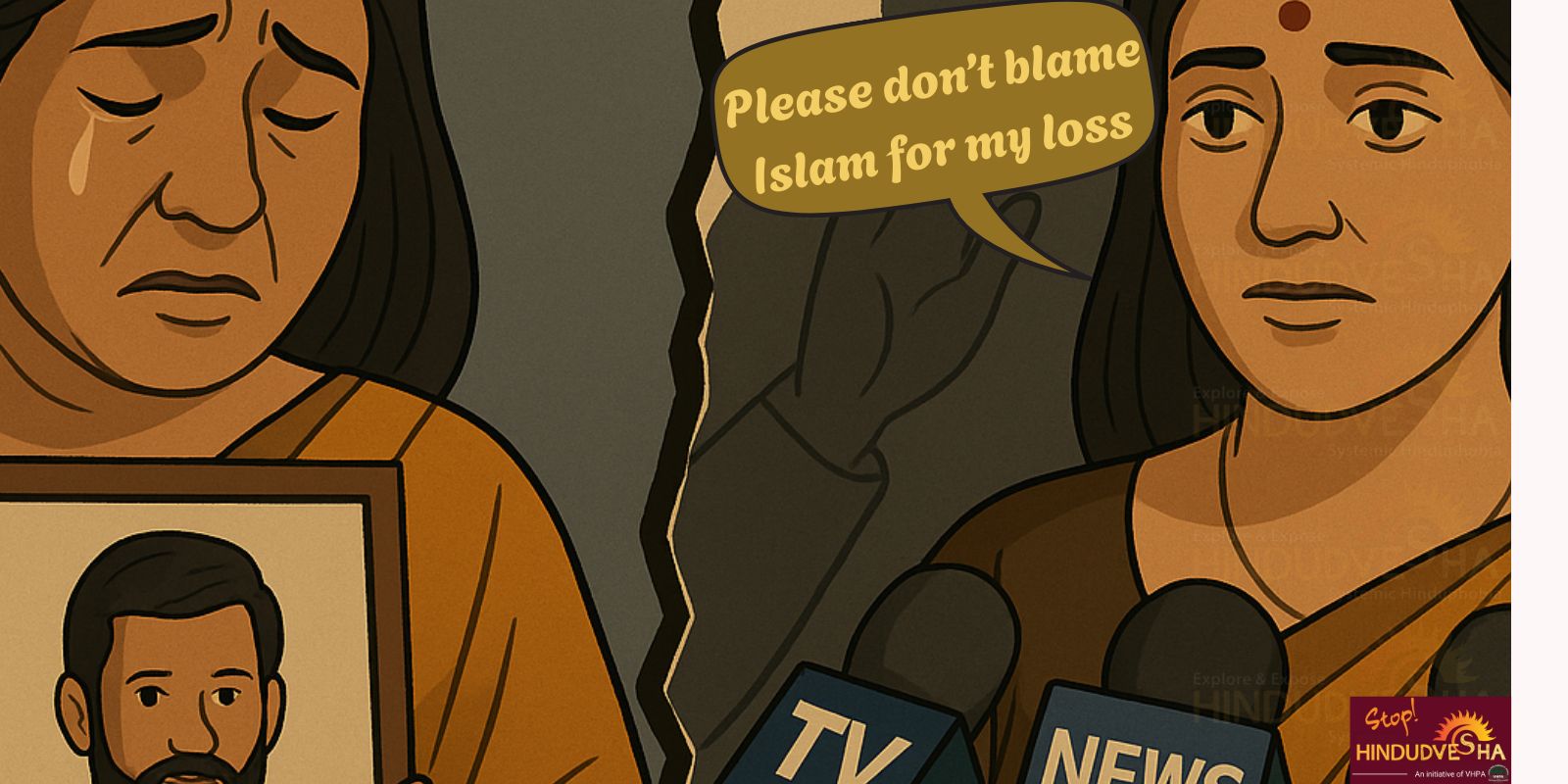
- The Pahalgam massacre was a premeditated, religion-driven attack targeting Hindus, not a random act of violence.
- Some survivors and media outlets distorted the motive, downplaying the Islamic extremism behind the killings.
- Grief was politicized to promote secular narratives, often excusing or deflecting attention from the killers’ ideology.
- Such responses reflect deep-rooted ideological subversion and moral disorientation within India’s academic and media elite.
- When victims defend their murderers, it signals not compassion—but the collapse of cultural confidence and moral clarity.
Mourning is a profoundly personal matter. You have the right to grieve in silence, cry in public, or not shed a tear. Trauma affects people differently, and no one can dictate how someone should process the horror of losing a loved one. But, while grief belongs to the private realm, truth does not. Truth is public. Truth is non-negotiable.
And in the wake of a national tragedy, what must never be allowed is the distortion of that truth to fit a comforting or convenient narrative. The reality of the Pahalgam terror attack is simply this: four armed Muslim terrorists killed 26 innocent Hindu tourists after first identifying their religion by asking their names[1], forcing them to drop their trousers to ascertain if they were circumcised, and finally asking them to recite the Islamic kalma.[2] Only after confirming that their victims were non-Muslim did they open fire.
This was not a random shooting. It was not, as the intellectually dishonest leftists like to claim, the act of misguided youth caught in a cycle of poverty. It was a cold, calculated, religiously motivated terrorist attack. Religion wasn’t an incidental detail — it was the central filter by which life or death was decided.
Narrative Distortion
In the emotional aftermath of the Pahalgam tragedy, it’s natural for survivors to seek meaning and grasp a narrative that helps them cope. But some have gone a step further — or perhaps been nudged into doing so — by suggesting that this attack had nothing to do with religion. That the men behind it were just lost boys, tricked or brainwashed, the sons of poor schoolmasters caught up in a broader political web.
This is not only inaccurate — it is a lie, and it is dangerous.
Such portrayals attempt to humanize the killers while softening the ideological hate that fueled their actions. They deflect attention from the belief system that justifies murder based on religious identity. In doing so, they confuse the public, mislead policy responses, and dishonor the memory of the victims.
Grief cannot be allowed to be used to gaslight a nation.
Selective Mourning
But gaslighting is precisely what some of the survivors are doing – either intentionally or inadvertently. Kochi native Arathi R Menon, whose 65-year-old father, N Ramachandran, was gunned down by the militants, said that amidst the tragedy, two local Muslim men, including her driver, helped her by taking her to the mortuary. “They took care of me like a sister,” she said. And as she left Srinagar, Menon said: “I have two brothers in Kashmir now. May Allah protect you both.”[3]
Really? How can the loss of your father be compensated by the gain of two so-called brothers? With her flippant words, Menon trivialized her own tragedy. Couldn’t she wait to reach her hometown 3,000 km away in Kerala and let her loss sink in?” Couldn’t she wait until after his funeral to preach secularism? By deflecting the focus from his murder, she made Ramachandran – to use George Orwell’s term – an “unperson” – a person whose name or existence is denied or ignored, especially for political reasons.[4]
Or take Aishanya Dwivedi, who initially told the Indian media how Hindus, including her husband Shubham Dwivedi, were separated from the Muslim tourists and then shot by the terrorists. However, in a subsequent interview with the BBC, she said, “Terrorists don’t belong to any caste. They are not human. So why are we talking about whether they are Hindu or Muslim?”[5]
Did BBC somehow influence her view?
The most curious case is that of Indian Navy Lieutenant Vinay Narwal’s widow, Himanshi. She became the face of the tragedy when a photograph of her sitting forlorn by the side of her dead husband went viral across social media. Just minutes after the terrorists shot her husband, she said in a quivering voice: “They said you are not Muslim and shot him dead.” [6] At that moment, she made no effort to deny that Pahalgam was a targeted attack on Hindus. But later, in a series of interviews with the media, she tried to play down the killings, insisting that there should be no hatred toward Kashmiris or Muslims. [7]
Again, this article does not hold all Kashmiri Muslims responsible for the attack, but is an attempt to find out why, in the midst of her tragedy, Himanshi put secularism above justice for her husband. Indeed, only when prompted by reporters did she say that she also wanted justice, almost as an afterthought. Even worse, at her husband’s funeral, she seemed to behave like it was a celebration, smiling at visitors and peering into her mobile phone.[8]
A scan of Himanshi’s social media accounts offered a peek into her mindset. She is a product of Jawaharlal Nehru University, the den of anti-Hindu activities, and where communists and other anti-national characters set the narrative. She seemed obsessed with Kashmiri Muslim men, Muslim culture, and Muslim food.
Her infatuation with everything Muslim appears to have clouded her judgment and skewed her worldview so much that she could not see the radicalism in her Kashmiri friends. In one of her posts, she blamed the entire Hindu community and Hindu temples when in 2018, a Muslim girl was raped inside a temple.[9] Yet, when Muslims killed her husband, she asked Hindus not to blame Kashmiris and Muslims. The dissonance is striking.
Himanshi’s call for national unity is admirable, but not at the cost of truth, accountability, and justice. If secularism means maintaining silence on terror against Hindus, it’s not secularism — it’s selective blindness.
Moral Collapse
Perhaps more controversially, videos also surfaced showing groups of women expressing that they had a “great time” in Kashmir and faced “no danger from the locals.” One such video appeared to be filmed by hotel staff, possibly after tour operators issued refunds, capturing tourists expressing satisfaction with their stay. Another video featured a woman from Kerala echoing similar sentiments, suggesting that the entire trip was enjoyable and that the locals were welcoming. These responses struck many as tone-deaf in light of the bloodshed just 48 hours earlier.[10]
Such instances raise questions about the influence of media framing and commercial interests in shaping public narratives. When comfort and tourism are prioritized over acknowledging the national trauma experienced just days earlier, it reveals a deep disconnect between different segments of society.
Ideological Subversion
Fear, coercion, and Stockholm Syndrome may partly explain the bizarre behavior of the Indian survivors of terrorism. But the real reason may be something more insidious: ideological subversion.
To understand this psychological shift, one must revisit the insights of Yuri Bezmenov, a former KGB agent who operated in India during the 1970s. Bezmenov defected to the West and revealed the Soviet Union’s strategies of psychological warfare, particularly ideological subversion — a method of slowly and systematically undermining a nation’s cultural and moral values.[11]
Bezmenov explained that ideological subversion aims to erode a country’s social fabric over generations. It is not about immediate conquest but changing how people think, interpret, and react to reality. Over time, victims of this subversion begin to sympathize with narratives that weaken their own identity, even when confronted with hard evidence or personal tragedy.
In India, this process had already begun long before the Soviets. The Macaulay education policy of 1835, introduced by the British, was a conscious effort to produce a class of Indians more loyal to British thought than their own heritage. Nehruvian policies later expanded on this framework, embracing English-centric modernization while marginalizing Indic thought. [12]
By the 1970s, the KGB reportedly intensified its psychological operations in India, targeting academia, media, and political institutions. The aim? To embed a worldview that was suspicious of Hinduism, dismissive of its cultural values, and open to globalist, left-leaning ideologies.
Victims of a Broader War
Against this backdrop, the contradictions in the statements of Shubham Dwivedi’s wife and Himanshi Narwal are not anomalies but symptoms of a troubling pattern of psychological conditioning. Their shift from acknowledging a Hindu-targeted killing to speaking in vague, universalist terms may reflect not just personal grief but years of conditioning under an ideological framework that actively discourages identifying with Hindu causes or concerns.
Himanshi’s background is telling. Her past social media posts vilified the Hindu community for systemic problems. Such ideological stances are not rare within certain academic and media circles, where postmodernist and Marxist narratives dominate the discourse, often portraying Hinduism as oppressive or backward.
When such ideologies take root, even victims of violence may internalize guilt or deny their own realities. This is the ultimate success of ideological subversion — when individuals defend the very systems or narratives that target them.
Crisis of Consciousness
The broader left ecosystem, which includes academic institutions, mainstream media, and certain political factions, has long shaped discourse in India. It often promotes a globalist, secular framework that treats the acknowledgment of Hindu suffering as either communalism or victimhood. In this climate, calling out the religious identity of a terrorist is seen as provocative, while denying it is applauded as progressive.
This is not just political correctness — it is psychological warfare. It alters how Hindus perceive themselves, their history, and their place in the world. Over time, this produces generations that either disconnect from their cultural roots or feel ashamed of them.
Silent War
Ideological subversion is not loud; it doesn’t announce itself. It works silently through textbooks, media narratives, and carefully chosen language. It tells Hindus that standing up for their identity is regressive, that remembering historical injustices is communal, and that self-defense is extremism.
This isn’t merely a battle of ideas—it’s a fight for civilizational survival.
The statements of those like Himanshi Narwal and Shubham Dwivedi’s wife should serve as a wake-up call — not just about terror, but about how deeply this ideological war has penetrated Indian society. If even those who lose everything hesitate to name the truth, then perhaps the real loss is more profound: a loss of clarity, identity, and conviction.
We must ask: Are we witnessing isolated tragedies or the long-term effects of a war fought in the minds of a nation?
Facts Demand Courage
It takes moral clarity — and courage — to name the ideology behind terror. In the Pahalgam attack, that ideology was Islamic extremism. The perpetrators weren’t striking out in a blind rage; they were targeting with intention. Their criteria were religious. Their goal was to kill non-Muslims. This was a terror attack rooted in faith-based hatred.
Recognizing this is not an invitation to bigotry; it’s a demand for honesty. To protect future lives, we must first acknowledge why these lives were lost.
Conclusion
Mourn howsoever you must — in private or public, in sorrow or strength. But you don’t get to pick your facts or rewrite them. The pain of losing someone to terror is profound. But the only thing worse than that loss is allowing the truth of how it happened to be buried alongside them.
We owe it to the victims to remember not just that they died but why.
Citations
[1] ‘Terrorists fired after asking tourists’ names’: Pahalgam attack victim’s cousin (Hindustan Times, 2025); https://www.hindustantimes.com/india-news/firing-began-after-terrorists-asked-tourists-names-pahalgam-terror-attack-victim-s-cousin-death-toll-shubham-dwivedi-101745369738426.html
[2] What Is Kalima? The Sacred Islamic Verse Cited By Pahalgam Survivors (NDTV News, 2025); https://www.ndtv.com/india-news/what-is-kalima-the-sacred-islamic-verse-cited-by-pahalgam-survivors-8242366
[3] ‘I have two brothers in Kashmir now’; Kochi native who lost father to Pahalgam attack recounts being helped by locals (New Indian Express, 2025); https://www.newindianexpress.com/nation/2025/Apr/24/i-have-two-brothers-in-kashmir-now-kochi-native-who-lost-father-to-pahalgam-attack-recounts-being-helped-by-locals#:~:text=’I%20have%20two%20brothers%20in%20Kashmir%20now’%3B%20Kochi%20native,May%20Allah%20protect%20you%20both.%22
[4] Unperson 1984 (Book Analysis); https://bookanalysis.com/1984/unperson/
[5] Both the statements given by Shubham Dwivedi’s wife are completely contrasting to each other (Diksha Kanpal on X, 2025); https://x.com/DikshaKandpal8/status/1918204110064762983
[6] She is the same girl who earlier said “Muslim ni hai bol ke goli maar di’ (Diksha Kanpal on X, 2025); : https://x.com/DikshaKandpal8/status/1918195098401296688
[7] Himanshi, the wife of Lieutenant Vinay Narwal Blames Kashmiri Hindus and temples for Asifa. But she says don’t blame Kashmir and Muslims Even when Islamist terrorists killed her husband (Yanika_Li on X, 2025); https://x.com/LogicLitLatte/status/1918237802191311320
[8] Himanshi Swami, the wife of Vinay Narwal. This is a Shraddhanjali ceremony, not Aashirwad ceremony (Lady Khabri on X, 2025); https://x.com/KhabriBossLady/status/1919372730102595922
[9] Himanshi, the wife of Lieutenant Vinay Narwal Blames Kashmiri Hindus and temples for Asifa. But she says don’t blame Kashmir and Muslims Even when Islamist terrorists killed her husband (Yanika_Li on X, 2025); https://x.com/LogicLitLatte/status/1918237802191311320
[10] Kerala women says “Acha Lagra hai bohot maja mar rahe hai humlog” in Kashmir despite Pahalgam Attack (YouTube); https://www.youtube.com/watch?v=y8-Lze5_wr8
[11] Yuri Bezmenov on India (YouTube); https://www.youtube.com/watch?v=XgHkJLaxBno
[12] Demerits Of Macaulay Education System (LivingSmartly.com); https://living-smartly.com/2022/08/demerits-macaulay-education-system/

Donate to HINDUDVESHA
Our Mission is to explore and expose Hindudvesha through research analysis, education and response.
SUPPORT US